
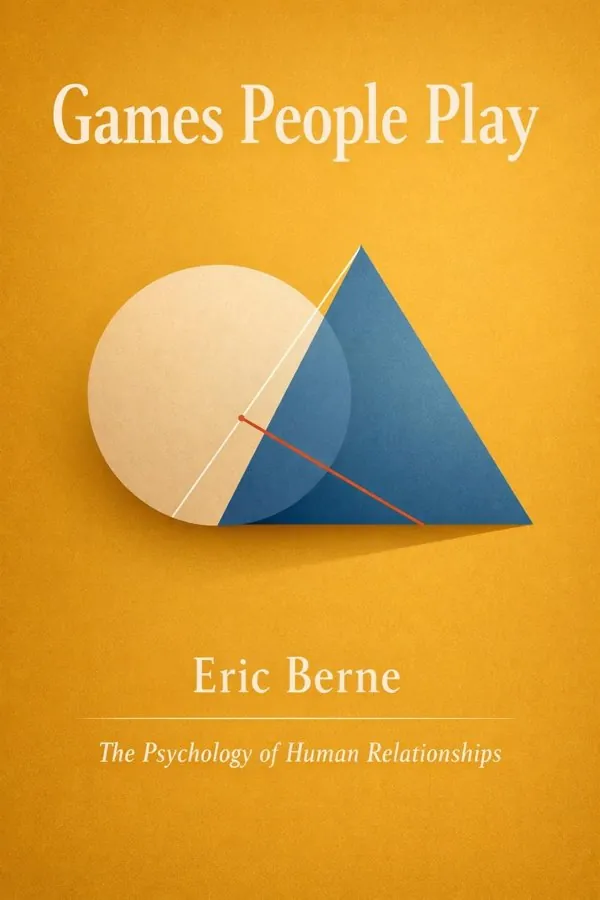
Games People Play: The Psychology of Human Relationships: Summary & Key Insights
by Eric Berne
 10 min5 chaptersAudio available
What Is Games People Play: The Psychology of Human Relationships About?
Games People Play: The Psychology of Human Relationships by Eric Berne is a psychology book spanning 5 pages. This groundbreaking book by psychiatrist Eric Berne introduces the concept of transactional analysis, a method for understanding social interactions through the 'games' people unconsciously play. Berne categorizes these games as repetitive patterns of behavior that reveal underlying psychological motives and emotional needs. The work explores how these interactions shape relationships, communication, and self-awareness, offering insights into human behavior and personal growth.
This FizzRead summary covers all 5 key chapters of Games People Play: The Psychology of Human Relationships in approximately 10 minutes, distilling the most important ideas, arguments, and takeaways from Eric Berne's work. Also available as an audio summary and Key Quotes Podcast.
Games People Play: The Psychology of Human Relationships
This groundbreaking book by psychiatrist Eric Berne introduces the concept of transactional analysis, a method for understanding social interactions through the 'games' people unconsciously play. Berne categorizes these games as repetitive patterns of behavior that reveal underlying psychological motives and emotional needs. The work explores how these interactions shape relationships, communication, and self-awareness, offering insights into human behavior and personal growth.
Who Should Read Games People Play: The Psychology of Human Relationships?
This book is perfect for anyone interested in psychology and looking to gain actionable insights in a short read. Whether you're a student, professional, or lifelong learner, the key ideas from Games People Play: The Psychology of Human Relationships by Eric Berne will help you think differently.
- ✓Readers who enjoy psychology and want practical takeaways
- ✓Professionals looking to apply new ideas to their work and life
- ✓Anyone who wants the core insights of Games People Play: The Psychology of Human Relationships in just 10 minutes
Want the full summary?
Get instant access to this book summary and 100K+ more with Fizz Moment.
Get Free SummaryAvailable on App Store • Free to download
Key Chapters
Transactional analysis began not as a grand theory but as a simple observation. In therapy sessions, I noticed patients oscillating between distinct ways of speaking and behaving—sometimes nurturing and moralistic, sometimes rational and calm, sometimes playful or defiant. These weren’t random mood swings; they reflected separate parts of personality functioning in social exchanges. I called these parts *ego states*, and the interactions between people through these states I called *transactions*.
Every communication—every glance, word, or gesture—is a transaction. It’s the unit of human interaction. You send a message from one ego state, and the recipient responds from one of theirs. These interactions form the building blocks of social life. Understanding them provides a powerful lens to decode behavior.
Transactional analysis rests on a few simple ideas: people have three major ego states (Parent, Adult, Child); transactions occur between these states; and the pattern of transactions determines whether communication is smooth, crossed, or deceptive.
In daily life, we operate these transactions continuously. A teacher may address a student from a Parental voice of authority, and the student may respond from a Child state—compliant, rebellious, or cheeky. Two businesspeople exchange Adult-to-Adult information when discussing figures, then suddenly one slips into a Parent tone, moralizing, pulling the other into a Child apology. Communication, in this sense, is not just language—it’s psychology.
What makes transactional analysis powerful is its simplicity. It translates complex psychoanalytic ideas into a language everyone can understand. When you observe interactions as exchanges between ego states, you begin to see where dialogue aligns and where it breaks down. More profoundly, you learn how relationships become patterned and predictable—why we repeat certain frustrations even with different people.
The method thus opens a path toward awareness. By observing your transactions consciously, you begin to respond deliberately instead of reacting mechanically. And that awareness is the first step out of playing games unconsciously.
Within each of us live three distinctive clusters of behavior and feeling that I call ego states—the Parent, the Adult, and the Child. These are not metaphors; they are observable phenomena in communication and emotion, and they manifest physiologically and linguistically in distinct ways.
The **Parent** represents the voices of authority recorded from childhood. It dictates, comforts, criticizes, or guides—it is the repository of the moral and instructional messages we absorbed from our caretakers. When we say, “You shouldn’t do that,” with a tone of finality, it’s likely our Parent speaking.
The **Adult** is the data processor. It deals with here-and-now reality, evaluates facts, and makes rational decisions. When you calmly assess, ask questions, and weigh evidence without emotional coloring, you operate from your Adult.
The **Child** is the original self—the spontaneous, emotional core of the personality. It contains curiosity, playfulness, creativity, but also fear, rebellion, and dependency. The Child says, “I don’t want to,” or “Whee!” depending on the moment.
These ego states form our internal architecture of communication. When two people meet, each carries these three states, and their exchanges can occur between any combination—Parent to Child, Adult to Adult, Child to Parent, and so forth. Some pairings create harmony, others distort understanding. A key insight is that healthy communication depends on keeping the Adult active. The Parent can offer standards; the Child can offer vitality; but the Adult integrates reality.
Recognizing which state you operate from—and which one your partner is activating—gives enormous freedom. Many conflicts are simply the wrong ego states talking to each other. A partner scolding from Parent to Child evokes rebellion. But if you shift the same exchange to Adult-to-Adult, the tension dissolves. Emotional intelligence, in this model, is awareness of ego states in motion.
Understanding these patterns is not about assigning blame but regaining choice. When you know which ego state speaks, you can decide whether it’s the one you want leading the conversation. This self-awareness enables authentic relationships, free from automatic scripts.
+ 3 more chapters — available in the FizzRead app
All Chapters in Games People Play: The Psychology of Human Relationships
About the Author
Eric Berne (1910–1970) was a Canadian-born psychiatrist best known for developing transactional analysis, a theory of social interaction and personality. He studied at McGill University and Yale, and his work profoundly influenced psychotherapy, communication theory, and popular psychology.
Get This Summary in Your Preferred Format
Read or listen to the Games People Play: The Psychology of Human Relationships summary by Eric Berne anytime, anywhere. FizzRead offers multiple formats so you can learn on your terms — all free.
Available formats: App · Audio · PDF · EPUB — All included free with FizzRead
Download Games People Play: The Psychology of Human Relationships PDF and EPUB Summary
Key Quotes from Games People Play: The Psychology of Human Relationships
“Transactional analysis began not as a grand theory but as a simple observation.”
“Within each of us live three distinctive clusters of behavior and feeling that I call ego states—the Parent, the Adult, and the Child.”
Frequently Asked Questions about Games People Play: The Psychology of Human Relationships
Games People Play: The Psychology of Human Relationships by Eric Berne is a psychology book that explores key ideas across 5 chapters. This groundbreaking book by psychiatrist Eric Berne introduces the concept of transactional analysis, a method for understanding social interactions through the 'games' people unconsciously play. Berne categorizes these games as repetitive patterns of behavior that reveal underlying psychological motives and emotional needs. The work explores how these interactions shape relationships, communication, and self-awareness, offering insights into human behavior and personal growth.
You Might Also Like
The Body Keeps the Score
Bessel van der Kolk
10 min
Surrounded by Idiots
Thomas Erikson
10 min
Emotional Intelligence
Daniel Goleman
10 min
Attached
Amir Levine
10 min
Why Does He Do That
Lundy Bancroft
10 min
Women Who Run with the Wolves
Clarissa Pinkola Estés
10 minBrowse by Category
Ready to read Games People Play: The Psychology of Human Relationships?
Get the full summary and 100K+ more books with Fizz Moment.