
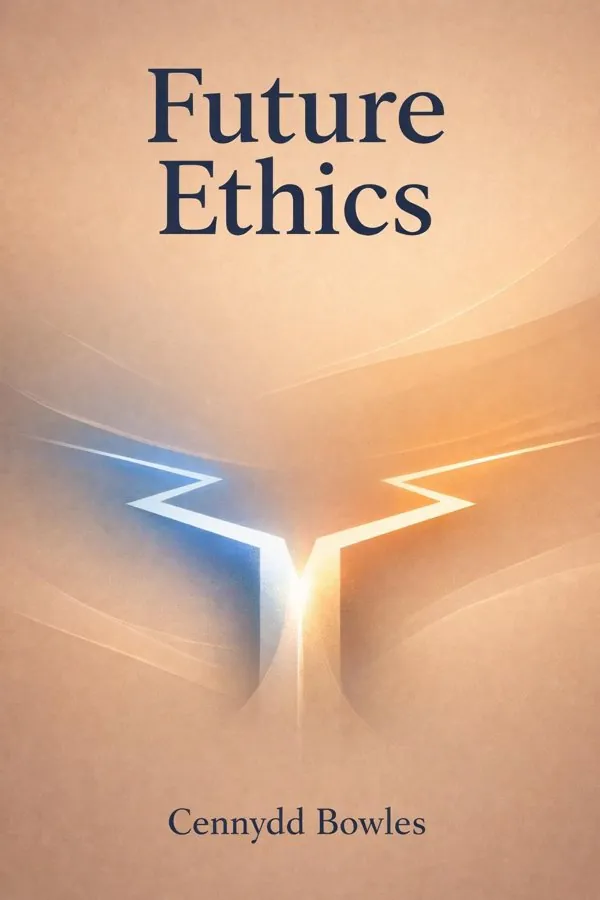
Future Ethics: Summary & Key Insights
 10 min9 chaptersAudio available
What Is Future Ethics About?
Future Ethics by Cennydd Bowles is a ethics book spanning 9 pages. Future Ethics is a thought-provoking exploration of the moral challenges posed by emerging technologies. Cennydd Bowles examines how designers, technologists, and innovators can act ethically in a world shaped by artificial intelligence, automation, and digital systems. The book encourages readers to move beyond compliance and consider the deeper ethical implications of their work, offering frameworks for responsible innovation and humane technology design.
This FizzRead summary covers all 9 key chapters of Future Ethics in approximately 10 minutes, distilling the most important ideas, arguments, and takeaways from Cennydd Bowles's work. Also available as an audio summary and Key Quotes Podcast.
Future Ethics
Future Ethics is a thought-provoking exploration of the moral challenges posed by emerging technologies. Cennydd Bowles examines how designers, technologists, and innovators can act ethically in a world shaped by artificial intelligence, automation, and digital systems. The book encourages readers to move beyond compliance and consider the deeper ethical implications of their work, offering frameworks for responsible innovation and humane technology design.
Who Should Read Future Ethics?
This book is perfect for anyone interested in ethics and looking to gain actionable insights in a short read. Whether you're a student, professional, or lifelong learner, the key ideas from Future Ethics by Cennydd Bowles will help you think differently.
- ✓Readers who enjoy ethics and want practical takeaways
- ✓Professionals looking to apply new ideas to their work and life
- ✓Anyone who wants the core insights of Future Ethics in just 10 minutes
Want the full summary?
Get instant access to this book summary and 100K+ more with Fizz Moment.
Get Free SummaryAvailable on App Store • Free to download
Key Chapters
To talk about future ethics, we must first revisit the moral terrain. Ethics begins, after all, not in technology, but in philosophy. I explore how the three major traditions of ethical thought—consequentialism, deontology, and virtue ethics—offer different lenses through which we can evaluate our technologies.
Consequentialism asks us to weigh outcomes: does a design decision increase well-being or cause harm? It invites the utilitarian calculus that underpins many technology tradeoffs today. Deontology, on the other hand, grounds morality in duties and rules: it is wrong to deceive users, no matter how efficient manipulation might be. Virtue ethics, my personal favorite, emphasizes character and human flourishing. It reminds us that ethical technology can’t just be judged by outputs but by what it makes of us—the kind of people, and societies, it helps us become.
When a designer chooses to optimize engagement at all costs, they might be obeying a business incentive, yet violating deeper ethical duties. When a company automates labor, it may maximize efficiency but erode community. Ethics, in this context, is not about perfection, but about awareness. It’s about balancing competing values with moral sensitivity: justice against innovation, autonomy against convenience, privacy against profit.
Understanding these philosophical roots lets us see ethical dilemmas not as abstract thought experiments, but as living tensions embedded in every product design, every machine-learning model, every interface decision. Ethical reflection, then, isn’t optional for technologists—it’s the foundation of responsible creation.
Technology is never neutral. Every design embeds assumptions about how the world should work—and therefore, who should hold power. Social networks amplify certain voices and silence others. Algorithms decide who gets credit, or bail, or a job interview. These are not accidents. They are expressions of power encoded into software.
In *Future Ethics*, I challenge you to recognize that as a creator, you are a participant in this power system. The architectures you design—interfaces, databases, platform policies—shape how people behave and what opportunities they can access. That’s a form of soft governance. The question then becomes: how responsibly are you exercising it?
Too often, we’ve hidden behind the myth of technological neutrality, insisting that tools mirror society instead of molding it. But every line of code carries bias born from human culture. Our duty as designers isn’t to erase our influence—it’s to wield it ethically. That means actively questioning who benefits and who bears the cost of technological progress.
Technology ethics, at its core, is political ethics. It demands awareness of privilege, of systemic injustice, of the power dynamics we replicate through automation. When we start seeing design as a moral act, every choice—what we collect, what we show, what we automate—becomes an opportunity to strive for justice rather than reinforce inequality.
+ 7 more chapters — available in the FizzRead app
All Chapters in Future Ethics
About the Author
Cennydd Bowles is a designer, futurist, and technology ethicist based in the United Kingdom. He has worked with major organizations such as Google, Twitter, and the BBC, and is known for his advocacy of ethical design and responsible innovation. Bowles frequently writes and speaks on the intersection of technology, ethics, and the future of design.
Get This Summary in Your Preferred Format
Read or listen to the Future Ethics summary by Cennydd Bowles anytime, anywhere. FizzRead offers multiple formats so you can learn on your terms — all free.
Available formats: App · Audio · PDF · EPUB — All included free with FizzRead
Download Future Ethics PDF and EPUB Summary
Key Quotes from Future Ethics
“To talk about future ethics, we must first revisit the moral terrain.”
“Every design embeds assumptions about how the world should work—and therefore, who should hold power.”
Frequently Asked Questions about Future Ethics
Future Ethics by Cennydd Bowles is a ethics book that explores key ideas across 9 chapters. Future Ethics is a thought-provoking exploration of the moral challenges posed by emerging technologies. Cennydd Bowles examines how designers, technologists, and innovators can act ethically in a world shaped by artificial intelligence, automation, and digital systems. The book encourages readers to move beyond compliance and consider the deeper ethical implications of their work, offering frameworks for responsible innovation and humane technology design.
You Might Also Like
What We Owe the Future
William MacAskill
10 min
Abortion
David Boonin
10 min
Blind Spots: Why We Fail to Do What's Right and What to Do About It
Max H. Bazerman, Ann E. Tenbrunsel
10 min
Digital Ethics: Research and Practice
Christopher Burr, Luciano Floridi (Editors)
10 min
Doing Good Better: Effective Altruism and a Radical New Way to Make a Difference
William MacAskill
10 min
Eating Animals
Jonathan Safran Foer
10 minBrowse by Category
Ready to read Future Ethics?
Get the full summary and 100K+ more books with Fizz Moment.