
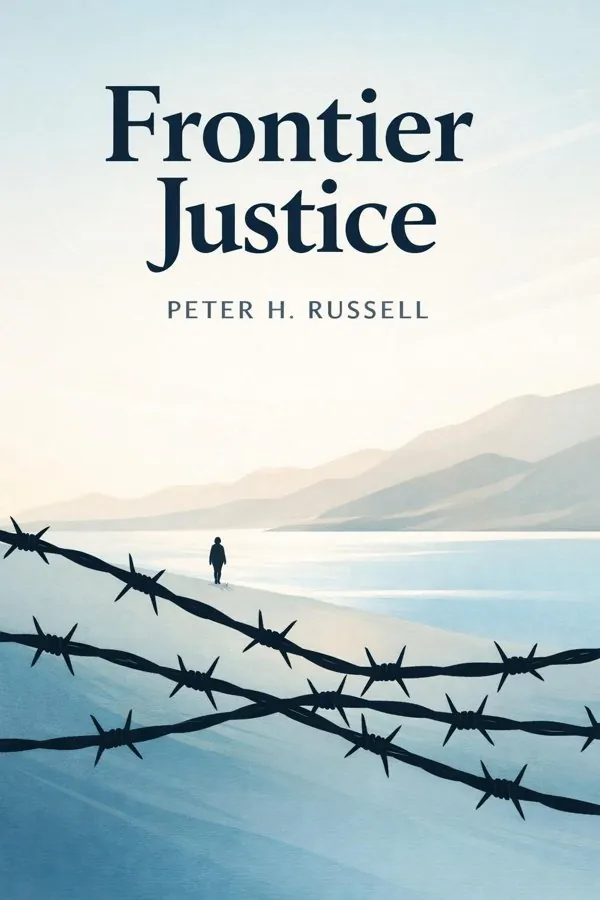
Frontier Justice: The Global Refugee Crisis and What to Do About It: Summary & Key Insights
 10 min7 chaptersAudio available
What Is Frontier Justice: The Global Refugee Crisis and What to Do About It About?
Frontier Justice: The Global Refugee Crisis and What to Do About It by Peter H. Russell is a politics book spanning 7 pages. Frontier Justice: The Global Refugee Crisis and What to Do About It is a non-fiction work by Canadian political scientist Peter H. Russell. The book examines the moral and political challenges of the global refugee crisis, exploring how international law, national sovereignty, and human rights intersect in the treatment of displaced persons. Russell argues for a more just and humane approach to refugee protection, grounded in principles of fairness and shared responsibility.
This FizzRead summary covers all 7 key chapters of Frontier Justice: The Global Refugee Crisis and What to Do About It in approximately 10 minutes, distilling the most important ideas, arguments, and takeaways from Peter H. Russell's work. Also available as an audio summary and Key Quotes Podcast.
Frontier Justice: The Global Refugee Crisis and What to Do About It
Frontier Justice: The Global Refugee Crisis and What to Do About It is a non-fiction work by Canadian political scientist Peter H. Russell. The book examines the moral and political challenges of the global refugee crisis, exploring how international law, national sovereignty, and human rights intersect in the treatment of displaced persons. Russell argues for a more just and humane approach to refugee protection, grounded in principles of fairness and shared responsibility.
Who Should Read Frontier Justice: The Global Refugee Crisis and What to Do About It?
This book is perfect for anyone interested in politics and looking to gain actionable insights in a short read. Whether you're a student, professional, or lifelong learner, the key ideas from Frontier Justice: The Global Refugee Crisis and What to Do About It by Peter H. Russell will help you think differently.
- ✓Readers who enjoy politics and want practical takeaways
- ✓Professionals looking to apply new ideas to their work and life
- ✓Anyone who wants the core insights of Frontier Justice: The Global Refugee Crisis and What to Do About It in just 10 minutes
Want the full summary?
Get instant access to this book summary and 100K+ more with Fizz Moment.
Get Free SummaryAvailable on App Store • Free to download
Key Chapters
The story of modern refugee protection begins in the ashes of war. The Second World War displaced millions across Europe and beyond, creating a humanitarian challenge that demanded new international solutions. What the world faced then was not simply a logistical problem but an ethical reckoning: how to protect people whose own states had become their persecutors. From that reckoning came the creation of the United Nations and, later, the Office of the United Nations High Commissioner for Refugees (UNHCR).
The period between 1945 and the early 1950s was one of unprecedented moral aspiration. With Nuremberg behind us and the Universal Declaration of Human Rights newly adopted, the world wanted to ensure that displacement would no longer be met with indifference. Yet that very aspiration was complicated by Cold War realities. Refugee movements were interpreted through ideological lenses — the West welcomed those fleeing communist regimes as ideological trophies, while those escaping Western-backed dictatorships often found closed doors. It would be misleading to romanticize the early postwar period as a golden age of humanitarianism. It was, rather, a tentative beginning, where geopolitics and moral ideals coexisted uneasily.
Since then, refugee flows have become increasingly globalized. From the Vietnamese "boat people" to those displaced by conflicts in the Horn of Africa, Central America, and the Middle East, each era has exposed the adaptive failures of the international refugee system. The initial framework designed for European political refugees seemed ill-suited to new kinds of displacement — those caused by economic collapse, environmental degradation, or civil wars where persecution blurred with chaos. Yet, despite its limitations, the architecture put in place after World War II represents the moral foundation upon which all subsequent debates have rested.
At the heart of modern refugee protection lies the 1951 Convention Relating to the Status of Refugees and its later 1967 Protocol. These documents define who qualifies as a refugee, codify states’ obligations toward them, and, most importantly, enshrine the principle of non-refoulement — that no person should be returned to a country where their life or freedom would be threatened. This principle has become the cornerstone of international refugee law, embodying the moral insight that the right to life and dignity cannot stop at a nation’s border.
Yet the Convention was born under particular historical circumstances. It was designed primarily for Europeans displaced by World War II and contained temporal and geographic limitations that excluded vast populations elsewhere. The 1967 Protocol sought to universalize its reach, but even with that revision, the Convention’s core definition of a refugee — a person fleeing persecution based on race, religion, nationality, membership in a particular social group, or political opinion — remained narrow. It did not contemplate those fleeing famine, economic devastation, or environmental disaster. Nor did it foresee the large-scale movement of internally displaced people trapped within failed states.
Through my study of this legal framework, I argue that the Convention’s noble intentions now operate within a changed world. States have learned to manipulate its definitions and procedures, erecting bureaucratic walls to limit who qualifies for protection. While the law remains a crucial moral beacon, it requires reinterpretation — not abandonment — if we are to meet twenty-first-century realities. The promise of refugee law lies not in legal technicality but in its underlying spirit: that justice must be extended to those whose very existence depends on our capacity for empathy and fairness.
+ 5 more chapters — available in the FizzRead app
All Chapters in Frontier Justice: The Global Refugee Crisis and What to Do About It
About the Author
Peter H. Russell is a Canadian political scientist and professor emeritus at the University of Toronto. He is known for his work on constitutional politics, judicial independence, and Canadian governance. Russell has written extensively on democracy, law, and political ethics.
Get This Summary in Your Preferred Format
Read or listen to the Frontier Justice: The Global Refugee Crisis and What to Do About It summary by Peter H. Russell anytime, anywhere. FizzRead offers multiple formats so you can learn on your terms — all free.
Available formats: App · Audio · PDF · EPUB — All included free with FizzRead
Download Frontier Justice: The Global Refugee Crisis and What to Do About It PDF and EPUB Summary
Key Quotes from Frontier Justice: The Global Refugee Crisis and What to Do About It
“The story of modern refugee protection begins in the ashes of war.”
“At the heart of modern refugee protection lies the 1951 Convention Relating to the Status of Refugees and its later 1967 Protocol.”
Frequently Asked Questions about Frontier Justice: The Global Refugee Crisis and What to Do About It
Frontier Justice: The Global Refugee Crisis and What to Do About It by Peter H. Russell is a politics book that explores key ideas across 7 chapters. Frontier Justice: The Global Refugee Crisis and What to Do About It is a non-fiction work by Canadian political scientist Peter H. Russell. The book examines the moral and political challenges of the global refugee crisis, exploring how international law, national sovereignty, and human rights intersect in the treatment of displaced persons. Russell argues for a more just and humane approach to refugee protection, grounded in principles of fairness and shared responsibility.
You Might Also Like
Antifa: The Anti-Fascist Handbook
Mark Bray
10 min
Attack from Within: How Disinformation Is Sabotaging America
Barbara McQuade
10 min
Coercion, Capital, and European States, AD 990–1992
Charles Tilly
10 min
Digital Democracy: Concepts, Methodologies, Tools, and Applications
Various Authors
10 min
Fascism
Stanley G. Payne
10 min
Fire And Fury: Inside The Trump White House
Michael Wolff
10 minBrowse by Category
Ready to read Frontier Justice: The Global Refugee Crisis and What to Do About It?
Get the full summary and 100K+ more books with Fizz Moment.