
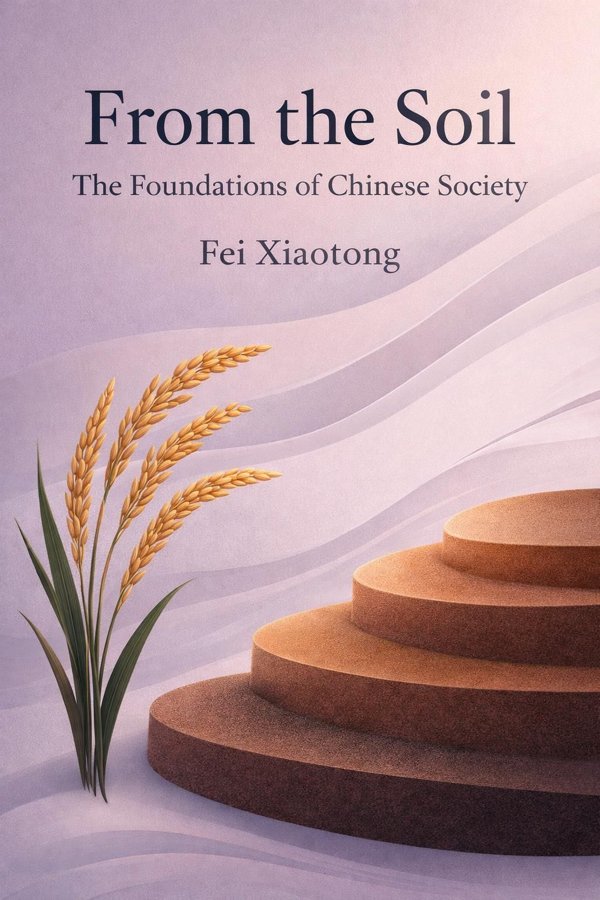
From the Soil: The Foundations of Chinese Society: Summary & Key Insights
by Fei Xiaotong
 10 min9 chaptersAudio available
What Is From the Soil: The Foundations of Chinese Society About?
From the Soil: The Foundations of Chinese Society by Fei Xiaotong is a sociology book spanning 9 pages. From the Soil: The Foundations of Chinese Society is a classic sociological study by Fei Xiaotong, first published in 1947. The book systematically analyzes the structure and functioning of traditional Chinese rural society. It introduces key concepts such as the 'differential mode of association' and 'rule of ritual,' revealing the unique logic of interpersonal relationships and social organization in China. The work remains a cornerstone for understanding Chinese social and cultural patterns.
This FizzRead summary covers all 9 key chapters of From the Soil: The Foundations of Chinese Society in approximately 10 minutes, distilling the most important ideas, arguments, and takeaways from Fei Xiaotong's work. Also available as an audio summary and Key Quotes Podcast.
From the Soil: The Foundations of Chinese Society
From the Soil: The Foundations of Chinese Society is a classic sociological study by Fei Xiaotong, first published in 1947. The book systematically analyzes the structure and functioning of traditional Chinese rural society. It introduces key concepts such as the 'differential mode of association' and 'rule of ritual,' revealing the unique logic of interpersonal relationships and social organization in China. The work remains a cornerstone for understanding Chinese social and cultural patterns.
Who Should Read From the Soil: The Foundations of Chinese Society?
This book is perfect for anyone interested in sociology and looking to gain actionable insights in a short read. Whether you're a student, professional, or lifelong learner, the key ideas from From the Soil: The Foundations of Chinese Society by Fei Xiaotong will help you think differently.
- ✓Readers who enjoy sociology and want practical takeaways
- ✓Professionals looking to apply new ideas to their work and life
- ✓Anyone who wants the core insights of From the Soil: The Foundations of Chinese Society in just 10 minutes
Want the full summary?
Get instant access to this book summary and 100K+ more with Fizz Moment.
Get Free SummaryAvailable on App Store • Free to download
Key Chapters
When I invoke 'soil,' I am not merely describing earth and agriculture but the social world born from them. The Chinese countryside has historically been a community of continuity—where people live where they are born, marry near their homes, and are buried in the same ground. That continuity gives rise to particular modes of feeling and behavior. A village is not simply a geographical unit; it is the moral landscape of Chinese civilization. People living from the soil depend on one another, develop habits suited to cooperation and mutual reliance, and see social stability as a reflection of natural order.
Unlike societies oriented toward mobility, competition, and contract, the Chinese rural world was structured through kinship, moral obligation, and the gradual accumulation of trust. This gave rise to a feeling I describe as 'localism'—a consciousness rooted in place. It is easy, in the modern era, to dismiss localism as provincial, but it provides the foundation of Chinese moral and social life. Because everyone’s existence is tied to the same fields and water sources, norms emerge organically rather than being imposed from above. To live from the soil is to live embedded in familiar relations—to know your elders, your lineage, and your obligations. From the soil, Chinese society grew like a living organism, each part connected, each generation organically linked to the next.
The soil nourishes this way of life not only physically but socially. The regularity of agricultural seasons demands cooperation and respect for cyclical time; the soil reminds people of continuity and patience. Thus, in Chinese life, order is not created by abstract rules but by accumulated custom. Understanding this helps explain many aspects of Chinese civilization—the strength of family, the endurance of ritual, and the resistance to disruptive, rapid change. The soil teaches people the meaning of persistence. And yet, as modernization advances, the uprooting of people from their origins poses a serious cultural challenge: how can we build new forms of social solidarity when the soil that sustained the old ones is no longer the foundation?
To understand the Chinese social structure, we must begin with relationships, not individuals or groups. The Western model often assumes people are equal members of abstract categories—citizens or classes—bound together by law or mutual contract. In the Chinese world, social order radiates from personal relationships, each defined by its distance from the center—the self. I call this pattern 'chaxu geju,' the differential mode of association.
Imagine ripples on water spreading out from where a stone falls. The self is the center, and relationships are concentric circles around it. The closer the circle, the stronger the sense of obligation and trust; the further, the weaker. Relationships are graded, not uniform. This structure explains why Chinese society is deeply personal and context-dependent. An action is moral or acceptable not in an abstract sense, but according to one’s relationship to the other person involved.
This mode of association gives Chinese social life its fluidity, warmth, and moral character but also its ambiguity. It means that relationships substitute for institutions; what holds society together are human feelings and rituals, not written contracts. A father and son do not relate through rights, but through 'li'—ritual propriety. A friend’s loyalty carries social obligation stronger than legal obligation. This system rewards those who maintain harmony and balance in relationships but can challenge modern legal rationality, which demands universal equality.
By studying this pattern, we find the reason why officialdom and bureaucracy in China historically relied on personal relationships. It is not corruption in the Western sense; it is the continuation of a relational logic. As modernization unfolds, however, this differential mode is pressured by the demand for impersonal systems. Understanding the chaxu geju allows us to see both the richness and the limits of the traditional system—it shows that the Chinese way of social organization is profoundly humane but ill-suited to the speed and impersonality of modern institutions. The question for the future is how to preserve human warmth while establishing fairness.
+ 7 more chapters — available in the FizzRead app
All Chapters in From the Soil: The Foundations of Chinese Society
About the Author
Fei Xiaotong (1910–2005) was a renowned Chinese sociologist, anthropologist, and educator. He served as a professor at Peking University and as president of the Chinese Sociological Association. His research covered rural society, ethnic relations, and social development. His major works include Peasant Life in China, From the Soil, and The Fertility System.
Get This Summary in Your Preferred Format
Read or listen to the From the Soil: The Foundations of Chinese Society summary by Fei Xiaotong anytime, anywhere. FizzRead offers multiple formats so you can learn on your terms — all free.
Available formats: App · Audio · PDF · EPUB — All included free with FizzRead
Download From the Soil: The Foundations of Chinese Society PDF and EPUB Summary
Key Quotes from From the Soil: The Foundations of Chinese Society
“When I invoke 'soil,' I am not merely describing earth and agriculture but the social world born from them.”
“To understand the Chinese social structure, we must begin with relationships, not individuals or groups.”
Frequently Asked Questions about From the Soil: The Foundations of Chinese Society
From the Soil: The Foundations of Chinese Society by Fei Xiaotong is a sociology book that explores key ideas across 9 chapters. From the Soil: The Foundations of Chinese Society is a classic sociological study by Fei Xiaotong, first published in 1947. The book systematically analyzes the structure and functioning of traditional Chinese rural society. It introduces key concepts such as the 'differential mode of association' and 'rule of ritual,' revealing the unique logic of interpersonal relationships and social organization in China. The work remains a cornerstone for understanding Chinese social and cultural patterns.
You Might Also Like

Between the World and Me
Ta-Nehisi Coates
10 min
Half the Sky
Nicholas D. Kristof, Sheryl WuDunn
10 min
Men Explain Things To Me
Rebecca Solnit
10 min
Rational Ritual
Michael Suk-Young Chwe
10 min
The New Jim Crow
Michelle Alexander
10 min
Beyond Culture
Edward T. Hall
10 minBrowse by Category
Ready to read From the Soil: The Foundations of Chinese Society?
Get the full summary and 100K+ more books with Fizz Moment.