
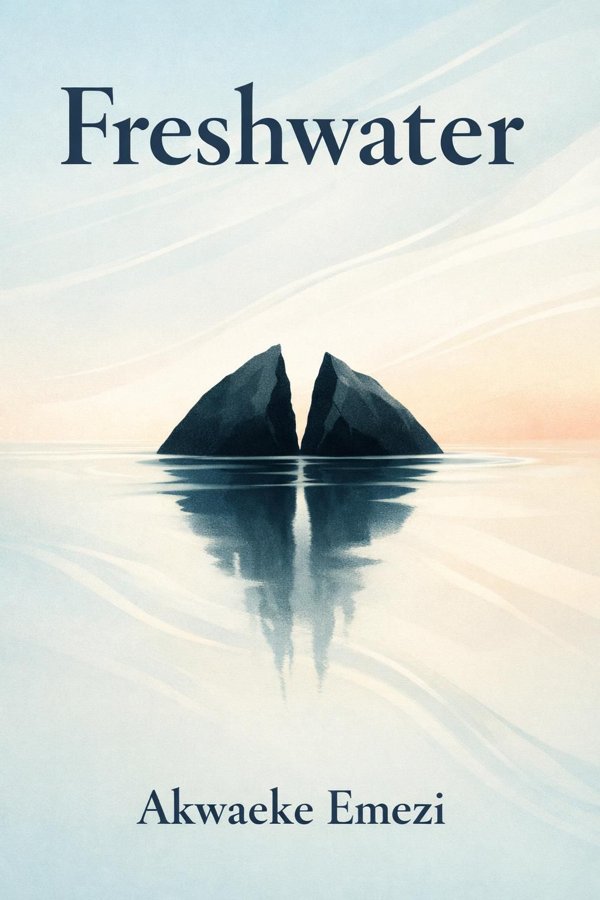
Freshwater: Summary & Key Insights
 10 min9 chaptersAudio available
Key Takeaways from Freshwater
Some lives begin with conflict already inside them.
What we can name, we can begin to understand.
Distance does not erase what lives inside us; it often amplifies it.
Violence does not only hurt the body; it can rearrange the architecture of the self.
Intimacy does not merely reveal who we are; it tests how well our selves can live together.
What Is Freshwater About?
Freshwater by Akwaeke Emezi is a bestsellers book spanning 4 pages. Freshwater is Akwaeke Emezi’s striking debut novel, first published in 2018, and it remains one of the most original works of contemporary literary fiction. At its center is Ada, a Nigerian girl born “with one foot on the other side,” whose life unfolds not as a single, stable identity but as a chorus of selves, spirits, wounds, and desires sharing one body. Drawing deeply from Igbo cosmology, especially the concept of the ogbanje, Emezi builds a narrative that challenges Western assumptions about personhood, sanity, trauma, and embodiment. The novel moves between Nigeria and the United States, between physical reality and spirit world, and between tenderness and violence, creating an experience that feels intimate, unsettling, and revelatory at once. What makes Freshwater matter is not only its subject but its form: fragmented, lyrical, and emotionally fearless, it gives language to experiences that are often misunderstood or erased. Emezi writes with rare authority, blending cultural knowledge, philosophical depth, and lived insight into a novel that asks a radical question: what if the self was never singular to begin with?
This FizzRead summary covers all 9 key chapters of Freshwater in approximately 10 minutes, distilling the most important ideas, arguments, and takeaways from Akwaeke Emezi's work. Also available as an audio summary and Key Quotes Podcast.
Freshwater
Freshwater is Akwaeke Emezi’s striking debut novel, first published in 2018, and it remains one of the most original works of contemporary literary fiction. At its center is Ada, a Nigerian girl born “with one foot on the other side,” whose life unfolds not as a single, stable identity but as a chorus of selves, spirits, wounds, and desires sharing one body. Drawing deeply from Igbo cosmology, especially the concept of the ogbanje, Emezi builds a narrative that challenges Western assumptions about personhood, sanity, trauma, and embodiment. The novel moves between Nigeria and the United States, between physical reality and spirit world, and between tenderness and violence, creating an experience that feels intimate, unsettling, and revelatory at once. What makes Freshwater matter is not only its subject but its form: fragmented, lyrical, and emotionally fearless, it gives language to experiences that are often misunderstood or erased. Emezi writes with rare authority, blending cultural knowledge, philosophical depth, and lived insight into a novel that asks a radical question: what if the self was never singular to begin with?
Who Should Read Freshwater?
This book is perfect for anyone interested in bestsellers and looking to gain actionable insights in a short read. Whether you're a student, professional, or lifelong learner, the key ideas from Freshwater by Akwaeke Emezi will help you think differently.
- ✓Readers who enjoy bestsellers and want practical takeaways
- ✓Professionals looking to apply new ideas to their work and life
- ✓Anyone who wants the core insights of Freshwater in just 10 minutes
Want the full summary?
Get instant access to this book summary and 100K+ more with Fizz Moment.
Get Free SummaryAvailable on App Store • Free to download
Key Chapters
Some lives begin with conflict already inside them. In Freshwater, Ada’s story opens with a powerful idea from Igbo cosmology: she is not born as a unified self, but as a being inhabited by ogbanje, spirit-selves who move between worlds. This framing changes everything. Instead of treating Ada’s inner fragmentation as a problem that appears later, the novel presents multiplicity as foundational to her existence. The body becomes a meeting ground, not a container for one stable identity.
Emezi uses this spiritual beginning to challenge the narrow language often used to describe psychological distress. Ada’s internal divisions are not explained away as simple metaphor, nor reduced to a clinical case. They are rendered as real presences with motives, voices, and power. This allows the reader to encounter identity as something layered, contested, and haunted by forces larger than individual will.
In practical terms, this idea pushes us to question how we interpret human complexity. Many people experience themselves differently in different settings: one self at home, another at work, another in intimacy, another in pain. Freshwater magnifies that truth into a spiritual and narrative structure. It invites us to ask whether contradiction always signals brokenness, or whether it can reveal a deeper map of experience.
The opening also establishes one of the novel’s central insights: naming the forces inside us can be the first step toward surviving them. Rather than insisting on a false simplicity, Emezi begins with plurality.
Actionable takeaway: When you encounter inner conflict in yourself or others, resist the urge to simplify it immediately; start by naming the different pressures, histories, and voices at work.
What we can name, we can begin to understand. One of Freshwater’s most remarkable achievements is its creation of a language for experiences that often feel unspeakable. Through shifting narrators, spirit voices, and lyrical fragmentation, Emezi refuses the conventional vocabulary of a neat coming-of-age story. Instead, the novel invents a form equal to the instability of Ada’s life.
This matters because language is never neutral. The stories a culture tells about mental health, gender, trauma, and spirituality shape what kinds of lives become legible. Western narratives often demand coherence: a person should have one identity, one truth, one stable self. Freshwater rejects that demand. It says that fractured experience may require fractured storytelling. The result is not confusion for its own sake, but precision through unconventional form.
Readers can apply this insight beyond literature. In everyday life, many experiences are flattened by limited language. Someone may say “I’m overwhelmed” when they are also grieving, dissociating, performing strength, and longing for escape. Someone may say “I don’t feel like myself” because they lack more precise terms. Emezi’s novel reminds us that finding better language can open better understanding, whether through therapy, journaling, spirituality, art, or conversation.
Freshwater also models the courage of speaking from outside accepted categories. It does not ask permission to define experience on dominant terms. Instead, it builds its own vocabulary and trusts the reader to follow.
Actionable takeaway: If your experience feels hard to explain, experiment with new language through writing, art, or reflection rather than forcing yourself into descriptions that do not fit.
Distance does not erase what lives inside us; it often amplifies it. When Ada leaves Nigeria for university in the United States, the move is more than geographic. It is a severing from familiar cultural ground, ancestral rhythms, and social context. In that dislocation, the selves within her become louder, more active, and more dangerous. Migration in Freshwater is not simply an opportunity for reinvention. It is a destabilizing crossing that exposes the fragility of identity.
Emezi shows how relocation can produce both freedom and rupture. Ada enters a new country where she is less held by inherited structures, but that looseness comes at a price. Isolation, alienation, racial difference, and the pressure to adapt create conditions in which her inner world intensifies. The ocean crossing becomes symbolic: she is physically farther from home and spiritually more vulnerable.
This idea resonates far beyond the novel. People who move across countries, classes, languages, or communities often discover that transition awakens hidden parts of themselves. A high-achieving student moving away from home may suddenly feel anxious in ways they never did before. An immigrant professional may become hyperaware of code-switching, loneliness, and self-division. Change can reveal fault lines that stability once concealed.
Freshwater suggests that dislocation should not be romanticized. Reinvention is real, but so are fragmentation and grief. New environments can offer possibility while also stripping away protective frameworks. Understanding that dual reality helps us respond to transition more honestly.
Actionable takeaway: During major life transitions, build deliberate anchors, such as routines, community, cultural practices, or trusted relationships, to protect yourself from the destabilizing effects of dislocation.
Violence does not only hurt the body; it can rearrange the architecture of the self. One of the most devastating turning points in Freshwater is Ada’s experience of sexual assault, after which a more forceful and destructive presence emerges within her. Emezi portrays trauma not as an isolated event that simply becomes a memory, but as something that transforms how a person inhabits their body, desire, and reality.
The novel is especially powerful in showing how trauma creates both protection and danger. Some inner selves arise to shield Ada from unbearable pain, numbness, and vulnerability. Yet those same defenses can become harmful, leading to self-destruction, emotional detachment, and fractured intimacy. This is one of the book’s deepest truths: survival strategies are often double-edged. What keeps us alive in one moment may wound us in another.
In practical life, this insight can help readers think more compassionately about behavior that appears irrational. Withdrawal, hyper-independence, compulsive control, risk-taking, or emotional shutdown may not be random flaws. They may be adaptations to injury. Freshwater does not excuse harm, but it insists on understanding its roots.
The book also underscores the importance of recognizing trauma as embodied. Healing is not just about changing thoughts. It involves safety, relationships, bodily awareness, and space to grieve what has been lost. Ada’s struggle reminds us that pain ignored tends to return in altered forms.
Actionable takeaway: If a painful event continues to shape your reactions, treat those responses as signals of injury rather than personal failure, and seek forms of support that address both mind and body.
Intimacy does not merely reveal who we are; it tests how well our selves can live together. In Freshwater, Ada’s relationships expose the fragile seams of her identity. Desire, attachment, sexuality, and vulnerability become spaces where her inner divisions sharpen. Love is not presented as a simple cure for suffering, nor as a clean route to self-knowledge. Instead, Emezi shows that closeness can intensify unresolved fractures.
Ada longs for connection, but connection requires presence, trust, and continuity, all of which are difficult when one’s selfhood feels divided. The novel explores the tension between wanting to be seen and fearing what being seen might cost. This is especially true in relationships shaped by power, longing, and the search for recognition. Love can become a site where pain is repeated, disguised, or mistaken for intimacy.
This idea has broad application. Many people discover that they can function effectively in work or public life while still feeling destabilized in romantic or deeply personal relationships. Why? Because intimacy asks us to bring our unguarded selves forward. If those selves are wounded, fragmented, or defended, relationships often become mirrors that reflect those internal struggles.
Freshwater encourages readers to question inherited ideas about love as salvation. Another person cannot integrate what we refuse to face ourselves. At the same time, relationships can reveal patterns we might otherwise avoid: where we disappear, where we perform, where we crave domination, where we fear tenderness.
Actionable takeaway: Pay attention to what your closest relationships consistently bring out in you; recurring emotional patterns often reveal unresolved parts of the self that need care, not concealment.
To live in a body is not always to feel at home in it. Freshwater returns again and again to embodiment as a site of conflict, transformation, and meaning. Ada’s body is where spirits act, trauma lands, desire speaks, gender becomes unstable, and identity is negotiated. The novel refuses the comforting idea that the body is a neutral vessel. Instead, it presents the body as contested territory, shaped by forces both internal and external.
This is one reason the book resonates so deeply with readers thinking about gender, dissociation, sexuality, and selfhood. Ada’s experience is not reducible to any single framework, but Emezi shows how bodily experience can become estranged. One may occupy a body yet feel watched within it, trapped by it, detached from it, or remade through it. The body can be a place of pleasure and violation, power and alienation, visibility and misrecognition.
In everyday life, this insight helps explain why embodiment is often emotional, cultural, and political all at once. A person may feel disconnected from their body after illness, after harassment, after major weight changes, or during periods of gender questioning. Another may feel that society imposes meanings on their body that do not match internal truth. Freshwater gives those tensions artistic form.
Importantly, the novel does not offer easy reconciliation. But it does insist that bodily estrangement is real and worthy of serious attention. Listening to the body means more than monitoring health; it also means asking what histories, fears, and identities are being lived through flesh.
Actionable takeaway: Notice when your body feels like a source of ease versus conflict, and use that awareness to explore what emotional, relational, or social pressures may be shaping your sense of embodiment.
Reality is often larger than the frameworks used to explain it. A central achievement of Freshwater is its refusal to choose between spiritual and psychological interpretations of Ada’s experience. The novel operates in a space where Igbo cosmology, trauma, mental distress, and identity can all be meaningful at once. Rather than resolving one framework into another, Emezi lets them coexist in productive tension.
This is a radical move because modern discourse often demands a single authorized explanation. Is Ada possessed, traumatized, mentally ill, spiritually marked, or symbolically fragmented? Freshwater suggests that the question itself may be too narrow. Human experience can be layered enough to hold several truths simultaneously. The spiritual language of ogbanje does not cancel psychological insight, and psychological insight does not erase spiritual reality.
This idea is useful far beyond the novel. In many communities, people understand suffering through family history, religion, culture, social conditions, medicine, and intuition all at once. A person may go to therapy and pray. They may take medication and consult elders. They may understand their pain as both biochemical and historical. Freshwater honors that complexity.
By making room for multiple systems of meaning, the book also resists cultural erasure. It does not treat African cosmology as decorative folklore added to a Western story. It centers that cosmology as a living intellectual and spiritual framework.
Actionable takeaway: When trying to understand a difficult experience, consider whether more than one interpretive lens may be valid instead of forcing a single explanation too quickly.
Identity is not only discovered; it is claimed, negotiated, and sometimes fought for. Throughout Freshwater, the question of who gets to define Ada is deeply contested. Family, culture, religion, violence, migration, and the inner selves all make claims on her. The novel suggests that naming oneself is never a purely private act. It happens within systems of power and expectation.
Emezi’s treatment of identity is especially compelling because it resists tidy resolution. Ada is not moving toward a simple, singular answer. Instead, the book shows identity as dynamic and multiple, shaped by voice, history, and embodiment. This has clear significance for readers interested in gender and nonbinary experience, but its reach is broader. Many people know what it means to feel misnamed by the roles assigned to them: dutiful child, successful student, stable partner, grateful immigrant, strong survivor.
Freshwater asks what happens when those names fail to contain lived truth. The struggle to self-name can feel liberating, but it can also provoke fear and backlash. To choose one’s language is to challenge inherited authority. That is why the novel treats naming as both necessary and dangerous.
In practical terms, this insight invites us to examine how much of our identity is self-authored and how much is compliance. We may discover that parts of our public self were built for safety, approval, or survival rather than authenticity. The task is not to erase every role, but to recognize which ones fit and which ones deform.
Actionable takeaway: Write down the labels that shape your life, then separate the ones you chose from the ones imposed on you; that distinction can clarify where change is needed.
Healing is not always becoming whole in the conventional sense; sometimes it is learning how to live with what cannot be simplified. In the later movement of Freshwater, Ada’s journey turns toward a difficult form of recognition. Rather than permanently defeating every inner force or arriving at perfect unity, she moves toward a deeper awareness of what she is, where she comes from, and how her worlds intersect. This is the novel’s version of return: not a sentimental homecoming, but an encounter with origin and truth.
The idea of “source” works on several levels. It points to Igbo cosmology, to ancestry, to the spiritual logic that shaped Ada from birth, and to the buried wounds that must be acknowledged rather than denied. Return is therefore not regression. It is an attempt to understand the self by tracing its roots instead of fleeing its complexity.
This has practical relevance for anyone trying to make sense of a fractured life. Healing often requires returning to what we avoided: family stories, cultural inheritance, formative pain, old beliefs, lost language, or the body itself. We may want a future untouched by the past, but Freshwater suggests that integration begins when we face what formed us.
Crucially, the book does not promise neat closure. Self-acceptance here is partial, ongoing, and hard-won. But it is more honest than fantasies of permanent cure. The goal is not purity. It is a more livable relationship with multiplicity.
Actionable takeaway: If you feel divided or disconnected, revisit the origins of that feeling with curiosity rather than shame; understanding where your patterns began can make them easier to live with and transform.
All Chapters in Freshwater
About the Author
Akwaeke Emezi is a Nigerian writer and artist celebrated for innovative work that explores identity, spirituality, embodiment, and the boundaries between visible and invisible worlds. Born in Umuahia, Nigeria, and educated in the United States, Emezi often draws on Igbo ontology in ways that reshape contemporary literary fiction. Their debut novel, Freshwater, brought international acclaim for its fearless treatment of multiplicity, trauma, and selfhood. Emezi has since published acclaimed fiction and memoir, building a body of work known for lyrical intensity, formal experimentation, and emotional honesty. Widely recognized as one of the most distinctive voices in modern literature, Emezi continues to challenge inherited ideas about gender, personhood, and what stories are allowed to contain.
Get This Summary in Your Preferred Format
Read or listen to the Freshwater summary by Akwaeke Emezi anytime, anywhere. FizzRead offers multiple formats so you can learn on your terms — all free.
Available formats: App · Audio · PDF · EPUB — All included free with FizzRead
Download Freshwater PDF and EPUB Summary
Key Quotes from Freshwater
“Some lives begin with conflict already inside them.”
“What we can name, we can begin to understand.”
“Distance does not erase what lives inside us; it often amplifies it.”
“Violence does not only hurt the body; it can rearrange the architecture of the self.”
“Intimacy does not merely reveal who we are; it tests how well our selves can live together.”
Frequently Asked Questions about Freshwater
Freshwater by Akwaeke Emezi is a bestsellers book that explores key ideas across 9 chapters. Freshwater is Akwaeke Emezi’s striking debut novel, first published in 2018, and it remains one of the most original works of contemporary literary fiction. At its center is Ada, a Nigerian girl born “with one foot on the other side,” whose life unfolds not as a single, stable identity but as a chorus of selves, spirits, wounds, and desires sharing one body. Drawing deeply from Igbo cosmology, especially the concept of the ogbanje, Emezi builds a narrative that challenges Western assumptions about personhood, sanity, trauma, and embodiment. The novel moves between Nigeria and the United States, between physical reality and spirit world, and between tenderness and violence, creating an experience that feels intimate, unsettling, and revelatory at once. What makes Freshwater matter is not only its subject but its form: fragmented, lyrical, and emotionally fearless, it gives language to experiences that are often misunderstood or erased. Emezi writes with rare authority, blending cultural knowledge, philosophical depth, and lived insight into a novel that asks a radical question: what if the self was never singular to begin with?
More by Akwaeke Emezi
You Might Also Like

The Godfather
Mario Puzo
10 min
The Handmaid's Tale
Margaret Atwood
10 min
The Hunger Games
Suzanne Collins
10 min
The Nightingale
Kristin Hannah
10 min
The Seven Husbands of Evelyn Hugo
Taylor Jenkins Reid
10 min
Backwater Justice
Fern Michaels
10 minBrowse by Category
Ready to read Freshwater?
Get the full summary and 100K+ more books with Fizz Moment.