
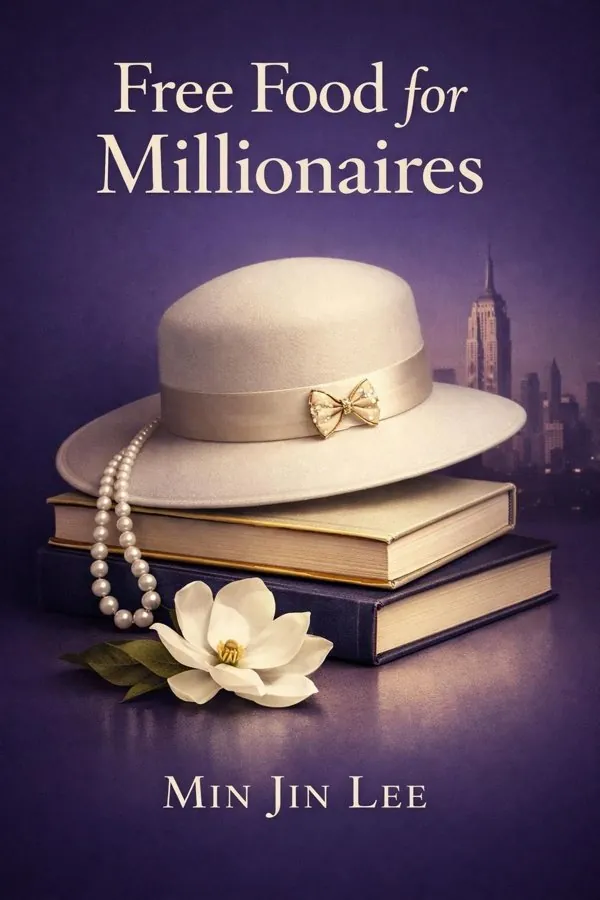
Free Food for Millionaires: Summary & Key Insights
by Min Jin Lee
 10 min8 chaptersAudio available
Key Takeaways from Free Food for Millionaires
A diploma can change your résumé faster than it changes your inner life.
We often learn what we want by standing close to people who already have it.
No community is as uniform as outsiders imagine.
Romance often reveals social truths that ambition tries to hide.
Money problems are rarely just about money.
What Is Free Food for Millionaires About?
Free Food for Millionaires by Min Jin Lee is a bestsellers book spanning 5 pages. What happens when elite education opens a door, but class, culture, and family history refuse to let you walk through it easily? In Free Food for Millionaires, Min Jin Lee answers that question through the life of Casey Han, a young Korean American woman fresh out of Princeton who wants sophistication, independence, and status, yet remains tethered to the sacrifices and expectations of her immigrant parents. Set in New York City in the years before the financial crash, the novel moves between Queens and Manhattan, exposing how money, pedigree, and social codes shape who gets to belong and who is merely allowed to visit. More than a coming-of-age story, this is a sharp, emotionally intelligent study of ambition, shame, romance, friendship, and the hidden costs of reinvention. Lee writes with unusual authority because she understands both the immigrant household and the world of elite institutions from the inside. Her insight into Korean American family life, social mobility, and the performance of class gives the novel its force. The result is a rich, observant portrait of modern America, where success is never just personal and belonging is always negotiated.
This FizzRead summary covers all 8 key chapters of Free Food for Millionaires in approximately 10 minutes, distilling the most important ideas, arguments, and takeaways from Min Jin Lee's work. Also available as an audio summary and Key Quotes Podcast.
Free Food for Millionaires
What happens when elite education opens a door, but class, culture, and family history refuse to let you walk through it easily? In Free Food for Millionaires, Min Jin Lee answers that question through the life of Casey Han, a young Korean American woman fresh out of Princeton who wants sophistication, independence, and status, yet remains tethered to the sacrifices and expectations of her immigrant parents. Set in New York City in the years before the financial crash, the novel moves between Queens and Manhattan, exposing how money, pedigree, and social codes shape who gets to belong and who is merely allowed to visit. More than a coming-of-age story, this is a sharp, emotionally intelligent study of ambition, shame, romance, friendship, and the hidden costs of reinvention. Lee writes with unusual authority because she understands both the immigrant household and the world of elite institutions from the inside. Her insight into Korean American family life, social mobility, and the performance of class gives the novel its force. The result is a rich, observant portrait of modern America, where success is never just personal and belonging is always negotiated.
Who Should Read Free Food for Millionaires?
This book is perfect for anyone interested in bestsellers and looking to gain actionable insights in a short read. Whether you're a student, professional, or lifelong learner, the key ideas from Free Food for Millionaires by Min Jin Lee will help you think differently.
- ✓Readers who enjoy bestsellers and want practical takeaways
- ✓Professionals looking to apply new ideas to their work and life
- ✓Anyone who wants the core insights of Free Food for Millionaires in just 10 minutes
Want the full summary?
Get instant access to this book summary and 100K+ more with Fizz Moment.
Get Free SummaryAvailable on App Store • Free to download
Key Chapters
A diploma can change your résumé faster than it changes your inner life. Casey Han leaves Princeton expecting momentum, freedom, and the glamorous adulthood she has imagined. Instead, she returns to her parents’ cramped apartment in Flushing, Queens, where the habits of thrift, obedience, and collective family duty still rule daily life. This homecoming is not simply inconvenient; it reveals the emotional contradiction at the center of her life. She has been educated to compete in elite spaces, but she has been raised to remember sacrifice, avoid waste, and honor her parents’ authority.
Min Jin Lee uses this return to show how first-generation immigrant success often comes with second-generation confusion. Casey is not poor in the absolute sense, but she feels deprived when measured against the wealthy world she wants to enter. Her parents, by contrast, see security and gratitude as the only sane goals after years of labor and uncertainty. These two value systems crash into one another over money, housing, work, and respectability.
This tension is deeply recognizable beyond the novel. Many ambitious young adults experience a version of Casey’s conflict when they return home after college and discover that achievement has not erased old family dynamics. Education may expand your possibilities, but family history still shapes your instincts, guilt, and fears.
The practical lesson is to name the value systems competing inside you. Ask yourself whether a decision is driven by aspiration, loyalty, shame, or fear. Actionable takeaway: write down three beliefs you inherited from family and three ambitions you developed on your own, then note where they conflict. That clarity is the first step toward living deliberately.
We often learn what we want by standing close to people who already have it. In Manhattan, Casey enters a world of glossy apartments, subtle status signals, and social confidence so polished it can look effortless. She works, observes, dates, and drifts through spaces where wealth is not merely money but a language of taste, ease, and assumption. Here, desire becomes an education. Casey does not just want material comfort; she wants fluency in the rituals of upper-class life.
Lee is especially perceptive about the theater of wealth. The right restaurant, the right internship, the right acquaintance, the right outfit, even the right tone of casualness all become markers of belonging. Casey is intelligent enough to decode these rules, but decoding them is not the same as owning them. She begins to see that aspiration can be intoxicating precisely because it promises transformation. Yet it also breeds comparison, anxiety, and self-erasure.
This idea remains relevant in any city or industry shaped by prestige. Whether in finance, media, law, technology, or academia, many people learn quickly that advancement depends on unspoken social codes as much as talent. Casey’s Manhattan is a reminder that institutions do not simply reward merit; they reward familiarity.
The practical application is not to reject ambition, but to examine the price of imitation. Ask what parts of your aspiration reflect genuine desire and what parts come from proximity to status. Actionable takeaway: before chasing a new lifestyle, role, or social circle, define what success would feel like without external applause. That helps you pursue growth without surrendering your sense of self.
No community is as uniform as outsiders imagine. One of the novel’s quiet achievements is its portrayal of Korean American life as varied, layered, and internally divided. Through Casey’s friendships and social interactions, Lee reveals a mosaic of class positions, religious commitments, generational attitudes, and personal ambitions. Some characters embrace traditional expectations, some resist them, and many do both at once. The result is a richer picture of ethnic identity than the simplified narratives often found in mainstream culture.
Casey’s relationships with other Korean Americans become mirrors that reflect possible versions of adulthood. Friends can represent discipline, compromise, rebellion, piety, cynicism, or strategic assimilation. Through them, Casey sees that ethnicity does not automatically produce belonging. Shared background may create recognition, but it does not eliminate competition, judgment, or difference. In fact, proximity can intensify comparison, especially when everyone is trying to navigate race, class, and family obligation in slightly different ways.
This matters because identity is often negotiated socially rather than privately. We discover what we believe not only through introspection but through contrast with peers. Readers who have lived between cultures will recognize how friendships can become laboratories for testing values: how much tradition to keep, how much ambition to pursue, what kind of partner to choose, and what counts as respectability.
The practical lesson is to treat community as a source of insight rather than a rigid script. You can learn from people who share your background without copying their choices. Actionable takeaway: identify two relationships in your life that challenge your assumptions about success or identity, and ask what those relationships are teaching you about the life you actually want.
Romance often reveals social truths that ambition tries to hide. In Free Food for Millionaires, Casey’s relationships are not merely emotional plotlines; they expose how class, race, gender, and self-worth shape intimacy. Attraction may feel spontaneous, but long-term connection is filtered through family expectations, financial realities, and the need to be seen fully. Casey wants love, yet she also wants elevation, validation, and escape. That makes romance a site of hope but also self-deception.
Lee shows that relationships are rarely separate from social hierarchy. A partner can symbolize entry into a better life, distance from one’s upbringing, or rebellion against family norms. But when love becomes a vehicle for class mobility or self-repair, it grows unstable. Casey’s choices suggest how easily desire can be mixed with projection. Does she want the person, or the world that person represents? Does she feel cherished, or merely selected? These questions give the novel much of its emotional tension.
Readers can apply this insight far beyond the book. Many people unconsciously evaluate partners through lenses inherited from family, peers, and status culture. Education, profession, accent, wealth, and social polish can become proxies for safety or worth. Yet those markers do not guarantee kindness, mutual respect, or emotional maturity.
The practical takeaway is to examine what your romantic preferences are really measuring. Before committing to a relationship, ask whether you feel more like yourself or less like yourself around that person. Actionable takeaway: make two lists, one for the qualities that impress others and one for the qualities that make you feel secure and respected. Prioritize the second list when judging a relationship’s true value.
Money problems are rarely just about money. Casey’s financial struggles expose the psychological burden of trying to appear independent before becoming truly stable. Debt, precarious work, and social aspiration create a dangerous combination: the need to project competence while privately losing control. Lee treats financial distress not as a moral failure but as a lived consequence of ambition, denial, and the pressure to keep up with a world that normalizes excess.
The novel is especially sharp about the shame attached to money. Casey comes from a household shaped by austerity, but instead of protecting her, that background leaves her vulnerable in another way. She has not fully learned either the discipline of her parents or the security of the elite. She floats between them, vulnerable to overspending, poor judgment, and the fantasy that one breakthrough will fix everything. Her financial setbacks force her to confront not only bills but the gap between the image she wants and the life she actually has.
This is one of the book’s most practical themes. Many young professionals, especially those entering status-driven environments, overspend to match the norms around them. Housing, clothing, dining, travel, and networking all become disguised forms of pressure. Debt then compounds emotional stress and weakens decision-making.
The lesson is that financial clarity is a form of self-respect. You cannot build a stable identity on unstable numbers. Actionable takeaway: review your current spending and separate it into essentials, investments, and image-maintenance expenses. Then cut one recurring cost you keep mainly to look as if you belong. Reducing financial performance creates room for genuine security.
Children of immigrants often inherit two conflicting stories: you are free to succeed, and you must never forget what your freedom cost. Casey’s relationship with her parents is charged by this contradiction. Their sacrifices gave her education and opportunity, but those gifts arrive wrapped in expectation. Gratitude becomes tangled with obligation, and affection is often expressed through criticism, worry, or control.
Lee refuses easy caricature. Casey’s parents are not simply oppressive, and Casey is not simply ungrateful. Instead, the novel shows how love can be distorted by fear. Her parents fear instability, social humiliation, and wasted opportunity because they have lived close to all three. Casey, meanwhile, fears a life of narrowness, compromise, and emotional confinement. Both sides are reacting to real pressures, but they speak different emotional languages.
This dynamic resonates with many readers from families shaped by migration, scarcity, or social vulnerability. Parents may measure success through safety, marriage, steady work, and reputation. Their children may seek fulfillment, creativity, romance, or independence. Conflict emerges not because either side lacks love, but because they imagine survival differently.
The practical value of this theme lies in learning to translate rather than simply react. Instead of hearing only control, ask what fear or hope sits underneath a parent’s demand. Instead of offering only defensiveness, explain your goals in concrete terms rather than abstract rebellion.
Actionable takeaway: choose one recurring family conflict and rewrite it in terms of underlying values. For example, “They want control” may become “They fear insecurity.” That shift will not solve everything, but it can turn confrontation into conversation.
Modern success is often less about possession than performance. Throughout the novel, characters learn to display competence, refinement, and confidence even when their inner lives are messy or uncertain. Clothes, manners, résumés, neighborhoods, and conversational ease become props in a larger drama: convincing others that you belong. Casey is both fascinated by and trapped within this system. She studies the signals of success because she knows they matter, yet she also senses how hollow they can become.
Lee’s portrait of America is especially incisive here. The culture celebrates individual achievement, but it quietly rewards those who already know the rules. People who come from privilege can mistake inherited fluency for personal merit. Those who come from outside must not only work hard but also master codes they were never taught. Casey’s struggle reveals that social mobility is not simply climbing a ladder; it is learning a script while acting as though you always knew it.
This theme extends to professional life today. Many workplaces reward presentation as much as substance. Being articulate in meetings, networking smoothly, dressing correctly, and signaling the right ambition can affect outcomes as much as actual performance. That does not make the game unreal, but it does make it unequal.
The useful lesson is to distinguish strategic adaptation from identity loss. There is nothing wrong with learning new codes, but it becomes dangerous when performance replaces self-knowledge. Actionable takeaway: identify the three success signals most rewarded in your environment, then decide which ones you can adopt authentically and which ones pressure you to become someone false. Keep the tools; discard the masquerade.
Maturity begins when borrowed definitions stop working. By the later stages of Casey’s journey, the novel shifts from social observation to moral recalibration. The central question is no longer whether she can enter elite spaces, but whether entry alone would satisfy her. After disappointments in work, love, and money, Casey is forced to confront a painful truth: chasing validation from class systems, romantic fantasies, and family approval cannot produce a coherent self.
Lee does not offer a simplistic ending in which Casey suddenly rejects ambition and embraces a pure authentic life. That would betray the novel’s realism. Instead, the deeper movement is toward self-recognition. Casey begins to understand that adulthood requires choosing among competing loyalties rather than escaping them. She may never fully resolve the tension between Korean daughter, American striver, romantic dreamer, and independent woman. But she can stop mistaking external approval for inner direction.
This is one of the book’s most enduring insights. Redefining success often means moving from comparison to calibration. Instead of asking, “How do I look next to others?” the better question becomes, “What kind of life can I sustain ethically, emotionally, and financially?” For many readers, that shift is liberating. It makes room for ambition without worshipping prestige.
The practical application is to create a personal success definition that includes more than status. Consider relationships, integrity, mental peace, and economic realism alongside achievement. Actionable takeaway: write a one-sentence definition of success that does not include job title, income, or others’ approval. Revisit major decisions against that sentence. If a goal violates it, the goal may not truly be yours.
All Chapters in Free Food for Millionaires
About the Author
Min Jin Lee is a Korean American novelist celebrated for her expansive, emotionally intelligent fiction about migration, identity, class, and family. Born in Seoul, South Korea, she moved with her family to the United States as a child and grew up in New York, an experience that deeply informs her writing. Before becoming a full-time author, she studied history at Yale and trained as a lawyer, bringing both intellectual rigor and social insight to her work. Her debut novel, Free Food for Millionaires, introduced her as a major literary voice with its vivid portrait of Korean American life and New York ambition. She later gained international acclaim with Pachinko, a multigenerational epic about Koreans in Japan. Lee is admired for combining intimate character studies with a powerful understanding of history, status, and belonging.
Get This Summary in Your Preferred Format
Read or listen to the Free Food for Millionaires summary by Min Jin Lee anytime, anywhere. FizzRead offers multiple formats so you can learn on your terms — all free.
Available formats: App · Audio · PDF · EPUB — All included free with FizzRead
Download Free Food for Millionaires PDF and EPUB Summary
Key Quotes from Free Food for Millionaires
“A diploma can change your résumé faster than it changes your inner life.”
“We often learn what we want by standing close to people who already have it.”
“No community is as uniform as outsiders imagine.”
“Romance often reveals social truths that ambition tries to hide.”
“Money problems are rarely just about money.”
Frequently Asked Questions about Free Food for Millionaires
Free Food for Millionaires by Min Jin Lee is a bestsellers book that explores key ideas across 8 chapters. What happens when elite education opens a door, but class, culture, and family history refuse to let you walk through it easily? In Free Food for Millionaires, Min Jin Lee answers that question through the life of Casey Han, a young Korean American woman fresh out of Princeton who wants sophistication, independence, and status, yet remains tethered to the sacrifices and expectations of her immigrant parents. Set in New York City in the years before the financial crash, the novel moves between Queens and Manhattan, exposing how money, pedigree, and social codes shape who gets to belong and who is merely allowed to visit. More than a coming-of-age story, this is a sharp, emotionally intelligent study of ambition, shame, romance, friendship, and the hidden costs of reinvention. Lee writes with unusual authority because she understands both the immigrant household and the world of elite institutions from the inside. Her insight into Korean American family life, social mobility, and the performance of class gives the novel its force. The result is a rich, observant portrait of modern America, where success is never just personal and belonging is always negotiated.
More by Min Jin Lee
You Might Also Like

The Godfather
Mario Puzo
10 min
The Handmaid's Tale
Margaret Atwood
10 min
The Hunger Games
Suzanne Collins
10 min
The Nightingale
Kristin Hannah
10 min
The Seven Husbands of Evelyn Hugo
Taylor Jenkins Reid
10 min
Backwater Justice
Fern Michaels
10 minBrowse by Category
Ready to read Free Food for Millionaires?
Get the full summary and 100K+ more books with Fizz Moment.