
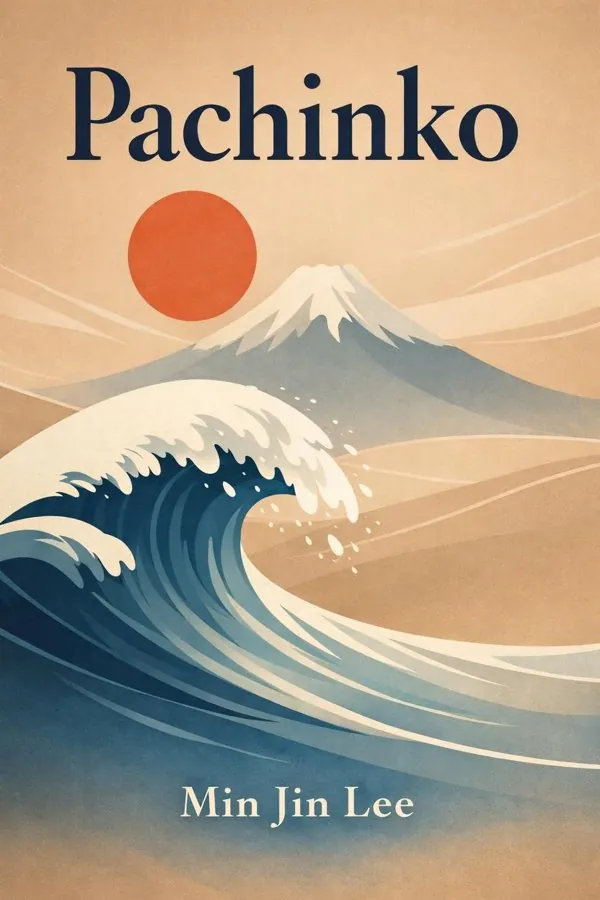
Pachinko: Summary & Key Insights
by Min Jin Lee
 10 min9 chaptersAudio available
Key Takeaways from Pachinko
The most powerful histories are often not told through leaders or battlefields, but through kitchens, boarding houses, schoolrooms, and workplaces.
A person can live in a country for decades and still be treated as if they do not belong.
Strength is often quiet, repetitive, and uncelebrated.
People rarely make choices in clean moral conditions.
No one begins life as a blank slate, yet no one is defined solely by inheritance.
What Is Pachinko About?
Pachinko by Min Jin Lee is a general book. What does it mean to build a life in a place that never fully accepts you? Pachinko by Min Jin Lee answers that question through a powerful, multigenerational novel that follows a Korean family living under Japanese rule and later as immigrants in Japan across much of the twentieth century. Beginning in a small Korean fishing village and expanding into Osaka, Tokyo, and beyond, the book traces how one family endures poverty, war, discrimination, shame, sacrifice, and reinvention. At its center are unforgettable characters, especially women, who must make impossible choices and continue anyway. The novel matters because it gives emotional and historical depth to the experience of Koreans in Japan, a subject often overlooked in mainstream literature. It shows how political forces shape intimate lives, how prejudice can become structural, and how dignity survives in ordinary acts of care. Min Jin Lee brings extraordinary authority to this story through years of research and interviews with Koreans in Japan, combined with her gift for humane, panoramic storytelling. Pachinko is both a family saga and a profound meditation on belonging, identity, and survival.
This FizzRead summary covers all 9 key chapters of Pachinko in approximately 10 minutes, distilling the most important ideas, arguments, and takeaways from Min Jin Lee's work. Also available as an audio summary and Key Quotes Podcast.
Pachinko
What does it mean to build a life in a place that never fully accepts you? Pachinko by Min Jin Lee answers that question through a powerful, multigenerational novel that follows a Korean family living under Japanese rule and later as immigrants in Japan across much of the twentieth century. Beginning in a small Korean fishing village and expanding into Osaka, Tokyo, and beyond, the book traces how one family endures poverty, war, discrimination, shame, sacrifice, and reinvention. At its center are unforgettable characters, especially women, who must make impossible choices and continue anyway. The novel matters because it gives emotional and historical depth to the experience of Koreans in Japan, a subject often overlooked in mainstream literature. It shows how political forces shape intimate lives, how prejudice can become structural, and how dignity survives in ordinary acts of care. Min Jin Lee brings extraordinary authority to this story through years of research and interviews with Koreans in Japan, combined with her gift for humane, panoramic storytelling. Pachinko is both a family saga and a profound meditation on belonging, identity, and survival.
Who Should Read Pachinko?
This book is perfect for anyone interested in general and looking to gain actionable insights in a short read. Whether you're a student, professional, or lifelong learner, the key ideas from Pachinko by Min Jin Lee will help you think differently.
- ✓Readers who enjoy general and want practical takeaways
- ✓Professionals looking to apply new ideas to their work and life
- ✓Anyone who wants the core insights of Pachinko in just 10 minutes
Want the full summary?
Get instant access to this book summary and 100K+ more with Fizz Moment.
Get Free SummaryAvailable on App Store • Free to download
Key Chapters
The most powerful histories are often not told through leaders or battlefields, but through kitchens, boarding houses, schoolrooms, and workplaces. Pachinko shows this with remarkable force. Rather than presenting history as a sequence of dates and political events, Min Jin Lee lets readers experience colonialism, migration, war, and economic upheaval through the daily decisions of one Korean family. The result is a novel that makes large-scale historical forces feel intimate and immediate.
The story begins with Sunja, a young woman in early twentieth-century Korea, whose personal choices are shaped by Japanese occupation and rigid social expectations. As her family moves into the precarious world of Korean life in Japan, history stops being abstract. It becomes the difficulty of finding work, renting an apartment, attending school, or being treated with basic respect. Each generation inherits not only family memories, but also the consequences of systems they did not create.
This idea has practical relevance beyond the novel. In real life, people often underestimate how much history shapes identity, opportunity, and even emotional life. Family migration stories, legal status, class background, and national conflict all continue to influence present choices. Pachinko invites readers to look at their own family narratives with more curiosity. Why did relatives move, hide parts of themselves, change names, or cling to tradition? What political forces shaped those choices?
One practical application is to treat family history as a source of understanding rather than nostalgia. Interview older relatives, learn the context around major moves or hardships, and notice how inherited fears or ambitions continue today. Historical awareness can deepen empathy both within families and across communities.
Actionable takeaway: Explore one branch of your family’s history and ask not only what happened, but what larger social forces made those events possible.
A person can live in a country for decades and still be treated as if they do not belong. That painful truth stands at the center of Pachinko. For Koreans in Japan, residence does not automatically lead to acceptance. Even families born and raised there remain marked by ancestry, language, names, and social prejudice. Min Jin Lee reveals that exclusion is not only emotional; it is institutional, economic, and cultural.
In the novel, characters face barriers in housing, education, employment, and marriage because they are Korean. Some try to adapt by concealing their identity, adopting Japanese names, or distancing themselves from their heritage. Others insist on preserving their roots. Neither path is simple. Assimilation may offer practical protection, but it can produce shame and dislocation. Openly claiming identity can preserve dignity, but may invite discrimination.
This tension is deeply relevant in modern societies shaped by migration. Many people still live with the pressure to become acceptable versions of themselves in order to succeed. Children of immigrants, racial minorities, and other marginalized groups often understand this dilemma well: how much of yourself can you reveal without paying a price? Pachinko does not offer easy answers. Instead, it shows the emotional cost of a world where belonging is conditional.
A useful application is to examine how institutions define who is considered “normal.” In schools and workplaces, ask whether people are expected to flatten their identities to fit in. In personal life, notice whether inclusion means true acceptance or merely tolerance under strict terms.
Actionable takeaway: Identify one setting in your life where belonging feels conditional, and take one concrete step toward making it more genuinely inclusive for yourself or others.
Strength is often quiet, repetitive, and uncelebrated. Pachinko makes this visible through its women, especially Sunja, who become the moral and practical anchors of family survival. In many epic stories, men occupy the center through ambition, power, or public action. Min Jin Lee instead shows how women sustain life through labor that is easily overlooked: feeding others, enduring scandal, managing scarcity, protecting children, and making impossible trade-offs with limited power.
Sunja’s life is defined by choices made within constraint. She does not control the social system around her, yet she repeatedly acts with courage and discipline. Later generations continue this pattern. Women in the novel are not idealized saints; they are complex, proud, wounded, resourceful, and sometimes contradictory. What unites them is their willingness to keep going when history, men, institutions, and economics fail them.
The book’s portrait of female resilience has practical significance. Many families and organizations still depend on invisible labor, especially the labor of women: emotional regulation, caregiving, social planning, conflict smoothing, and sacrifice. Because this work is often unpaid or normalized, it is undervalued. Pachinko encourages readers to see these acts as foundational rather than secondary.
A practical application is to make hidden labor visible. In households, list recurring tasks and who performs them. In workplaces, notice who handles mentoring, emotional support, or team cohesion without recognition. Naming these contributions is the first step toward fairness.
The novel also reminds us that resilience should not be romanticized. Admiring endurance must not become an excuse for ignoring injustice. Strong people still deserve support, rest, and opportunity.
Actionable takeaway: Acknowledge one person whose steady, often invisible labor holds your world together, and pair that gratitude with a concrete act of support or redistribution.
People rarely make choices in clean moral conditions. One of Pachinko’s deepest insights is that survival under oppression often forces compromise, ambiguity, and uncomfortable trade-offs. Characters take jobs, relationships, and risks they might not choose in a more just world. The novel refuses simplistic judgments. Instead, it asks readers to consider what dignity looks like when all options are flawed.
This theme is embodied in the world of pachinko itself, a gaming industry associated with social stigma yet one of the few available routes to financial stability for many Koreans in Japan. For some characters, pachinko is not a dream but a necessity. It offers income, leverage, and survival in a society that shuts other doors. The moral tension is central: can a compromised path still sustain a meaningful life? The novel suggests that hardship often turns ethics from a matter of purity into a matter of endurance and responsibility.
In everyday life, people face smaller versions of this problem all the time. A worker may stay in a flawed company to support family. A student may soften part of their identity to avoid harassment. An immigrant may accept exploitative conditions because immediate survival matters more than abstract ideals. These realities do not erase ethics, but they complicate judgment.
The practical lesson is to cultivate moral humility. Before criticizing others’ choices, ask what alternatives were truly available to them. At the same time, examine your own compromises honestly. Which are temporary survival strategies, and which are slowly becoming your values?
Compromise is dangerous when it becomes self-erasure, but it can also be a rational response to injustice. The challenge is to survive without losing all capacity for reflection.
Actionable takeaway: Review one compromise you are currently making and ask whether it is helping you endure temporarily or quietly shaping a life you no longer want.
No one begins life as a blank slate, yet no one is defined solely by inheritance. Pachinko explores identity as a negotiation between ancestry, circumstance, and personal choice. Each generation of the family receives a legacy of language, stigma, memory, and expectation. But each person also responds differently. Some protect tradition. Some reject it. Some reinvent themselves in ways that create both freedom and fracture.
This dynamic is especially visible in the children and grandchildren of immigrants, who often inhabit multiple worlds at once. They may speak one language at home and another in public. They may feel loyalty to a heritage they did not fully choose, while longing for acceptance in the dominant culture. In the novel, these tensions produce conflict within families as much as between families and society. Different generations define success, duty, and selfhood in very different ways.
The book’s insight applies widely in multicultural societies. Many readers will recognize the pressure to honor where they come from while also building a self that feels authentic. Identity is not a fixed label; it is an ongoing conversation between past and present. Problems arise when people are denied the freedom to participate in that conversation, either because society stereotypes them or because family tradition becomes too rigid.
A practical way to use this idea is to separate inherited identity from unquestioned obligation. Ask: Which parts of my background genuinely nourish me? Which parts do I preserve only out of fear, guilt, or social pressure? Likewise, if you are raising children or mentoring younger people, allow room for identity to evolve rather than demanding strict replication.
Pachinko suggests that identity becomes strongest not when it is pure, but when it is consciously owned.
Actionable takeaway: Write down three aspects of your identity you inherited and three you actively chose, then reflect on where they align and where they conflict.
Hard work matters, but it does not erase structural barriers. Pachinko challenges the comforting belief that talent and determination are always enough. Again and again, characters study, strive, sacrifice, and dream, only to discover that discrimination can block advancement no matter how deserving they are. This is one of the novel’s most unsettling and realistic contributions.
The family’s experiences in Japan reveal how systems reproduce inequality. Employers discriminate. Schools stigmatize. Social networks close ranks. Respectability politics offer only partial protection. Even those who achieve financial success remain vulnerable to exclusion because prejudice is embedded in institutions, not just in personal attitudes. The novel does not deny individual agency, but it refuses to turn success into a simple morality tale.
This insight is highly practical in modern discussions of meritocracy. People often explain inequality through personal choices alone, overlooking how rules, norms, and gatekeepers shape outcomes. Pachinko reminds readers that perseverance is admirable, but societies must also confront bias in hiring, housing, education, and citizenship. Otherwise, “work harder” becomes a cruel instruction given to those already carrying extra weight.
For individuals, this means adopting a more accurate framework for achievement. If you face repeated obstacles, it may not be a sign of personal failure. If you have progressed smoothly, it may not be due solely to superior effort. For leaders, the lesson is to examine systems instead of celebrating rare exceptions as proof of fairness.
The novel’s realism can be painful, but it is clarifying. It asks readers to honor effort while refusing illusions about the world in which that effort takes place.
Actionable takeaway: In one area you care about, look beyond individual performance and identify one structural barrier that may be shaping outcomes more than people admit.
Affection can transform lives, but it cannot by itself overcome social hierarchy. Pachinko portrays love in many forms—romantic, parental, sacrificial, unspoken—and shows both its beauty and its limits. Characters love one another deeply, yet that love remains entangled with class, gender, nationality, legitimacy, and power. The novel is unsentimental in the best way: it values love without pretending it can erase injustice.
Relationships in the book are shaped by unequal conditions from the start. A woman may be cherished but still constrained by patriarchy. A child may be adored but still inherit stigma. A lover may offer protection while also exercising control. Family bonds provide comfort, identity, and motivation, yet they can also bring duty, guilt, and painful expectations. Love in Pachinko is rarely simple. It is sustaining, but it is not magical.
This is a useful lesson for real life, where people often assume good intentions are enough. Parents may love children and still burden them with unresolved dreams. Partners may care deeply and still replicate unfair dynamics. Institutions may celebrate diversity rhetorically while maintaining exclusion in practice. Emotional sincerity matters, but systems and habits matter too.
A practical application is to evaluate love through behavior and structure, not feeling alone. In families, ask whether care is accompanied by respect. In relationships, ask whether affection coexists with freedom and accountability. In communities, ask whether solidarity changes conditions or merely offers comfort within them.
Pachinko ultimately argues that love is essential because the world is unjust, not because it makes injustice disappear. Love helps people endure, but it cannot substitute for fairness.
Actionable takeaway: In one important relationship, identify a caring intention that needs to be matched by a more just action, boundary, or shared responsibility.
Endurance is not usually a dramatic breakthrough; it is the accumulation of small decisions made under pressure. Pachinko excels at showing resilience as a daily practice rather than a heroic trait. Characters survive not because they are fearless, but because they continue to act despite fear, grief, humiliation, and exhaustion. They cook, study, work, save, mourn, and begin again. The repetition matters.
This perspective makes resilience feel more realistic and more humane. In popular culture, resilience is often framed as inspiration: one powerful speech, one grand comeback, one defining moment. Min Jin Lee shows something truer. People are shaped by routine persistence. A mother stretches limited resources. A student keeps learning despite prejudice. A family member returns to work after loss. These acts may seem ordinary, but over time they determine whether a family collapses or continues.
In practical terms, this idea can change how readers approach hardship. When facing a large problem, waiting to feel strong enough may delay action indefinitely. Pachinko suggests another method: shrink survival into manageable tasks. Preserve the next hour, then the next day. Build conditions for continuity rather than demanding emotional certainty.
This also has implications for how we support others. Instead of admiring resilience from a distance, help reduce the burdens that make resilience necessary. Offer childcare, share information, provide transportation, create opportunity, or simply remain reliable. Stability often grows through ordinary support systems.
The novel’s wisdom is that resilience is not glamorous, and it does not always feel noble. Often it is tired, repetitive, and invisible. Yet it is also one of the strongest forces in human life.
Actionable takeaway: When facing a major challenge, define the three smallest repeatable actions that would help you keep going, and commit to them before seeking dramatic change.
A life does not need public validation to possess meaning. This is one of Pachinko’s quietest and most profound lessons. Many of the characters are denied status, legitimacy, and social praise. Their labor goes unnoticed, their suffering is private, and their contributions are rarely honored by the world around them. Yet the novel insists that dignity can survive in hidden forms: in perseverance, decency, responsibility, and the refusal to treat oneself or others as disposable.
This matters because modern culture often ties worth to visibility. Recognition, prestige, and measurable success are treated as proof of value. Pachinko rejects that logic. Some of the most admirable people in the novel are not the most powerful or celebrated. Their greatness lies in the way they carry burdens, protect others, maintain standards, or choose compassion when bitterness would be easier.
The practical implication is significant. Many meaningful forms of work—caregiving, honest labor, moral steadiness, emotional discipline—may never bring applause. If people rely only on external recognition, they become vulnerable to despair or vanity. A stronger foundation is to cultivate an internal sense of what makes a life honorable.
This does not mean people should accept injustice or stop seeking acknowledgment. Fair recognition matters. But the novel reminds us that a person’s worth exceeds what institutions reward. This perspective can sustain people in periods when their efforts are unseen or undervalued.
One useful practice is to define dignity in behavior rather than reputation. Ask not only, “Am I being noticed?” but “Am I acting in a way I can respect?” That question offers steadier guidance.
Actionable takeaway: Write a personal definition of dignity based on conduct, not status, and use it to evaluate your choices over the next week.
All Chapters in Pachinko
About the Author
Min Jin Lee is a Korean American novelist celebrated for her expansive, deeply humane fiction about migration, identity, class, and belonging. Born in Seoul, South Korea, she moved to the United States as a child and later studied history at Yale University before training and working as a lawyer. She eventually turned to fiction full time, bringing rigorous research and emotional intelligence to her work. Lee is the author of Free Food for Millionaires and the internationally acclaimed Pachinko, which drew widespread praise for its portrayal of Koreans living in Japan across generations. Known for combining historical depth with intimate character writing, she has become one of the most respected contemporary literary voices exploring diaspora and the long afterlife of social exclusion.
Get This Summary in Your Preferred Format
Read or listen to the Pachinko summary by Min Jin Lee anytime, anywhere. FizzRead offers multiple formats so you can learn on your terms — all free.
Available formats: App · Audio · PDF · EPUB — All included free with FizzRead
Download Pachinko PDF and EPUB Summary
Key Quotes from Pachinko
“The most powerful histories are often not told through leaders or battlefields, but through kitchens, boarding houses, schoolrooms, and workplaces.”
“A person can live in a country for decades and still be treated as if they do not belong.”
“Strength is often quiet, repetitive, and uncelebrated.”
“People rarely make choices in clean moral conditions.”
“No one begins life as a blank slate, yet no one is defined solely by inheritance.”
Frequently Asked Questions about Pachinko
Pachinko by Min Jin Lee is a general book that explores key ideas across 9 chapters. What does it mean to build a life in a place that never fully accepts you? Pachinko by Min Jin Lee answers that question through a powerful, multigenerational novel that follows a Korean family living under Japanese rule and later as immigrants in Japan across much of the twentieth century. Beginning in a small Korean fishing village and expanding into Osaka, Tokyo, and beyond, the book traces how one family endures poverty, war, discrimination, shame, sacrifice, and reinvention. At its center are unforgettable characters, especially women, who must make impossible choices and continue anyway. The novel matters because it gives emotional and historical depth to the experience of Koreans in Japan, a subject often overlooked in mainstream literature. It shows how political forces shape intimate lives, how prejudice can become structural, and how dignity survives in ordinary acts of care. Min Jin Lee brings extraordinary authority to this story through years of research and interviews with Koreans in Japan, combined with her gift for humane, panoramic storytelling. Pachinko is both a family saga and a profound meditation on belonging, identity, and survival.
More by Min Jin Lee
You Might Also Like
Duct Tape Marketing: The World's Most Practical Small Business Marketing Guide
John Jantsch
10 minDusk, Night, Dawn: On Revival and Courage
Anne Lamott
10 minFinish Big: How Great Entrepreneurs Exit Their Companies on Top
Bo Burlingham
10 minFirst As Tragedy, Then As Farce
Slavoj Zizek
10 minFirst Principles: What America's Founders Learned from the Greeks and Romans and How That Shaped Our Country
Thomas E. Ricks
10 minGood Habits, Bad Habits: The Science of Making Positive Changes That Stick
Wendy Wood
10 minBrowse by Category
Ready to read Pachinko?
Get the full summary and 100K+ more books with Fizz Moment.