
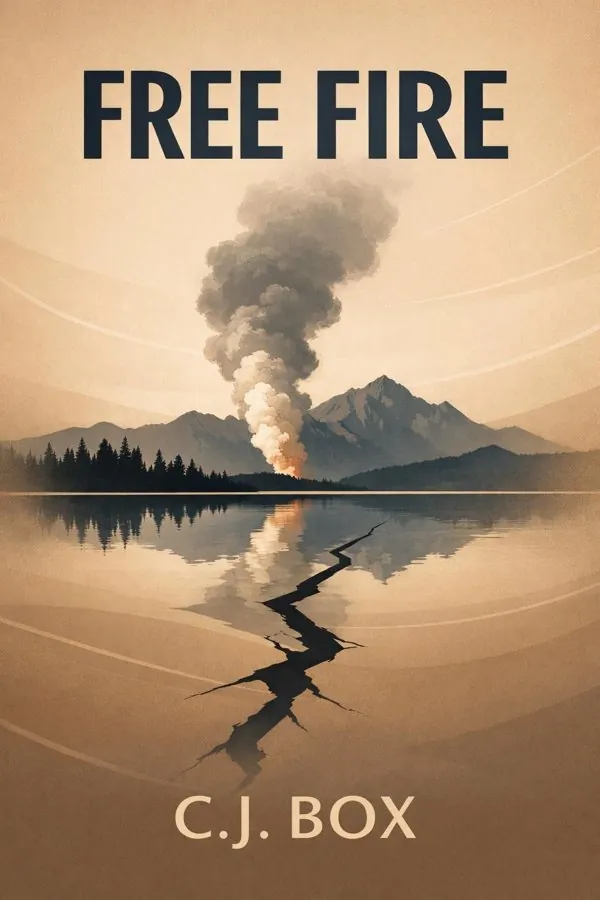
Free Fire: Summary & Key Insights
by C.J. Box
 10 min3 chaptersAudio available
What Is Free Fire About?
Free Fire by C.J. Box is a mystery book spanning 3 pages. In this seventh installment of the Joe Pickett series, Wyoming game warden Joe Pickett is asked by the governor to investigate a mysterious multiple murder in Yellowstone National Park, where jurisdictional loopholes have left the case unsolved. As Joe delves deeper, he uncovers corruption, environmental conflict, and moral dilemmas that test his integrity and courage.
This FizzRead summary covers all 3 key chapters of Free Fire in approximately 10 minutes, distilling the most important ideas, arguments, and takeaways from C.J. Box's work. Also available as an audio summary and Key Quotes Podcast.
Free Fire
In this seventh installment of the Joe Pickett series, Wyoming game warden Joe Pickett is asked by the governor to investigate a mysterious multiple murder in Yellowstone National Park, where jurisdictional loopholes have left the case unsolved. As Joe delves deeper, he uncovers corruption, environmental conflict, and moral dilemmas that test his integrity and courage.
Who Should Read Free Fire?
This book is perfect for anyone interested in mystery and looking to gain actionable insights in a short read. Whether you're a student, professional, or lifelong learner, the key ideas from Free Fire by C.J. Box will help you think differently.
- ✓Readers who enjoy mystery and want practical takeaways
- ✓Professionals looking to apply new ideas to their work and life
- ✓Anyone who wants the core insights of Free Fire in just 10 minutes
Want the full summary?
Get instant access to this book summary and 100K+ more with Fizz Moment.
Get Free SummaryAvailable on App Store • Free to download
Key Chapters
Joe Pickett is beginning to settle back into routine life as a game warden when Governor Spencer Rulon—ever politically astute, ever interested in turning chaos into advantage—calls him into his office. The governor’s request sounds almost unreal: go to Yellowstone National Park and look into a murder case that technically cannot be prosecuted. Four people have been shot to death by a man named Clay McCann, a lawyer who turned himself in and announced he couldn’t be touched by federal or state law. Rulon sees the situation as both an outrage and an opportunity; he wants someone trustworthy, someone incorruptible, to get the truth behind the story. Joe, to his own dismay, fits that description.
When Joe hears the phrase ‘Zone of Death,’ he can hardly believe it. Yellowstone’s southwestern corner—scarcely accessible wilderness—is technically part of the jurisdictional anomaly: federal land managed by the park service but not clearly bound to any active judicial district. In theory, a crime there could never face trial due to constitutional technicalities. For Joe, the concept feels like a violation of everything he believes in as a lawman. If there’s a place where accountability dissolves, then the wilderness itself becomes complicit.
Joe sets out for the park disguised as a temporary liaison, his cover allowing him to move around without drawing federal attention. From the first moment, the park’s spirit overwhelms him. I wanted readers to feel that mixture of reverence and foreboding—the smell of sulfur from geyser vents, the metallic shimmer of geothermal pools, and the way silence can make a man feel both insignificant and watched. Yet there’s also tension everywhere: rangers distrustful of outsiders, environmentalists clashing with corporate developers, tourists oblivious to how close they walk to danger.
Joe begins to study McCann’s case file. The lawyer had camped near a geothermal stream with a group of colleagues, then turned a gun on them. He called the sheriff himself, calmly surrendered, and smiled as he explained that the Constitution protected him from any trial. His confidence is unnerving, almost smug. What troubles Joe most isn’t the loophole—it’s the man’s serenity, as though he knew something no one else did.
The deeper Joe roams the park, the more he senses that the murders might not be random. There’s talk of secret geothermal drilling and experiments that could threaten the park’s ecosystem. Rumors swirl about investors with government ties and locals who’ve been silenced. Each lead draws Joe deeper into terrain where both geology and humanity are unstable. As he contemplates the violence that the wilderness can both conceal and absolve, he feels that this mission is about more than stopping a murderer—it’s about confronting the failure of the very system he serves.
Yellowstone is a place built on pressure—volcanic, political, moral. In Free Fire, this pressure becomes a metaphor for the buried truths Joe Pickett must dig through. His cover assignment earns him cautious cooperation from park officials, but their smiles feel thin. Superintendent McCann, the killer’s namesake, keeps everyone at bay, and whispers drift of special permits granted to private companies to access geothermal vents. Joe’s instincts as a warden—his ability to notice small details in wild places—prove essential. He notices vehicle tracks where none should be, suppressed reports of animal die-offs, and strange warning markers near hot springs that don’t appear on any map.
Meanwhile, Marybeth, his wife back in Saddlestring, takes on the invisible battle of research. I’ve always admired how Marybeth serves as Joe’s intellectual counterweight. While Joe’s courage moves through the landscape, hers moves through data, law, and history. She unearths the details of the jurisdictional gap: the Sixth Amendment requires a trial by jury drawn from the district and state where the crime occurred—but in the zone of Yellowstone that lies in Idaho, no residents exist. No residents means no jury, no trial, and effectively, no law. Their exchanges, though separated by miles, reveal the Pickett partnership’s essence: shared integrity bound by quiet love and mutual respect.
As Joe uncovers more evidence, he learns that McCann had connections to a secret geothermal project funded by unscrupulous investors seeking to tap underground heat sources for profit. Yellowstone, symbol of national purity, becomes a stage for greed disguised as innovation. The murders, Joe comes to believe, were not acts of madness but part of a larger scheme to silence whistleblowers who discovered the illegal drilling.
Every conversation Joe has with locals feels dangerous. Rangers hint they’re being watched. Environmental activists pursue noble causes but accept funding from mysterious benefactors. Joe’s sense of isolation deepens amid the endless forests, the sulfur fog curling around his boots. His old instincts whisper that he’s the prey now.
When he finally confronts Clay McCann in person, Joe encounters not a raving killer but a lawyer calm in his intellectual armor. McCann taunts him, pointing out that law is nothing more than geography and paperwork. In the vacuum of the Zone of Death, he claims, morality itself is irrelevant. Joe’s anger in that moment isn’t just personal—it’s existential. If McCann is right, then the very idea of civilization cannot exist in wilderness.
From that point onward, Joe resolves not simply to find proof, but to restore meaning to the law. He could call for federal backup or leak the story, but the rot runs too deep. He chooses instead to track what really happened at the murder site, knowing that understanding motives will be the only way to challenge the loophole’s moral authority. Through pouring rain, thermal fog, and the metallic scent of sulfur, he pushes deeper into an environment that mirrors human corruption—beautiful, volatile, and ready to erupt.
+ 1 more chapters — available in the FizzRead app
All Chapters in Free Fire
About the Author
C.J. Box is an American author best known for his Joe Pickett series of novels set in the American West. His works often explore themes of wilderness, justice, and human conflict against the backdrop of rugged landscapes. Box has received multiple awards, including the Edgar Award and the Anthony Award.
Get This Summary in Your Preferred Format
Read or listen to the Free Fire summary by C.J. Box anytime, anywhere. FizzRead offers multiple formats so you can learn on your terms — all free.
Available formats: App · Audio · PDF · EPUB — All included free with FizzRead
Download Free Fire PDF and EPUB Summary
Key Quotes from Free Fire
“The governor’s request sounds almost unreal: go to Yellowstone National Park and look into a murder case that technically cannot be prosecuted.”
“Yellowstone is a place built on pressure—volcanic, political, moral.”
Frequently Asked Questions about Free Fire
Free Fire by C.J. Box is a mystery book that explores key ideas across 3 chapters. In this seventh installment of the Joe Pickett series, Wyoming game warden Joe Pickett is asked by the governor to investigate a mysterious multiple murder in Yellowstone National Park, where jurisdictional loopholes have left the case unsolved. As Joe delves deeper, he uncovers corruption, environmental conflict, and moral dilemmas that test his integrity and courage.
More by C.J. Box
You Might Also Like
Browse by Category
Ready to read Free Fire?
Get the full summary and 100K+ more books with Fizz Moment.