
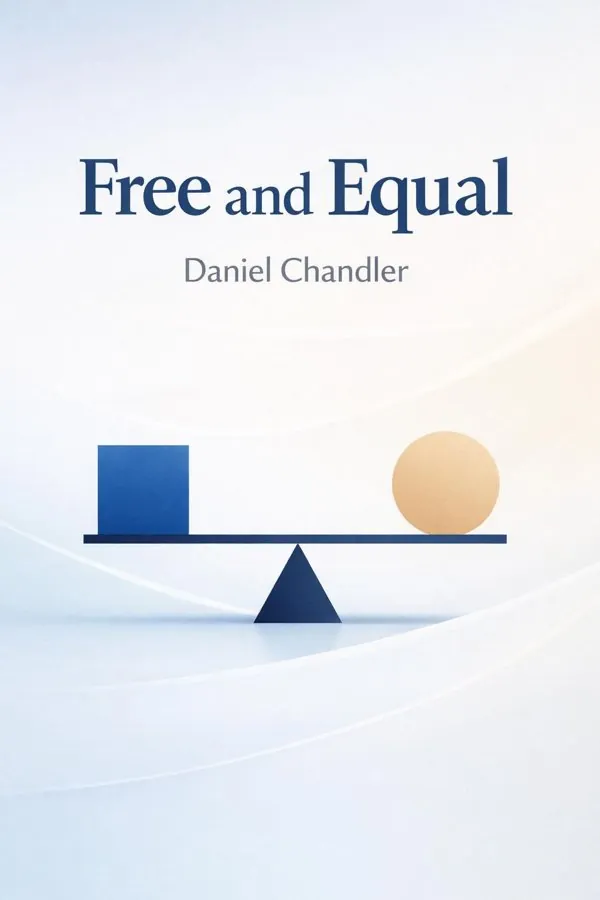
Free and Equal: What Would a Fair Society Look Like?: Summary & Key Insights
 10 min11 chaptersAudio available
What Is Free and Equal: What Would a Fair Society Look Like? About?
Free and Equal: What Would a Fair Society Look Like? by Daniel Chandler is a politics book spanning 11 pages. In this book, Daniel Chandler reinterprets John Rawls’s theory of justice for the twenty-first century, exploring how the principles of fairness and equality can be applied to modern societies. Chandler argues for a vision of a fair society that balances freedom with equality, offering practical policy ideas for achieving social justice in areas such as wealth distribution, education, and democracy.
This FizzRead summary covers all 11 key chapters of Free and Equal: What Would a Fair Society Look Like? in approximately 10 minutes, distilling the most important ideas, arguments, and takeaways from Daniel Chandler's work. Also available as an audio summary and Key Quotes Podcast.
Free and Equal: What Would a Fair Society Look Like?
In this book, Daniel Chandler reinterprets John Rawls’s theory of justice for the twenty-first century, exploring how the principles of fairness and equality can be applied to modern societies. Chandler argues for a vision of a fair society that balances freedom with equality, offering practical policy ideas for achieving social justice in areas such as wealth distribution, education, and democracy.
Who Should Read Free and Equal: What Would a Fair Society Look Like??
This book is perfect for anyone interested in politics and looking to gain actionable insights in a short read. Whether you're a student, professional, or lifelong learner, the key ideas from Free and Equal: What Would a Fair Society Look Like? by Daniel Chandler will help you think differently.
- ✓Readers who enjoy politics and want practical takeaways
- ✓Professionals looking to apply new ideas to their work and life
- ✓Anyone who wants the core insights of Free and Equal: What Would a Fair Society Look Like? in just 10 minutes
Want the full summary?
Get instant access to this book summary and 100K+ more with Fizz Moment.
Get Free SummaryAvailable on App Store • Free to download
Key Chapters
Any conversation about fairness in the modern world must begin with John Rawls. His *A Theory of Justice* proposed one of the most influential moral frameworks of the last century: two fundamental principles of justice that together define what it means for a society to be fair.
The first principle guarantees equal basic liberties for all — freedom of speech, conscience, and association — ensuring that each person has a secure foundation of personal rights that cannot be sacrificed for collective gain. The second, the now-famous 'difference principle,' governs economic and social inequalities: such inequalities are only just if they work to the benefit of the least advantaged members of society.
What makes Rawls’s vision so profound is not just its content but its structure. He treats justice like architecture: freedoms provide the framework, and economic arrangements fill in the walls and rooms. No amount of prosperity or efficiency, no claim to merit or desert, can justify limiting basic rights. Within those boundaries, however, the difference principle demands that the economy function for everyone’s good — particularly those at the bottom of the social hierarchy.
In revisiting Rawls for the twenty-first century, I wanted to translate this philosophical architecture into plain policy terms — to show that these principles are not abstract moral ornaments but blueprints for action. They have the power to guide not just how we judge fairness in theory but how we build institutions in practice.
Many imagine freedom and equality as natural enemies — liberty as the domain of the right and equality the ambition of the left. But Rawls, and I with him, reject that false dichotomy. Freedom and equality, properly understood, complete each other. Without equality, freedom becomes hollow, the preserve of those who can afford it. Without freedom, equality becomes oppressive, a flattening of human potential.
When I speak of freedom, I mean real freedom: not merely the absence of coercion but the genuine ability to make meaningful choices about one’s life. This requires more than formal rights; it demands fair access to the social and economic resources that make choice possible. Education, healthcare, and a secure income are not luxuries but the very conditions that allow people to live as free agents.
Equality too must be understood dynamically, not as sameness but as fairness — the assurance that differences in talent or ambition do not translate into unjust inequalities in outcome. A society that is truly free must ensure that its structure does notprivilege some lives over others from the start. Fairness, in this sense, is the scaffolding on which freedom is built.
In a time when liberalism is accused of elitism or moral emptiness, I argue that the liberal tradition, properly rooted in Rawlsian thought, remains our best hope for combining freedom with justice. It asks us to preserve liberty not through indifference but through active commitment to equality of conditions.
+ 9 more chapters — available in the FizzRead app
All Chapters in Free and Equal: What Would a Fair Society Look Like?
About the Author
Daniel Chandler is a British economist and philosopher based at the London School of Economics. His work focuses on political philosophy, public policy, and the application of moral theory to contemporary social issues.
Get This Summary in Your Preferred Format
Read or listen to the Free and Equal: What Would a Fair Society Look Like? summary by Daniel Chandler anytime, anywhere. FizzRead offers multiple formats so you can learn on your terms — all free.
Available formats: App · Audio · PDF · EPUB — All included free with FizzRead
Download Free and Equal: What Would a Fair Society Look Like? PDF and EPUB Summary
Key Quotes from Free and Equal: What Would a Fair Society Look Like?
“Any conversation about fairness in the modern world must begin with John Rawls.”
“Many imagine freedom and equality as natural enemies — liberty as the domain of the right and equality the ambition of the left.”
Frequently Asked Questions about Free and Equal: What Would a Fair Society Look Like?
Free and Equal: What Would a Fair Society Look Like? by Daniel Chandler is a politics book that explores key ideas across 11 chapters. In this book, Daniel Chandler reinterprets John Rawls’s theory of justice for the twenty-first century, exploring how the principles of fairness and equality can be applied to modern societies. Chandler argues for a vision of a fair society that balances freedom with equality, offering practical policy ideas for achieving social justice in areas such as wealth distribution, education, and democracy.
You Might Also Like
Antifa: The Anti-Fascist Handbook
Mark Bray
10 min
Attack from Within: How Disinformation Is Sabotaging America
Barbara McQuade
10 min
Coercion, Capital, and European States, AD 990–1992
Charles Tilly
10 min
Digital Democracy: Concepts, Methodologies, Tools, and Applications
Various Authors
10 min
Fascism
Stanley G. Payne
10 min
Fire And Fury: Inside The Trump White House
Michael Wolff
10 minBrowse by Category
Ready to read Free and Equal: What Would a Fair Society Look Like??
Get the full summary and 100K+ more books with Fizz Moment.