
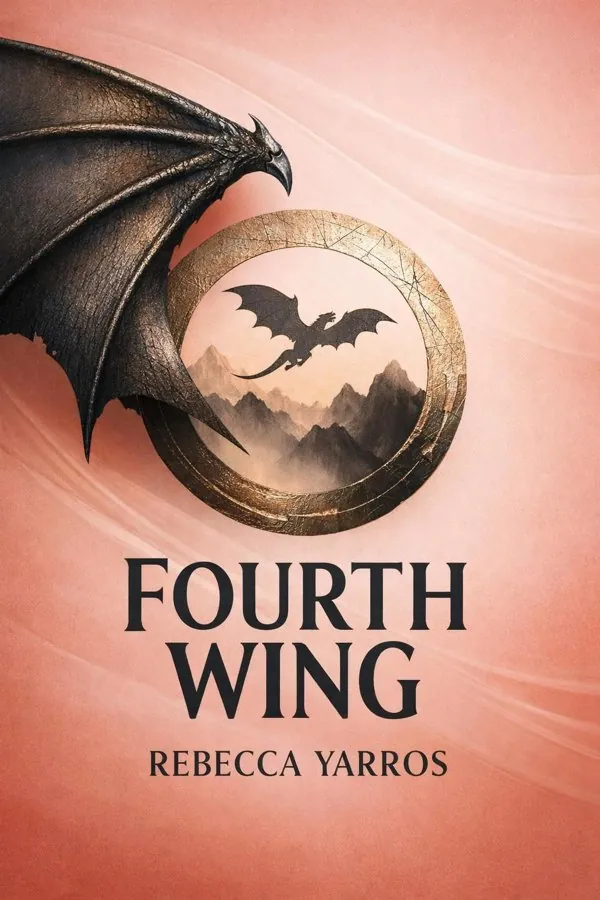
Fourth Wing: Summary & Key Insights
 10 min8 chaptersAudio available
Key Takeaways from Fourth Wing
Real courage often begins where certainty ends.
Power becomes transformative only when it is chosen, not taken.
Institutions are often most dangerous when they seem most honorable.
The environments we endure can eventually teach us who we think we are.
In worlds obsessed with visible strength, thinking becomes a radical act.
What Is Fourth Wing About?
Fourth Wing by Rebecca Yarros is a fantasy book published in 2023 spanning 3 pages. What if survival depended not on being the strongest person in the room, but on learning how to turn your vulnerabilities into weapons? That question lies at the blazing heart of Fourth Wing, Rebecca Yarros’s breakout fantasy novel set in the lethal halls of Basgiath War College. The story follows Violet Sorrengail, a bookish young woman who expected a quiet future in the Scribe Quadrant until her formidable mother forces her into the Riders Quadrant, where cadets either bond with dragons or die trying. From its opening pages, the novel combines high-stakes trials, political tension, brutal competition, and emotionally charged romance into a fast-moving story about identity, resilience, and truth. What makes Fourth Wing matter is that it offers more than spectacle. Beneath the dragon battles and academy intrigue, Yarros explores what leadership looks like when strength is misunderstood, how institutions use propaganda to shape loyalty, and why courage often begins with fear rather than confidence. Yarros, known for emotionally intense storytelling and unforgettable character dynamics, brings both accessibility and depth to the fantasy genre, creating a novel that feels thrilling, modern, and deeply human.
This FizzRead summary covers all 8 key chapters of Fourth Wing in approximately 10 minutes, distilling the most important ideas, arguments, and takeaways from Rebecca Yarros's work. Also available as an audio summary and Key Quotes Podcast.
Fourth Wing
What if survival depended not on being the strongest person in the room, but on learning how to turn your vulnerabilities into weapons? That question lies at the blazing heart of Fourth Wing, Rebecca Yarros’s breakout fantasy novel set in the lethal halls of Basgiath War College. The story follows Violet Sorrengail, a bookish young woman who expected a quiet future in the Scribe Quadrant until her formidable mother forces her into the Riders Quadrant, where cadets either bond with dragons or die trying. From its opening pages, the novel combines high-stakes trials, political tension, brutal competition, and emotionally charged romance into a fast-moving story about identity, resilience, and truth.
What makes Fourth Wing matter is that it offers more than spectacle. Beneath the dragon battles and academy intrigue, Yarros explores what leadership looks like when strength is misunderstood, how institutions use propaganda to shape loyalty, and why courage often begins with fear rather than confidence. Yarros, known for emotionally intense storytelling and unforgettable character dynamics, brings both accessibility and depth to the fantasy genre, creating a novel that feels thrilling, modern, and deeply human.
Who Should Read Fourth Wing?
This book is perfect for anyone interested in fantasy and looking to gain actionable insights in a short read. Whether you're a student, professional, or lifelong learner, the key ideas from Fourth Wing by Rebecca Yarros will help you think differently.
- ✓Readers who enjoy fantasy and want practical takeaways
- ✓Professionals looking to apply new ideas to their work and life
- ✓Anyone who wants the core insights of Fourth Wing in just 10 minutes
Want the full summary?
Get instant access to this book summary and 100K+ more with Fizz Moment.
Get Free SummaryAvailable on App Store • Free to download
Key Chapters
Real courage often begins where certainty ends. Violet Sorrengail enters Fourth Wing as someone profoundly unsuited, at least on paper, for the brutal world she is thrust into. She has trained for a life among books, records, and history in the Scribe Quadrant, not for combat, endurance tests, or dragon riding. Her body is physically fragile compared with the other cadets, and that fact is not treated as decorative characterization. It shapes every decision she makes, every risk she calculates, and every prejudice she faces.
What makes Violet compelling is that she does not become powerful by pretending her limitations do not exist. Instead, she learns to survive by understanding them better than anyone else does. She studies people, patterns, and systems. She adapts rather than dominates. In a place that worships brute force, Violet proves that intelligence, preparation, and emotional restraint can be forms of strength just as valuable as muscle. Her journey challenges the fantasy trope that heroes must be naturally suited to greatness. Sometimes greatness emerges because someone has no choice but to reinvent how survival works.
This idea applies far beyond fiction. In work, school, or personal crises, people often assume they must fit an existing model of success. Violet shows the opposite. If you cannot win by conventional standards, build a new method. Use observation if you lack authority. Use planning if you lack resources. Use calm if others rely on intimidation.
Actionable takeaway: Identify one area where you feel disadvantaged, then list three alternative strengths you can use there instead of competing on someone else’s terms.
Power becomes transformative only when it is chosen, not taken. One of the most memorable elements of Fourth Wing is the dragon-bonding process, where surviving cadets must face creatures who are ancient, intelligent, and utterly unwilling to indulge human ambition. In Basgiath, dragons are not pets, tools, or symbols. They are sovereign beings with their own judgments, loyalties, and standards. That changes the emotional and thematic weight of every encounter.
For Violet, the bond with a dragon is not merely a rite of passage. It is a moment that reframes her identity. In a culture that has already judged her as weak, being chosen by dragons becomes both a source of legitimacy and a burden of expectation. The dragon bond represents mutual recognition: the rider needs the dragon for survival and power, but the dragon also chooses based on qualities deeper than appearance. Strength, in this world, includes conviction, wit, endurance, and the ability to withstand truth.
This idea has practical resonance. In real life, the most meaningful alliances, whether in friendship, mentorship, or leadership, are not manufactured through force. They are built through trust and earned respect. You cannot compel true loyalty. You can only become the kind of person others choose to stand beside. Violet’s bond also teaches that external validation matters less when it confirms inner qualities you are still learning to trust in yourself.
Actionable takeaway: Instead of asking how to impress others, ask what traits would make you worthy of trust, then strengthen one of those traits deliberately this week.
Institutions are often most dangerous when they seem most honorable. As Fourth Wing unfolds, the story widens from a survival narrative into something far more unsettling: a challenge to the official truths that hold Navarre together. What begins as training for military glory gradually reveals itself as participation in a system built on selective history, propaganda, and hidden violence. Violet, raised among scribes and trained to respect recorded knowledge, becomes uniquely positioned to notice the cracks in the story she has been told.
This is one of the novel’s strongest contributions. The book is not only about whether Violet can survive Basgiath. It is about whether she can survive the collapse of certainty. The war is not what it seems. The enemy is not fully understood. The leadership’s version of duty is contaminated by secrecy. As hidden realities emerge, loyalty becomes morally complicated. Is loyalty obedience to authority, or is it commitment to truth, even when truth threatens the system you serve?
The theme is deeply relevant outside fantasy. In any organization, nation, or community, people inherit narratives that explain who is right, who is dangerous, and what must be protected. Fourth Wing asks readers to examine who controls those narratives and who benefits from silence. Critical thinking is not betrayal. Sometimes it is the highest form of responsibility.
Actionable takeaway: Choose one belief you have accepted from authority, tradition, or group culture and investigate it more deeply. Ask what evidence supports it, what evidence complicates it, and who gains by keeping it unquestioned.
The environments we endure can eventually teach us who we think we are. Basgiath War College is not simply a setting in Fourth Wing; it is a machine designed to shape human beings through scarcity, danger, hierarchy, and fear. Cadets are forced to cross deadly parapets, survive combat challenges, accept brutal casualties, and live under a culture where weakness is punished quickly. This system does more than test ability. It normalizes cruelty in the name of readiness.
Yarros uses Basgiath to examine how harsh institutions claim necessity for practices that may actually erode empathy. The school tells cadets that this brutality prepares them for war, but it also trains them to suppress compassion, distrust vulnerability, and equate survival with worth. Violet’s presence exposes the moral cost of this logic. Because she enters the Riders Quadrant as an outsider, she sees not only the danger but the ideology beneath it. Her struggle is not merely to stay alive; it is to avoid becoming the kind of person the system rewards.
This idea is useful in everyday life because many people live inside smaller versions of Basgiath: workplaces that glorify burnout, social groups that reward aggression, or academic cultures that treat stress as proof of excellence. Over time, harmful systems can make people believe they deserve what exhausts them. Violet reminds us that adaptation should not require surrendering conscience.
Actionable takeaway: Look at one demanding environment in your life and ask whether it is building your character or just consuming your energy. Name one boundary that protects your values without reducing your commitment.
In worlds obsessed with visible strength, thinking becomes a radical act. Violet survives Fourth Wing not because she suddenly outmuscles everyone around her, but because she learns how to treat knowledge as strategy. Her background among scribes gives her pattern recognition, memory, curiosity, and a disciplined relationship to information. At Basgiath, those traits are initially mocked because they are not theatrical. Yet again and again, they become decisive.
Violet studies the motives of rivals, the rules of the institution, the behavior of dragons, and the hidden structure behind official narratives. She knows when to speak, when to conceal, and when to connect fragments of information others dismiss. The novel insists that intelligence is not passive. It can be tactical, protective, and even subversive. In fact, in a violent system, understanding may be one of the few tools that allows a vulnerable person to survive without becoming cruel.
This matters because modern culture often praises confidence faster than competence. Many people undervalue quiet strengths such as research, listening, preparation, and analysis because they do not look dramatic. Fourth Wing pushes back on that assumption. It shows that knowledge matters most when circumstances turn chaotic. In crises, the person who has paid attention often becomes the person who can act effectively.
A practical application is simple: before entering a difficult conversation, a new role, or a high-stakes decision, do the invisible work. Learn the context. Study the players. Understand incentives. Preparation may never receive the same admiration as bravado, but it often produces better outcomes.
Actionable takeaway: Pick one challenge you are facing and spend 30 focused minutes gathering information before taking action. Let strategy reduce fear.
Romance matters most in fantasy when it reveals character under pressure. In Fourth Wing, the relationship dynamics, especially between Violet and Xaden Riorson, do more than add attraction and emotional intensity. They become a testing ground for trust, judgment, vulnerability, and power. Xaden is dangerous, politically complicated, and deeply connected to the history Violet has been taught to fear. Their connection therefore carries emotional and ideological stakes at the same time.
What makes this compelling is that desire in the novel is never separated from risk. To care for someone is to become more exposed. To trust them is to revise your assumptions. To love them is to confront whether your inherited beliefs are true. Violet’s feelings force her to examine not just who Xaden is, but who she is becoming. Is she capable of seeing someone beyond official labels? Can she distinguish warning signs from prejudice? Can intimacy coexist with independence?
The book suggests that meaningful relationships are not escapes from conflict but catalysts for growth. The right person does not make your life simpler; they make your self-deception harder to maintain. That is a useful lesson in real life. Healthy relationships often challenge your habits, sharpen your discernment, and expose the stories you tell yourself about safety and control.
Actionable takeaway: In an important relationship, ask yourself whether you are reacting to the person in front of you or to assumptions shaped by past fear, status, or outside opinion. Then have one more honest conversation than feels comfortable.
Survival becomes sustainable when it is shared. Although Fourth Wing begins with isolation, competition, and distrust, one of its most resonant ideas is the gradual formation of loyalty among people who might otherwise have remained enemies or strangers. Violet cannot endure Basgiath alone. She needs allies, defenders, truth-tellers, and people willing to see beyond the ranking system that defines cadet life. The friendships and fragile alliances she forms become emotional shelter in a culture built to keep everyone suspicious.
This matters because oppressive systems often gain power by preventing solidarity. If everyone is competing, no one has the safety to question the rules together. Basgiath encourages cadets to view one another as threats, which makes deeper trust a form of resistance. As Violet’s circle grows, so does her ability to survive physically and morally. These relationships are not sentimental additions to the plot. They are evidence that community is often the only antidote to institutional dehumanization.
In practical terms, this reflects real life closely. During intense periods, whether in demanding jobs, illness, grief, or transition, people often try to become more self-sufficient. But resilience is not the same as isolation. Support systems do not make us weaker; they allow us to remain human under pressure. Friendship, mentorship, and mutual care can become forms of protection and clarity.
Actionable takeaway: Strengthen one relationship that helps you feel more honest, not just more comfortable. Send a message, offer help, or ask for support before you reach a breaking point.
The real test of power is not whether you can wield it, but whether you can imagine using it differently. As Violet grows into her abilities and learns more about the political structure around her, Fourth Wing asks a larger question than who deserves strength. It asks what people do once they possess it. Many characters at Basgiath chase status, survival, or command without examining the ethical shape of their ambition. Violet’s journey stands apart because her rise in power is tied to a rising awareness of consequence.
This is why the novel’s fantasy elements feel emotionally grounded. Dragon bonds, combat skill, and magical abilities are exciting, but they matter because they intensify moral responsibility. Violet cannot remain innocent once she knows more. She must decide whether power will make her more obedient, more ruthless, or more accountable to lives beyond her own. The story repeatedly suggests that becoming formidable is not enough. One must also become principled.
That idea translates well to ordinary life. Influence comes in many forms: authority at work, social credibility, specialized knowledge, financial stability, or simply the power to shape decisions for others. The question is not whether you have power. The question is whether you use it narrowly or imaginatively. Do you protect only yourself, or do you widen safety and truth for others too?
Actionable takeaway: Identify one form of influence you currently hold and ask how you can use it to create fairness, clarity, or protection for someone besides yourself.
All Chapters in Fourth Wing
About the Author
Rebecca Yarros is an American bestselling author known for emotionally powerful fiction that blends strong character development, intense relationships, and high-stakes storytelling. She first built a loyal readership through contemporary romance and military-themed novels, earning praise for her ability to write vulnerable, resilient characters under pressure. With Fourth Wing, she expanded into fantasy in spectacular fashion, bringing her signature emotional immediacy to a world of dragons, war colleges, and political secrets. Yarros lives in Colorado with her family and is also recognized for her advocacy on behalf of military families and foster and adoptive communities. Her work often reflects a deep interest in sacrifice, loyalty, endurance, and the complicated ways love and duty intersect. That combination of heart and momentum is a major reason her books resonate so widely.
Get This Summary in Your Preferred Format
Read or listen to the Fourth Wing summary by Rebecca Yarros anytime, anywhere. FizzRead offers multiple formats so you can learn on your terms — all free.
Available formats: App · Audio · PDF · EPUB — All included free with FizzRead
Download Fourth Wing PDF and EPUB Summary
Key Quotes from Fourth Wing
“Real courage often begins where certainty ends.”
“Power becomes transformative only when it is chosen, not taken.”
“Institutions are often most dangerous when they seem most honorable.”
“The environments we endure can eventually teach us who we think we are.”
“In worlds obsessed with visible strength, thinking becomes a radical act.”
Frequently Asked Questions about Fourth Wing
Fourth Wing by Rebecca Yarros is a fantasy book that explores key ideas across 8 chapters. What if survival depended not on being the strongest person in the room, but on learning how to turn your vulnerabilities into weapons? That question lies at the blazing heart of Fourth Wing, Rebecca Yarros’s breakout fantasy novel set in the lethal halls of Basgiath War College. The story follows Violet Sorrengail, a bookish young woman who expected a quiet future in the Scribe Quadrant until her formidable mother forces her into the Riders Quadrant, where cadets either bond with dragons or die trying. From its opening pages, the novel combines high-stakes trials, political tension, brutal competition, and emotionally charged romance into a fast-moving story about identity, resilience, and truth. What makes Fourth Wing matter is that it offers more than spectacle. Beneath the dragon battles and academy intrigue, Yarros explores what leadership looks like when strength is misunderstood, how institutions use propaganda to shape loyalty, and why courage often begins with fear rather than confidence. Yarros, known for emotionally intense storytelling and unforgettable character dynamics, brings both accessibility and depth to the fantasy genre, creating a novel that feels thrilling, modern, and deeply human.
More by Rebecca Yarros


You Might Also Like


Featured In
Browse by Category
Ready to read Fourth Wing?
Get the full summary and 100K+ more books with Fizz Moment.