
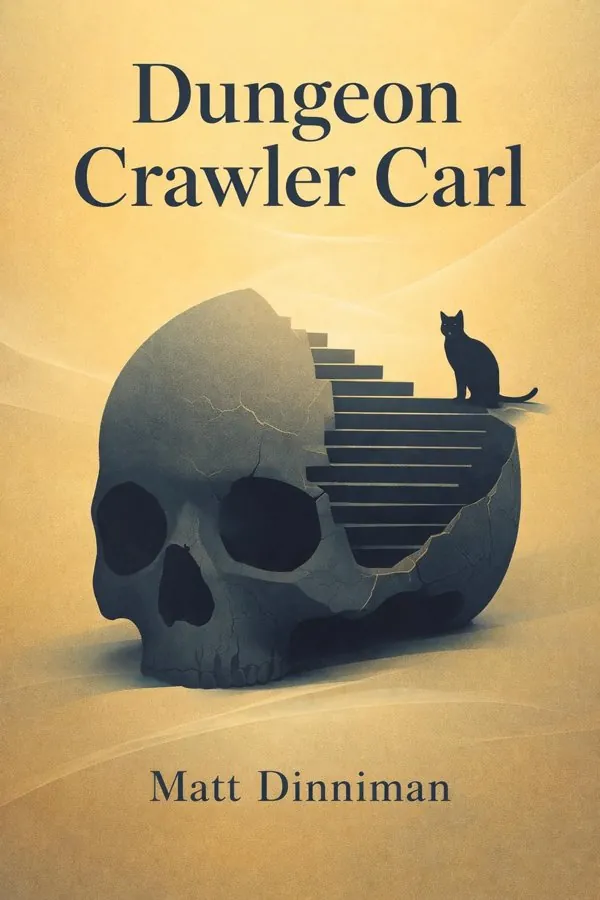
Dungeon Crawler Carl: Summary & Key Insights
 10 min8 chaptersAudio available
Key Takeaways from Dungeon Crawler Carl
Civilization is more fragile than most people like to believe, and Dungeon Crawler Carl opens by ripping away that illusion with shocking speed.
Companionship becomes most visible when the world strips everything else away.
In a hostile system, ignorance is not innocence; it is vulnerability.
Crisis reveals character, but it also creates the conditions under which character becomes complicated.
Many stories of survival rely on a fantasy of hidden greatness suddenly unleashed.
What Is Dungeon Crawler Carl About?
Dungeon Crawler Carl by Matt Dinniman is a fantasy book published in 2020 spanning 5 pages. What if the end of the world arrived not as fire from the heavens, but as a grotesque game show built for the entertainment of an alien audience? In Dungeon Crawler Carl, Matt Dinniman takes a seemingly outrageous premise and turns it into a fiercely entertaining, surprisingly sharp fantasy novel about survival, identity, and spectacle. After Earth is abruptly transformed into a vast, deadly dungeon, ordinary people are forced to become contestants in a brutal crawl filled with monsters, traps, loot, rankings, and constant surveillance. At the center are Carl, a reluctant but resourceful everyman, and Princess Donut, his pampered cat who gains intelligence, speech, and a personality too large to ignore. Beneath the humor, chaos, and game mechanics, Dinniman explores how people adapt when institutions collapse and suffering becomes content. His background in dark fantasy and LitRPG gives the novel its addictive systems and propulsive pacing, but his real strength lies in how he uses absurdity to expose something deeply human. Dungeon Crawler Carl matters because it is more than a genre romp: it is a satire of entertainment culture, a study of resilience, and a story about refusing to lose one’s humanity when the world demands performance instead.
This FizzRead summary covers all 8 key chapters of Dungeon Crawler Carl in approximately 10 minutes, distilling the most important ideas, arguments, and takeaways from Matt Dinniman's work. Also available as an audio summary and Key Quotes Podcast.
Dungeon Crawler Carl
What if the end of the world arrived not as fire from the heavens, but as a grotesque game show built for the entertainment of an alien audience? In Dungeon Crawler Carl, Matt Dinniman takes a seemingly outrageous premise and turns it into a fiercely entertaining, surprisingly sharp fantasy novel about survival, identity, and spectacle. After Earth is abruptly transformed into a vast, deadly dungeon, ordinary people are forced to become contestants in a brutal crawl filled with monsters, traps, loot, rankings, and constant surveillance. At the center are Carl, a reluctant but resourceful everyman, and Princess Donut, his pampered cat who gains intelligence, speech, and a personality too large to ignore.
Beneath the humor, chaos, and game mechanics, Dinniman explores how people adapt when institutions collapse and suffering becomes content. His background in dark fantasy and LitRPG gives the novel its addictive systems and propulsive pacing, but his real strength lies in how he uses absurdity to expose something deeply human. Dungeon Crawler Carl matters because it is more than a genre romp: it is a satire of entertainment culture, a study of resilience, and a story about refusing to lose one’s humanity when the world demands performance instead.
Who Should Read Dungeon Crawler Carl?
This book is perfect for anyone interested in fantasy and looking to gain actionable insights in a short read. Whether you're a student, professional, or lifelong learner, the key ideas from Dungeon Crawler Carl by Matt Dinniman will help you think differently.
- ✓Readers who enjoy fantasy and want practical takeaways
- ✓Professionals looking to apply new ideas to their work and life
- ✓Anyone who wants the core insights of Dungeon Crawler Carl in just 10 minutes
Want the full summary?
Get instant access to this book summary and 100K+ more with Fizz Moment.
Get Free SummaryAvailable on App Store • Free to download
Key Chapters
Civilization is more fragile than most people like to believe, and Dungeon Crawler Carl opens by ripping away that illusion with shocking speed. One moment Earth is ordinary, and the next it has been reduced to the entrance layer of an enormous, game-structured dungeon controlled by alien powers. Homes, roads, routines, and institutions become meaningless almost instantly. In their place comes a new reality defined by loot, monsters, stat screens, environmental hazards, and arbitrary-seeming rules that are absolute once imposed.
This transformation is not just a flashy premise. It reveals how deeply human life depends on shared systems that feel permanent until they vanish. Carl survives his first moments not because he is the strongest person alive, but because he accepts the new logic faster than many others. He learns that denial is deadly. Those who cling to the old world are often crushed by the new one.
The dungeon also turns apocalypse into infrastructure. It is not chaos for its own sake; it is ordered, administered, and broadcast. That makes the catastrophe even more disturbing. Suffering is organized. Survival is gamified. Humanity is not simply dying; it is being repackaged into content.
In practical terms, the novel mirrors real crises in which old assumptions collapse overnight. Economic downturns, technological upheavals, and personal disasters all require the same first step Carl takes: understand the new rules before resenting them. That does not mean endorsing injustice. It means recognizing that adaptation is often a prerequisite for resistance.
Actionable takeaway: When circumstances change radically, stop asking how things should work and start learning how they actually work now. Clear-eyed adaptation creates the possibility of survival and, eventually, meaningful pushback.
Companionship becomes most visible when the world strips everything else away. Princess Donut begins as Carl’s show cat, a creature associated with vanity, domestic routine, and comic contrast. But once the dungeon transforms Earth, she undergoes an awakening that turns her into one of the story’s most memorable forces. She can speak, reason, strategize, and judge, and she does all of it with flair, ego, vulnerability, and unexpected emotional intelligence.
Her presence changes the novel in two major ways. First, she prevents Carl’s survival from shrinking into pure brutality. Alone, he might become only reactive, cynical, or numb. With Donut beside him, survival acquires relationship, obligation, and humor. He is not just fighting to stay alive; he is navigating partnership, loyalty, and trust under impossible conditions. Second, Donut destabilizes assumptions about who gets to matter. She is easy to underestimate because of her appearance and theatrical personality, but that makes her power all the more subversive.
Their bond shows that competence comes in many forms. Carl offers grounding, grit, and tactical pragmatism. Donut offers charisma, social instinct, and fierce self-belief. Together they become more effective than either could alone. The lesson reaches beyond fantasy. In high-pressure situations, teams often fail because they value only one type of strength. Practical thinkers may dismiss emotional or performative intelligence, even though influence, morale, and communication are often decisive.
The novel also reminds readers that companionship is not sentimental decoration. It is a survival technology. Humor shared with another person can interrupt despair. Caring for someone else can keep a person from surrendering to fear.
Actionable takeaway: Do not underestimate unconventional allies. In crisis, seek relationships that balance your weaknesses, preserve your humanity, and widen your definition of strength.
In a hostile system, ignorance is not innocence; it is vulnerability. One of the central pleasures of Dungeon Crawler Carl is watching Carl learn the dungeon’s mechanics and gradually turn knowledge into leverage. Levels, loot, classes, achievements, traps, and status effects may look like game features, but in the novel they function as the laws of reality. The characters do not have the luxury of dismissing them as silly. Their lives depend on understanding them.
Carl’s advantage comes less from raw dominance than from attention. He observes cause and effect, notices patterns, tests limits, and adapts his behavior accordingly. The book repeatedly shows that surviving in a system means more than being brave. It means becoming literate in its language. A monster encounter is not just a fight; it is also a problem of timing, resources, terrain, incentives, and hidden information.
This idea gives the novel its LitRPG engine, but it also makes a broader point about modern life. Bureaucracies, algorithms, markets, and institutions often shape outcomes in ways that feel impersonal or absurd. People who do not understand the rules are frequently controlled by them. People who study them can sometimes exploit cracks, protect themselves, or help others navigate more safely.
Importantly, learning the rules does not mean morally accepting the system. Carl does not conclude that the dungeon is fair. Instead, he treats comprehension as a weapon. This distinction matters. Too often, people confuse realism with surrender. The novel insists that strategic understanding can coexist with ethical refusal.
A practical example is how individuals face career systems, legal processes, or digital platforms. Knowing the metrics, loopholes, and incentives involved does not make those systems just, but it can prevent costly mistakes and create room for agency.
Actionable takeaway: Whenever you enter a difficult environment, become a student before trying to become a hero. Learn the rules, question the incentives, and use that knowledge to protect your values rather than abandon them.
Crisis reveals character, but it also creates the conditions under which character becomes complicated. As Carl moves deeper into the dungeon, he encounters other survivors, factions, temporary partners, and people whose goals only partially align with his own. The novel refuses simplistic ideas about teamwork. Alliances are necessary, but they are never pure. Every partnership contains uncertainty, unequal risk, competing motives, and the possibility of betrayal.
What makes this theme powerful is that the dungeon itself pressures people into moral compromise. Scarcity and constant danger distort judgment. When every choice may cost lives, ethics stop feeling abstract. Carl must repeatedly ask what he owes strangers, what he owes friends, and how much of himself he can afford to sacrifice. The answers are rarely clean.
Yet the book does not become nihilistic. Instead, it suggests that moral seriousness matters most when easy innocence is no longer possible. Carl’s willingness to care, even when caring hurts, distinguishes him from those who become fully transactional. He learns that leadership is not about staying unstained; it is about making hard decisions without forgetting that other people are real.
This applies well beyond fantasy. In workplaces, politics, or family crises, collaboration is often essential, but people bring conflicting priorities to the table. Mature cooperation requires boundaries, clarity, and an understanding that trust must be built and maintained, not assumed. It also requires accepting that helping one group may limit your ability to help another.
The novel’s alien spectators amplify the pressure by turning human relationships into entertainment. Even compassion becomes part of the performance economy. That makes sincere loyalty feel radical.
Actionable takeaway: Build alliances carefully. Trust people in layers, define shared goals clearly, and remember that ethical decision-making is not the absence of difficult tradeoffs but the refusal to forget their human consequences.
Many stories of survival rely on a fantasy of hidden greatness suddenly unleashed. Dungeon Crawler Carl is more interesting than that. Carl improves, but his growth is neither magical destiny nor simple physical escalation. He survives because he combines experimentation, planning, courage, and improvisation. The dungeon rewards spectacle, but it punishes mindless aggression. To advance, Carl must think several moves ahead while remaining flexible enough to respond when plans break apart.
This strategic growth applies to combat, resource management, and social positioning. Every floor introduces new dangers, but also new systems to learn and exploit. Progress depends on accumulating advantages that may look small in isolation: a better read of an opponent, a more efficient use of equipment, a reputation that affects how others respond, or a creative approach to an encounter that brute force cannot solve.
The deeper point is that mastery often looks less dramatic than talent myths suggest. In real life, people admire visible wins while overlooking the routines that produce them: preparation, review, adaptation, and recovery. Carl embodies a more durable model of competence. He is not unbeatable; he is teachable. He does not avoid failure entirely; he learns from it faster.
The novel also ties growth to revelation. As Carl ascends, he gains not only power but perspective. He begins to understand that the dungeon is part of a larger machinery of exploitation. That means progress cannot remain purely personal. Advancement raises questions about responsibility.
Readers can apply this by rethinking goals in any demanding field. Whether training for a job, managing a project, or rebuilding after loss, sustainable improvement comes from systems, not motivational spikes. Strategy turns effort into results.
Actionable takeaway: Stop measuring progress only by dramatic breakthroughs. Build repeatable habits of observation, preparation, and revision, because long-term survival and success usually belong to those who improve deliberately.
Laughter can be a refusal to let terror own the whole story. One of Matt Dinniman’s greatest achievements is his ability to make Dungeon Crawler Carl genuinely funny without weakening its brutality. The book’s absurd item descriptions, ridiculous dungeon logic, and the magnificent personality of Princess Donut create constant comedy. But this humor is not ornamental. It is structural. It keeps the novel from collapsing into misery and gives the characters a way to remain psychologically intact.
Dark humor works here because the situation is so extreme. The world has ended, but it has ended with branding, rankings, and absurd entertainment value. That contradiction is funny and horrifying at once. The joke often lands because it exposes how cruelty is disguised as fun. The aliens do not merely dominate humanity; they package human suffering as a consumable experience.
For Carl and Donut, humor also functions as emotional triage. A joke can create distance from fear, restore a sense of agency, and help people keep moving when grief might otherwise immobilize them. This is recognizably human. In hospitals, military units, emergency professions, and families under strain, humor often appears not because people care less, but because they care so much they need a way to endure.
The novel warns, however, that humor can be used in opposite ways. Shared laughter among survivors can build resilience, but entertainment systems can also weaponize absurdity to make violence easier to watch. That distinction matters. One form of humor humanizes; the other anesthetizes.
In everyday life, this idea encourages a more intentional use of wit. Joking about difficulty can help groups cope, but only if it does not erase accountability or numb empathy.
Actionable takeaway: Use humor to sustain courage and connection, not to deny reality. The best laughter helps people face hard truths without being crushed by them.
The most unsettling idea in Dungeon Crawler Carl is not that Earth is destroyed, but that its destruction is managed as a show. The dungeon is monitored, narrated, monetized, and consumed by alien audiences who treat human pain as content. This turns the novel into more than an action fantasy; it becomes a satire of spectacle culture, where visibility often matters more than dignity and where systems reward whatever attracts attention.
Carl is forced to survive in an environment where performance affects outcomes. Skill matters, but so do presentation, audience reaction, and the ability to remain interesting. This creates a moral distortion that feels both futuristic and familiar. In many modern contexts, institutions incentivize people to brand themselves, dramatize their lives, and translate private experience into public engagement metrics. The novel pushes that logic to a monstrous extreme.
Dinniman’s satire lands because it never feels abstract. The characters understand they are being watched, judged, and manipulated by entities who are emotionally distant from the consequences. That dynamic resembles the way large systems often treat people as data points, avatars, or narrative roles rather than full human beings.
There is also a political dimension here. When suffering becomes spectacle, audiences may feel involved without being responsible. Watching replaces acting. Emotion replaces solidarity. The novel asks what happens when entertainment value starts governing whose pain is seen, whose pain is ignored, and what kinds of heroism become marketable.
For readers, this is a useful lens on media habits. Social feeds, reality television, outrage cycles, and attention markets frequently reward extremes over nuance. The challenge is to resist becoming a passive consumer of other people’s crisis.
Actionable takeaway: Notice when a system encourages you to treat real struggle as entertainment. Practice consuming media with more skepticism, more empathy, and a stronger commitment to the difference between witnessing and helping.
When everything familiar is stripped away, who are you if not your routines, status, job, or social role? Dungeon Crawler Carl repeatedly returns to this question. The dungeon changes bodies, abilities, incentives, and even the language through which reality is understood. Yet within that upheaval, identity does not disappear. It is tested, reassembled, and clarified through choice.
Carl begins as an ordinary man in extraordinary circumstances, but the novel gradually shows that ordinariness can contain deep reserves of principle. He is not important because he was destined for greatness; he becomes important because he keeps choosing what kind of person he wants to be under pressure. Princess Donut undergoes a parallel transformation. She begins as a pet shaped by human expectations, then emerges as a self-defining being with pride, opinions, loyalties, and ambition.
The larger point is that identity is not merely something discovered; it is something enacted. In stable times, many people inherit a sense of self from environment and habit. In unstable times, values become more visible because they must be chosen repeatedly. Will you become cruel because cruelty is efficient? Will you surrender dignity because the system rewards humiliation? Will you reduce others to tools because that seems practical?
This idea has wide application. Career changes, illness, loss, migration, and social upheaval can all dissolve previous identities. People often respond by clinging to labels that no longer fit or by assuming they are nothing without them. The novel offers a stronger alternative: build identity around conduct rather than circumstance.
That does not make life easier, but it makes the self more durable. Values such as loyalty, courage, curiosity, and compassion can travel across radically changed environments.
Actionable takeaway: In times of upheaval, define yourself by the principles you can still practice. When circumstances become unstable, chosen values provide a steadier identity than any external role.
All Chapters in Dungeon Crawler Carl
About the Author
Matt Dinniman is an American novelist known for his distinctive blend of LitRPG mechanics, dark fantasy, horror, and biting humor. He became especially well known through the Dungeon Crawler Carl series, which has earned a devoted following for its inventive worldbuilding, fast pacing, and memorable character dynamics. Dinniman’s fiction often takes outrageous or high-concept premises and grounds them in emotional realism, moral tension, and sharp social commentary. His writing stands out for balancing absurd comedy with genuine danger and pathos, allowing readers to enjoy both the spectacle and the deeper critique beneath it. Through works like Dungeon Crawler Carl, he has become a prominent voice in modern genre fiction, especially among readers who enjoy stories that are both entertaining and unexpectedly insightful.
Get This Summary in Your Preferred Format
Read or listen to the Dungeon Crawler Carl summary by Matt Dinniman anytime, anywhere. FizzRead offers multiple formats so you can learn on your terms — all free.
Available formats: App · Audio · PDF · EPUB — All included free with FizzRead
Download Dungeon Crawler Carl PDF and EPUB Summary
Key Quotes from Dungeon Crawler Carl
“Civilization is more fragile than most people like to believe, and Dungeon Crawler Carl opens by ripping away that illusion with shocking speed.”
“Companionship becomes most visible when the world strips everything else away.”
“In a hostile system, ignorance is not innocence; it is vulnerability.”
“Crisis reveals character, but it also creates the conditions under which character becomes complicated.”
“Many stories of survival rely on a fantasy of hidden greatness suddenly unleashed.”
Frequently Asked Questions about Dungeon Crawler Carl
Dungeon Crawler Carl by Matt Dinniman is a fantasy book that explores key ideas across 8 chapters. What if the end of the world arrived not as fire from the heavens, but as a grotesque game show built for the entertainment of an alien audience? In Dungeon Crawler Carl, Matt Dinniman takes a seemingly outrageous premise and turns it into a fiercely entertaining, surprisingly sharp fantasy novel about survival, identity, and spectacle. After Earth is abruptly transformed into a vast, deadly dungeon, ordinary people are forced to become contestants in a brutal crawl filled with monsters, traps, loot, rankings, and constant surveillance. At the center are Carl, a reluctant but resourceful everyman, and Princess Donut, his pampered cat who gains intelligence, speech, and a personality too large to ignore. Beneath the humor, chaos, and game mechanics, Dinniman explores how people adapt when institutions collapse and suffering becomes content. His background in dark fantasy and LitRPG gives the novel its addictive systems and propulsive pacing, but his real strength lies in how he uses absurdity to expose something deeply human. Dungeon Crawler Carl matters because it is more than a genre romp: it is a satire of entertainment culture, a study of resilience, and a story about refusing to lose one’s humanity when the world demands performance instead.
You Might Also Like


Featured In
Browse by Category
Ready to read Dungeon Crawler Carl?
Get the full summary and 100K+ more books with Fizz Moment.