
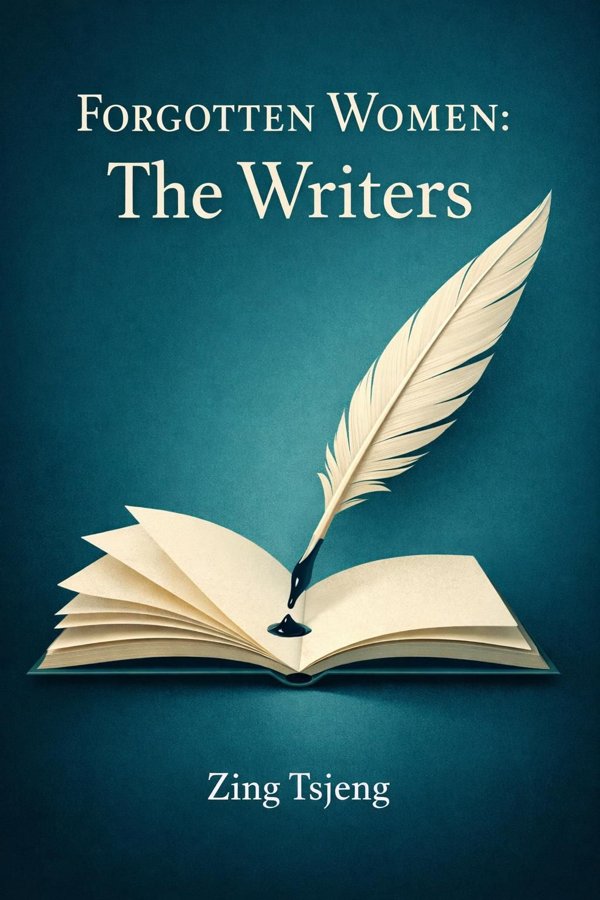
Forgotten Women: The Writers: Summary & Key Insights
by Zing Tsjeng
 10 min9 chaptersAudio available
Key Takeaways from Forgotten Women: The Writers
The most striking truth behind forgotten women writers is that they were not forgotten by accident.
Every woman who wrote in eras hostile to female expression did more than produce literature; she defied a social order.
One of Tsjeng’s most powerful insights is that women’s writing has often functioned as resistance long before critics labeled it political.
These writers did not merely add diversity to an existing canon; they questioned the worldview that the canon was built upon.
Innovation is often credited to a small cluster of famous male modernists, but Tsjeng reminds readers that women were equally bold in transforming literary form.
What Is Forgotten Women: The Writers About?
Forgotten Women: The Writers by Zing Tsjeng is a western_phil book spanning 9 pages. Literary history often looks neat in hindsight: a handful of canonical names, a sequence of great movements, a story of progress told through celebrated masterpieces. Zing Tsjeng’s Forgotten Women: The Writers disrupts that tidy narrative by revealing how many extraordinary women helped shape literature while being sidelined, misread, or erased altogether. Through sharp portraits of 48 writers across centuries, regions, and traditions, Tsjeng shows that women were never absent from the literary world; they were simply excluded from the version of history that institutions chose to preserve. What makes this book compelling is not just its recovery of forgotten names, but its broader argument about power. Tsjeng examines how class, race, empire, censorship, and gender norms influenced who got published, who was believed, and who was remembered. The result is both an accessible introduction to neglected literary figures and a critique of the forces that built the canon. As a journalist, editor, and creator of the Forgotten Women series, Tsjeng brings clarity, cultural range, and a strong sense of purpose to the subject. This book matters because it changes how we read the past and, just as importantly, how we decide whose voices deserve space today.
This FizzRead summary covers all 9 key chapters of Forgotten Women: The Writers in approximately 10 minutes, distilling the most important ideas, arguments, and takeaways from Zing Tsjeng's work. Also available as an audio summary and Key Quotes Podcast.
Forgotten Women: The Writers
Literary history often looks neat in hindsight: a handful of canonical names, a sequence of great movements, a story of progress told through celebrated masterpieces. Zing Tsjeng’s Forgotten Women: The Writers disrupts that tidy narrative by revealing how many extraordinary women helped shape literature while being sidelined, misread, or erased altogether. Through sharp portraits of 48 writers across centuries, regions, and traditions, Tsjeng shows that women were never absent from the literary world; they were simply excluded from the version of history that institutions chose to preserve.
What makes this book compelling is not just its recovery of forgotten names, but its broader argument about power. Tsjeng examines how class, race, empire, censorship, and gender norms influenced who got published, who was believed, and who was remembered. The result is both an accessible introduction to neglected literary figures and a critique of the forces that built the canon.
As a journalist, editor, and creator of the Forgotten Women series, Tsjeng brings clarity, cultural range, and a strong sense of purpose to the subject. This book matters because it changes how we read the past and, just as importantly, how we decide whose voices deserve space today.
Who Should Read Forgotten Women: The Writers?
This book is perfect for anyone interested in western_phil and looking to gain actionable insights in a short read. Whether you're a student, professional, or lifelong learner, the key ideas from Forgotten Women: The Writers by Zing Tsjeng will help you think differently.
- ✓Readers who enjoy western_phil and want practical takeaways
- ✓Professionals looking to apply new ideas to their work and life
- ✓Anyone who wants the core insights of Forgotten Women: The Writers in just 10 minutes
Want the full summary?
Get instant access to this book summary and 100K+ more with Fizz Moment.
Get Free SummaryAvailable on App Store • Free to download
Key Chapters
The most striking truth behind forgotten women writers is that they were not forgotten by accident. Literary memory is often treated as if it were a natural process in which the best writing simply rises to the top. Tsjeng challenges that comforting myth by showing that the canon was shaped by institutions dominated by men: publishers, universities, critics, libraries, prize committees, and reviewers. These gatekeepers did not merely overlook women; they defined seriousness, artistry, and authority in ways that often excluded them from the start.
For centuries, women were denied education, financial independence, legal autonomy, and access to intellectual circles. Even when they wrote, they were told their work was too domestic, too emotional, too political, or too improper. Some were published anonymously or under male pseudonyms to be taken seriously. Others were judged more for their morality than their craft. The result was a distorted literary history in which women’s writing was treated as marginal, even when it was innovative, influential, and widely read in its own time.
Tsjeng’s larger point is that forgetting is not passive. It is an outcome of cultural power. Once a writer is omitted from school syllabi, reference works, adaptation pipelines, and public conversation, each generation is less likely to encounter her. That cycle then reinforces itself, making exclusion look inevitable.
A practical way to apply this idea is to question every “great books” list or literary timeline you encounter. Ask who is missing, who made those choices, and what standards were used. Actionable takeaway: treat literary history not as a fixed record, but as a curated narrative that deserves active revision.
Every woman who wrote in eras hostile to female expression did more than produce literature; she defied a social order. Tsjeng highlights early pioneers such as Aphra Behn and others who proved that women could claim authorship publicly, professionally, and artistically. Their existence mattered as much as their output because they made women’s writing visible in cultures that preferred women to be quiet, obedient, and private.
These early writers often worked under extreme constraints. They faced ridicule for earning money through writing, suspicion for entering public discourse, and hostility for expressing desire, ambition, or critique. Yet they persisted. Some wrote plays, poems, essays, memoirs, and fiction that carved out room for women’s subjectivity. Others reimagined what women could be on the page, refusing to limit female characters to dutiful wives, tragic lovers, or moral ornaments.
Their example reminds us that literary innovation often begins as social disobedience. A woman publishing her voice in a hostile environment is not merely making art; she is asserting intellectual citizenship. Tsjeng’s portraits help readers see that the road to women’s literary freedom was built by figures who were willing to absorb personal risk so later generations could write more openly.
Today, this idea still matters wherever people are discouraged from speaking, creating, or claiming authority. Students, emerging writers, and readers can honor these pioneers by tracing lineages rather than assuming progress appeared fully formed. Read an early woman writer alongside a later famous author and notice the inheritance. Actionable takeaway: when you admire a celebrated literary voice, look backward and identify the overlooked women who made that voice possible.
One of Tsjeng’s most powerful insights is that women’s writing has often functioned as resistance long before critics labeled it political. To write honestly about female desire, racial identity, domestic confinement, abuse, loneliness, ambition, or social hypocrisy was, in many contexts, an act of rebellion. These writers challenged not only laws and norms but the stories societies told about who women were allowed to be.
Resistance took many forms. Some writers used satire to expose patriarchal absurdity. Others turned inward, documenting emotional lives that dominant culture dismissed as trivial. Some wrote openly about sexuality, labor, motherhood, mental health, or violence, refusing the silence imposed on those experiences. For women from marginalized communities, writing could also reclaim humanity from systems that distorted or erased it.
Tsjeng shows that defiance does not always look loud. It can appear in a poem that dignifies female interiority, a novel that gives complexity to the socially condemned, or an essay that names injustice in plain language. Literature becomes a space where silenced people not only testify but imagine alternatives.
This has practical implications for modern readers. When a work by a woman seems intensely personal, do not assume it is therefore apolitical. The personal has often been the only available route to challenge public structures. Readers, educators, and book clubs can ask: What pressure was this writer writing against? What risks did honesty involve?
Actionable takeaway: read women’s literature with an eye for both artistry and courage, and pay attention to the social conditions that made certain truths dangerous to say.
A literary history focused only on Europe and North America misses one of Tsjeng’s central interventions: women from colonized or formerly colonized societies used writing to confront empire, reclaim culture, and reshape language itself. These writers did not merely add diversity to an existing canon; they questioned the worldview that the canon was built upon.
Colonialism influenced which languages were considered literary, which stories were publishable, and which lives were treated as worthy of record. Women writing within these systems often faced layered exclusions: as women, as colonized subjects, and in many cases as members of racialized or indigenous communities. Their work addressed displacement, assimilation, class conflict, nationalism, migration, and the intimate violence of empire.
Tsjeng emphasizes that postcolonial women writers frequently did more than criticize domination. They expanded form and voice by blending oral traditions, local histories, multilingual expression, and experimental structures. In doing so, they unsettled the assumption that literary excellence had a single center or model.
A practical application of this idea is to notice how often “world literature” still flows through old imperial filters. Which authors get translated, taught, marketed, or reviewed? Readers can build a richer reading life by seeking women writers beyond familiar Anglophone lists and by paying attention to translators, independent presses, and regional traditions.
Actionable takeaway: broaden your reading geographically and linguistically, and approach postcolonial women’s writing not as supplementary material but as essential to understanding modern literature and the histories that shaped it.
Innovation is often credited to a small cluster of famous male modernists, but Tsjeng reminds readers that women were equally bold in transforming literary form. Many experimented with stream of consciousness, fragmented narration, nonlinear time, hybrid genres, and unstable perspective. Yet their formal daring has often been overshadowed by biographies, gossip, or reductive labels that frame their work as secondary to male peers.
This matters because literary history tends to separate technical brilliance from social exclusion, as if neglect happens only to “minor” writers. Tsjeng demonstrates the opposite: women were often innovators precisely because traditional forms could not fully contain their realities. New experiences demanded new structures. A fractured narrative could represent a fractured self. Shifting viewpoints could expose the instability of social roles. Blended forms could capture lives split between public expectation and private consciousness.
Examples from women modernists show how style itself can become argument. A novel’s shape can challenge authority just as much as its themes. Once readers recognize this, they begin to see forgotten women writers not simply as victims of neglect but as architects of literary change.
For contemporary readers and writers, this invites a more attentive approach to craft. Ask not just what a work says, but why it says it that way. If a writer breaks convention, what pressure is that break responding to? Classroom discussions, creative writing workshops, and personal reading notes can all benefit from this question.
Actionable takeaway: when reading women writers, look for formal innovation with the same seriousness typically reserved for canonical men, and treat experimentation as part of their legacy, not a footnote.
Tsjeng’s collection makes clear that many women writers did not separate art from action. Their novels, essays, journalism, speeches, memoirs, and poems became tools for confronting injustice, organizing thought, and mobilizing public feeling. In their hands, literature was not an escape from politics; it was a way to influence how politics was understood.
Some wrote against slavery, fascism, colonial violence, censorship, poverty, and misogyny. Others illuminated labor conditions, reproductive rights, education, or state repression. Importantly, Tsjeng does not flatten these writers into slogans. Their political commitments were often inseparable from stylistic intelligence and emotional depth. They persuaded not only through argument but through storytelling, wit, irony, intimacy, and moral imagination.
This reminds readers that political literature is not propaganda by default. It can be subtle, layered, and artistically ambitious. A character’s constrained life may reveal structural inequality more effectively than a manifesto. A memoir may humanize a crisis that statistics cannot. A poem may condense outrage into unforgettable language.
In practical terms, this idea encourages readers to revisit the false divide between “timely” books and “literary” books. Many of the most enduring women writers achieved both. For activists, educators, and anyone trying to communicate social concerns, these authors offer models of how to combine clarity with complexity.
Actionable takeaway: choose at least one politically engaged woman writer to read not just for her message, but for the craft techniques she uses to turn conviction into lasting literature.
Not all women were erased in the same way, and Tsjeng’s work is strongest when it shows that gender alone cannot explain literary neglect. Race, class, sexuality, disability, nationality, language, caste, and colonial status all shape who is permitted visibility and who remains vulnerable to disappearance. The category “woman writer” is not neutral; it contains unequal levels of access and recognition.
Some women could enter literary culture because they had wealth, elite education, or proximity to dominant institutions. Others faced multiple barriers at once, making publication itself extraordinary. Even after gaining an audience, marginalized women were often ghettoized as “special interest” writers rather than treated as central literary voices. Critics might praise them for authenticity while ignoring formal brilliance, or reduce their work to autobiography while denying them universality.
Tsjeng’s broader lesson is that recovery projects must go deeper than adding a few women to existing lists. If the standards of prestige remain unchanged, exclusion simply repeats itself in subtler forms. True revision means asking whose stories are being centered, whose aesthetics are valued, and whose complexity is recognized.
Readers can apply this by examining their own habits. Do you read women from only one class background, one region, one racial identity, one language tradition? Book clubs, schools, and media outlets can diversify not just authorship but perspective, genre, and critical framing.
Actionable takeaway: build a reading list that reflects differences within women’s experience, and resist the temptation to treat one successful female author as representative of all women’s literary histories.
Forgotten writers do not return to public consciousness on their own. Tsjeng shows that rediscovery is labor: archivists preserving papers, scholars editing texts, publishers reissuing books, translators recovering voices across languages, teachers assigning neglected works, journalists writing essays, and readers recommending titles that deserve a second life. Canon revision is not a symbolic gesture but a chain of practical acts.
Many women disappear for reasons that have little to do with quality. Their books go out of print. Their papers are lost. Their estates lack champions. Their work is misclassified, untranslated, or overshadowed by better-connected contemporaries. Sometimes they are remembered as muses, wives, or scandal figures rather than artists in their own right. Rediscovery corrects these distortions, but it also requires persistence because visibility can be temporary.
Tsjeng’s project contributes to this process by making forgotten figures accessible to general readers. A concise, engaging profile can become an entry point to deeper reading. That matters because recovery begins with curiosity. Once a reader encounters a name, she can be taught, discussed, adapted, and researched.
This idea has direct application in everyday reading culture. Libraries can feature neglected women writers. Teachers can pair canonical texts with forgotten contemporaries. Readers can support reissues and independent publishers. Even social media recommendations can help reverse neglect when they circulate names that institutions have overlooked.
Actionable takeaway: choose one forgotten woman writer from this book and follow the recovery chain yourself: read her work, share it, and if possible request or recommend it in a library, classroom, or book group.
The final irony Tsjeng exposes is that many forgotten women are not truly absent from modern culture at all. Their ideas, themes, forms, and struggles continue to shape what we read and how we think, even when their names are missing from mainstream recognition. Influence often survives more visibly than attribution.
You can see their legacy in contemporary feminist nonfiction, autofiction, political essays, speculative fiction, memoir, and experimental prose. Writers today build on paths forged by women who challenged censorship, expanded emotional vocabulary, redefined narration, and insisted that private lives were worthy of public art. Their cultural impact also extends beyond books into film, journalism, academia, activism, and online discourse.
Tsjeng’s point is not simply celebratory. It is corrective. If we benefit from these women’s innovations, we owe them proper credit. Naming predecessors changes how we understand originality. It also gives emerging writers a fuller lineage. Instead of seeing themselves as isolated exceptions, they can place their work within a tradition of women who made room where none seemed available.
For readers, this means tracing connections across time. When you encounter a current author discussing bodily autonomy, migration, domesticity, or narrative fragmentation, ask which earlier women opened that possibility. For creators, studying these lineages can deepen both craft and confidence.
Actionable takeaway: the next time a contemporary book moves you, investigate the women writers who anticipated its themes or techniques, and make literary influence part of how you talk about books.
All Chapters in Forgotten Women: The Writers
About the Author
Zing Tsjeng is a British journalist, editor, and author known for uncovering overlooked stories, particularly those involving women written out of mainstream history. She has held major editorial roles in digital media, including serving as UK Editor-in-Chief of VICE, where she became known for sharp cultural commentary and socially engaged journalism. Tsjeng is the author of the Forgotten Women series, a set of books dedicated to recovering the lives and achievements of women omitted from conventional historical narratives. Her work blends accessibility with critical insight, making complex issues around gender, power, representation, and memory readable for a broad audience. In Forgotten Women: The Writers, she applies that approach to literary history, showing how women shaped the written tradition even when institutions denied them lasting recognition.
Get This Summary in Your Preferred Format
Read or listen to the Forgotten Women: The Writers summary by Zing Tsjeng anytime, anywhere. FizzRead offers multiple formats so you can learn on your terms — all free.
Available formats: App · Audio · PDF · EPUB — All included free with FizzRead
Download Forgotten Women: The Writers PDF and EPUB Summary
Key Quotes from Forgotten Women: The Writers
“The most striking truth behind forgotten women writers is that they were not forgotten by accident.”
“Every woman who wrote in eras hostile to female expression did more than produce literature; she defied a social order.”
“One of Tsjeng’s most powerful insights is that women’s writing has often functioned as resistance long before critics labeled it political.”
“These writers did not merely add diversity to an existing canon; they questioned the worldview that the canon was built upon.”
“Innovation is often credited to a small cluster of famous male modernists, but Tsjeng reminds readers that women were equally bold in transforming literary form.”
Frequently Asked Questions about Forgotten Women: The Writers
Forgotten Women: The Writers by Zing Tsjeng is a western_phil book that explores key ideas across 9 chapters. Literary history often looks neat in hindsight: a handful of canonical names, a sequence of great movements, a story of progress told through celebrated masterpieces. Zing Tsjeng’s Forgotten Women: The Writers disrupts that tidy narrative by revealing how many extraordinary women helped shape literature while being sidelined, misread, or erased altogether. Through sharp portraits of 48 writers across centuries, regions, and traditions, Tsjeng shows that women were never absent from the literary world; they were simply excluded from the version of history that institutions chose to preserve. What makes this book compelling is not just its recovery of forgotten names, but its broader argument about power. Tsjeng examines how class, race, empire, censorship, and gender norms influenced who got published, who was believed, and who was remembered. The result is both an accessible introduction to neglected literary figures and a critique of the forces that built the canon. As a journalist, editor, and creator of the Forgotten Women series, Tsjeng brings clarity, cultural range, and a strong sense of purpose to the subject. This book matters because it changes how we read the past and, just as importantly, how we decide whose voices deserve space today.
You Might Also Like
A Little History of Philosophy
Nigel Warburton
10 min
Areopagitica
John Milton
10 min
How To Think Like A Philosopher: Essential Principles For Clear Thinking
Peter Cave
10 min
Language, Truth and Logic
A. J. Ayer
10 min
The Age of Reason
Thomas Paine
10 min
The Essays
Michel De Montaigne
10 minBrowse by Category
Ready to read Forgotten Women: The Writers?
Get the full summary and 100K+ more books with Fizz Moment.