
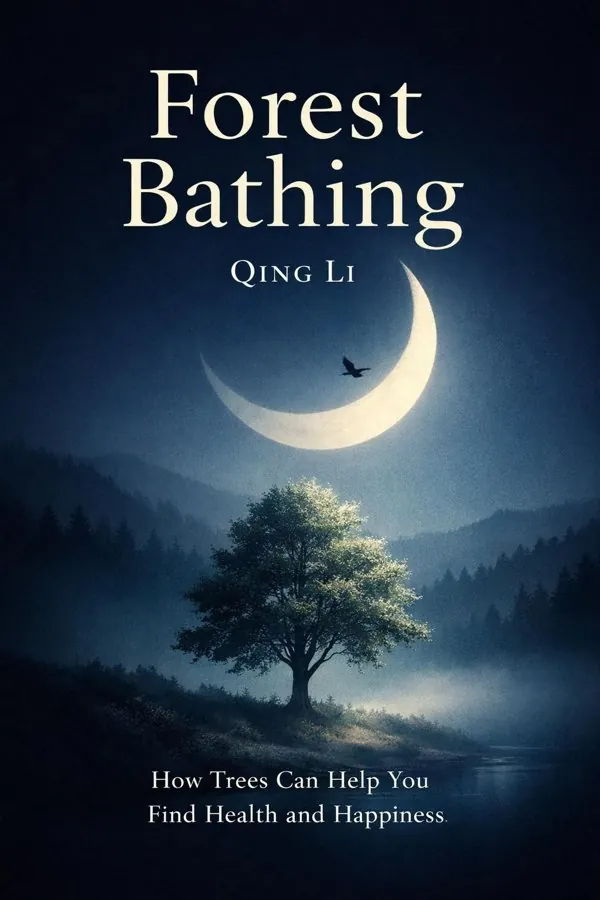
Forest Bathing: How Trees Can Help You Find Health and Happiness: Summary & Key Insights
by Qing Li
 10 min5 chaptersAudio available
What Is Forest Bathing: How Trees Can Help You Find Health and Happiness About?
Forest Bathing: How Trees Can Help You Find Health and Happiness by Qing Li is a wellness book spanning 5 pages. Forest Bathing: How Trees Can Help You Find Health and Happiness by Dr. Qing Li explores the Japanese practice of Shinrin-yoku, or 'forest bathing,' as a scientifically supported method to improve physical and mental well-being. Drawing on decades of research in environmental medicine, Li explains how spending mindful time in nature can reduce stress, boost immunity, and enhance happiness. The book combines scientific insights with practical guidance for integrating nature therapy into daily life.
This FizzRead summary covers all 5 key chapters of Forest Bathing: How Trees Can Help You Find Health and Happiness in approximately 10 minutes, distilling the most important ideas, arguments, and takeaways from Qing Li's work. Also available as an audio summary and Key Quotes Podcast.
Forest Bathing: How Trees Can Help You Find Health and Happiness
Forest Bathing: How Trees Can Help You Find Health and Happiness by Dr. Qing Li explores the Japanese practice of Shinrin-yoku, or 'forest bathing,' as a scientifically supported method to improve physical and mental well-being. Drawing on decades of research in environmental medicine, Li explains how spending mindful time in nature can reduce stress, boost immunity, and enhance happiness. The book combines scientific insights with practical guidance for integrating nature therapy into daily life.
Who Should Read Forest Bathing: How Trees Can Help You Find Health and Happiness?
This book is perfect for anyone interested in wellness and looking to gain actionable insights in a short read. Whether you're a student, professional, or lifelong learner, the key ideas from Forest Bathing: How Trees Can Help You Find Health and Happiness by Qing Li will help you think differently.
- ✓Readers who enjoy wellness and want practical takeaways
- ✓Professionals looking to apply new ideas to their work and life
- ✓Anyone who wants the core insights of Forest Bathing: How Trees Can Help You Find Health and Happiness in just 10 minutes
Want the full summary?
Get instant access to this book summary and 100K+ more with Fizz Moment.
Get Free SummaryAvailable on App Store • Free to download
Key Chapters
The modern practice of shinrin-yoku began in Japan in the early 1980s, a time when the nation faced rising levels of stress, urbanization, and workplace burnout. The Japanese Forestry Agency introduced the term to encourage citizens to spend time in forests, not as exercise or recreation, but as a therapeutic act of connection with nature. Yet the idea itself is deeply woven into Japan's cultural fabric. In the Shinto belief system, natural elements—trees, mountains, rivers—are considered sacred, inhabited by kami, or spirits. To dwell silently among trees has always been a form of reverence, a way to cleanse one’s spirit and attune to the rhythms of life.
In Japanese culture, nature is not something outside us—it is an extension of who we are. The traditional garden, the art of flower arrangement (ikebana), and poetry forms like haiku all reflect this respect for simplicity, impermanence, and natural harmony. Shinrin-yoku arose, therefore, not as a trend but a rediscovery of an ancient truth: that health and happiness blossom when humans and nature are in harmony. When I began researching forest medicine, I was building on this cultural inheritance, bringing biological evidence to what our ancestors intuitively knew. Through each measurement of stress hormones or immune markers, I was simply confirming scientifically what we have always felt spiritually—that nature heals.
Forest medicine as a discipline emerged from the intersection of environmental science and human physiology. My colleagues and I began studying how time spent in forests affects the human body’s stress response, immune system, and overall biochemical balance. The results startled even us. After a few hours or days in a forest, we found reduced levels of cortisol, lower blood pressure, and slower heart rates. Participants reported greater vigor, less anxiety, and deeper sleep. But the changes were not just psychological—they were cellular.
Our immune systems are governed by specialized white blood cells known as natural killer (NK) cells. These cells seek and destroy infected or malignant cells in our bodies. We discovered that forest bathing significantly increases both the number and activity of NK cells, and that these effects can last for days after returning to the city. The forest, it seemed, was stimulating immune function in a measurable, lasting way.
Why does this happen? Part of the answer lies in phytoncides—natural aromatic compounds emitted by trees, particularly evergreens like pine, cedar, and cypress. When you inhale the forest air, you are breathing in these volatile substances, which have antibacterial and antifungal properties that protect the trees themselves. In humans, they appear to enhance immune defenses and reduce stress, essentially tuning our bodies to a state of physiological harmony.
This research, replicated across sites in Japan, Korea, and beyond, laid the foundation for forest medicine as a legitimate field. What had begun as intuition became data: the forest is not simply beautiful—it is medicinal.
+ 3 more chapters — available in the FizzRead app
All Chapters in Forest Bathing: How Trees Can Help You Find Health and Happiness
About the Author
Get This Summary in Your Preferred Format
Read or listen to the Forest Bathing: How Trees Can Help You Find Health and Happiness summary by Qing Li anytime, anywhere. FizzRead offers multiple formats so you can learn on your terms — all free.
Available formats: App · Audio · PDF · EPUB — All included free with FizzRead
Download Forest Bathing: How Trees Can Help You Find Health and Happiness PDF and EPUB Summary
Key Quotes from Forest Bathing: How Trees Can Help You Find Health and Happiness
“The modern practice of shinrin-yoku began in Japan in the early 1980s, a time when the nation faced rising levels of stress, urbanization, and workplace burnout.”
“Forest medicine as a discipline emerged from the intersection of environmental science and human physiology.”
Frequently Asked Questions about Forest Bathing: How Trees Can Help You Find Health and Happiness
Forest Bathing: How Trees Can Help You Find Health and Happiness by Qing Li is a wellness book that explores key ideas across 5 chapters. Forest Bathing: How Trees Can Help You Find Health and Happiness by Dr. Qing Li explores the Japanese practice of Shinrin-yoku, or 'forest bathing,' as a scientifically supported method to improve physical and mental well-being. Drawing on decades of research in environmental medicine, Li explains how spending mindful time in nature can reduce stress, boost immunity, and enhance happiness. The book combines scientific insights with practical guidance for integrating nature therapy into daily life.
More by Qing Li

You Might Also Like

How We Heal: Uncover Your Power and Set Yourself Free
Alexandra Elle
10 min
A Year of Self-Care: Daily Practices and Inspiration for Caring for Yourself
Zoe Shaw
10 min
Biohacker’s Handbook: Upgrade Your Life
Olli Sovijärvi, Teemu Arina, Jaakko Halmetoja
10 min
Bliss More: How to Succeed in Meditation Without Really Trying
Light Watkins
10 min
Body Kindness: Transform Your Health from the Inside Out—and Never Say Diet Again
Rebecca Scritchfield
10 min
Cook, Eat, Run: Cook Fast, Boost Performance with 75 Ultimate Recipes for Runners
Charlie Watson
10 minFeatured In
Browse by Category
Ready to read Forest Bathing: How Trees Can Help You Find Health and Happiness?
Get the full summary and 100K+ more books with Fizz Moment.