
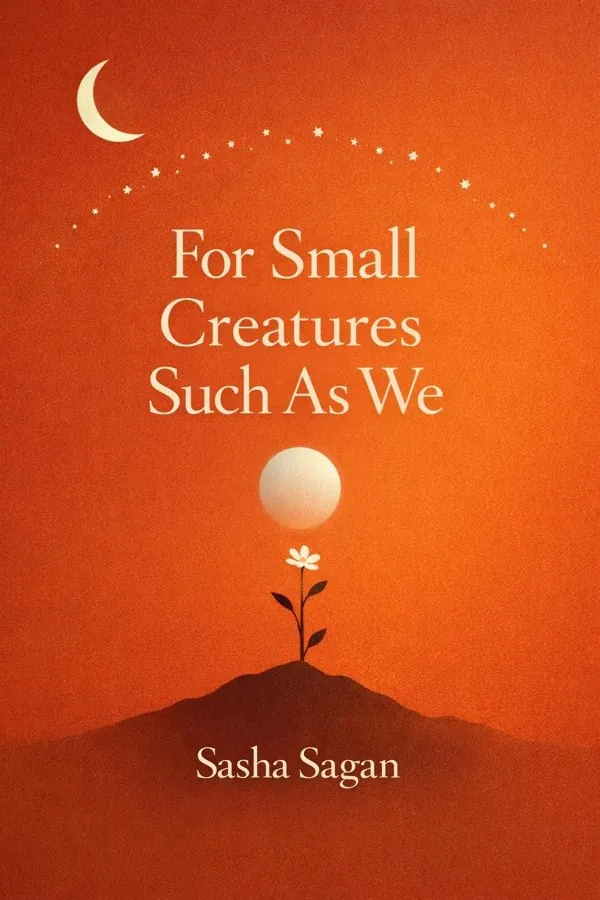
For Small Creatures Such As We: Rituals for Finding Meaning in Our Unlikely World: Summary & Key Insights
by Sasha Sagan
 10 min9 chaptersAudio available
Key Takeaways from For Small Creatures Such As We: Rituals for Finding Meaning in Our Unlikely World
A life without ritual can become a blur of tasks, deadlines, and private feelings that never fully take shape.
The more we understand our smallness, the more extraordinary our existence becomes.
None of us invent meaning from scratch.
Major life changes do not automatically become meaningful just because they happen.
Modern life often traps people indoors, under artificial light, insulated from seasonal rhythms that once shaped daily existence.
What Is For Small Creatures Such As We: Rituals for Finding Meaning in Our Unlikely World About?
For Small Creatures Such As We: Rituals for Finding Meaning in Our Unlikely World by Sasha Sagan is a philosophy book spanning 7 pages. For Small Creatures Such As We is a thoughtful, elegant exploration of how human beings create meaning without relying on religious certainty. In this deeply personal book, Sasha Sagan asks a timeless question: if we live in a universe explained by science rather than divine command, how do we still honor birth, love, loss, family, and the passage of time? Her answer is not to reject ritual, but to reclaim it. She shows that ceremonies, traditions, and shared symbols are not the exclusive property of religion; they are human tools for expressing gratitude, belonging, grief, hope, and awe. What makes this book especially compelling is Sagan’s unique perspective. As the daughter of Carl Sagan and Ann Druyan, she was raised in a home where wonder, skepticism, and reverence for the cosmos lived side by side. Drawing on memoir, anthropology, philosophy, and science, she makes a powerful case that secular life need not be emotionally thin or spiritually empty. This book matters because it offers a humane, practical vision of meaning for modern people: one rooted in humility, connection, and astonishment at the improbable fact of existence itself.
This FizzRead summary covers all 9 key chapters of For Small Creatures Such As We: Rituals for Finding Meaning in Our Unlikely World in approximately 10 minutes, distilling the most important ideas, arguments, and takeaways from Sasha Sagan's work. Also available as an audio summary and Key Quotes Podcast.
For Small Creatures Such As We: Rituals for Finding Meaning in Our Unlikely World
For Small Creatures Such As We is a thoughtful, elegant exploration of how human beings create meaning without relying on religious certainty. In this deeply personal book, Sasha Sagan asks a timeless question: if we live in a universe explained by science rather than divine command, how do we still honor birth, love, loss, family, and the passage of time? Her answer is not to reject ritual, but to reclaim it. She shows that ceremonies, traditions, and shared symbols are not the exclusive property of religion; they are human tools for expressing gratitude, belonging, grief, hope, and awe.
What makes this book especially compelling is Sagan’s unique perspective. As the daughter of Carl Sagan and Ann Druyan, she was raised in a home where wonder, skepticism, and reverence for the cosmos lived side by side. Drawing on memoir, anthropology, philosophy, and science, she makes a powerful case that secular life need not be emotionally thin or spiritually empty. This book matters because it offers a humane, practical vision of meaning for modern people: one rooted in humility, connection, and astonishment at the improbable fact of existence itself.
Who Should Read For Small Creatures Such As We: Rituals for Finding Meaning in Our Unlikely World?
This book is perfect for anyone interested in philosophy and looking to gain actionable insights in a short read. Whether you're a student, professional, or lifelong learner, the key ideas from For Small Creatures Such As We: Rituals for Finding Meaning in Our Unlikely World by Sasha Sagan will help you think differently.
- ✓Readers who enjoy philosophy and want practical takeaways
- ✓Professionals looking to apply new ideas to their work and life
- ✓Anyone who wants the core insights of For Small Creatures Such As We: Rituals for Finding Meaning in Our Unlikely World in just 10 minutes
Want the full summary?
Get instant access to this book summary and 100K+ more with Fizz Moment.
Get Free SummaryAvailable on App Store • Free to download
Key Chapters
A life without ritual can become a blur of tasks, deadlines, and private feelings that never fully take shape. Sagan argues that rituals exist because human beings need ways to mark change. We are not only rational creatures who move from one event to another; we are symbolic creatures who long to pause and say, something important has happened here. Ritual gives form to inner experience. It helps us acknowledge transitions that might otherwise pass unnoticed: becoming a parent, falling in love, moving homes, grieving a death, entering adulthood, or ending a difficult chapter.
One of the book’s central insights is that ritual is not irrational simply because it is not scientifically necessary. A wedding ceremony does not cause love, and a funeral does not erase grief, yet both can help people integrate emotional realities into shared life. Rituals also create memory. The meal, the music, the gathering, the repeated words—these make meaning visible and social. They tell us that our private emotions belong within a larger human pattern.
Sagan especially emphasizes that secular people need ritual too. Rejecting supernatural beliefs does not eliminate the need for ceremony; it simply changes the framework. You can celebrate milestones without pretending the universe was designed around you. You can gather people, light candles, speak names, give toasts, and build traditions rooted in honesty rather than dogma.
In practice, this could mean establishing simple rituals around birthdays, seasonal changes, farewells, family dinners, or acts of remembrance. What matters is intention, repetition, and shared acknowledgment. Actionable takeaway: choose one recurring moment in your life that currently passes unnoticed and create a simple ritual to honor it with others.
The more we understand our smallness, the more extraordinary our existence becomes. Sagan inherits from her father a sense of cosmic awe: the atoms in our bodies were forged in stars, and every living thing on Earth shares a common ancestry. Rather than making human life meaningless, this scientific view makes it more miraculous. We are not separate from nature or dropped into the universe from outside it; we are made of the same materials as galaxies, oceans, trees, and insects. This perspective can inspire a feeling close to reverence without requiring faith in the supernatural.
A cosmic perspective also corrects the ego. It reminds us that our worries, ambitions, and resentments are local and temporary. That can sound bleak, but Sagan presents it as liberating. If we are tiny in the scheme of things, we are also relieved of the illusion that everything revolves around us. Humility becomes a form of peace. At the same time, our smallness makes every human connection more precious. Against the vast background of time and space, even brief love and fleeting beauty matter intensely because they are rare.
This idea has practical force. Parents can use science to teach gratitude. Friends can mark significant occasions by looking at the night sky. Families can frame celebrations around wonder at the Earth, the seasons, and our biological inheritance. Even ordinary habits—walking outside, noticing moon phases, learning constellations—can become secular acts of devotion.
Actionable takeaway: build one weekly habit that reconnects you to the scale of the universe, whether through stargazing, nature walks, or reading science with loved ones.
None of us invent meaning from scratch. Sagan shows that identity is built from inheritance: family stories, cultural customs, ancestral memory, and the emotional atmosphere of childhood. Even those who reject aspects of their upbringing remain shaped by it. The question is not whether tradition influences us, but how consciously we choose what to carry forward.
In her own life, Sagan reflects on what it meant to be raised by Carl Sagan and Ann Druyan in a household committed to science, curiosity, and beauty. Wonder was not treated as childish sentiment but as a disciplined response to reality. Questions were welcomed, evidence mattered, and emotional richness coexisted with intellectual rigor. This background gave her a framework for building secular rituals that feel sincere rather than borrowed.
The book suggests that heritage should be approached neither with blind loyalty nor total rejection. Some inherited customs can be transformed, stripped of theological claims while preserving emotional resonance. A holiday meal, a family song, a storytelling habit, a way of welcoming guests—these can become bridges between generations. Other traditions may need to be left behind if they no longer align with one’s values. The important thing is discernment.
Practically, this means asking: what from my upbringing still feels alive, and what was merely habitual? A family might preserve the structure of a holiday gathering while redefining its meaning around gratitude, memory, or community. Someone with mixed cultural roots might consciously blend customs rather than feeling forced to choose one identity over another.
Actionable takeaway: write down three traditions you inherited, then decide which one to preserve, which one to adapt, and which one to release.
Major life changes do not automatically become meaningful just because they happen. Sagan argues that thresholds—birth, partnership, parenthood, maturity, illness, aging, and death—need acknowledgment. Ritual helps us cross from one phase of life into another with awareness. Without this, transitions can feel emotionally unfinished, as though the external event occurred but the inner transformation lagged behind.
Sagan is especially interested in how secular people can honor these milestones without relying on traditional religious scripts. A naming ceremony, for example, can welcome a child into a network of care and responsibility. A wedding can emphasize mutual commitment, community witness, and the improbable beauty of choosing one another. A coming-of-age ritual can invite reflection on responsibility rather than simply celebrating independence. Even smaller transitions—a first home, a divorce, recovery from illness, retirement—deserve thoughtful marking.
The broader point is that ritual creates containers for emotion. It gives people language and structure at moments when they may feel overwhelmed or inarticulate. It also invites community participation. Loved ones are not just informed that something happened; they are enlisted as witnesses, supporters, and memory-keepers.
Readers can apply this by designing ceremonies that reflect their values. A partnership celebration might include vows written around shared principles. A memorial might feature stories, music, and acts of service instead of doctrinal readings. A child’s birthday might include a yearly reflection on what they learned and how they grew.
Actionable takeaway: identify one life transition—past, present, or upcoming—that deserves fuller recognition, and create a simple ceremony or gathering to mark it intentionally.
Modern life often traps people indoors, under artificial light, insulated from seasonal rhythms that once shaped daily existence. Sagan argues that one of the richest sources of meaning is simply paying attention to the cycles of the natural world. Solstices, equinoxes, harvests, migrations, blooming periods, and changing weather remind us that we are animals living on a planet, not detached minds floating above nature.
Seasonal rituals matter because they restore context. They remind us that time is not only measured by calendars and appointments but by recurring patterns larger than ourselves. Winter invites endurance, coziness, and reflection. Spring suggests renewal. Summer expands outward into abundance and sociability. Autumn turns attention toward harvest, impermanence, and gratitude. These associations are not mystical commandments; they are embodied observations that can guide emotional life.
Sagan’s secular approach does not require pretending nature is morally organized for human benefit. Storms destroy, seasons change without concern for our plans, and the Earth is not sentimental. But there is still comfort in aligning our celebrations with realities beyond commerce and productivity. A midwinter gathering with candles, a spring planting ritual, a summer outdoor feast, or an autumn gratitude practice can all reconnect people to place and time.
This idea is especially useful for families. Seasonal customs create continuity for children and help adults resist the flattening effect of digital life. They can be simple: special foods, walks, songs, decorations from natural materials, or annual acts of generosity tied to a season.
Actionable takeaway: choose one season you usually rush through and design a recurring ritual that helps you experience it with attention and gratitude.
Many people assume that science explains mechanisms but cannot satisfy existential hunger. Sagan challenges that split. She argues that scientific understanding can itself be emotionally nourishing. To know how old the universe is, how life evolved, how stars forged the elements, and how fragile consciousness is on a small planet does not drain life of value. It can intensify astonishment. Knowledge becomes not the enemy of wonder but one of its deepest sources.
This argument matters because some people feel trapped between intellectual honesty and emotional depth, as though they must choose skepticism or reverence. Sagan refuses that false choice. A worldview grounded in evidence can still be lyrical, grateful, and morally serious. In fact, it may produce a particularly honest form of awe because it does not rely on comforting illusion. The beauty is real precisely because it is improbable and finite.
Scientific meaning also encourages curiosity as a life practice. Instead of asking only what to believe, we ask how things work, what evidence shows, and how our understanding keeps changing. That posture fosters humility. It also creates a culture in which questioning is not rebellion but respect for reality.
Applied practically, this might mean using scientific facts in ceremonies, reading about astronomy with children, visiting museums as a family tradition, or framing gratitude around actual interdependence—sunlight, ecosystems, evolution, and the labor of countless humans. These habits build a worldview in which truth and wonder reinforce one another.
Actionable takeaway: choose one scientific topic that fills you with awe and make it part of how you teach, celebrate, or reflect with the people you love.
Not every tradition deserves loyalty simply because it is old. Sagan’s secular philosophy requires active selection. Traditions can comfort, connect, and orient us, but they can also become empty performances or vehicles for exclusion. Meaningful ritual begins when we ask not only what our culture does, but why it does it and whether that purpose still serves human flourishing.
This approach avoids two common mistakes. The first is unthinking preservation: repeating customs without understanding them, then mistaking familiarity for truth. The second is total dismissal: assuming that because some traditions are irrational or oppressive, all ritual is unnecessary. Sagan offers a middle path. Keep what is beautiful, humane, and connective. Revise what can be redeemed. Discard what demands dishonesty or cruelty.
This process of choosing is itself meaningful. It turns ritual into an expression of values rather than mere conformity. A family might reject gendered expectations in a wedding while preserving vows and communal witness. Someone may love the warmth of holiday gatherings but remove theological elements they do not believe. Another person might create new observances for events modern life neglects, such as adoption, migration, recovery, or chosen family.
Conscious tradition-making also prepares us for pluralistic life. In diverse communities, people need rituals that can include participants with different beliefs. Choosing intentionally allows ceremonies to be emotionally rich without requiring false consensus.
Actionable takeaway: before your next major celebration, identify one element you are keeping out of genuine conviction and one element you will change to better reflect your values.
One of the book’s quietest but most powerful themes is that meaning does not require grandiosity. Sagan resists the idea that human life matters only if the universe was designed for us. Instead, she finds dignity in accepting our scale. We are brief, vulnerable creatures on a small world, and that is enough. Humility is not humiliation; it is clarity about who we are and where we stand.
This matters because much existential anxiety comes from wanting guarantees we cannot have. We want permanence, cosmic centrality, and certainty that our lives fit a larger plan. Sagan suggests that these desires can distort our appreciation of what is actually available: love, consciousness, beauty, memory, curiosity, care, and temporary participation in a vast unfolding reality. Once we stop demanding that life be infinite to matter, finitude itself sharpens value.
Humility also improves our relationships. It softens self-importance, encourages gratitude, and makes room for wonder. When we remember that we are tiny and lucky, entitlement becomes harder to sustain. So does despair. Our limitations remain real, but they are held within a broader perspective.
Practically, humility can be cultivated through reflective habits: gratitude rituals, learning history, studying nature, listening well, and participating in communities that do not revolve around personal achievement. Even small acts—sharing a meal, tending a garden, caring for a child, honoring the dead—can become profound when approached without self-dramatization.
Actionable takeaway: begin or end each day by naming one fact that makes you feel small and one relationship or experience that makes your brief life feel meaningful.
All Chapters in For Small Creatures Such As We: Rituals for Finding Meaning in Our Unlikely World
About the Author
Sasha Sagan is a writer, producer, and speaker known for her thoughtful work on science, culture, ritual, and the search for meaning in modern life. The daughter of astronomer Carl Sagan and writer-producer Ann Druyan, she grew up in a household where curiosity, evidence, and wonder were treated as essential values. That upbringing deeply informs her writing, which often explores how intellectual honesty can coexist with emotional richness and reverence for existence. Her essays and articles have appeared in publications including New York Magazine, The Cut, O, The Oprah Magazine, and other major outlets. In For Small Creatures Such As We, she brings together memoir, philosophy, anthropology, and science writing to offer a distinctive vision of secular meaning, tradition, and awe.
Get This Summary in Your Preferred Format
Read or listen to the For Small Creatures Such As We: Rituals for Finding Meaning in Our Unlikely World summary by Sasha Sagan anytime, anywhere. FizzRead offers multiple formats so you can learn on your terms — all free.
Available formats: App · Audio · PDF · EPUB — All included free with FizzRead
Download For Small Creatures Such As We: Rituals for Finding Meaning in Our Unlikely World PDF and EPUB Summary
Key Quotes from For Small Creatures Such As We: Rituals for Finding Meaning in Our Unlikely World
“A life without ritual can become a blur of tasks, deadlines, and private feelings that never fully take shape.”
“The more we understand our smallness, the more extraordinary our existence becomes.”
“Sagan shows that identity is built from inheritance: family stories, cultural customs, ancestral memory, and the emotional atmosphere of childhood.”
“Major life changes do not automatically become meaningful just because they happen.”
“Modern life often traps people indoors, under artificial light, insulated from seasonal rhythms that once shaped daily existence.”
Frequently Asked Questions about For Small Creatures Such As We: Rituals for Finding Meaning in Our Unlikely World
For Small Creatures Such As We: Rituals for Finding Meaning in Our Unlikely World by Sasha Sagan is a philosophy book that explores key ideas across 9 chapters. For Small Creatures Such As We is a thoughtful, elegant exploration of how human beings create meaning without relying on religious certainty. In this deeply personal book, Sasha Sagan asks a timeless question: if we live in a universe explained by science rather than divine command, how do we still honor birth, love, loss, family, and the passage of time? Her answer is not to reject ritual, but to reclaim it. She shows that ceremonies, traditions, and shared symbols are not the exclusive property of religion; they are human tools for expressing gratitude, belonging, grief, hope, and awe. What makes this book especially compelling is Sagan’s unique perspective. As the daughter of Carl Sagan and Ann Druyan, she was raised in a home where wonder, skepticism, and reverence for the cosmos lived side by side. Drawing on memoir, anthropology, philosophy, and science, she makes a powerful case that secular life need not be emotionally thin or spiritually empty. This book matters because it offers a humane, practical vision of meaning for modern people: one rooted in humility, connection, and astonishment at the improbable fact of existence itself.
You Might Also Like




Browse by Category
Ready to read For Small Creatures Such As We: Rituals for Finding Meaning in Our Unlikely World?
Get the full summary and 100K+ more books with Fizz Moment.