
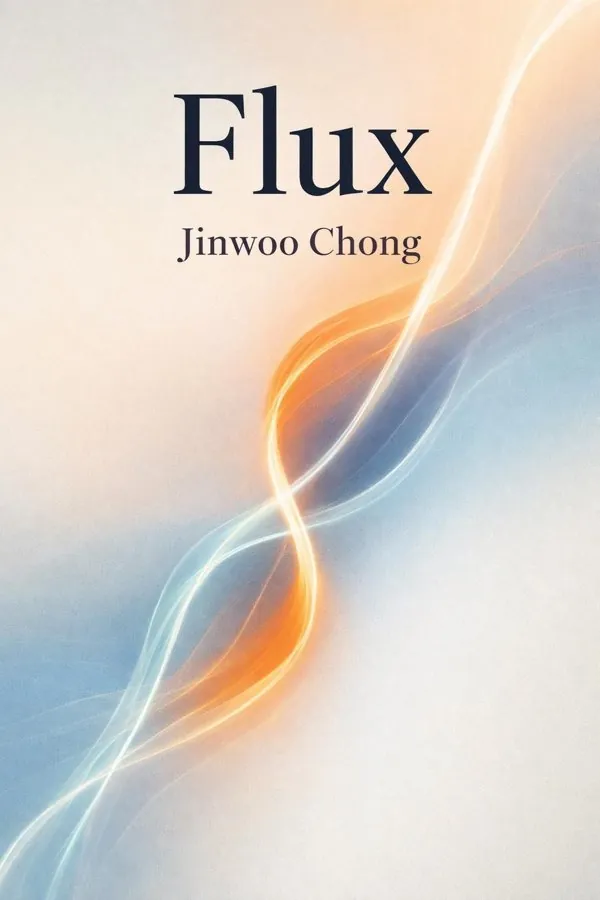
Flux: Summary & Key Insights
by Jinwoo Chong
 10 min8 chaptersAudio available
Key Takeaways from Flux
Grief often feels less like an emotion than a new calendar imposed on the living.
Childhood is where many identities begin not through certainty, but through imitation.
The future in speculative fiction often reveals the hidden logic of the present.
Some stories move toward revelation by connecting plot points; Flux moves toward revelation by collapsing temporal distance.
We tend to think of memory as proof of who we are, but Flux suggests it can be just as destabilizing as it is preserving.
What Is Flux About?
Flux by Jinwoo Chong is a bestsellers book spanning 4 pages. What if time does not move cleanly forward, but loops, fractures, and returns through grief, media, and memory? Jinwoo Chong’s Flux is a genre-defying debut that fuses literary fiction, speculative unease, family drama, and pop-cultural nostalgia into a haunting meditation on identity. The novel follows three seemingly separate figures—Brandon in the present, Blue in the 1980s, and Bo in a speculative future—whose lives are linked by loss, transformation, and a mysterious corporation whose technologies promise to reshape reality itself. As these narratives begin to echo and overlap, Flux asks whether memory is something we preserve, something that distorts us, or something that can be engineered. What makes the novel matter is not just its clever structure, but its emotional precision. Chong writes about loneliness, immigrant family dynamics, queer longing, and the seductive pull of nostalgia with unusual sensitivity, while also using speculative elements to sharpen rather than dilute those concerns. A Columbia-trained fiction writer with work published in respected literary venues, Chong brings both stylistic ambition and psychological depth to his first novel. Flux is a striking exploration of how people survive trauma by reinventing time, and at what cost.
This FizzRead summary covers all 8 key chapters of Flux in approximately 10 minutes, distilling the most important ideas, arguments, and takeaways from Jinwoo Chong's work. Also available as an audio summary and Key Quotes Podcast.
Flux
What if time does not move cleanly forward, but loops, fractures, and returns through grief, media, and memory? Jinwoo Chong’s Flux is a genre-defying debut that fuses literary fiction, speculative unease, family drama, and pop-cultural nostalgia into a haunting meditation on identity. The novel follows three seemingly separate figures—Brandon in the present, Blue in the 1980s, and Bo in a speculative future—whose lives are linked by loss, transformation, and a mysterious corporation whose technologies promise to reshape reality itself. As these narratives begin to echo and overlap, Flux asks whether memory is something we preserve, something that distorts us, or something that can be engineered.
What makes the novel matter is not just its clever structure, but its emotional precision. Chong writes about loneliness, immigrant family dynamics, queer longing, and the seductive pull of nostalgia with unusual sensitivity, while also using speculative elements to sharpen rather than dilute those concerns. A Columbia-trained fiction writer with work published in respected literary venues, Chong brings both stylistic ambition and psychological depth to his first novel. Flux is a striking exploration of how people survive trauma by reinventing time, and at what cost.
Who Should Read Flux?
This book is perfect for anyone interested in bestsellers and looking to gain actionable insights in a short read. Whether you're a student, professional, or lifelong learner, the key ideas from Flux by Jinwoo Chong will help you think differently.
- ✓Readers who enjoy bestsellers and want practical takeaways
- ✓Professionals looking to apply new ideas to their work and life
- ✓Anyone who wants the core insights of Flux in just 10 minutes
Want the full summary?
Get instant access to this book summary and 100K+ more with Fizz Moment.
Get Free SummaryAvailable on App Store • Free to download
Key Chapters
Grief often feels less like an emotion than a new calendar imposed on the living. In Flux, Brandon embodies this disorientation. His mother’s death has severed his connection to ordinary time, leaving him suspended between before and after, memory and numbness. He moves through life as though the world is still operating on rules that no longer apply to him. Into that psychic emptiness enters a strange professional opportunity tied to a powerful technology company, one that appears to offer more than employment. It offers the possibility that time, memory, and selfhood might be manipulated rather than endured.
Brandon’s storyline is compelling because it shows how vulnerable people become when pain makes the present intolerable. The company’s promise is seductive precisely because grief creates a wish to revise reality: to revisit the past, to edit regret, to soften loss. Brandon is not simply chasing answers. He is chasing continuity, trying to discover whether identity can survive bereavement when the person who anchored your life is gone.
This thread also works as a broader reflection on modern life. Many of us seek technological or psychological shortcuts that promise relief from pain: endless distraction, algorithmic nostalgia, self-optimization, curated memory through photos and feeds. Brandon’s choices dramatize what happens when that desire becomes literalized. Rather than healing through acceptance, he is tempted to heal through alteration.
The practical insight here is that unresolved sorrow can make impossible solutions look reasonable. When we are hurting, we may pursue control instead of mourning. Brandon reminds us to ask whether a solution actually helps us process pain, or simply delays it in more sophisticated form.
Actionable takeaway: When facing loss, notice any impulse to “fix” the past. Choose one grounded ritual—journaling, conversation, therapy, or memorial practice—that helps you feel grief honestly rather than escape it.
Childhood is where many identities begin not through certainty, but through imitation. Blue’s 1980s-set narrative captures this truth with aching clarity. He is a young boy shaped by distance, longing, and mediated images, especially the stylized television hero Raider. In a home where intimacy is unstable and parental attention feels partial, the screen becomes more than entertainment. It becomes instruction, fantasy, and refuge. Blue studies performance before he understands selfhood, learning how to desire, how to mask, and how to survive by watching someone else embody confidence and power.
Chong uses Blue’s story to examine nostalgia in a nuanced way. The past is not presented as innocent or warm. It is alluring because it contains formative moments, but also painful because those moments were marked by loneliness and emotional absence. Blue’s attachment to pop culture reveals how identity can be assembled out of borrowed fragments. He does not simply consume an image; he builds himself in conversation with it.
This has obvious contemporary resonance. People still grow up constructing themselves through media, celebrity, fandom, and online performance. We learn emotional scripts from shows, songs, and curated personas. Sometimes that process is empowering. Sometimes it leaves us estranged from our unperformed selves. Blue’s narrative asks what happens when media gives us a language for becoming, but not the safety to become fully.
The insight is that nostalgia can mislead us when we mistake intensity for authenticity. The things that shaped us are not always the things that healed us. Blue’s memories matter not because they are pure, but because they reveal the compromises involved in self-creation.
Actionable takeaway: Reflect on one cultural artifact that shaped you deeply—a show, song, game, or book. Ask what it gave you, what it concealed, and whether the version of yourself built around it still serves you.
The future in speculative fiction often reveals the hidden logic of the present. Bo’s storyline does exactly that. Set in a later world where technological systems shape everyday existence in intimate ways, his narrative examines what happens when identity becomes increasingly externalized, monitored, or engineered. While Brandon represents grief in the present and Blue shows formation in the past, Bo faces the downstream consequences of a culture that treats memory, embodiment, and personhood as mutable data.
Bo’s section expands the novel’s scope from personal anguish to systemic critique. Here, technology is not just a tool but an environment, one that influences how people remember, relate, and define themselves. The futuristic setting sharpens concerns already visible in earlier sections: the desire to transcend pain, the commercialization of selfhood, and the temptation to outsource inner life to institutions. Bo’s struggle is therefore not merely survival in a strange world. It is a confrontation with the idea that human continuity can be redesigned for efficiency, convenience, or control.
This future feels plausible because its foundations are already present around us. Consider biometric tracking, predictive algorithms, AI companions, deepfake memory culture, and the increasing pressure to package oneself into readable, profitable forms. Bo inhabits an intensified version of our own moment, where the boundaries between authentic memory and manufactured experience are harder to defend.
Chong’s achievement lies in making these themes emotional rather than abstract. Bo’s predicament asks whether adaptation always counts as growth. If a person changes to fit a technological system, is that evolution—or erasure? The question matters whenever we reshape ourselves to meet external expectations.
Actionable takeaway: Audit one digital system you rely on heavily—social media, health tracking, cloud archives, or recommendation feeds. Ask how it influences your sense of self, and reclaim one small area of life that remains unquantified and self-directed.
Some stories move toward revelation by connecting plot points; Flux moves toward revelation by collapsing temporal distance. As Brandon, Blue, and Bo’s narratives begin to mirror and intersect, the novel reveals that time is not merely a structure for events but a medium through which identity is distorted, repeated, and reinterpreted. The convergence is not a gimmick. It is the emotional and philosophical center of the book. By folding different eras into one another, Chong shows how the self can be simultaneously inherited, performed, and reinvented.
This structure asks readers to abandon the expectation that truth arrives in a straight line. Instead, truth emerges through resonance: recurring motifs, emotional echoes, and delayed recognition. A gesture in one timeline acquires new meaning in another. What seems isolated becomes relational. What seems futuristic turns out to be rooted in old wounds. The result is a reading experience that mimics memory itself, where understanding often arrives retroactively.
On a practical level, this idea applies beyond fiction. Many people experience their lives not as neatly divided chapters but as overlapping versions of self. Childhood fears appear in adult relationships. Unresolved losses influence future decisions. Older media and family narratives keep scripting present behavior. The convergence in Flux dramatizes this psychological reality: we do not outgrow the past so much as keep negotiating with it.
The novel also suggests that coherence is not always found by simplifying one’s story. Sometimes it comes from acknowledging contradiction. You can be multiple selves across time and still be one person. The challenge is not to erase those versions, but to recognize their connections without being trapped by them.
Actionable takeaway: Create a personal timeline marking three moments that still shape you. Look for repeated patterns in emotion, choice, or desire. Naming those echoes can help you understand the present with greater clarity.
We tend to think of memory as proof of who we are, but Flux suggests it can be just as destabilizing as it is preserving. Across all three narrative strands, memories do not sit quietly in the background. They intrude, distort, repeat, and sometimes offer a false promise of return. Characters revisit the past not simply because they cherish it, but because they cannot stop negotiating with it. Memory becomes a space where longing and confusion coexist.
What makes Chong’s treatment of memory so compelling is that he resists easy binaries. Memory is neither sacred truth nor disposable illusion. It can sustain identity by preserving attachments, cultural traces, and emotional meaning. At the same time, it can imprison a person inside unresolved pain or nostalgic fantasy. This duality is central to the novel’s emotional force. The more the characters seek certainty in recollection, the more they confront its instability.
This dynamic mirrors ordinary life. People often replay formative experiences in order to understand themselves, yet repeated rehearsal can harden into fixation. Family stories become selective myths. Photos and recordings preserve moments while flattening complexity. Social platforms intensify this process by constantly resurfacing “memories” as curated packages, encouraging us to revisit the past without necessarily reinterpreting it.
Flux invites readers to distinguish between remembering and living inside remembrance. Healthy memory can create continuity and compassion. Unexamined memory can turn identity into a museum of injuries or lost possibilities. The goal is not to forget, but to relate to the past in a way that allows movement.
Actionable takeaway: Identify one memory you return to often. Write down the event, the meaning you usually attach to it, and one alternative interpretation. This simple practice can loosen the grip of fixed narratives and open space for growth.
Technology in Flux is frightening not because it is alien, but because it intensifies desires people already have. The novel does not imagine machines as cold intruders disrupting an otherwise stable humanity. Instead, it shows how tools and systems amplify grief, nostalgia, loneliness, and the wish for transformation. The mysterious corporation at the center of the novel is powerful precisely because it recognizes emotional vulnerability and repackages it as innovation.
This is one of Chong’s sharpest insights. People rarely adopt technology just because it is advanced; they adopt it because it promises emotional relief, social belonging, or narrative control. A device that archives memory appeals to the bereaved. A system that curates identity appeals to the uncertain. A platform that offers idealized connection appeals to the lonely. In this sense, the novel’s speculative machinery is an exaggerated mirror of contemporary life.
Consider how often we use technology to manage inner states. We revisit old messages to feel close to someone absent. We document experiences to make them real. We scroll through fandom spaces or nostalgia feeds to regain a lost version of ourselves. None of this is inherently wrong. The danger begins when a technological medium starts defining the emotional problem and selling us the only acceptable solution.
Flux insists that no system can neutralize pain without also shaping the person who seeks relief. Every convenience carries an anthropology: an assumption about what a human being is and what should count as healing. The novel asks us to be suspicious of tools that promise seamless self-reinvention.
Actionable takeaway: Before embracing a new app, platform, or device for emotional support, ask: What need is this meeting, and what habits or assumptions will it train into me over time? Awareness is the first defense against manipulation.
Few novels capture as vividly as Flux the uncomfortable truth that identity is often assembled under conditions we did not choose. Across Brandon, Blue, and Bo, selfhood appears less as a stable essence than as a set of adaptations: to family absence, cultural expectation, mediated fantasy, institutional power, and personal loss. Chong does not suggest that identity is fake. He suggests that it is negotiated, often painfully, in response to pressure.
Blue learns to become through observation and mimicry. Brandon struggles to remain coherent when grief has hollowed out the narratives that once defined him. Bo confronts environments that may reward flexibility while threatening integrity. Together, these arcs reveal that the self is not simply discovered deep inside. It is tested and revised through relation to forces outside the self.
This is especially relevant to queer experience, immigrant family dynamics, and anyone who has had to perform legibility in order to be accepted. People learn when to reveal desire, when to soften difference, when to become recognizable to institutions or loved ones. The cost of that performance can be subtle. You may gain safety or belonging while slowly losing access to your own complexity.
The novel’s contribution is not to condemn performance outright. Performance can also be generative. Trying on roles, aesthetics, and stories is part of becoming. The question is whether those performances expand your freedom or shrink it. Are you rehearsing possibilities, or disappearing into expectation?
Actionable takeaway: Notice one role you play habitually—at work, with family, online, or in relationships. Ask whether it reflects your values or just your survival strategy. If it is the latter, experiment with one small act of honesty that makes the role less confining.
The novel understands something many readers feel but rarely articulate: pop culture does not merely entertain us; it stores emotional instruction. Raider, the fictional media touchstone in Blue’s storyline, represents more than fandom. It becomes a vehicle for aspiration, attachment, and emotional coding. Through it, Blue encounters a stylized script for strength, beauty, masculinity, and longing. The result is a portrait of how cultural texts can become as formative as family stories.
This idea matters because people often dismiss pop attachments as trivial. Flux rejects that dismissal. The songs, films, shows, and icons we cling to often become containers for emotions we cannot otherwise process. A television hero may stand in for an absent parent. A fictional universe may offer language for desires not yet speakable. A repeated scene may become a rehearsal space for future identity.
At the same time, pop culture can narrow our imaginations. If the available scripts are limited, stylized, or exclusionary, then the selves built from them may inherit those limitations. Blue’s relationship to media is moving partly because it reveals both empowerment and constraint. He is not duped by fantasy; he is sustained by it, even as it leaves things unresolved.
Readers can apply this insight by taking their own cultural attachments seriously. Instead of asking whether a beloved work is “just entertainment,” ask what emotional labor it has done for you. Why that story, that character, that era? What need did it meet when other structures failed?
Actionable takeaway: Revisit a favorite cultural object from your formative years and note what values, desires, or fears it encoded for you. Use that reflection to better understand the emotional blueprint you still carry.
All Chapters in Flux
About the Author
Jinwoo Chong is an American writer whose fiction is known for blending literary depth with speculative and pop-cultural elements. He earned an MFA in fiction from Columbia University, where he refined the stylistic precision and structural ambition that would later define his debut novel. His shorter work has appeared in respected literary outlets including The Rumpus and CRAFT, and he has been recognized for writing that is emotionally incisive, formally adventurous, and attentive to questions of identity, memory, and longing. In Flux, Chong brings together many of his recurring interests—grief, queerness, media, family, and the instability of time—into a striking first novel. He is widely seen as part of a new generation of authors expanding the possibilities of contemporary literary fiction.
Get This Summary in Your Preferred Format
Read or listen to the Flux summary by Jinwoo Chong anytime, anywhere. FizzRead offers multiple formats so you can learn on your terms — all free.
Available formats: App · Audio · PDF · EPUB — All included free with FizzRead
Download Flux PDF and EPUB Summary
Key Quotes from Flux
“Grief often feels less like an emotion than a new calendar imposed on the living.”
“Childhood is where many identities begin not through certainty, but through imitation.”
“The future in speculative fiction often reveals the hidden logic of the present.”
“Some stories move toward revelation by connecting plot points; Flux moves toward revelation by collapsing temporal distance.”
“We tend to think of memory as proof of who we are, but Flux suggests it can be just as destabilizing as it is preserving.”
Frequently Asked Questions about Flux
Flux by Jinwoo Chong is a bestsellers book that explores key ideas across 8 chapters. What if time does not move cleanly forward, but loops, fractures, and returns through grief, media, and memory? Jinwoo Chong’s Flux is a genre-defying debut that fuses literary fiction, speculative unease, family drama, and pop-cultural nostalgia into a haunting meditation on identity. The novel follows three seemingly separate figures—Brandon in the present, Blue in the 1980s, and Bo in a speculative future—whose lives are linked by loss, transformation, and a mysterious corporation whose technologies promise to reshape reality itself. As these narratives begin to echo and overlap, Flux asks whether memory is something we preserve, something that distorts us, or something that can be engineered. What makes the novel matter is not just its clever structure, but its emotional precision. Chong writes about loneliness, immigrant family dynamics, queer longing, and the seductive pull of nostalgia with unusual sensitivity, while also using speculative elements to sharpen rather than dilute those concerns. A Columbia-trained fiction writer with work published in respected literary venues, Chong brings both stylistic ambition and psychological depth to his first novel. Flux is a striking exploration of how people survive trauma by reinventing time, and at what cost.
You Might Also Like

The Godfather
Mario Puzo
10 min
The Handmaid's Tale
Margaret Atwood
10 min
The Hunger Games
Suzanne Collins
10 min
The Nightingale
Kristin Hannah
10 min
The Seven Husbands of Evelyn Hugo
Taylor Jenkins Reid
10 min
Backwater Justice
Fern Michaels
10 minBrowse by Category
Ready to read Flux?
Get the full summary and 100K+ more books with Fizz Moment.