
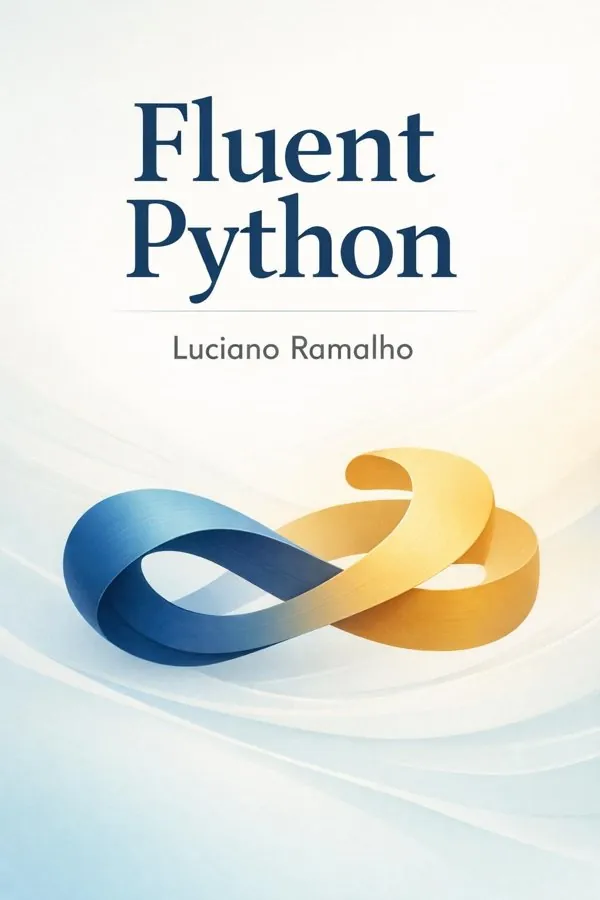
Fluent Python: Clear, Concise, and Effective Programming: Summary & Key Insights
 10 min6 chaptersAudio available
What Is Fluent Python: Clear, Concise, and Effective Programming About?
Fluent Python: Clear, Concise, and Effective Programming by Luciano Ramalho is a programming book spanning 6 pages. Fluent Python é um guia abrangente para programadores que desejam dominar os recursos avançados da linguagem Python. O autor explora profundamente conceitos como iteradores, geradores, decoradores, metaclasses e programação assíncrona, mostrando como escrever código mais idiomático e eficiente. O livro enfatiza o uso das melhores práticas e padrões da comunidade Python, ajudando o leitor a pensar de forma mais fluente na linguagem.
This FizzRead summary covers all 6 key chapters of Fluent Python: Clear, Concise, and Effective Programming in approximately 10 minutes, distilling the most important ideas, arguments, and takeaways from Luciano Ramalho's work. Also available as an audio summary and Key Quotes Podcast.
Fluent Python: Clear, Concise, and Effective Programming
Fluent Python é um guia abrangente para programadores que desejam dominar os recursos avançados da linguagem Python. O autor explora profundamente conceitos como iteradores, geradores, decoradores, metaclasses e programação assíncrona, mostrando como escrever código mais idiomático e eficiente. O livro enfatiza o uso das melhores práticas e padrões da comunidade Python, ajudando o leitor a pensar de forma mais fluente na linguagem.
Who Should Read Fluent Python: Clear, Concise, and Effective Programming?
This book is perfect for anyone interested in programming and looking to gain actionable insights in a short read. Whether you're a student, professional, or lifelong learner, the key ideas from Fluent Python: Clear, Concise, and Effective Programming by Luciano Ramalho will help you think differently.
- ✓Readers who enjoy programming and want practical takeaways
- ✓Professionals looking to apply new ideas to their work and life
- ✓Anyone who wants the core insights of Fluent Python: Clear, Concise, and Effective Programming in just 10 minutes
Want the full summary?
Get instant access to this book summary and 100K+ more with Fizz Moment.
Get Free SummaryAvailable on App Store • Free to download
Key Chapters
If there is a single turning point in every Python developer’s life, it’s when they stop emulating other languages and start letting Python lead the way. The Zen of Python—those spare aphorisms by Tim Peters—is more than poetry; it is practical guidance encoded in humor. 'Beautiful is better than ugly. Simple is better than complex.' We anchor every discussion of Pythonic thinking here.
In this book, I explore what it means to choose simplicity not as a lack of ambition but as a disciplined form of elegance. Taking advantage of Python’s dynamic nature allows us to write code that is concise and expressive without sacrificing readability. We favor duck typing over verbosity, using protocols rather than rigid hierarchies to describe how objects should behave. We rely on comprehensions, slicing, and iteration not just as syntactic sugar, but as reflections of a deeper idea—that data should be explored directly, intuitively.
The essence of writing idiomatic Python is to trust the language. When you are tempted to write verbose loops, reach for built-in iteration tools. When you find yourself crafting complex hierarchies, ask if a few well-placed dunder methods can make your objects feel like part of the language itself. True Pythonic design feels effortless—but achieving that effortlessness requires understanding *why* things work the way they do. This foundation sets the stage for every structure, protocol, and technique that follows in the chapters ahead.
In Python, data structures are not mere containers—they’re idiomatic building blocks designed to mirror the way we think about collections. Lists, tuples, dictionaries, and sets are not just convenient; they express deliberate design philosophies.
A list, mutable and ordered, is your go-to for sequences that evolve. Tuples, on the other hand, are about fixed relationships—records, immutable meaning. Learn to see tuples not as 'immutable lists' but as *data carriers*, the backbone of unpacking and function returns. Understanding dispatching through sequence protocols—iteration, slicing, and comprehension—reveals the quiet logic uniting all of Python’s collections.
Dictionaries elevate this to another level. Once merely hash maps, Python’s dicts are now ordered and versatile. They are central to namespaces, object attributes, and JSON-like configurations. Knowing how to use dictionary comprehension or the defaultdict from collections shows how deeply Python embraces mappings as first-class citizens.
Sets, meanwhile, reward the mathematically minded. They express distinctness and relationships between groups more naturally than lists. If you’ve ever filtered duplicates or enforced membership, you’ve lived the set philosophy already.
Through these structures, we begin to see how Python blurs the line between data and control—between what we store and how we act upon it. Efficiency, elegance, and expressiveness converge in these humble types.
+ 4 more chapters — available in the FizzRead app
All Chapters in Fluent Python: Clear, Concise, and Effective Programming
About the Author
Luciano Ramalho é desenvolvedor de software, instrutor e autor brasileiro com décadas de experiência em Python. Ele foi um dos fundadores da Associação Python Brasil e atua como instrutor e consultor, promovendo o uso de Python em empresas e comunidades de tecnologia.
Get This Summary in Your Preferred Format
Read or listen to the Fluent Python: Clear, Concise, and Effective Programming summary by Luciano Ramalho anytime, anywhere. FizzRead offers multiple formats so you can learn on your terms — all free.
Available formats: App · Audio · PDF · EPUB — All included free with FizzRead
Download Fluent Python: Clear, Concise, and Effective Programming PDF and EPUB Summary
Key Quotes from Fluent Python: Clear, Concise, and Effective Programming
“If there is a single turning point in every Python developer’s life, it’s when they stop emulating other languages and start letting Python lead the way.”
“In Python, data structures are not mere containers—they’re idiomatic building blocks designed to mirror the way we think about collections.”
Frequently Asked Questions about Fluent Python: Clear, Concise, and Effective Programming
Fluent Python: Clear, Concise, and Effective Programming by Luciano Ramalho is a programming book that explores key ideas across 6 chapters. Fluent Python é um guia abrangente para programadores que desejam dominar os recursos avançados da linguagem Python. O autor explora profundamente conceitos como iteradores, geradores, decoradores, metaclasses e programação assíncrona, mostrando como escrever código mais idiomático e eficiente. O livro enfatiza o uso das melhores práticas e padrões da comunidade Python, ajudando o leitor a pensar de forma mais fluente na linguagem.
You Might Also Like
ANSI Common Lisp
Paul Graham
10 min
Automate the Boring Stuff with Python: Practical Programming for Total Beginners
Al Sweigart
10 min
Black Hat Python: Python Programming for Hackers and Pentesters
Justin Seitz
10 min
Building Microservices: Designing Fine-Grained Systems
Sam Newman
10 min
C++ Primer
Stanley B. Lippman, Josée Lajoie, Barbara E. Moo
10 min
Clean Code: A Handbook of Agile Software Craftsmanship
Robert C. Martin
10 minBrowse by Category
Ready to read Fluent Python: Clear, Concise, and Effective Programming?
Get the full summary and 100K+ more books with Fizz Moment.