
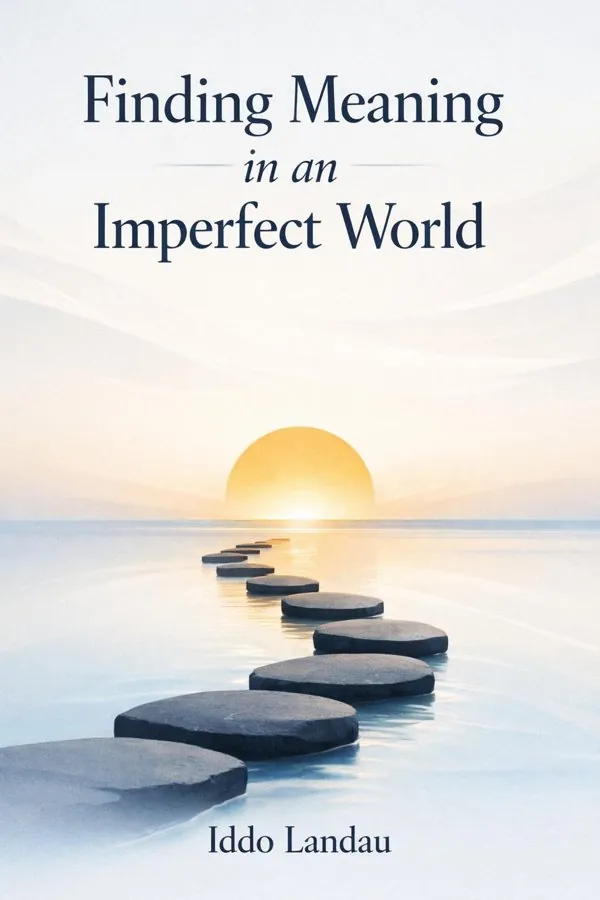
Finding Meaning in an Imperfect World: Summary & Key Insights
by Iddo Landau
 10 min11 chaptersAudio available
What Is Finding Meaning in an Imperfect World About?
Finding Meaning in an Imperfect World by Iddo Landau is a western_phil book spanning 11 pages. In this philosophical work, Iddo Landau challenges the notion that life is meaningless. Drawing on existentialist and analytic traditions, he argues that meaning can be found even in an imperfect world. Landau explores how individuals can cultivate purpose through creativity, relationships, and moral engagement, offering a rational and optimistic perspective on the human condition.
This FizzRead summary covers all 11 key chapters of Finding Meaning in an Imperfect World in approximately 10 minutes, distilling the most important ideas, arguments, and takeaways from Iddo Landau's work. Also available as an audio summary and Key Quotes Podcast.
Finding Meaning in an Imperfect World
In this philosophical work, Iddo Landau challenges the notion that life is meaningless. Drawing on existentialist and analytic traditions, he argues that meaning can be found even in an imperfect world. Landau explores how individuals can cultivate purpose through creativity, relationships, and moral engagement, offering a rational and optimistic perspective on the human condition.
Who Should Read Finding Meaning in an Imperfect World?
This book is perfect for anyone interested in western_phil and looking to gain actionable insights in a short read. Whether you're a student, professional, or lifelong learner, the key ideas from Finding Meaning in an Imperfect World by Iddo Landau will help you think differently.
- ✓Readers who enjoy western_phil and want practical takeaways
- ✓Professionals looking to apply new ideas to their work and life
- ✓Anyone who wants the core insights of Finding Meaning in an Imperfect World in just 10 minutes
Want the full summary?
Get instant access to this book summary and 100K+ more with Fizz Moment.
Get Free SummaryAvailable on App Store • Free to download
Key Chapters
Many people who conclude that life is meaningless are, in fact, borrowing arguments that sound profound but lack coherence upon closer inspection. When I began examining these arguments systematically, I noticed that they often share a pessimistic bias that takes imperfection as disproof of value. Some claim that suffering renders life meaningless: how could a world filled with pain and injustice possibly harbor genuine meaning? Others insist that our mortality nullifies significance; if all achievements fade with time, what is the point of striving? Still others turn to the vastness of the cosmos—what meaning could a brief human existence have in an infinite, indifferent universe?
To each of these lines of thought, I respond by first taking them seriously, then testing their logic. Consider suffering: it is true that pain, trauma, and loss are integral to human experience. Yet it is also true that some of the deepest meanings in human life—love, compassion, courage, moral growth—arise precisely in response to suffering. The argument that suffering cancels meaning incorrectly assumes that value and pain cannot coexist. But the opposite is often the case. Mortality, too, while it limits duration, does not necessarily limit depth. A life’s meaning is not measured by its length in cosmic time, but by the quality of engagement it embodies. As for cosmic insignificance, it relies on a false comparison between scales of existence. Meaning is relational and contextual, not dependent on cosmic centrality. The fact that we are small compared to the universe does not imply that our actions, loves, or creations are meaningless within the human sphere.
When we disentangle these arguments, we see that pessimism often stems from exaggerated contrasts—between the ideal and the real, the infinite and the finite. But meaning arises in the space between these poles, in the finite effort to live well despite limitation. That is not naivety; it is clarity.
Before we can defend the idea that life has meaning, we must clarify what we mean by ‘meaning.’ I find that many philosophical and everyday discussions conflate very different questions. Some people ask, ‘Does life have meaning?’ when they really mean, ‘Does the universe have a purpose designed by some external agent?’ Others wonder, ‘Is my life meaningful?’—which concerns personal fulfillment and value. Thus I distinguish between the meaning *of* life and meaning *in* life. The former is cosmic or theological; the latter is individual and experiential. Even if the universe has no overarching purpose, this does not entail that lives within it cannot possess meaning.
I also differentiate between subjective and objective senses of meaning. Subjective meaning refers to what feels significant to us—projects, relationships, passions. Objective meaning involves criteria that can be evaluated independently of personal feelings—actions that genuinely contribute value to the world, to knowledge, or to others. A complete account of meaning requires both dimensions. Purely subjective enthusiasm is insufficient if it rests on harmful or empty pursuits, while purely objective achievement without emotional connection risks hollowness. Meaning blossoms where these two sides intersect—where our personal engagement meets real value.
Once this conceptual groundwork is clear, many confusions dissolve. We stop asking whether meaning must be externally ordained and start considering how it can be cultivated through human activity. Meaning, as I see it, is not discovered like a hidden treasure; it is realized through intentional living, guided by values that transcend but also fulfill the self.
+ 9 more chapters — available in the FizzRead app
All Chapters in Finding Meaning in an Imperfect World
About the Author
Iddo Landau is a professor of philosophy at the University of Haifa, Israel. His research focuses on meaning in life, ethics, and the history of philosophy. He is known for his clear and accessible writing that bridges academic philosophy and everyday concerns.
Get This Summary in Your Preferred Format
Read or listen to the Finding Meaning in an Imperfect World summary by Iddo Landau anytime, anywhere. FizzRead offers multiple formats so you can learn on your terms — all free.
Available formats: App · Audio · PDF · EPUB — All included free with FizzRead
Download Finding Meaning in an Imperfect World PDF and EPUB Summary
Key Quotes from Finding Meaning in an Imperfect World
“Many people who conclude that life is meaningless are, in fact, borrowing arguments that sound profound but lack coherence upon closer inspection.”
“Before we can defend the idea that life has meaning, we must clarify what we mean by ‘meaning.”
Frequently Asked Questions about Finding Meaning in an Imperfect World
Finding Meaning in an Imperfect World by Iddo Landau is a western_phil book that explores key ideas across 11 chapters. In this philosophical work, Iddo Landau challenges the notion that life is meaningless. Drawing on existentialist and analytic traditions, he argues that meaning can be found even in an imperfect world. Landau explores how individuals can cultivate purpose through creativity, relationships, and moral engagement, offering a rational and optimistic perspective on the human condition.
You Might Also Like
A Little History of Philosophy
Nigel Warburton
10 min
Areopagitica
John Milton
10 min
How To Think Like A Philosopher: Essential Principles For Clear Thinking
Peter Cave
10 min
Language, Truth and Logic
A. J. Ayer
10 min
The Age of Reason
Thomas Paine
10 min
The Essays
Michel De Montaigne
10 minBrowse by Category
Ready to read Finding Meaning in an Imperfect World?
Get the full summary and 100K+ more books with Fizz Moment.