
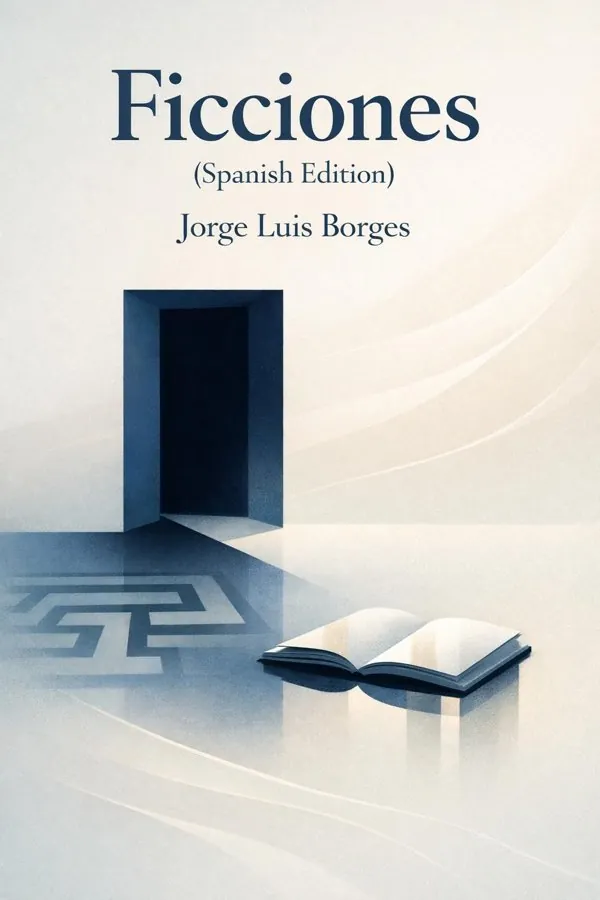
Ficciones (Spanish Edition): Summary & Key Insights
 10 min9 chaptersAudio available
Key Takeaways from Ficciones (Spanish Edition)
A made-up world can become more powerful than the real one when enough people agree to believe in it.
Every act of reading rewrites a text, which is why Borges turns authorship into one of literature’s great illusions.
Too much information can feel as paralyzing as too little.
We often imagine time as a straight path from past to future, but Borges prefers branching corridors.
We usually praise memory as a gift, but Borges shows that perfect recall may destroy thought itself.
What Is Ficciones (Spanish Edition) About?
Ficciones (Spanish Edition) by Jorge Luis Borges is a classics book spanning 12 pages. Ficciones (Spanish Edition) is Jorge Luis Borges’s dazzling collection of short stories about books that do not exist, worlds invented by language, detectives trapped by logic, and minds undone by infinity. First published in the 1940s and later brought together in two sections, The Garden of Forking Paths and Artifices, the book turns fiction into a philosophical instrument. Borges uses compact, elegant narratives to ask enormous questions: What is reality? Can language create the world it describes? Is identity stable, or only a mask made of memory and interpretation? What makes Ficciones endure is not only its originality but its precision. Borges compresses metaphysics, literary criticism, theology, and mystery into stories that feel both playful and profound. He writes as a scholar, a magician, and a skeptic at once, inviting readers into labyrinths of thought where every clue leads to another question. His influence on modern literature, fantasy, postmodernism, and speculative fiction is immense, reaching writers as different as Umberto Eco, Italo Calvino, and Gabriel García Márquez. Ficciones matters because it proves that short fiction can contain entire universes—and that the act of reading is itself one of literature’s greatest adventures.
This FizzRead summary covers all 9 key chapters of Ficciones (Spanish Edition) in approximately 10 minutes, distilling the most important ideas, arguments, and takeaways from Jorge Luis Borges's work. Also available as an audio summary and Key Quotes Podcast.
Ficciones (Spanish Edition)
Ficciones (Spanish Edition) is Jorge Luis Borges’s dazzling collection of short stories about books that do not exist, worlds invented by language, detectives trapped by logic, and minds undone by infinity. First published in the 1940s and later brought together in two sections, The Garden of Forking Paths and Artifices, the book turns fiction into a philosophical instrument. Borges uses compact, elegant narratives to ask enormous questions: What is reality? Can language create the world it describes? Is identity stable, or only a mask made of memory and interpretation?
What makes Ficciones endure is not only its originality but its precision. Borges compresses metaphysics, literary criticism, theology, and mystery into stories that feel both playful and profound. He writes as a scholar, a magician, and a skeptic at once, inviting readers into labyrinths of thought where every clue leads to another question. His influence on modern literature, fantasy, postmodernism, and speculative fiction is immense, reaching writers as different as Umberto Eco, Italo Calvino, and Gabriel García Márquez. Ficciones matters because it proves that short fiction can contain entire universes—and that the act of reading is itself one of literature’s greatest adventures.
Who Should Read Ficciones (Spanish Edition)?
This book is perfect for anyone interested in classics and looking to gain actionable insights in a short read. Whether you're a student, professional, or lifelong learner, the key ideas from Ficciones (Spanish Edition) by Jorge Luis Borges will help you think differently.
- ✓Readers who enjoy classics and want practical takeaways
- ✓Professionals looking to apply new ideas to their work and life
- ✓Anyone who wants the core insights of Ficciones (Spanish Edition) in just 10 minutes
Want the full summary?
Get instant access to this book summary and 100K+ more with Fizz Moment.
Get Free SummaryAvailable on App Store • Free to download
Key Chapters
A made-up world can become more powerful than the real one when enough people agree to believe in it. That is the unsettling force behind “Tlön, Uqbar, Orbis Tertius,” one of Borges’s most famous stories. It begins with a stray encyclopedia entry about a place that seems not to exist. From that tiny textual anomaly unfolds the discovery of an enormous intellectual conspiracy: scholars, writers, and secret societies have been constructing an entire world, Tlön, complete with languages, metaphysics, and histories. The terrifying brilliance of the story is that Tlön does not remain safely confined to books. Its ideas begin to invade reality itself.
Borges anticipates a modern problem: invented systems can reshape the world if they are coherent, seductive, and repeated often enough. Today this feels strikingly relevant. Online narratives, ideological echo chambers, branded myths, and artificial identities all show how quickly representation can eclipse fact. Borges is not merely warning against lies; he is examining how human beings prefer elegant systems to messy reality. Tlön is attractive because it is intellectually complete.
The story also reveals Borges’s larger method. He treats reference works, scholarly commentary, and invented citations as narrative devices, blurring the line between essay and fiction. In doing so, he asks readers to become skeptical investigators. What looks authoritative may be fabricated, and what is fabricated may still shape behavior.
A practical way to apply this insight is to examine the systems you trust most: media feeds, institutional language, even personal self-descriptions. Ask not only whether they are true, but how they organize your perception. Actionable takeaway: whenever a story about the world feels perfectly complete, pause and ask what complexities it leaves out.
Too much information can feel as paralyzing as too little. Borges captures this with unmatched elegance in “The Library of Babel,” his vision of a universe composed entirely of hexagonal rooms filled with books containing every possible combination of letters. Within that infinite library exist all truth, all falsehood, all coherent histories, all gibberish, and every possible correction of every mistake. In theory, every answer is somewhere. In practice, no one can find it.
The genius of the story lies in its psychological realism. Faced with total abundance, the librarians become desperate, religious, violent, or nihilistic. Some search for the book that justifies their lives. Others hunt for a catalog of catalogs. Some destroy books in frustration. Borges anticipates the modern internet, algorithmic overload, and the crisis of knowledge in an age of excess. Information does not automatically produce wisdom. Infinite access may instead generate anxiety, cults of certainty, and endless interpretation.
“The Lottery in Babylon” offers a related insight. There, chance becomes a total social system, governing every privilege and punishment. What begins as a game expands into a metaphysical order. Borges suggests that human beings will build elaborate meanings around randomness, especially when systems become too vast to understand.
Practically, these stories help us think about research, decision-making, and everyday digital life. Endless options can masquerade as freedom while draining judgment. The challenge is not acquiring more data but developing better criteria. Curating what to ignore becomes as important as seeking what to know.
Actionable takeaway: define your standards before you begin searching—whether for information, opportunities, or answers—so infinity does not dictate your thinking.
We often imagine time as a straight path from past to future, but Borges prefers branching corridors. In “The Garden of Forking Paths,” a wartime spy story becomes a metaphysical meditation on time itself. Borges introduces the idea of a novel and labyrinth in which all possible outcomes occur, each one opening onto further possibilities. The maze is not built in space but in time. Every decision generates multiple futures, and these futures coexist.
This is one of Borges’s most influential contributions to modern literature. Long before parallel universes became popular in science fiction and film, he treated reality as a structure of diverging temporal paths. Yet the story is not only theoretical. It is tightly plotted, suspenseful, and morally charged. The protagonist’s urgent mission unfolds within this broader philosophical frame, showing that abstract ideas matter most when they collide with concrete human choices.
Borges returns to temporal instability in “The Secret Miracle,” where a condemned writer appears to receive a year of inner time in the instant before execution. In that suspended interval, he completes a drama in his mind. Here time is subjective, elastic, and spiritually charged. Creativity itself becomes an act of resistance against annihilation.
In daily life, Borges’s view of time encourages humility. The paths not taken remain part of how we imagine ourselves. Regret, hope, and planning all involve alternate timelines we mentally inhabit. His fiction suggests that possibility is not noise surrounding life; it is part of its texture.
A practical application is decision-making. Instead of obsessing over the one perfect choice, map a few plausible futures and evaluate which values remain stable across them. Actionable takeaway: when facing a major decision, write down three branching futures and choose the path that best reflects who you want to become.
We usually praise memory as a gift, but Borges shows that perfect recall may destroy thought itself. In “Funes the Memorious,” the young Ireneo Funes gains the uncanny ability to remember everything in exact detail. Nothing fades, nothing blurs, nothing gets lost. At first this seems miraculous. Soon it becomes horrifying. Because he remembers every leaf, every cloud, every momentary angle of perception, he cannot generalize. He cannot think in concepts because concepts require forgetting differences.
This is one of Borges’s clearest statements about the mind. Human intelligence depends on selection, compression, and abstraction. To think “dog” is to ignore thousands of variations among actual dogs. To form memory into understanding, we must omit. Funes cannot omit. His consciousness is crowded with particulars, and so he becomes trapped inside an unbearable present thick with undigested detail.
“The Circular Ruins” complements this idea from another direction. A man dreams another person into existence, only to discover that he too may be the dream of someone else. Identity here is not stable substance but constructed pattern. Memory and selfhood are linked, but neither is final. We are assembled from narratives, habits, and acts of imagination as much as from facts.
The practical relevance is immediate. In work, study, and relationships, raw data is not the same as insight. Meticulous recollection can be useful, but wisdom requires organizing experience into patterns that guide action. Even emotionally, healing often depends not on erasing the past but on reinterpreting it.
Actionable takeaway: after any intense experience, do not just record what happened; summarize it in one sentence, one lesson, and one change you will make. That is how memory becomes understanding.
The self is rarely singular in Borges; it is layered, theatrical, and morally unstable. “The Shape of the Sword” and “Theme of the Traitor and the Hero” explore betrayal, disguise, and the way personal identity can be rewritten through narrative. In “The Shape of the Sword,” a scar becomes the key to a confession that reverses the reader’s assumptions about heroism and cowardice. In “Theme of the Traitor and the Hero,” political history turns into a stage-managed script in which treason and sacrifice become entangled. Public memory edits events until persons become symbols.
Borges is fascinated by how stories assign roles. The hero, the traitor, the victim, the judge: these may appear fixed, yet his fiction reveals how easily they exchange places. Reputation depends on perspective, and perspective depends on power, timing, and interpretation. This does not mean morality is meaningless. Rather, Borges warns that moral judgment often arrives already shaped by narrative design.
This concern appears again in “Death and the Compass,” where detective logic becomes its own trap. The brilliant investigator believes he is deciphering a sublime pattern, but his interpretive confidence leads him exactly where his enemy wants him. Intelligence becomes a mask for vanity.
These stories are useful beyond literature because modern life constantly pressures us to simplify identities. In workplaces, families, politics, and online spaces, people get reduced to roles based on one event or one label. Borges asks us to resist that flattening. Every identity includes hidden scripts, self-deceptions, and revisions.
Actionable takeaway: before finalizing your judgment about a person or yourself, ask what story structure you are unconsciously imposing—hero, villain, loser, genius—and what evidence complicates that role.
Reason is one of humanity’s greatest tools, but Borges repeatedly shows that it can become lethal when mistaken for total mastery. In “Death and the Compass,” detective Erik Lönnrot pursues a series of murders through an increasingly abstract pattern of mystical and geometric clues. He believes he is solving a grand intellectual puzzle. In reality, he is being led into a trap by an adversary who understands his mind better than he understands the world. The detective’s failure is not a lack of intelligence but an excess of interpretive confidence.
Borges’s point is subtle. Patterns are real, but our hunger for elegant explanations can make us vulnerable. We often prefer a sophisticated theory over a simple motive because complexity flatters us. Lönnrot’s downfall lies in confusing interpretive beauty with truth. The story is both a parody of detective fiction and a philosophical warning about overreading.
This idea resonates with “The Lottery in Babylon” and “Tlön, Uqbar, Orbis Tertius,” where systems become so comprehensive that people submit to them almost religiously. Whether the system is chance, philosophy, or crime detection, Borges asks the same question: when does interpretation stop helping us navigate reality and start replacing it?
In practical terms, this matters in analysis-heavy environments: strategy, academia, finance, politics, even personal relationships. A model can be useful, but no model exhausts reality. The more elegant your explanation, the more rigorously you should test it against inconvenient facts.
Actionable takeaway: when you think you have found the pattern that explains everything, force yourself to identify one simpler explanation and one contradictory piece of evidence before acting.
Borges often writes about annihilation, but he is equally interested in the stubborn survival of meaning. “The Secret Miracle” is perhaps his clearest artistic manifesto in narrative form. A writer condemned to death prays for time to finish his incomplete play. At the instant before execution, external time stops, and in the silence of frozen reality he completes the work mentally over the course of a year. The miracle remains invisible to everyone else. No audience sees the play. Yet the act of creation is still fulfilled.
This story transforms artistic labor into an inner vocation rather than a public performance. Borges suggests that completion, attention, and form possess value even without recognition. Creation can be a private triumph over chaos. That insight matters not only for artists but for anyone whose most meaningful work unfolds unseen: caregiving, study, ethical discipline, long preparation, inner change.
Across Ficciones, books are burned, worlds dissolve, identities fracture, and certainty fails. Yet language keeps generating forms. Even the most skeptical stories are acts of exact composition. Borges does not offer sentimental hope; he offers formal endurance. To make something precise in the face of confusion is already a victory.
This can be applied to ordinary work. Much of what matters in life does not receive immediate validation. A carefully written proposal, a repaired relationship, a disciplined practice, a private insight—these may never become visible achievements, but they still shape reality.
Actionable takeaway: choose one meaningful task you have postponed because no one may notice it, and complete it anyway. Borges reminds us that invisible completion is still real accomplishment.
Ficciones is not just a set of separate stories; it is a carefully orchestrated experience in which motifs echo, deepen, and transform one another. The movement from The Garden of Forking Paths to Artifices shows Borges refining his signature concerns: labyrinths, mirrors, false documents, infinite systems, and unstable selves. One story may present a cosmic encyclopedia, another a detective puzzle, another a biographical sketch, another a theological paradox. Yet together they form a unified meditation on how human beings seek order through narrative.
The collection’s structure matters because Borges teaches by variation. “The Garden of Forking Paths” dramatizes branching time through espionage. “The Library of Babel” transforms infinity into architecture. “Pierre Menard” makes authorship a conceptual riddle. “The Circular Ruins” turns creation into recursion. “The Secret Miracle” compresses art and time into a single suspended instant. Each story investigates one aspect of a larger problem: how can finite minds confront realities that exceed them?
Reading the collection as a whole also reveals Borges’s tonal range. He is philosophical but never merely abstract; playful but never trivial; erudite but often ironic. His invented references and scholarly poses create trust only to unsettle it. The result is a reading experience that trains attentiveness. You begin to notice how easily authority can be fabricated, how often language directs thought, and how stories become instruments for metaphysical exploration.
In practical terms, Ficciones rewards slow reading and rereading. Its stories are short, but their implications expand over time. Actionable takeaway: read Borges comparatively—pair two stories and ask how each reworks the same theme differently. That method reveals the architecture of the whole collection.
All Chapters in Ficciones (Spanish Edition)
About the Author
Jorge Luis Borges (1899–1986) was an Argentine writer, poet, essayist, translator, and librarian whose work transformed modern literature. Born in Buenos Aires and educated in both Argentina and Europe, he developed an early love of philosophy, languages, and world literature. Borges became famous for short stories that fused metaphysical speculation with narrative precision, often using the forms of essays, reviews, and detective fiction to explore infinity, time, memory, and identity. His best-known books include Ficciones and The Aleph, both central works of twentieth-century literature. Although he gradually lost his sight, he continued to write, lecture, and shape literary culture internationally. Borges’s influence extends across postmodern fiction, fantasy, literary theory, and philosophical writing, making him one of the most widely admired and studied authors of the modern era.
Get This Summary in Your Preferred Format
Read or listen to the Ficciones (Spanish Edition) summary by Jorge Luis Borges anytime, anywhere. FizzRead offers multiple formats so you can learn on your terms — all free.
Available formats: App · Audio · PDF · EPUB — All included free with FizzRead
Download Ficciones (Spanish Edition) PDF and EPUB Summary
Key Quotes from Ficciones (Spanish Edition)
“A made-up world can become more powerful than the real one when enough people agree to believe in it.”
“Every act of reading rewrites a text, which is why Borges turns authorship into one of literature’s great illusions.”
“Too much information can feel as paralyzing as too little.”
“We often imagine time as a straight path from past to future, but Borges prefers branching corridors.”
“We usually praise memory as a gift, but Borges shows that perfect recall may destroy thought itself.”
Frequently Asked Questions about Ficciones (Spanish Edition)
Ficciones (Spanish Edition) by Jorge Luis Borges is a classics book that explores key ideas across 9 chapters. Ficciones (Spanish Edition) is Jorge Luis Borges’s dazzling collection of short stories about books that do not exist, worlds invented by language, detectives trapped by logic, and minds undone by infinity. First published in the 1940s and later brought together in two sections, The Garden of Forking Paths and Artifices, the book turns fiction into a philosophical instrument. Borges uses compact, elegant narratives to ask enormous questions: What is reality? Can language create the world it describes? Is identity stable, or only a mask made of memory and interpretation? What makes Ficciones endure is not only its originality but its precision. Borges compresses metaphysics, literary criticism, theology, and mystery into stories that feel both playful and profound. He writes as a scholar, a magician, and a skeptic at once, inviting readers into labyrinths of thought where every clue leads to another question. His influence on modern literature, fantasy, postmodernism, and speculative fiction is immense, reaching writers as different as Umberto Eco, Italo Calvino, and Gabriel García Márquez. Ficciones matters because it proves that short fiction can contain entire universes—and that the act of reading is itself one of literature’s greatest adventures.
More by Jorge Luis Borges


You Might Also Like


Browse by Category
Ready to read Ficciones (Spanish Edition)?
Get the full summary and 100K+ more books with Fizz Moment.