
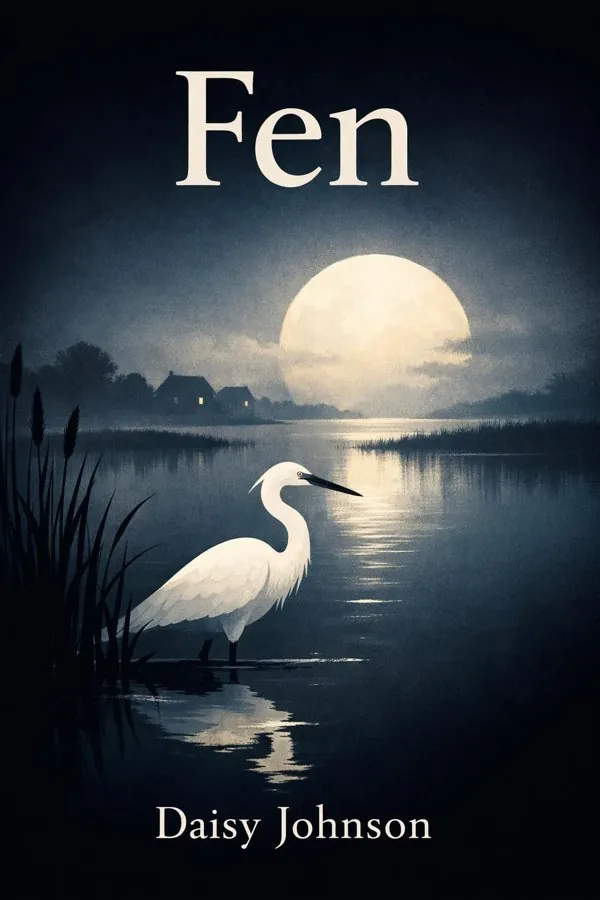
Fen: Summary & Key Insights
 10 min9 chaptersAudio available
Key Takeaways from Fen
Some landscapes do more than frame a story; they generate it.
Transformation in Fen is rarely symbolic in a neat, distant way; it is bodily, sticky, intimate, and unsettling.
Ghosts in Fen are not only supernatural figures; they are the forms taken by unfinished need.
Growing up is often described as a process of becoming recognizable, but Fen presents adolescence as a period of radical estrangement.
Family in Fen is rarely a stable refuge.
What Is Fen About?
Fen by Daisy Johnson is a bestsellers book spanning 9 pages. Daisy Johnson’s Fen is a striking short story collection that turns the English fenlands into a place of dread, beauty, appetite, and change. Set in flat, waterlogged landscapes where boundaries are always shifting, these stories blend folklore, body horror, adolescence, sexuality, and rural realism into something uncanny and unforgettable. Johnson writes about girls and women, families and ghosts, desire and violence, but she never treats these themes as separate from the land. In Fen, the marshes, rivers, reeds, and mud seem to think and act alongside the characters, pulling them toward transformation. What makes the collection matter is its ability to make old myths feel urgently contemporary. Johnson explores how people live inside inherited stories about gender, power, motherhood, and belonging, then shows what happens when those stories become unstable. Her prose is lyrical without losing sharpness, and her imagination is bold without becoming abstract. As Johnson’s debut collection, Fen announced a major literary voice: one deeply interested in metamorphosis, female experience, and the eerie overlap between nature and human longing. It is a book for readers who want fiction that is both haunting and emotionally precise.
This FizzRead summary covers all 9 key chapters of Fen in approximately 10 minutes, distilling the most important ideas, arguments, and takeaways from Daisy Johnson's work. Also available as an audio summary and Key Quotes Podcast.
Fen
Daisy Johnson’s Fen is a striking short story collection that turns the English fenlands into a place of dread, beauty, appetite, and change. Set in flat, waterlogged landscapes where boundaries are always shifting, these stories blend folklore, body horror, adolescence, sexuality, and rural realism into something uncanny and unforgettable. Johnson writes about girls and women, families and ghosts, desire and violence, but she never treats these themes as separate from the land. In Fen, the marshes, rivers, reeds, and mud seem to think and act alongside the characters, pulling them toward transformation.
What makes the collection matter is its ability to make old myths feel urgently contemporary. Johnson explores how people live inside inherited stories about gender, power, motherhood, and belonging, then shows what happens when those stories become unstable. Her prose is lyrical without losing sharpness, and her imagination is bold without becoming abstract. As Johnson’s debut collection, Fen announced a major literary voice: one deeply interested in metamorphosis, female experience, and the eerie overlap between nature and human longing. It is a book for readers who want fiction that is both haunting and emotionally precise.
Who Should Read Fen?
This book is perfect for anyone interested in bestsellers and looking to gain actionable insights in a short read. Whether you're a student, professional, or lifelong learner, the key ideas from Fen by Daisy Johnson will help you think differently.
- ✓Readers who enjoy bestsellers and want practical takeaways
- ✓Professionals looking to apply new ideas to their work and life
- ✓Anyone who wants the core insights of Fen in just 10 minutes
Want the full summary?
Get instant access to this book summary and 100K+ more with Fizz Moment.
Get Free SummaryAvailable on App Store • Free to download
Key Chapters
Some landscapes do more than frame a story; they generate it. In Fen, the English fenlands are not passive scenery but a living threshold where categories begin to break down. Land and water blur, past and present overlap, and the human world never feels fully separate from older, stranger forces. Johnson uses this unstable geography to create a mood of continual possibility and threat. Because the fens are reclaimed land, always vulnerable to flooding, they carry a sense that control is temporary. What looks solid may soften. What seems settled may return to wildness.
This matters because the characters are often living on similarly unstable ground. They are daughters becoming women, mothers losing authority, lovers pulled by desire they cannot name, and isolated people haunted by the feeling that something just beyond the visible is waiting. The fen mirrors these conditions. Its flatness exposes people, yet its mist, ditches, and hidden water make concealment possible. It is both prison and escape route.
A practical way to read this idea is to ask, in each story, how place shapes emotion. Notice when water appears before a change, when animals seem to echo human instincts, or when domestic spaces feel invaded by the natural world. Johnson shows that environment is never neutral; it participates in identity.
Actionable takeaway: when reading Fen, treat the landscape as a character. Ask not just what happens in the fens, but what the fens make possible, distort, or reveal.
Transformation in Fen is rarely symbolic in a neat, distant way; it is bodily, sticky, intimate, and unsettling. One of the collection’s most memorable impulses is the idea that desire does not stay inside the mind. It changes the body, the senses, and the relation between person and world. In stories like the one involving a woman becoming an eel, metamorphosis is neither simple fantasy nor moral lesson. It is an expression of impulses that ordinary social language cannot hold.
Johnson uses bodily change to explore hunger, sexuality, shame, longing, and escape. Her characters do not merely feel overwhelmed; they become other forms through which those emotions can be experienced. An eel, for example, suggests slipperiness, survival, ancient instinct, and life in dark water. Such a transformation feels truer than a direct explanation because it captures how desire can dissolve familiar identity. You remain yourself and become strange to yourself at the same time.
Readers can apply this insight beyond literature. We often describe emotional states with physical metaphors: feeling frozen, burning up, crawling out of one’s skin. Johnson radicalizes that instinct, showing how bodies carry psychic experience. Her stories invite us to take seriously the physical dimensions of emotion, especially those society tries to regulate or suppress.
Actionable takeaway: pay attention to what each transformation reveals rather than asking only whether it is “real.” In Fen, metamorphosis is a tool for understanding desires that ordinary realism would flatten.
Ghosts in Fen are not only supernatural figures; they are the forms taken by unfinished need. Johnson repeatedly links haunting with loneliness, grief, repression, and the persistence of what has not been acknowledged. Her characters often live in emotional isolation, cut off by geography, class, family silence, or their own inability to speak what they want. In such settings, spectral presences feel less like intrusions than inevitable manifestations.
What is powerful here is that Johnson does not separate the eerie from the psychological. A haunting may be a ghost, a memory, a desire, or all three at once. The stories suggest that when people cannot process loss or longing, those feelings settle into places, rituals, and bodies. An empty room, a neglected road, a patch of marsh, or the repeated sound of water can hold emotional residue. This creates a reading experience where uncertainty becomes meaningful. We are not always supposed to decide between literal and figurative explanations.
In practical terms, this makes Fen an insightful book about isolation. Rural spaces can intensify emotional distance, but the same is true of modern life more broadly. Many people live among others while feeling unspoken things gathering force inside them. Johnson dramatizes what happens when silence becomes atmosphere.
Actionable takeaway: as you read, ask what each ghostly or uncanny element might be carrying emotionally. In Fen, haunting often marks a truth the characters have not yet found language for.
Growing up is often described as a process of becoming recognizable, but Fen presents adolescence as a period of radical estrangement. Johnson is especially interested in girls on the edge of adulthood, when the body changes faster than identity can keep up. In these stories, coming of age is not sentimental, liberating, or clean. It is frequently disorienting, erotic, frightening, and full of mismatched power.
The fenland setting intensifies this unease. Traditional markers of progress and stability are weak here; instead, young characters move through reeds, roads, marshes, and isolated homes where social rules feel both rigid and porous. They are watched, desired, dismissed, and misunderstood. Johnson captures the sense that adolescence involves entering stories already written by others: stories about femininity, sexuality, obedience, danger, and beauty. The uncanny enters because these inherited scripts do not fit lived experience.
A useful way to understand this theme is to notice how often Johnson links bodily awareness to threat or revelation. A young person may sense power for the first time and also feel newly vulnerable. Desire may open possibility while also exposing them to manipulation. This tension makes the stories especially sharp on the emotional reality of becoming a woman in environments shaped by silence and control.
Actionable takeaway: read the adolescent characters not as incomplete adults but as people experiencing the violence and intensity of self-formation. Fen shows that coming of age often feels less like arrival than mutation.
One of Fen’s greatest achievements is that it never treats myth as separate from ordinary life. Johnson places folklore inside kitchens, roads, farms, bedrooms, and village routines, showing that the mythical and the mundane constantly leak into each other. Her rural settings are grounded in labor, boredom, gossip, class pressures, and social neglect, yet beneath this realism run older currents of story and superstition.
This blending matters because it avoids two common traps. Johnson does not romanticize the countryside as pure enchantment, and she does not portray modern life as having outgrown myth. Instead, she reveals how folklore survives as atmosphere, instinct, warning, and imaginative structure. A strange animal, an old woman, a child’s game, a rumor, or a body in water can suddenly feel archetypal without ceasing to be local and specific.
For readers, this creates a valuable lens for understanding how culture works. People continue to make meaning through inherited narratives, especially in times of uncertainty. Even if we no longer say we believe in monsters or magic, we often still organize fear and desire through those forms. Johnson’s stories expose that continuity with unusual precision.
Actionable takeaway: notice how Fen moves from everyday detail into uncanny possibility without changing tone dramatically. This is Johnson’s method: she shows that myth is not elsewhere. It is already embedded in ordinary life, waiting to surface.
In Fen, the supernatural is not only a source of danger; it can also become a mode of resistance. Johnson’s female characters are often constrained by social expectations, male power, domestic roles, or emotional enclosure. Yet the uncanny sometimes gives them a way to exceed those limits. This does not mean empowerment in a simple, triumphant sense. Rather, the supernatural offers forms of agency that are ambiguous, risky, and difficult to domesticate.
Transformation, haunting, animal affinity, and other strange forces can function as refusals of the identities imposed on women. A character may become unreadable, inaccessible, or physically altered in ways that break the scripts governing her. In this sense, the uncanny can interrupt systems of control. What cannot be categorized cannot be easily managed. Johnson is especially good at showing that resistance may look monstrous to those invested in order.
This idea is useful because it complicates familiar narratives about power. Women in these stories are not always rescued, and they are not always morally pure. Their resistance may be unsettling, destructive, or opaque. But that complexity is precisely the point. Fen refuses to make female agency legible only when it is comfortable.
Actionable takeaway: as you read, ask when the strange becomes a resource rather than merely a threat. Johnson suggests that for marginalized characters, becoming uncanny can be one way of reclaiming power from restrictive realities.
Fen is full of repetition, but not the dead repetition of sameness. Instead, Johnson works with cycles: water rising and receding, generations echoing one another, desires returning in altered form, old stories surfacing in contemporary bodies. This cyclical structure gives the collection one of its deepest insights: myth endures because human experiences recur, even when their outward forms change.
Johnson does not present folklore as a fixed set of tales handed down intact. She shows it as a process of recurrence and mutation. A pattern reappears, but in a new household, a new body, a new century. This is why the stories feel ancient and modern at once. They are interested in what keeps happening: hunger, abandonment, attraction, fear of the wild, fear of motherhood, fear of becoming one’s parent, fear of one’s own desires. Myth persists not because people preserve it perfectly, but because life keeps generating shapes that myth already knows how to hold.
For readers, this means the collection can be approached as a network rather than a set of isolated stories. Images, moods, and dynamics resonate across the book. The more you notice these echoes, the richer the experience becomes.
Actionable takeaway: after finishing a story, connect it to another in the collection. Track recurring motifs such as water, animals, girls, mothers, and bodily change. Fen reveals its full power when read as a cycle of variations rather than a series of separate shocks.
All Chapters in Fen
About the Author
Daisy Johnson is a British writer born in 1990 in Oxford, England. She studied English and Creative Writing at Lancaster University and later completed a master’s degree in Creative Writing at Somerville College, Oxford. Johnson first gained major attention with her debut short story collection, Fen, which introduced her distinctive style: lyrical, eerie, and deeply interested in folklore, bodily transformation, and the tensions within family life. She went on to publish the novel Everything Under, which was shortlisted for the Booker Prize, making her one of the youngest authors ever to receive that recognition. Across her fiction, Johnson is known for blending myth with contemporary realism and for exploring female experience, desire, and instability with unusual intensity and imagination.
Get This Summary in Your Preferred Format
Read or listen to the Fen summary by Daisy Johnson anytime, anywhere. FizzRead offers multiple formats so you can learn on your terms — all free.
Available formats: App · Audio · PDF · EPUB — All included free with FizzRead
Download Fen PDF and EPUB Summary
Key Quotes from Fen
“Some landscapes do more than frame a story; they generate it.”
“Transformation in Fen is rarely symbolic in a neat, distant way; it is bodily, sticky, intimate, and unsettling.”
“Ghosts in Fen are not only supernatural figures; they are the forms taken by unfinished need.”
“Growing up is often described as a process of becoming recognizable, but Fen presents adolescence as a period of radical estrangement.”
“Family in Fen is rarely a stable refuge.”
Frequently Asked Questions about Fen
Fen by Daisy Johnson is a bestsellers book that explores key ideas across 9 chapters. Daisy Johnson’s Fen is a striking short story collection that turns the English fenlands into a place of dread, beauty, appetite, and change. Set in flat, waterlogged landscapes where boundaries are always shifting, these stories blend folklore, body horror, adolescence, sexuality, and rural realism into something uncanny and unforgettable. Johnson writes about girls and women, families and ghosts, desire and violence, but she never treats these themes as separate from the land. In Fen, the marshes, rivers, reeds, and mud seem to think and act alongside the characters, pulling them toward transformation. What makes the collection matter is its ability to make old myths feel urgently contemporary. Johnson explores how people live inside inherited stories about gender, power, motherhood, and belonging, then shows what happens when those stories become unstable. Her prose is lyrical without losing sharpness, and her imagination is bold without becoming abstract. As Johnson’s debut collection, Fen announced a major literary voice: one deeply interested in metamorphosis, female experience, and the eerie overlap between nature and human longing. It is a book for readers who want fiction that is both haunting and emotionally precise.
More by Daisy Johnson
You Might Also Like
The Godfather
Mario Puzo
10 min
The Handmaid's Tale
Margaret Atwood
10 min
The Hunger Games
Suzanne Collins
10 min
The Nightingale
Kristin Hannah
10 min
The Seven Husbands of Evelyn Hugo
Taylor Jenkins Reid
10 min
Backwater Justice
Fern Michaels
10 minBrowse by Category
Ready to read Fen?
Get the full summary and 100K+ more books with Fizz Moment.