
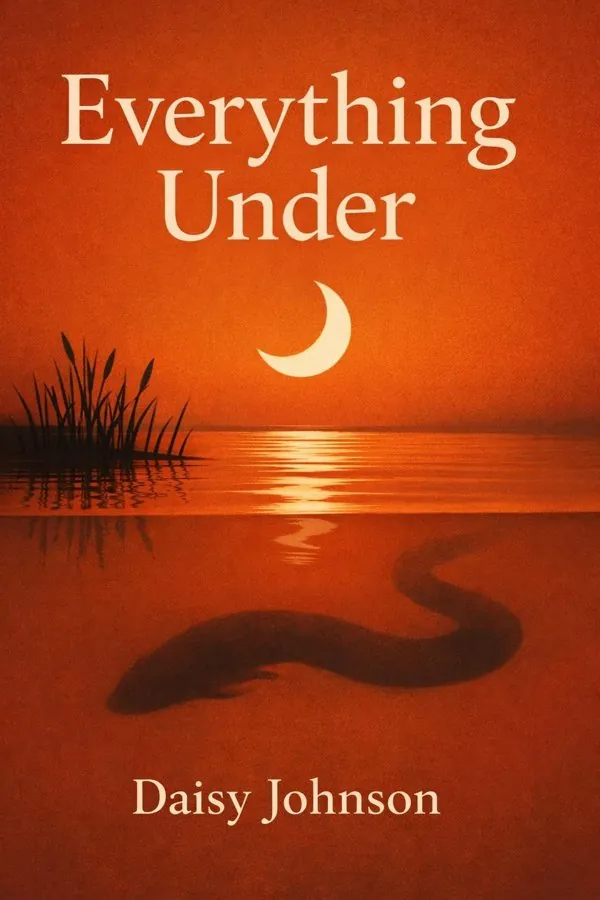
Everything Under: Summary & Key Insights
 10 min4 chaptersAudio available
What Is Everything Under About?
Everything Under by Daisy Johnson is a bestsellers book spanning 4 pages. Everything Under is a haunting and lyrical reimagining of the Oedipus myth set along the waterways of Oxfordshire. The story follows Gretel, a lexicographer who reconnects with her estranged mother after sixteen years apart. As they attempt to rebuild their relationship, memories of their shared private language, a mysterious creature in the river, and a missing boy resurface. Daisy Johnson’s debut novel explores themes of memory, identity, fate, and the power of language, blending myth and modernity in a deeply unsettling and moving narrative.
This FizzRead summary covers all 4 key chapters of Everything Under in approximately 10 minutes, distilling the most important ideas, arguments, and takeaways from Daisy Johnson's work. Also available as an audio summary and Key Quotes Podcast.
Everything Under
Everything Under is a haunting and lyrical reimagining of the Oedipus myth set along the waterways of Oxfordshire. The story follows Gretel, a lexicographer who reconnects with her estranged mother after sixteen years apart. As they attempt to rebuild their relationship, memories of their shared private language, a mysterious creature in the river, and a missing boy resurface. Daisy Johnson’s debut novel explores themes of memory, identity, fate, and the power of language, blending myth and modernity in a deeply unsettling and moving narrative.
Who Should Read Everything Under?
This book is perfect for anyone interested in bestsellers and looking to gain actionable insights in a short read. Whether you're a student, professional, or lifelong learner, the key ideas from Everything Under by Daisy Johnson will help you think differently.
- ✓Readers who enjoy bestsellers and want practical takeaways
- ✓Professionals looking to apply new ideas to their work and life
- ✓Anyone who wants the core insights of Everything Under in just 10 minutes
Want the full summary?
Get instant access to this book summary and 100K+ more with Fizz Moment.
Get Free SummaryAvailable on App Store • Free to download
Key Chapters
When Gretel receives the phone call that starts her search for Sarah, it is as though the river calls her back. She has built a life of precision and control, curating dictionaries, deciding what words mean. Yet language — her supposed mastery — proves fragile the moment the past resurfaces. The call reminds her of the years spent on a narrow canal boat, drifting between moorings with her mother, their lives shaped by the rhythm of water and silence.
In those floating days, words were treasures. She and Sarah invented a private tongue, a lexicon born from solitude: terms for moods, for dangers, for the unseen presence of the Bonak. Their shared speech made them both unique and isolated, cutting them off from others. It was love and boundaries at once. For Gretel, language equaled intimacy; yet when her mother left, even the memory of that language felt poisoned. Recalling it is painful, like touching a wound that never closed.
Her journey to find Sarah reflects a deeper pursuit — to reclaim those forgotten words and the identity they represent. When she does locate her mother, Sarah is no longer whole. She suffers from memory loss, living half in past, half in confusion. The irony is devastating: the woman who once taught Gretel how to name the world no longer knows the names herself. The daughter must now define clouds, places, and feelings for her mother, using both their former language and standard English, trying to rebuild sense out of broken phrases.
This is the emotional axis on which the novel turns. Every act of definition is also an act of mourning. The past slips away faster than it can be described. As Gretel pieces together memories, flashbacks dissolve the border between present and past. The reader too drifts between timelines, uncertain of what belongs to childhood and what belongs to imagination. The narrative structure mirrors the fluidity of remembrance: the way all beginnings seem to contain their own endings. Gretel’s search thus becomes an allegory for the lexicographer’s impossible task — to make permanent what is forever changing.
If water is the setting of *Everything Under*, then the Bonak is its shadow. Created from words and whispers, this creature represents everything the human mind refuses to face head-on. As a child, Gretel feared it — a river being that lurks in darkness, snatching people who stray too far. As an adult, she begins to realize that the Bonak was more than myth. It was memory’s embodiment of threat, a symbol of the unspeakable things buried within Sarah’s past.
The Bonak functions much like fate in myth. It does not choose; it simply appears when fear cannot be concealed any longer. Sarah’s belief in this creature shaped her decisions. It dictated how far they traveled, when they hid, why they submerged themselves in isolation. In her mind, danger lived not in society but in the currents beneath their boat. This worldview passed onto Gretel, forming a legacy of dread. Even after Sarah leaves and Gretel builds her careful life of dictionary entries, the Bonak resurfaces — sometimes as dreams, sometimes as real encounters on the riverbanks.
I wrote the Bonak as the articulation of what we avoid saying. The moment we give fear a name, we summon it. The Bonak’s presence asks: what happens when the stories we invent become real simply because we believe them too deeply? Through language we conjure worlds, and through forgetting we destroy them. For Gretel, confronting the Bonak is the same as facing her mother’s buried guilt — the truth of a boy who disappeared, the reality of what Sarah tried to hide.
The creature’s appearances grow more vivid as the timelines intertwine. Each resurfacing is not about horror, but awareness. Fear, Johnson reminds the reader through Gretel’s voice, is part of every river we cross. It guards what we most need to know. The Bonak remains ambiguous to the last: monster, metaphor, memory — all coexist. It is perhaps the truest expression of language’s double edge. Naming the unknown does not erase it; it gives it form.
+ 2 more chapters — available in the FizzRead app
All Chapters in Everything Under
About the Author
Daisy Johnson is a British author born in 1990 in Paignton, England. She studied English and Creative Writing at Lancaster University and earned a master’s degree in Creative Writing from Somerville College, Oxford. Her debut short story collection, Fen (2016), received critical acclaim, and her first novel, Everything Under (2018), was shortlisted for the Man Booker Prize, making her the youngest author ever to achieve this distinction.
Get This Summary in Your Preferred Format
Read or listen to the Everything Under summary by Daisy Johnson anytime, anywhere. FizzRead offers multiple formats so you can learn on your terms — all free.
Available formats: App · Audio · PDF · EPUB — All included free with FizzRead
Download Everything Under PDF and EPUB Summary
Key Quotes from Everything Under
“When Gretel receives the phone call that starts her search for Sarah, it is as though the river calls her back.”
“If water is the setting of *Everything Under*, then the Bonak is its shadow.”
Frequently Asked Questions about Everything Under
Everything Under by Daisy Johnson is a bestsellers book that explores key ideas across 4 chapters. Everything Under is a haunting and lyrical reimagining of the Oedipus myth set along the waterways of Oxfordshire. The story follows Gretel, a lexicographer who reconnects with her estranged mother after sixteen years apart. As they attempt to rebuild their relationship, memories of their shared private language, a mysterious creature in the river, and a missing boy resurface. Daisy Johnson’s debut novel explores themes of memory, identity, fate, and the power of language, blending myth and modernity in a deeply unsettling and moving narrative.
More by Daisy Johnson
You Might Also Like
The Godfather
Mario Puzo
10 min
The Handmaid's Tale
Margaret Atwood
10 min
The Hunger Games
Suzanne Collins
10 min
The Nightingale
Kristin Hannah
10 min
The Seven Husbands of Evelyn Hugo
Taylor Jenkins Reid
10 min
Backwater Justice
Fern Michaels
10 minBrowse by Category
Ready to read Everything Under?
Get the full summary and 100K+ more books with Fizz Moment.