
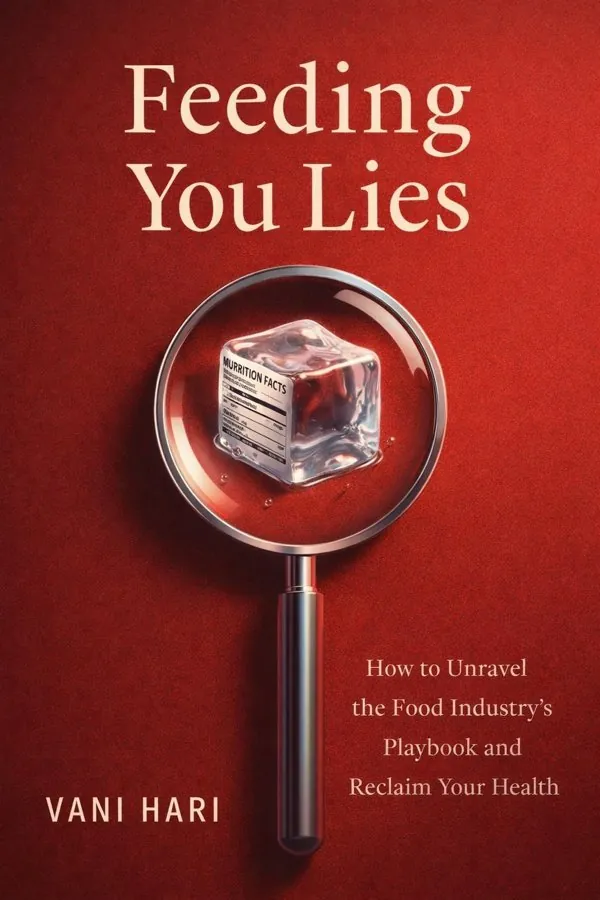
Feeding You Lies: How to Unravel the Food Industry's Playbook and Reclaim Your Health: Summary & Key Insights
by Vani Hari
 10 min8 chaptersAudio available
Key Takeaways from Feeding You Lies: How to Unravel the Food Industry's Playbook and Reclaim Your Health
The most dangerous thing about the food industry is not a single ingredient but the system that makes harmful choices look normal.
Food marketing works best when it feels invisible.
People assume nutrition guidance is built on neutral science, but Hari argues that the reality is often far messier.
What you do not notice in your food can matter more than what you do.
One informed consumer can seem powerless against a multinational corporation, yet Hari insists that awareness is where real leverage begins.
What Is Feeding You Lies: How to Unravel the Food Industry's Playbook and Reclaim Your Health About?
Feeding You Lies: How to Unravel the Food Industry's Playbook and Reclaim Your Health by Vani Hari is a health_med book spanning 5 pages. Feeding You Lies is a forceful investigation into how the modern food industry shapes what people eat, what they believe, and how they understand health. In this book, Vani Hari argues that many packaged foods are sold through a system built on manipulation: scientific studies funded by interested corporations, labels designed to mislead, advertising that exploits emotion, and institutions that often fail to protect consumers. Rather than treating poor health as a matter of weak willpower, she asks readers to examine the commercial forces that normalize ultra-processed ingredients and hide important information in plain sight. What makes the book compelling is its mix of personal awakening, consumer activism, and practical guidance. Hari writes not as a detached academic, but as a health advocate who built a large public platform by challenging food manufacturers and demanding ingredient transparency. Her central message is simple but powerful: if consumers learn how to read labels, question health claims, and understand industry incentives, they can make better choices and pressure companies to change. For anyone confused by nutrition messaging or concerned about processed food, this book offers both a wake-up call and a roadmap.
This FizzRead summary covers all 8 key chapters of Feeding You Lies: How to Unravel the Food Industry's Playbook and Reclaim Your Health in approximately 10 minutes, distilling the most important ideas, arguments, and takeaways from Vani Hari's work. Also available as an audio summary and Key Quotes Podcast.
Feeding You Lies: How to Unravel the Food Industry's Playbook and Reclaim Your Health
Feeding You Lies is a forceful investigation into how the modern food industry shapes what people eat, what they believe, and how they understand health. In this book, Vani Hari argues that many packaged foods are sold through a system built on manipulation: scientific studies funded by interested corporations, labels designed to mislead, advertising that exploits emotion, and institutions that often fail to protect consumers. Rather than treating poor health as a matter of weak willpower, she asks readers to examine the commercial forces that normalize ultra-processed ingredients and hide important information in plain sight.
What makes the book compelling is its mix of personal awakening, consumer activism, and practical guidance. Hari writes not as a detached academic, but as a health advocate who built a large public platform by challenging food manufacturers and demanding ingredient transparency. Her central message is simple but powerful: if consumers learn how to read labels, question health claims, and understand industry incentives, they can make better choices and pressure companies to change. For anyone confused by nutrition messaging or concerned about processed food, this book offers both a wake-up call and a roadmap.
Who Should Read Feeding You Lies: How to Unravel the Food Industry's Playbook and Reclaim Your Health?
This book is perfect for anyone interested in health_med and looking to gain actionable insights in a short read. Whether you're a student, professional, or lifelong learner, the key ideas from Feeding You Lies: How to Unravel the Food Industry's Playbook and Reclaim Your Health by Vani Hari will help you think differently.
- ✓Readers who enjoy health_med and want practical takeaways
- ✓Professionals looking to apply new ideas to their work and life
- ✓Anyone who wants the core insights of Feeding You Lies: How to Unravel the Food Industry's Playbook and Reclaim Your Health in just 10 minutes
Want the full summary?
Get instant access to this book summary and 100K+ more with Fizz Moment.
Get Free SummaryAvailable on App Store • Free to download
Key Chapters
Food marketing works best when it feels invisible. Hari shows how labels, health halos, slogans, and imagery are used to guide buying decisions without requiring outright falsehoods. The most effective deception is often technically legal but psychologically manipulative. Terms like natural, wholesome, light, made with real fruit, or immune-supporting can create the impression of health even when a product remains highly processed and nutritionally weak.
The strategy depends on selective emphasis. A snack may advertise protein while hiding excessive sweeteners. A granola bar may feature oats and nuts on the package while the actual formula depends heavily on syrups and isolates. A children's yogurt may present itself as a smart, fun lunchbox choice while containing dessert-level sugar. The consumer sees one virtue magnified and many concerns minimized.
Hari argues that this marketing is especially powerful because it exploits trust, time pressure, and aspiration. Parents want to feed their children well but often shop quickly. Busy adults want convenience without guilt. Companies design products and messages for exactly these emotional pressures. Even package colors matter: green suggests naturalness, earthy tones imply purity, and athletic imagery signals fitness.
A useful application is to treat front-of-package language as advertising, not evidence. Real evaluation begins with the nutrition panel and ingredient list, not the promises printed in large type. Compare two similar products and notice how differently they present themselves despite similar formulations. When you adopt this habit, you begin to separate story from substance.
Actionable takeaway: create a personal rule that no health claim on the front of a package counts until it is verified by the ingredients, sugar content, additives, and overall processing level on the back.
People assume nutrition guidance is built on neutral science, but Hari argues that the reality is often far messier. One of the book's most provocative claims is that corporations influence public understanding not only through ads but through experts, trade groups, lobbying, and selective research funding. When industries pay for studies, sponsor professional organizations, or support influential voices, they can tilt the conversation toward uncertainty, moderation language, or narrow definitions of harm.
This does not mean all scientists or institutions are corrupt. Hari's point is subtler: conflicts of interest shape what gets studied, how findings are framed, and which conclusions get amplified. A company may fund research that compares its product to something worse rather than to a genuinely healthy alternative. An expert may focus on calorie counts while ignoring additives or processing. A regulatory body may permit ingredients based on outdated assumptions, weak standards, or intense lobbying pressure.
For ordinary readers, the effect is confusion. One week a headline celebrates a food as healthy; the next week another warns against it. This makes people cynical and passive. Hari wants readers to recognize that nutrition debates often involve power, not just evidence. Knowing who funded a study, what was measured, and what was left out can change how persuasive a claim appears.
You can apply this insight whenever you encounter a strong dietary statement in media. Ask: who benefits if I believe this? Was the study independently funded? Does the conclusion match the actual data, or only the press release? Are there broader patterns from multiple studies, not just one attention-grabbing result?
Actionable takeaway: before accepting nutrition advice, look for funding sources, conflicts of interest, and independent confirmation from multiple reputable sources rather than relying on isolated headlines or authority alone.
One informed consumer can seem powerless against a multinational corporation, yet Hari insists that awareness is where real leverage begins. The book repeatedly returns to the idea that food companies respond when people notice, organize, and demand change. Public scrutiny can force reformulations, labeling updates, ingredient removals, and wider conversations that once seemed impossible.
This is one reason Hari frames food literacy as more than a personal wellness hobby. Reading labels, questioning claims, and sharing information are civic acts in a marketplace where corporations spend enormous sums to shape public behavior. When enough customers stop buying a product or challenge a misleading practice, executives pay attention. Brands may resist at first, but reputation risk and market pressure can move faster than regulation.
Examples of this dynamic appear whenever companies quietly alter formulas after public campaigns or adopt standards in one country that they initially resisted elsewhere. Such differences reveal that many formulations are not inevitable; they are strategic. If a company can produce a cleaner version for one market, consumers are right to ask why another market receives lower standards.
On an individual level, awareness also restores dignity. Instead of feeling manipulated, you begin to make decisions with intent. You shop differently, cook more deliberately, and become less vulnerable to fear-based or trend-based food messaging. Awareness does not require perfection. It requires attention and consistency.
A practical way to build this power is to pick one category each week, such as bread, yogurt, cereal, or salad dressing, and compare brands closely. Over time, your shopping habits become less automatic and more informed. Actionable takeaway: treat every purchase as a vote, and use your money, questions, and feedback to reward transparency and reject manipulation.
Many people blame themselves for eating poorly, but Hari argues that the food environment is deliberately designed to overpower restraint. Ultra-processed foods are not simply convenient versions of traditional foods; they are often engineered for craveability, repeat purchase, and broad shelf appeal. Salt, sugar, fat, texture, aroma, and flavor chemistry are combined in ways that make stopping difficult and moderation less natural than it sounds.
This matters because it shifts the conversation from personal weakness to structural reality. If your pantry is full of products built to trigger reward pathways, packaged for portability, and promoted constantly, self-control becomes only one small part of the equation. The environment does much of the deciding before you even feel hungry. End-cap displays, checkout snacks, meal deals, and targeted ads all nudge consumption.
Hari's message is not that tasty food is bad. It is that industrial design often prioritizes compulsion over nourishment. A homemade cookie and a shelf-stable snack cake may both be sweet, but they do not emerge from the same logic. One is food made in a kitchen; the other may be a laboratory-optimized product made to extend shelf life and intensify habit.
To apply this insight, focus first on your surroundings rather than your willpower. Remove the products that repeatedly sabotage your intentions. Make whole or minimally processed options easier to reach. Prep fruit, nuts, eggs, soup, or simple leftovers before you are tired or rushed. Environment redesign reduces decision fatigue.
Actionable takeaway: do not rely on discipline alone; redesign your home, shopping routine, and meal planning so that better choices become the default rather than the exception.
A food label can help you avoid problems, but it cannot by itself create health. Hari encourages readers not to become trapped in an endless scavenger hunt for the least harmful packaged option while forgetting a simpler truth: real, minimally processed foods usually require less interpretation. Fruits, vegetables, legumes, eggs, fish, meats, nuts, seeds, and basic grains often communicate their value more directly than products designed around claims.
This idea reframes healthy eating away from technical perfection and toward food reality. Many consumers spend enormous energy comparing bars, shakes, frozen meals, and breakfast products that all share the same industrial logic. Even if one option is modestly better, the larger opportunity may be to replace the category altogether. Instead of finding the healthiest flavored drink, drink water or unsweetened tea. Instead of the cleanest sweet cereal, choose eggs or oatmeal. Better substitutions often beat better branding.
Hari is careful to recognize that modern life includes convenience needs. People work long hours, travel, and care for families. The goal is not to eliminate every packaged product but to build a hierarchy: start with real food when possible, use cleaner packaged items strategically, and avoid turning marketing claims into your definition of health.
A practical method is the "ingredient purpose" test. Ask whether the ingredients look like components of a meal or components of a manufactured product. Chickpeas, tahini, olive oil, lemon, and salt resemble a kitchen. Stabilizers, gums, flavors, colors, and isolates point toward industrial assembly.
Actionable takeaway: let labels help you screen products, but make your core diet revolve around foods that do not need persuasive packaging to justify their place on your plate.
One of the book's strongest themes is that recovery of health often starts with a mental shift before a dietary one. Hari describes how many people assume that if a product is widely sold, endorsed by authorities, or placed in the health-food aisle, it must be reasonably safe and beneficial. She challenges that assumption directly. The path to better health begins when consumers give themselves permission to question what they have been taught.
This questioning is not meant to create paranoia. It is meant to replace passive trust with active discernment. Why is a product marketed as healthy? Why does it contain so many ingredients? Why are children targeted so aggressively? Why do certain additives appear in one country but not another? Why are consumers expected to decode misleading labels instead of receiving straightforward information? By asking these questions, you become harder to manipulate.
Hari also connects this mindset to bodily awareness. If a food repeatedly leaves you sluggish, bloated, overly hungry, or craving more, that experience matters. Numbers on a package do not tell the whole story. Your own response can reveal whether something marketed as balanced or convenient actually supports your well-being.
In practice, questioning assumptions may involve keeping a simple food journal, trying a short reset away from heavily processed items, or auditing your pantry for products you buy out of habit rather than intention. These steps help turn abstract skepticism into observable evidence.
Actionable takeaway: choose one food or beverage you currently trust, investigate its ingredients and claims, notice how it affects you, and decide whether that trust is still earned.
All Chapters in Feeding You Lies: How to Unravel the Food Industry's Playbook and Reclaim Your Health
About the Author
Vani Hari is an American author, speaker, and food activist best known as the founder of the Food Babe brand. She rose to prominence by campaigning for greater transparency in the food industry and urging major companies to remove artificial ingredients, dyes, and other additives from their products. Through her writing, online platform, and consumer advocacy, she has helped popularize label reading and public scrutiny of processed foods. Hari's work focuses on the relationship between corporate power, ingredient disclosure, and personal health, often translating complex food issues into accessible guidance for everyday consumers. While her outspoken style has attracted both strong support and criticism, she remains a prominent voice in the movement for cleaner food, informed shopping, and greater accountability from food manufacturers.
Get This Summary in Your Preferred Format
Read or listen to the Feeding You Lies: How to Unravel the Food Industry's Playbook and Reclaim Your Health summary by Vani Hari anytime, anywhere. FizzRead offers multiple formats so you can learn on your terms — all free.
Available formats: App · Audio · PDF · EPUB — All included free with FizzRead
Download Feeding You Lies: How to Unravel the Food Industry's Playbook and Reclaim Your Health PDF and EPUB Summary
Key Quotes from Feeding You Lies: How to Unravel the Food Industry's Playbook and Reclaim Your Health
“The most dangerous thing about the food industry is not a single ingredient but the system that makes harmful choices look normal.”
“Food marketing works best when it feels invisible.”
“People assume nutrition guidance is built on neutral science, but Hari argues that the reality is often far messier.”
“What you do not notice in your food can matter more than what you do.”
“One informed consumer can seem powerless against a multinational corporation, yet Hari insists that awareness is where real leverage begins.”
Frequently Asked Questions about Feeding You Lies: How to Unravel the Food Industry's Playbook and Reclaim Your Health
Feeding You Lies: How to Unravel the Food Industry's Playbook and Reclaim Your Health by Vani Hari is a health_med book that explores key ideas across 8 chapters. Feeding You Lies is a forceful investigation into how the modern food industry shapes what people eat, what they believe, and how they understand health. In this book, Vani Hari argues that many packaged foods are sold through a system built on manipulation: scientific studies funded by interested corporations, labels designed to mislead, advertising that exploits emotion, and institutions that often fail to protect consumers. Rather than treating poor health as a matter of weak willpower, she asks readers to examine the commercial forces that normalize ultra-processed ingredients and hide important information in plain sight. What makes the book compelling is its mix of personal awakening, consumer activism, and practical guidance. Hari writes not as a detached academic, but as a health advocate who built a large public platform by challenging food manufacturers and demanding ingredient transparency. Her central message is simple but powerful: if consumers learn how to read labels, question health claims, and understand industry incentives, they can make better choices and pressure companies to change. For anyone confused by nutrition messaging or concerned about processed food, this book offers both a wake-up call and a roadmap.
You Might Also Like

On Immunity
Eula Biss
10 min
The Three-Body Problem
Liu Cixin
10 min
Community Health Volunteer Toolkit: Training and Practical Activities
World Health Organization
10 min
Healing Back Pain: The Mind-Body Connection
John E. Sarno
10 min
Health Literacy for All: Practical Guides to Communicate Health Information (Compilations)
World Health Organization
10 min
The Complete Guide to Sports Supplements: An Evidence-Based Review
Anita Bean
10 minBrowse by Category
Ready to read Feeding You Lies: How to Unravel the Food Industry's Playbook and Reclaim Your Health?
Get the full summary and 100K+ more books with Fizz Moment.