
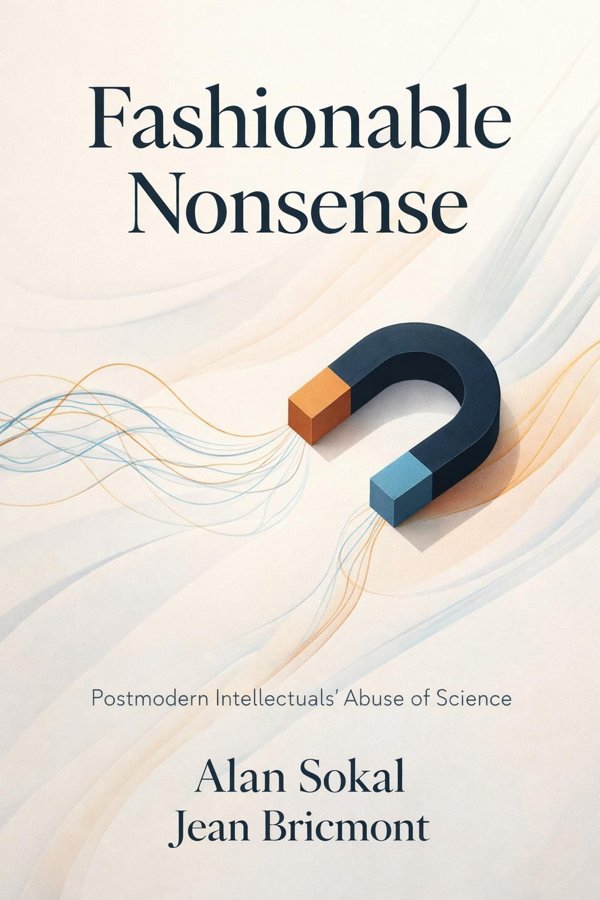
Fashionable Nonsense: Postmodern Intellectuals' Abuse of Science: Summary & Key Insights
 10 min11 chaptersAudio available
What Is Fashionable Nonsense: Postmodern Intellectuals' Abuse of Science About?
Fashionable Nonsense: Postmodern Intellectuals' Abuse of Science by Alan Sokal, Jean Bricmont is a philosophy book spanning 11 pages. Fashionable Nonsense (originally published in French as 'Impostures intellectuelles') is a critical examination of how certain postmodernist thinkers have misused scientific and mathematical concepts. The authors, physicists Alan Sokal and Jean Bricmont, analyze writings by prominent intellectuals such as Lacan, Kristeva, Irigaray, Baudrillard, and Deleuze, arguing that these figures employ scientific terminology in ways that are either meaningless or misleading. The book sparked significant debate about the relationship between science and the humanities, and about intellectual rigor in cultural theory.
This FizzRead summary covers all 11 key chapters of Fashionable Nonsense: Postmodern Intellectuals' Abuse of Science in approximately 10 minutes, distilling the most important ideas, arguments, and takeaways from Alan Sokal, Jean Bricmont's work. Also available as an audio summary and Key Quotes Podcast.
Fashionable Nonsense: Postmodern Intellectuals' Abuse of Science
Fashionable Nonsense (originally published in French as 'Impostures intellectuelles') is a critical examination of how certain postmodernist thinkers have misused scientific and mathematical concepts. The authors, physicists Alan Sokal and Jean Bricmont, analyze writings by prominent intellectuals such as Lacan, Kristeva, Irigaray, Baudrillard, and Deleuze, arguing that these figures employ scientific terminology in ways that are either meaningless or misleading. The book sparked significant debate about the relationship between science and the humanities, and about intellectual rigor in cultural theory.
Who Should Read Fashionable Nonsense: Postmodern Intellectuals' Abuse of Science?
This book is perfect for anyone interested in philosophy and looking to gain actionable insights in a short read. Whether you're a student, professional, or lifelong learner, the key ideas from Fashionable Nonsense: Postmodern Intellectuals' Abuse of Science by Alan Sokal, Jean Bricmont will help you think differently.
- ✓Readers who enjoy philosophy and want practical takeaways
- ✓Professionals looking to apply new ideas to their work and life
- ✓Anyone who wants the core insights of Fashionable Nonsense: Postmodern Intellectuals' Abuse of Science in just 10 minutes
Want the full summary?
Get instant access to this book summary and 100K+ more with Fizz Moment.
Get Free SummaryAvailable on App Store • Free to download
Key Chapters
Before writing 'Fashionable Nonsense', I carried out what later became known as the 'Sokal Affair'. I submitted a deliberately nonsensical paper—stuffed with pseudo-scientific jargon and flattering allusions to postmodern theory—to a cultural studies journal, and it was published without a hint of skepticism. That moment confirmed our suspicion: some academic circles had drifted so far into linguistic self-enchantment that the basic norms of meaningful argument were neglected. The Affair was not intended as humiliation, but as diagnosis. It demonstrated that style had begun to outweigh content, that critical judgment was often displaced by ideological conformity.
Through that backdrop, this book seeks to expose why such errors happen. When theoretical discourse prizes obscurity over explanation, it becomes vulnerable to abuses of scientific language. Terms like 'nonlinearity' or 'quantum discontinuity' carry technical meanings developed through decades of experiment and abstraction. But when transported into cultural commentary, they often serve merely to suggest profundity, not convey it. A passage brimming with mathematical metaphors might impress the unspecialized reader but collapse under scrutiny. Our method in the book is empirical—we quote passages verbatim, we analyze them grammatically and semantically, and we ask: does this usage make sense within any scientific framework? Time after time, the answer is no.
The deeper significance lies in the moral dimension of scholarship. Rigor is not a property of the natural sciences alone—it is a moral stance, a willingness to test one’s ideas against evidence and coherence. In the absence of this stance, intellectual discourse degenerates into performance. The Sokal Affair was not about one fraudulent article; it was a mirror showing a culture infatuated with abstraction unmoored from precision. 'Fashionable Nonsense' became our extended reflection on that mirror image.
Postmodernism emerged as a rebellion against grand narratives—against the confidence that reason could yield universal truths. It was a movement born from historical disappointment, a reaction to the failures of ideological totalities. In literature and philosophy, it brought refreshing diversity and self-awareness. But in some hands, its skepticism spiraled into denial of rational discourse itself. In the book, we acknowledge the rich intellectual roots of postmodernism—from Lyotard’s critique of metanarratives to Derrida’s deconstruction—but we focus on its damaging excesses. When science becomes merely a story among stories, we lose the distinction between empirical constraint and imaginative freedom.
What we found disturbing was not the questioning of scientific authority—that can be valuable—but the casual misuse of scientific formalisms as poetic ornaments. Authors cited quantum mechanics or Gödel’s theorem in discussions of social identity, sometimes arguing that uncertainty in physics justifies relativism in ethics. This conflation undermines both fields. Postmodernism’s initial promise, to resist dogmatism, dissolves when it replaces precision with fashionable vagueness. Our critique is thus not against creativity, but against intellectual irresponsibility.
We urge readers to respect both the beauty and limits of science. Interdisciplinarity requires dialogue, not appropriation. A philosopher may engage with the implications of relativity, but must do so by understanding what relativity actually means. Otherwise, discourse becomes an echo chamber where terminology performs prestige. Throughout 'Fashionable Nonsense', this is the recurring theme: the drift from insight to obscurantism and the cultural celebration of opacity as depth. We aim to show that clarity is not naïve—it is courageous.
+ 9 more chapters — available in the FizzRead app
All Chapters in Fashionable Nonsense: Postmodern Intellectuals' Abuse of Science
About the Authors
Alan Sokal is an American physicist and professor known for his work in statistical mechanics and for the 'Sokal Affair', a hoax that exposed issues in academic publishing. Jean Bricmont is a Belgian theoretical physicist and philosopher of science, recognized for his contributions to quantum mechanics and his critiques of postmodernism.
Get This Summary in Your Preferred Format
Read or listen to the Fashionable Nonsense: Postmodern Intellectuals' Abuse of Science summary by Alan Sokal, Jean Bricmont anytime, anywhere. FizzRead offers multiple formats so you can learn on your terms — all free.
Available formats: App · Audio · PDF · EPUB — All included free with FizzRead
Download Fashionable Nonsense: Postmodern Intellectuals' Abuse of Science PDF and EPUB Summary
Key Quotes from Fashionable Nonsense: Postmodern Intellectuals' Abuse of Science
“Before writing 'Fashionable Nonsense', I carried out what later became known as the 'Sokal Affair'.”
“Postmodernism emerged as a rebellion against grand narratives—against the confidence that reason could yield universal truths.”
Frequently Asked Questions about Fashionable Nonsense: Postmodern Intellectuals' Abuse of Science
Fashionable Nonsense: Postmodern Intellectuals' Abuse of Science by Alan Sokal, Jean Bricmont is a philosophy book that explores key ideas across 11 chapters. Fashionable Nonsense (originally published in French as 'Impostures intellectuelles') is a critical examination of how certain postmodernist thinkers have misused scientific and mathematical concepts. The authors, physicists Alan Sokal and Jean Bricmont, analyze writings by prominent intellectuals such as Lacan, Kristeva, Irigaray, Baudrillard, and Deleuze, arguing that these figures employ scientific terminology in ways that are either meaningless or misleading. The book sparked significant debate about the relationship between science and the humanities, and about intellectual rigor in cultural theory.
You Might Also Like


Browse by Category
Ready to read Fashionable Nonsense: Postmodern Intellectuals' Abuse of Science?
Get the full summary and 100K+ more books with Fizz Moment.