
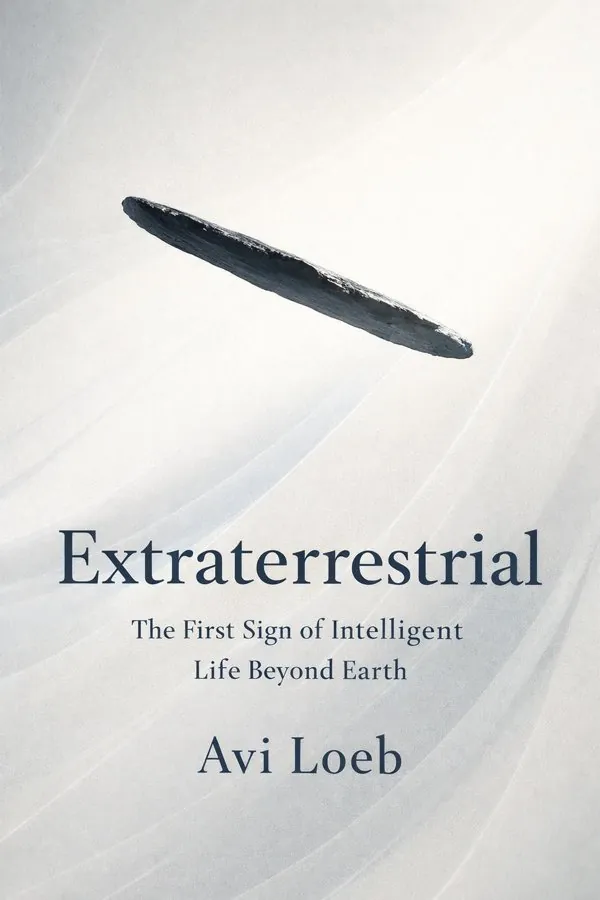
Extraterrestrial: The First Sign of Intelligent Life Beyond Earth: Summary & Key Insights
by Avi Loeb
 10 min10 chaptersAudio available
What Is Extraterrestrial: The First Sign of Intelligent Life Beyond Earth About?
Extraterrestrial: The First Sign of Intelligent Life Beyond Earth by Avi Loeb is a popular_sci book spanning 10 pages. In this groundbreaking work, Harvard astronomer Avi Loeb argues that the interstellar object ‘Oumuamua, which passed through our solar system in 2017, may be the first evidence of intelligent life beyond Earth. Loeb challenges conventional scientific thinking and invites readers to consider the possibility that humanity has already encountered technology from another civilization.
This FizzRead summary covers all 10 key chapters of Extraterrestrial: The First Sign of Intelligent Life Beyond Earth in approximately 10 minutes, distilling the most important ideas, arguments, and takeaways from Avi Loeb's work. Also available as an audio summary and Key Quotes Podcast.
Extraterrestrial: The First Sign of Intelligent Life Beyond Earth
In this groundbreaking work, Harvard astronomer Avi Loeb argues that the interstellar object ‘Oumuamua, which passed through our solar system in 2017, may be the first evidence of intelligent life beyond Earth. Loeb challenges conventional scientific thinking and invites readers to consider the possibility that humanity has already encountered technology from another civilization.
Who Should Read Extraterrestrial: The First Sign of Intelligent Life Beyond Earth?
This book is perfect for anyone interested in popular_sci and looking to gain actionable insights in a short read. Whether you're a student, professional, or lifelong learner, the key ideas from Extraterrestrial: The First Sign of Intelligent Life Beyond Earth by Avi Loeb will help you think differently.
- ✓Readers who enjoy popular_sci and want practical takeaways
- ✓Professionals looking to apply new ideas to their work and life
- ✓Anyone who wants the core insights of Extraterrestrial: The First Sign of Intelligent Life Beyond Earth in just 10 minutes
Want the full summary?
Get instant access to this book summary and 100K+ more with Fizz Moment.
Get Free SummaryAvailable on App Store • Free to download
Key Chapters
On October 19, 2017, astronomers operating the Pan-STARRS telescope in Hawaii spotted a faint object moving rapidly across the sky. At first, its motion suggested a typical asteroid orbiting the Sun—but detailed calculations soon told a different story. Its hyperbolic trajectory could not be bound by solar gravity; this object had entered our solar system from interstellar space and was already on its way out. We named it ‘Oumuamua—a fitting term meaning “a messenger from afar arriving first.”
Initially, excitement surged through the astrophysics community: this was the first interstellar object ever detected. Yet within days, puzzling features emerged. Its brightness varied drastically, implying an elongated form—perhaps ten times longer than its width. Its surface lacked the typical cometary tail, showing no evidence of volatile gases escaping when heated by the Sun. Equally intriguing was its speed and direction, consistent with no known family of solar system bodies. For scientists accustomed to well-characterized phenomena, ‘Oumuamua was a stubborn outsider.
I vividly recall the nights poring over observational data: how the light curve shifted unpredictably, how the reflected sunlight suggested a smooth and bright surface. I asked myself what could account for such distinct physical behavior. The standard models of asteroids and comets—the rocky, icy fragments that populate our neighborhood—simply couldn’t explain it. This was the turning point: for the first time in my career, I felt we were dealing with something fundamentally new.
This background is more than a catalog of facts—it is the starting line of a challenge. Every detail of ‘Oumuamua’s motion and structure nudged us toward deeper questions about what kinds of objects populate the galaxy. To explore it rigorously was to test the limits of imagination itself. And that is precisely what science should do: not shield us from the unknown, but guide us toward it.
As measurements accumulated, the anomalies surrounding ‘Oumuamua grew impossible to ignore. The most striking was its acceleration away from the Sun. Normally, comets accelerate because they release gas and dust under solar heating—a process called outgassing that acts like a natural rocket. But extensive monitoring found no trace of such emission. No tail, no coma, nothing. This defied the predictive frameworks astronomy had relied upon for decades.
I remember the analytical debates in conference rooms and on email threads—arguments about whether small bursts of unseen gas could still explain the acceleration. The data, however, spoke clearly. Even if there were hidden outgassing, it would have produced detectable torque, altering the object’s rotation. Yet the object’s spin remained stable. Furthermore, its reflectivity suggested a mirror-like surface, unusual for naturally formed rocks. Each discrepancy deepened the mystery.
Another anomaly lay in its proportions. Its dramatic variation in brightness during rotation implied an aspect ratio of at least five to one—unprecedented among known asteroids. Some speculated that it might be pancake-shaped rather than cigar-like, but either geometry made it unique. This extreme shape raised questions about formation mechanisms. No known natural process could easily mold such a thin, flat body capable of surviving interstellar travel intact.
To me, these anomalies weren’t obstacles—they were clues. They suggested physics that operated beyond our conventional inventory of space objects. When nature seems too strained to fit the evidence, one must consider alternatives. It is at this juncture that I began evaluating whether some form of artificial origin, consistent with these observational features, could exist. That is the essence of scientific curiosity: when reality diverges from expectation, explanation must follow truth, not comfort.
+ 8 more chapters — available in the FizzRead app
All Chapters in Extraterrestrial: The First Sign of Intelligent Life Beyond Earth
About the Author
Avi Loeb is an Israeli-American theoretical physicist and astrophysicist. He is the Frank B. Baird Jr. Professor of Science at Harvard University and has served as chair of the Department of Astronomy. Loeb is known for his research on black holes, the early universe, and the search for extraterrestrial life.
Get This Summary in Your Preferred Format
Read or listen to the Extraterrestrial: The First Sign of Intelligent Life Beyond Earth summary by Avi Loeb anytime, anywhere. FizzRead offers multiple formats so you can learn on your terms — all free.
Available formats: App · Audio · PDF · EPUB — All included free with FizzRead
Download Extraterrestrial: The First Sign of Intelligent Life Beyond Earth PDF and EPUB Summary
Key Quotes from Extraterrestrial: The First Sign of Intelligent Life Beyond Earth
“On October 19, 2017, astronomers operating the Pan-STARRS telescope in Hawaii spotted a faint object moving rapidly across the sky.”
“As measurements accumulated, the anomalies surrounding ‘Oumuamua grew impossible to ignore.”
Frequently Asked Questions about Extraterrestrial: The First Sign of Intelligent Life Beyond Earth
Extraterrestrial: The First Sign of Intelligent Life Beyond Earth by Avi Loeb is a popular_sci book that explores key ideas across 10 chapters. In this groundbreaking work, Harvard astronomer Avi Loeb argues that the interstellar object ‘Oumuamua, which passed through our solar system in 2017, may be the first evidence of intelligent life beyond Earth. Loeb challenges conventional scientific thinking and invites readers to consider the possibility that humanity has already encountered technology from another civilization.
You Might Also Like

Structures: Or Why Things Don"t Fall Down
J.E. Gordon
10 min
The Road to Wigan Pier
George Orwell
10 min
Bonk: The Curious Coupling of Science and Sex
Mary Roach
10 min
First Bite: How We Learn to Eat
Bee Wilson
10 min
In Pursuit Of The Unknown: 17 Equations That Changed The World
Ian Stewart
10 min
Napoleon's Buttons: 17 Molecules That Changed History
Penny Le Couteur and Jay Burreson
10 minBrowse by Category
Ready to read Extraterrestrial: The First Sign of Intelligent Life Beyond Earth?
Get the full summary and 100K+ more books with Fizz Moment.