
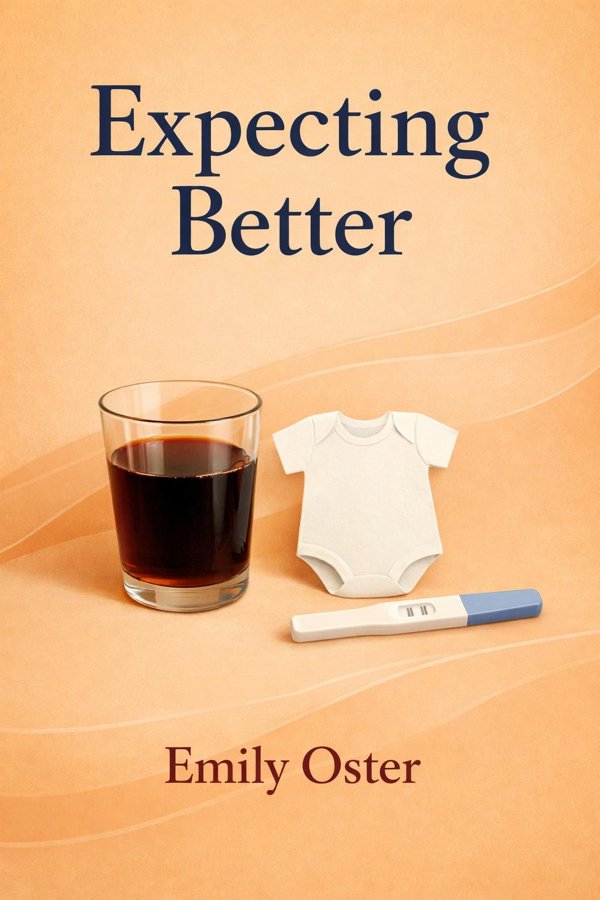
Expecting Better: Why the Conventional Pregnancy Wisdom Is Wrong—and What You Really Need to Know: Summary & Key Insights
by Emily Oster
 10 min10 chaptersAudio available
What Is Expecting Better: Why the Conventional Pregnancy Wisdom Is Wrong—and What You Really Need to Know About?
Expecting Better: Why the Conventional Pregnancy Wisdom Is Wrong—and What You Really Need to Know by Emily Oster is a health_med book spanning 10 pages. In this groundbreaking book, economist Emily Oster applies data analysis to pregnancy, challenging conventional medical advice and empowering women to make informed decisions. Drawing on extensive research, she examines topics such as caffeine, alcohol, exercise, and prenatal testing, offering evidence-based insights that help expectant mothers navigate pregnancy with confidence and clarity.
This FizzRead summary covers all 10 key chapters of Expecting Better: Why the Conventional Pregnancy Wisdom Is Wrong—and What You Really Need to Know in approximately 10 minutes, distilling the most important ideas, arguments, and takeaways from Emily Oster's work. Also available as an audio summary and Key Quotes Podcast.
Expecting Better: Why the Conventional Pregnancy Wisdom Is Wrong—and What You Really Need to Know
In this groundbreaking book, economist Emily Oster applies data analysis to pregnancy, challenging conventional medical advice and empowering women to make informed decisions. Drawing on extensive research, she examines topics such as caffeine, alcohol, exercise, and prenatal testing, offering evidence-based insights that help expectant mothers navigate pregnancy with confidence and clarity.
Who Should Read Expecting Better: Why the Conventional Pregnancy Wisdom Is Wrong—and What You Really Need to Know?
This book is perfect for anyone interested in health_med and looking to gain actionable insights in a short read. Whether you're a student, professional, or lifelong learner, the key ideas from Expecting Better: Why the Conventional Pregnancy Wisdom Is Wrong—and What You Really Need to Know by Emily Oster will help you think differently.
- ✓Readers who enjoy health_med and want practical takeaways
- ✓Professionals looking to apply new ideas to their work and life
- ✓Anyone who wants the core insights of Expecting Better: Why the Conventional Pregnancy Wisdom Is Wrong—and What You Really Need to Know in just 10 minutes
Want the full summary?
Get instant access to this book summary and 100K+ more with Fizz Moment.
Get Free SummaryAvailable on App Store • Free to download
Key Chapters
When you think like an economist, every choice begins with two questions: What are the potential outcomes, and what are the probabilities of each? Throughout pregnancy, you are flooded with advice that ignores these questions entirely. Instead of being told, “Don’t,” I wanted to know, “What happens if I do, and how likely is it?” That shift in thinking changes everything.
I emphasize that risk is not absolute. For example, if a certain food increases the risk of infection by one in a million, that’s very different from one in a hundred. Yet both are often lumped together as “unsafe.” My approach doesn’t mean dismissing rare dangers, but it allows you to measure whether the tradeoff—say, the joy of sushi versus an infinitesimal risk of illness—is worthwhile for you.
The core of evidence-based decision-making lies in distinguishing correlation from causation. A study may show that women who drink coffee have slightly higher rates of miscarriage. But are the caffeine molecules causing that, or are these women experiencing early pregnancy symptoms that reduce caffeine cravings only after miscarriage risk naturally declines? Understanding these nuances lets us see that science rarely gives us simple do’s and don’ts—it gives us probabilities, confidence intervals, and trends, all of which need interpretation.
I also discuss why much of the fear-based pregnancy advice persists. Often, it’s easier for medical professionals to issue blanket prohibitions than to explain complex statistics. But as expecting mothers, we deserve better—to be partners in decisions rather than passive recipients of cautionary tales. A data-driven framework gives you back that sense of agency.
The first trimester is often the most emotionally complicated phase of pregnancy. It’s a time when joy coexists with uncertainty—when the risk of miscarriage is highest, symptoms are strongest, and decisions can feel simultaneously urgent and opaque. Here, I lay out what the data actually tells us about those early weeks.
Miscarriage, while heartbreaking, is more common than most realize, with about one in five recognized pregnancies ending within the first trimester. Understanding probabilities doesn’t make loss easier, but it provides perspective: most miscarriages are caused by chromosomal abnormalities, not by something you did. This matters deeply, because so many women carry guilt, thinking they “caused” it by exercising, working too hard, or drinking coffee. Data shows that these factors rarely contribute significantly.
I also analyze prenatal testing, which enters the conversation early with tools like the nuchal translucency measurement and blood tests for chromosomal anomalies. These screenings are about probabilities too: a positive test doesn’t mean your baby has a condition, but that further testing—often amniocentesis or chorionic villus sampling—can clarify the likelihood. I guide readers through interpreting these results with the same logic economists apply to conditional probabilities, helping you understand what “99% accurate” actually means.
+ 8 more chapters — available in the FizzRead app
All Chapters in Expecting Better: Why the Conventional Pregnancy Wisdom Is Wrong—and What You Really Need to Know
About the Author
Emily Oster is an American economist and professor at Brown University. She is known for her work on health economics and data-driven decision-making, as well as for her bestselling books that apply statistical reasoning to everyday life choices, including pregnancy and parenting.
Get This Summary in Your Preferred Format
Read or listen to the Expecting Better: Why the Conventional Pregnancy Wisdom Is Wrong—and What You Really Need to Know summary by Emily Oster anytime, anywhere. FizzRead offers multiple formats so you can learn on your terms — all free.
Available formats: App · Audio · PDF · EPUB — All included free with FizzRead
Download Expecting Better: Why the Conventional Pregnancy Wisdom Is Wrong—and What You Really Need to Know PDF and EPUB Summary
Key Quotes from Expecting Better: Why the Conventional Pregnancy Wisdom Is Wrong—and What You Really Need to Know
“When you think like an economist, every choice begins with two questions: What are the potential outcomes, and what are the probabilities of each?”
“The first trimester is often the most emotionally complicated phase of pregnancy.”
Frequently Asked Questions about Expecting Better: Why the Conventional Pregnancy Wisdom Is Wrong—and What You Really Need to Know
Expecting Better: Why the Conventional Pregnancy Wisdom Is Wrong—and What You Really Need to Know by Emily Oster is a health_med book that explores key ideas across 10 chapters. In this groundbreaking book, economist Emily Oster applies data analysis to pregnancy, challenging conventional medical advice and empowering women to make informed decisions. Drawing on extensive research, she examines topics such as caffeine, alcohol, exercise, and prenatal testing, offering evidence-based insights that help expectant mothers navigate pregnancy with confidence and clarity.
More by Emily Oster

You Might Also Like

On Immunity
Eula Biss
10 min
The Three-Body Problem
Liu Cixin
10 min
Community Health Volunteer Toolkit: Training and Practical Activities
World Health Organization
10 min
Healing Back Pain: The Mind-Body Connection
John E. Sarno
10 min
Health Literacy for All: Practical Guides to Communicate Health Information (Compilations)
World Health Organization
10 min
The Complete Guide to Sports Supplements: An Evidence-Based Review
Anita Bean
10 minBrowse by Category
Ready to read Expecting Better: Why the Conventional Pregnancy Wisdom Is Wrong—and What You Really Need to Know?
Get the full summary and 100K+ more books with Fizz Moment.