
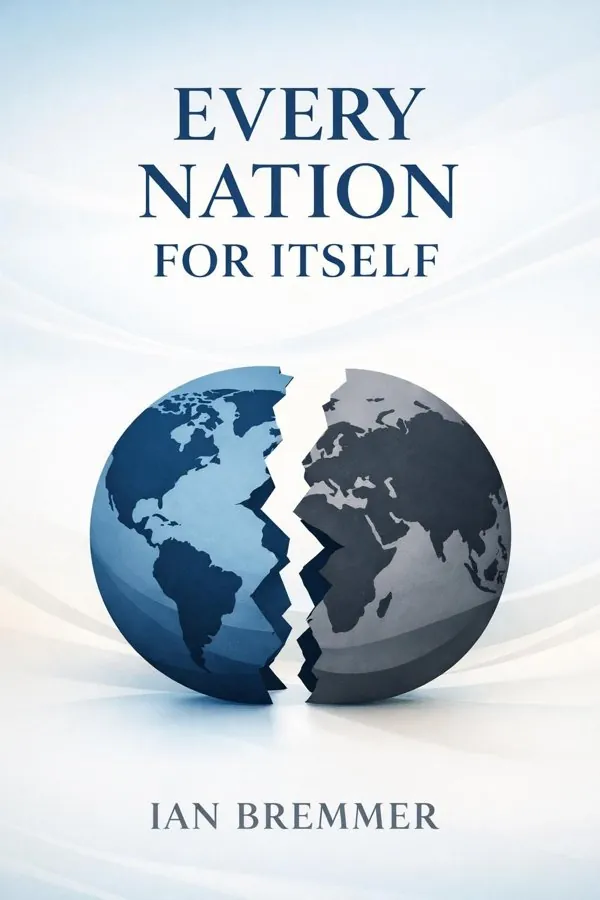
Every Nation for Itself: Winners and Losers in a G-Zero World: Summary & Key Insights
by Ian Bremmer
 10 min5 chaptersAudio available
What Is Every Nation for Itself: Winners and Losers in a G-Zero World About?
Every Nation for Itself: Winners and Losers in a G-Zero World by Ian Bremmer is a politics book spanning 5 pages. In 'Every Nation for Itself', political scientist Ian Bremmer explores the concept of the G-Zero world—a global order in which no single country or alliance of countries can provide consistent international leadership. Bremmer argues that the decline of U.S. dominance and the absence of a clear successor have created a vacuum in global governance, leading to instability and competition among nations. The book analyzes how different countries and regions adapt to this new reality and what strategies can help them thrive amid uncertainty.
This FizzRead summary covers all 5 key chapters of Every Nation for Itself: Winners and Losers in a G-Zero World in approximately 10 minutes, distilling the most important ideas, arguments, and takeaways from Ian Bremmer's work. Also available as an audio summary and Key Quotes Podcast.
Every Nation for Itself: Winners and Losers in a G-Zero World
In 'Every Nation for Itself', political scientist Ian Bremmer explores the concept of the G-Zero world—a global order in which no single country or alliance of countries can provide consistent international leadership. Bremmer argues that the decline of U.S. dominance and the absence of a clear successor have created a vacuum in global governance, leading to instability and competition among nations. The book analyzes how different countries and regions adapt to this new reality and what strategies can help them thrive amid uncertainty.
Who Should Read Every Nation for Itself: Winners and Losers in a G-Zero World?
This book is perfect for anyone interested in politics and looking to gain actionable insights in a short read. Whether you're a student, professional, or lifelong learner, the key ideas from Every Nation for Itself: Winners and Losers in a G-Zero World by Ian Bremmer will help you think differently.
- ✓Readers who enjoy politics and want practical takeaways
- ✓Professionals looking to apply new ideas to their work and life
- ✓Anyone who wants the core insights of Every Nation for Itself: Winners and Losers in a G-Zero World in just 10 minutes
Want the full summary?
Get instant access to this book summary and 100K+ more with Fizz Moment.
Get Free SummaryAvailable on App Store • Free to download
Key Chapters
To understand the G-Zero world, we first have to recognize how the grand structure of international leadership has evolved — and decayed. During the Cold War, the global system was defined by clear polarity. The United States and the Soviet Union provided not only competing ideologies but also frameworks for allies and adversaries alike. There was a grim kind of stability in this competition, as every nation knew its place within the bipolar chessboard. That order was followed by what I call the 'unipolar moment' — a period from roughly 1991 through the early 2000s when American economic, military, and cultural power seemed unrivaled. Washington was the final arbiter of global stability, the nation others both depended on and resented.
But this supremacy was never destined to last. The Iraq War exposed the limits of American power — militarily overstretched, politically divided, and economically strained. The 2008 financial crisis further undermined confidence in the U.S.-led global model. The rules-based order that had once seemed immutable began to fray as trust in Western leadership diminished. Meanwhile, new centers of influence emerged, none yet ready or willing to replace the United States as the system’s stabilizer. In this void, we began to see the outlines of the G-Zero world take shape: a landscape of shifting expectations and waning commitments.
In this atmosphere, leadership ceased to be about dominance; it became a negotiation over responsibility. The question was no longer who could lead, but who would dare to. Increasingly, no one did — and that withdrawal from leadership has come to define our time.
China, India, Brazil — these names conjure visions of energy, growth, and shifting global balance. Yet one of the paradoxes of the G-Zero world is that even as power diffuses eastward and southward, the appetite for global leadership has not followed. Each of these countries has its own priorities and constraints. China, for instance, has shown remarkable capacity for economic transformation, but it remains internally focused — preoccupied with sustaining growth, managing inequality, and preserving social stability. Its foreign policy is pragmatic and regional: securing resources, protecting markets, and building quiet influence through institutions like the Asian Infrastructure Investment Bank. But global stewardship — taking action on issues like security or climate change purely for the collective good — remains beyond its scope.
India exhibits a different pattern. It embraces its democratic identity and occasionally aspires to greater global voice, yet its domestic challenges — from poverty and infrastructure gaps to bureaucratic complexity — hold it back. Brazil, too, with all its regional promise, exemplifies this ambivalence: a country rich in resources and ideas but rarely assertive beyond its neighborhood.
What unites these emerging powers is not a shared vision for the world but a shared unwillingness to bear the costs of leadership. In the G-Zero order, influence is no longer synonymous with responsibility. As a result, global governance erodes into a series of tactical alignments — flexible, transactional, and short-lived. Nations collaborate on specific issues but avoid overarching commitments. In this context, the idea of a 'new G20' or a 'rising China-led order' remains premature. The G-Zero world is not multipolar; it is apolar — an arena where everyone looks inward just when global coordination is most needed.
+ 3 more chapters — available in the FizzRead app
All Chapters in Every Nation for Itself: Winners and Losers in a G-Zero World
About the Author
Ian Bremmer is an American political scientist and founder of Eurasia Group, a leading political risk research and consulting firm. He is known for his analysis of global political trends and the intersection of politics and economics. Bremmer has authored several influential books on international relations and global risk.
Get This Summary in Your Preferred Format
Read or listen to the Every Nation for Itself: Winners and Losers in a G-Zero World summary by Ian Bremmer anytime, anywhere. FizzRead offers multiple formats so you can learn on your terms — all free.
Available formats: App · Audio · PDF · EPUB — All included free with FizzRead
Download Every Nation for Itself: Winners and Losers in a G-Zero World PDF and EPUB Summary
Key Quotes from Every Nation for Itself: Winners and Losers in a G-Zero World
“To understand the G-Zero world, we first have to recognize how the grand structure of international leadership has evolved — and decayed.”
“China, India, Brazil — these names conjure visions of energy, growth, and shifting global balance.”
Frequently Asked Questions about Every Nation for Itself: Winners and Losers in a G-Zero World
Every Nation for Itself: Winners and Losers in a G-Zero World by Ian Bremmer is a politics book that explores key ideas across 5 chapters. In 'Every Nation for Itself', political scientist Ian Bremmer explores the concept of the G-Zero world—a global order in which no single country or alliance of countries can provide consistent international leadership. Bremmer argues that the decline of U.S. dominance and the absence of a clear successor have created a vacuum in global governance, leading to instability and competition among nations. The book analyzes how different countries and regions adapt to this new reality and what strategies can help them thrive amid uncertainty.
More by Ian Bremmer
You Might Also Like
Antifa: The Anti-Fascist Handbook
Mark Bray
10 min
Attack from Within: How Disinformation Is Sabotaging America
Barbara McQuade
10 min
Coercion, Capital, and European States, AD 990–1992
Charles Tilly
10 min
Digital Democracy: Concepts, Methodologies, Tools, and Applications
Various Authors
10 min
Fascism
Stanley G. Payne
10 min
Fire And Fury: Inside The Trump White House
Michael Wolff
10 minBrowse by Category
Ready to read Every Nation for Itself: Winners and Losers in a G-Zero World?
Get the full summary and 100K+ more books with Fizz Moment.