
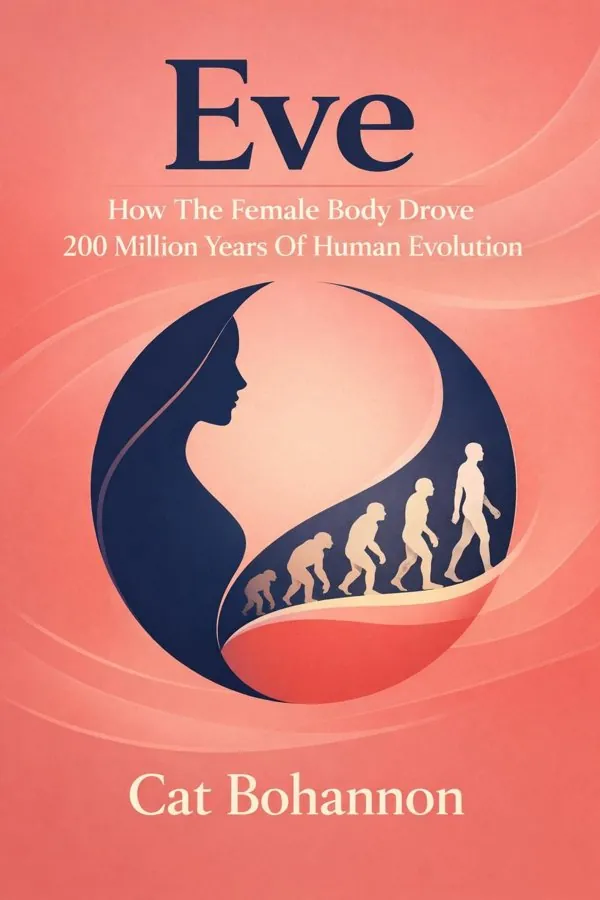
Eve: How The Female Body Drove 200 Million Years Of Human Evolution: Summary & Key Insights
by Cat Bohannon
 10 min10 chaptersAudio available
Key Takeaways from Eve: How The Female Body Drove 200 Million Years Of Human Evolution
A revolution in evolution began not with claws or bigger brains, but with mothers.
Pregnancy feels like a symbol of harmony, but evolution reveals it as a tense negotiation.
Human birth is unusually difficult, and that difficulty changed everything.
Energy is destiny, and female bodies became experts at managing it.
Hormones influence behavior, mood, reproduction, and aging, but Bohannon warns against turning them into simplistic explanations for womanhood.
What Is Eve: How The Female Body Drove 200 Million Years Of Human Evolution About?
Eve: How The Female Body Drove 200 Million Years Of Human Evolution by Cat Bohannon is a life_science book spanning 10 pages. Cat Bohannon’s Eve reframes the story of human evolution by asking a deceptively simple question: what changes when we put the female body at the center of the narrative? Instead of treating women as a side note to the “real” story of human development, Bohannon argues that female biology has been one of evolution’s main engines. From lactation and pregnancy to menopause, fat storage, communication, disease vulnerability, and caregiving, the female body has shaped how mammals survived, how primates adapted, and how humans became who we are. The book blends evolutionary biology, anthropology, medicine, and cultural history into a vivid, often provocative account of the last 200 million years. Bohannon writes with the rigor of a trained researcher and the storytelling flair of a gifted science communicator, showing how male-centered assumptions have distorted both science and society. Eve matters because it does more than recover women’s place in evolutionary history. It changes our understanding of the human species itself, revealing that to understand humanity fully, we must understand the female body not as an exception, but as foundational.
This FizzRead summary covers all 10 key chapters of Eve: How The Female Body Drove 200 Million Years Of Human Evolution in approximately 10 minutes, distilling the most important ideas, arguments, and takeaways from Cat Bohannon's work. Also available as an audio summary and Key Quotes Podcast.
Eve: How The Female Body Drove 200 Million Years Of Human Evolution
Cat Bohannon’s Eve reframes the story of human evolution by asking a deceptively simple question: what changes when we put the female body at the center of the narrative? Instead of treating women as a side note to the “real” story of human development, Bohannon argues that female biology has been one of evolution’s main engines. From lactation and pregnancy to menopause, fat storage, communication, disease vulnerability, and caregiving, the female body has shaped how mammals survived, how primates adapted, and how humans became who we are. The book blends evolutionary biology, anthropology, medicine, and cultural history into a vivid, often provocative account of the last 200 million years. Bohannon writes with the rigor of a trained researcher and the storytelling flair of a gifted science communicator, showing how male-centered assumptions have distorted both science and society. Eve matters because it does more than recover women’s place in evolutionary history. It changes our understanding of the human species itself, revealing that to understand humanity fully, we must understand the female body not as an exception, but as foundational.
Who Should Read Eve: How The Female Body Drove 200 Million Years Of Human Evolution?
This book is perfect for anyone interested in life_science and looking to gain actionable insights in a short read. Whether you're a student, professional, or lifelong learner, the key ideas from Eve: How The Female Body Drove 200 Million Years Of Human Evolution by Cat Bohannon will help you think differently.
- ✓Readers who enjoy life_science and want practical takeaways
- ✓Professionals looking to apply new ideas to their work and life
- ✓Anyone who wants the core insights of Eve: How The Female Body Drove 200 Million Years Of Human Evolution in just 10 minutes
Want the full summary?
Get instant access to this book summary and 100K+ more with Fizz Moment.
Get Free SummaryAvailable on App Store • Free to download
Key Chapters
A revolution in evolution began not with claws or bigger brains, but with mothers. Bohannon starts far back in prehistory, around 200 million years ago, when early mammals were small, vulnerable creatures living in the shadow of dinosaurs. What distinguished them was not physical dominance but a reproductive strategy centered on intense maternal investment. Hair, milk production, warm-bloodedness, and prolonged care for young were not minor biological details. They became the foundation for mammalian survival and, eventually, for human life.
The female body was central to this strategy. Lactation allowed offspring to be nourished outside the womb. Gestation protected developing young in unstable environments. Higher metabolic demands encouraged more efficient energy use. These traits changed how offspring survived and how species adapted. In other words, mammalian success was built less on brute force than on the biological capacity to grow, feed, and protect the next generation.
This matters because many classic evolutionary stories emphasize competition among males while underplaying the survival systems created by females. Yet if offspring depend on maternal bodies for warmth, nutrition, immunity, and safety, then female biology is not peripheral. It is the infrastructure of the species.
A practical way to apply this idea is to rethink how we define strength and adaptation. In workplaces, schools, and medicine, traits associated with care, endurance, and long-term investment are often undervalued compared with speed, aggression, or short-term output. Evolution suggests that sustained nurturing is itself a winning strategy.
Actionable takeaway: when evaluating human success, look beyond dominance and ask which systems of care, energy, and protection make survival possible over time.
Pregnancy feels like a symbol of harmony, but evolution reveals it as a tense negotiation. Bohannon explains that pregnancy is not a passive condition in which a mother simply hosts a fetus. It is a biologically intense relationship between two organisms whose interests overlap, but not perfectly. A fetus is selected to extract as many resources as possible to maximize its own survival, while the mother’s body must balance the needs of the fetus against her own health, future fertility, and ability to care for existing children.
This helps explain why human pregnancy is so physically demanding and medically risky. The placenta is a remarkable organ, but it is also invasive. Hormones are altered dramatically. Blood volume rises, immunity shifts, and metabolism changes. Conditions such as preeclampsia, gestational diabetes, and severe nausea are not random malfunctions; they can be understood as byproducts of a deeply complex evolutionary bargain.
Bohannon uses this insight to challenge the sentimental idea that pregnancy is always naturally smooth if left alone. The female body is powerful, but power does not eliminate vulnerability. Understanding pregnancy evolutionarily also shows why maternal healthcare matters so much. A biologically ancient process can still be dangerous.
In practical terms, this perspective can foster more realistic expectations around reproduction. It can help families, clinicians, and employers treat pregnancy as a major physiological event rather than a routine inconvenience. Better workplace accommodations, more attentive prenatal care, and less moral judgment all follow from this understanding.
Actionable takeaway: treat pregnancy as a serious whole-body transformation that deserves support, monitoring, and respect rather than romantic simplification.
Human birth is unusually difficult, and that difficulty changed everything. Bohannon shows that once our ancestors evolved larger brains and started walking upright, the female body faced a profound anatomical trade-off. A pelvis adapted for bipedal locomotion narrowed the birth canal, while larger infant heads made delivery more dangerous. Humans did not solve this problem neatly. Instead, evolution produced a compromise: babies are born relatively underdeveloped compared with many other mammals and require years of care.
This fact transformed not only female anatomy but the structure of human communities. Because birth is risky and newborns are helpless, human reproduction favors cooperation. Mothers often need assistance from partners, relatives, and social networks. The idea of “cooperative breeding,” in which multiple adults contribute to child-rearing, helps explain the importance of kinship, grandmothers, and social bonds in human history.
The chapter also pushes back against the notion that difficult birth is simply a flaw. It is part of the evolutionary package that made human intelligence and social complexity possible. But Bohannon is equally clear that “natural” does not mean easy or morally ideal. High maternal mortality throughout history shows how expensive this adaptation has been.
The modern application is clear in healthcare and public policy. Childbirth should not be reduced to ideology, whether hyper-medicalized or romantically anti-medical. The right question is what best protects mother and child in a biologically risky event. Access to skilled birth care, postpartum support, and community help is not optional luxury but a continuation of the cooperative systems humans have long relied on.
Actionable takeaway: build strong practical support around birth and early childcare, because human reproduction has always depended on collective care, not isolated mothers.
Energy is destiny, and female bodies became experts at managing it. Bohannon highlights how metabolism is not a neutral background process but one of evolution’s central design problems. Pregnancy, lactation, and childcare require enormous caloric investment, so female mammals evolved ways of storing, mobilizing, and allocating energy with exceptional flexibility. Human females, in particular, tend to carry more body fat than males, and this is not an evolutionary mistake. It is part of the biological strategy that supports reproduction and infant development.
This reframes many cultural anxieties around fat, appetite, and body shape. Female fat storage has often been pathologized or moralized, but evolution shows that these traits served critical functions. Body fat supports hormonal regulation, fertility, and breastfeeding. Metabolic shifts also help explain why women may experience hunger, fatigue, and energy use differently across menstrual cycles, pregnancy, and menopause.
Bohannon’s broader point is that the human story cannot be told without understanding calories, labor, and care. Food gathering, social sharing, and energy conservation are as evolutionary significant as hunting or fighting. A species that invests heavily in expensive offspring must become very good at budgeting energy over long periods.
In everyday life, this idea can encourage a less punitive view of the body. Nutrition, exercise, and health matter, but they should be understood in relation to function, life stage, and biological context rather than narrow beauty standards. It also suggests that public health policies should account for sex-specific metabolic realities.
Actionable takeaway: think about energy and body composition in terms of biological function and life demands, not only appearance, and make health choices that support resilience rather than shame.
Hormones influence behavior, mood, reproduction, and aging, but Bohannon warns against turning them into simplistic explanations for womanhood. Across popular culture and even parts of science, female hormones have often been treated as evidence that women are unstable, irrational, or biologically confined to certain roles. Eve dismantles that story. Hormones are better understood as dynamic signaling systems that help bodies adapt to changing conditions, from ovulation and pregnancy to stress, bonding, and menopause.
Estrogen, progesterone, oxytocin, and other hormones do not dictate a single script. Their effects depend on context, timing, environment, and interaction with other systems. Men also live under hormonal influence, yet female hormonal variation has been disproportionately stigmatized. Bohannon shows how these distortions have shaped medicine, psychology, and social expectations.
The discussion of menopause is especially revealing. Rather than viewing it as simple decline, Bohannon situates it within human evolutionary history, including the possibility that longer post-reproductive life contributed to social stability, caregiving, and intergenerational knowledge. This challenges the assumption that female biological value ends with fertility.
The practical lesson is to resist biological fatalism. Hormonal shifts are real and can be significant, but they are not excuses to stereotype women or dismiss their experiences. Better research, individualized healthcare, and more nuanced public conversation are needed. People can also use this framework personally by tracking patterns in sleep, stress, cycle changes, or menopausal symptoms without reducing themselves to them.
Actionable takeaway: use hormonal knowledge as a tool for understanding and support, not as a label that limits what women can do or be.
Human intelligence did not arise only from hunting, tool use, or male competition; it also emerged from the demands of raising vulnerable offspring. Bohannon argues that the female body helped shape cognition indirectly through the pressures of social care. If babies are born helpless, if they need years of feeding and protection, and if successful parenting depends on reading needs, remembering relationships, and coordinating with others, then selection will favor brains capable of empathy, communication, planning, and social learning.
This does not mean women alone evolved intelligence. It means that reproductive realities helped create the conditions in which human minds became more flexible and socially sophisticated. Language, emotional sensitivity, memory for social detail, and cooperative problem-solving may all be linked to the evolutionary challenges surrounding maternal and group care.
Bohannon also critiques the old tendency to code cognition as masculine when it looks like abstraction or aggression, while treating relational intelligence as secondary. But in evolutionary terms, keeping a fragile infant alive, navigating alliances, sharing resources, and teaching skills are cognitively demanding tasks. Care is not the opposite of intelligence; it is one of its proving grounds.
The modern application is broad. Education, leadership, and innovation often reward visibly competitive behaviors while undervaluing communication, emotional perception, and collaboration. Yet these abilities have deep adaptive roots and are essential in families, organizations, and societies.
Actionable takeaway: treat caregiving, communication, and emotional insight as core forms of intelligence, and cultivate them deliberately in work, parenting, and community life.
One of Bohannon’s most important corrections is that sexual selection is not just a story of flashy males and choosy females. Traditional accounts often focus on male competition and female passivity, but the reality is far more complex. Female preferences, female strategies, and female-female competition have all shaped the course of evolution. Women are not merely the audience for evolutionary theater. They are active participants in the script.
In humans, mating and reproduction are influenced by biology, social structure, resource access, risk, status, and culture. Female choices can affect which traits become more common, while female constraints such as pregnancy costs, childcare burdens, and vulnerability to violence alter sexual behavior in ways that simple theory can miss. Bohannon emphasizes that behavior evolves in context. There is no single “natural” pattern for attraction, monogamy, jealousy, or parenting roles.
This matters because bad evolutionary storytelling often gets used to justify stereotypes: men are naturally promiscuous, women naturally coy; men compete, women nurture; men seek youth, women seek providers. Bohannon’s account is more careful and more human. Biology creates pressures, but those pressures interact with culture in highly variable ways.
A practical application is to become skeptical of any claim that human relationships are biologically fixed. Good relationship design depends on communication, consent, shared expectations, and realistic awareness of constraints, not on clichés about what evolution “wants.” In research and everyday conversation alike, complexity is more truthful than myth.
Actionable takeaway: question one-size-fits-all stories about sex differences and build relationships on evidence, context, and mutual understanding rather than evolutionary stereotypes.
What science overlooks, medicine often mishandles. Bohannon shows that one consequence of male-centered evolutionary thinking is that the female body has too often been treated as a deviation from the human norm rather than as an essential subject of study. This has affected everything from how diseases are researched to how symptoms are interpreted and how clinical trials are designed.
Women can experience illness differently from men, not only because of reproductive organs but because of immune function, fat distribution, hormones, cardiovascular patterns, and pain signaling. Yet medical systems have frequently generalized from male bodies and then applied those findings to everyone. The result is delayed diagnosis, inadequate treatment, and avoidable suffering. Conditions linked to menstruation, pregnancy, postpartum changes, and menopause have been especially vulnerable to minimization.
Bohannon’s evolutionary lens helps make sense of this. If female physiology has been a major driver of adaptation, then failing to study it carefully means misunderstanding the species. It also means missing crucial clues about disease risk and resilience. The female body is not a niche topic. It is half the data and central to the story.
The application is practical and urgent. Patients should be encouraged to ask whether symptoms and treatments differ by sex. Researchers and institutions should include more female-specific and sex-aware analysis. Clinicians should take women’s reports seriously rather than filtering them through outdated bias.
Actionable takeaway: advocate for sex-informed healthcare by asking better questions, seeking evidence that includes women, and refusing to treat female-specific health concerns as secondary.
Human culture often presents itself as separate from biology, but Bohannon argues that many of our social structures grew around the recurring demands of female bodies. Menstruation, fertility, pregnancy, lactation, vulnerability during childbirth, and the long dependency of human children all created logistical problems that groups had to solve. Families, kinship systems, food-sharing arrangements, taboos, work divisions, and gender norms were shaped in part by these realities.
That does not mean culture is biologically determined. The same biological facts have produced very different social systems across history. Some societies built collective support around mothers and children; others imposed control, restriction, or hierarchy. Biology sets conditions, but culture interprets them. Bohannon’s key contribution is to show that if we ignore female biological experience, we miss why certain institutions emerged and why some inequalities persist.
This perspective helps explain contemporary debates over childcare, reproductive rights, workplace flexibility, and unpaid labor. These are not merely political disagreements floating above nature. They concern how societies distribute the costs of reproduction and care. A culture that pretends bodies do not matter tends to shove those costs onto women invisibly.
In practice, this idea encourages better institutional design. Schools, governments, and companies should account for caregiving labor and reproductive health rather than treating them as private inconveniences. Fairer parental leave, accessible childcare, and health protections reflect reality more honestly than systems built around an ideal worker with no bodily dependencies.
Actionable takeaway: examine whether your workplace, family, or community recognizes the real costs of reproduction and care, and push for structures that share those burdens more fairly.
The deepest insight of Eve is methodological: when you ask different questions, you discover a different human story. Bohannon is not arguing for replacing one simplistic narrative with another. She is arguing that science has too often started from the male body and treated female experience as an afterthought. Once the female body becomes central, old puzzles look new. Why are humans so social? Why are our babies so helpless? Why do we live so long after reproduction? Why do health outcomes differ? Why have cultural institutions formed as they have? Many answers come into sharper focus when women are no longer invisible.
This approach has consequences beyond evolutionary theory. It encourages intellectual humility. Scientific “common sense” may reflect who was studied, who asked the questions, and whose lives were considered important. The book therefore belongs not only to biology but also to the history of ideas. It shows how bias can shape knowledge itself.
For readers, the practical value is substantial. A female-centered lens can improve education, medicine, policy, and everyday conversation. It can also sharpen critical thinking: whenever a universal claim is made about humans, ask whose body and whose experience define that universal.
Bohannon ultimately offers a more complete vision of humanity. The point is not to celebrate women sentimentally, but to understand our species accurately. Better science begins with better framing.
Actionable takeaway: when you encounter explanations about “human nature,” pause and ask whether women’s bodies, labor, and risks were included in the evidence and the story.
All Chapters in Eve: How The Female Body Drove 200 Million Years Of Human Evolution
About the Author
Cat Bohannon is an American writer and researcher whose work bridges evolutionary science, cognition, and culture. She earned her Ph.D. from Columbia University, where her academic interests included the evolution of narrative and the ways humans make meaning through story. Her essays and commentary have appeared in outlets such as Scientific American, and she is known for making complex scientific debates accessible to broad audiences. In Eve, her first book, Bohannon combines biology, anthropology, medicine, and history to rethink human evolution through the female body. Her work is marked by intellectual range, rigorous research, and a willingness to challenge inherited assumptions in science. She writes with both analytical precision and narrative energy, helping readers see familiar subjects in entirely new ways.
Get This Summary in Your Preferred Format
Read or listen to the Eve: How The Female Body Drove 200 Million Years Of Human Evolution summary by Cat Bohannon anytime, anywhere. FizzRead offers multiple formats so you can learn on your terms — all free.
Available formats: App · Audio · PDF · EPUB — All included free with FizzRead
Download Eve: How The Female Body Drove 200 Million Years Of Human Evolution PDF and EPUB Summary
Key Quotes from Eve: How The Female Body Drove 200 Million Years Of Human Evolution
“A revolution in evolution began not with claws or bigger brains, but with mothers.”
“Pregnancy feels like a symbol of harmony, but evolution reveals it as a tense negotiation.”
“Human birth is unusually difficult, and that difficulty changed everything.”
“Energy is destiny, and female bodies became experts at managing it.”
“Hormones influence behavior, mood, reproduction, and aging, but Bohannon warns against turning them into simplistic explanations for womanhood.”
Frequently Asked Questions about Eve: How The Female Body Drove 200 Million Years Of Human Evolution
Eve: How The Female Body Drove 200 Million Years Of Human Evolution by Cat Bohannon is a life_science book that explores key ideas across 10 chapters. Cat Bohannon’s Eve reframes the story of human evolution by asking a deceptively simple question: what changes when we put the female body at the center of the narrative? Instead of treating women as a side note to the “real” story of human development, Bohannon argues that female biology has been one of evolution’s main engines. From lactation and pregnancy to menopause, fat storage, communication, disease vulnerability, and caregiving, the female body has shaped how mammals survived, how primates adapted, and how humans became who we are. The book blends evolutionary biology, anthropology, medicine, and cultural history into a vivid, often provocative account of the last 200 million years. Bohannon writes with the rigor of a trained researcher and the storytelling flair of a gifted science communicator, showing how male-centered assumptions have distorted both science and society. Eve matters because it does more than recover women’s place in evolutionary history. It changes our understanding of the human species itself, revealing that to understand humanity fully, we must understand the female body not as an exception, but as foundational.
You Might Also Like
The Selfish Gene
Richard Dawkins
10 min
Awakenings
Oliver Sacks
10 min
Parasite Rex: Inside the Bizarre World of Nature's Most Dangerous Creatures
Carl Zimmer
10 min
The Atlas of Life on Earth
Various
10 min
The Book of Humans: The Story of How We Became Us
Adam Rutherford
10 min
The Horse
Wendy Williams
10 minBrowse by Category
Ready to read Eve: How The Female Body Drove 200 Million Years Of Human Evolution?
Get the full summary and 100K+ more books with Fizz Moment.