
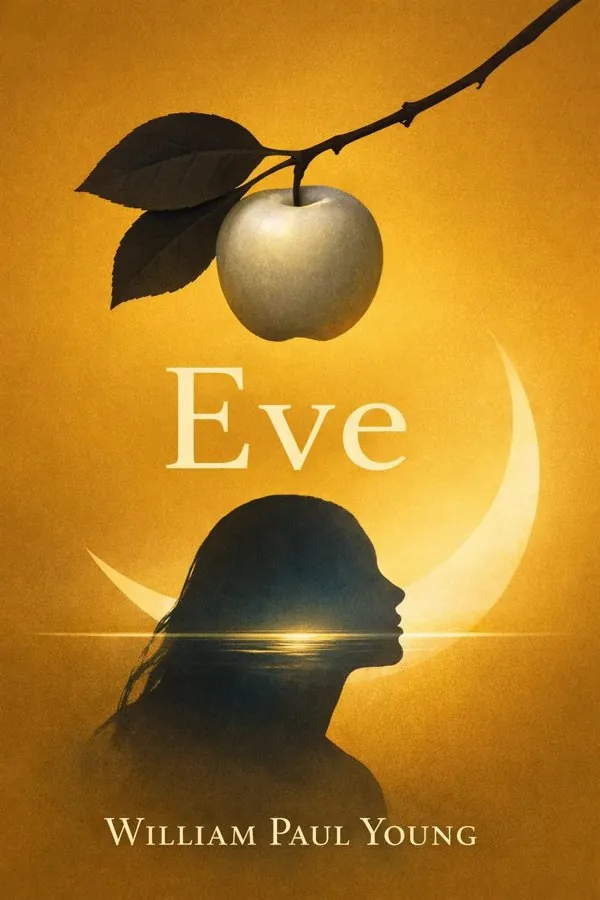
Eve: Summary & Key Insights
 10 min6 chaptersAudio available
What Is Eve About?
Eve by William Paul Young is a western_phil book spanning 6 pages. Eve is a 2015 novel by Canadian author William Paul Young that reimagines the biblical story of creation through a contemporary lens. The book explores themes of identity, redemption, and the nature of God, centering on a young woman who becomes a witness to the events of Genesis. It blends elements of theology, allegory, and psychological fiction to challenge traditional interpretations of the Adam and Eve narrative.
This FizzRead summary covers all 6 key chapters of Eve in approximately 10 minutes, distilling the most important ideas, arguments, and takeaways from William Paul Young's work. Also available as an audio summary and Key Quotes Podcast.
Eve
Eve is a 2015 novel by Canadian author William Paul Young that reimagines the biblical story of creation through a contemporary lens. The book explores themes of identity, redemption, and the nature of God, centering on a young woman who becomes a witness to the events of Genesis. It blends elements of theology, allegory, and psychological fiction to challenge traditional interpretations of the Adam and Eve narrative.
Who Should Read Eve?
This book is perfect for anyone interested in western_phil and looking to gain actionable insights in a short read. Whether you're a student, professional, or lifelong learner, the key ideas from Eve by William Paul Young will help you think differently.
- ✓Readers who enjoy western_phil and want practical takeaways
- ✓Professionals looking to apply new ideas to their work and life
- ✓Anyone who wants the core insights of Eve in just 10 minutes
Want the full summary?
Get instant access to this book summary and 100K+ more with Fizz Moment.
Get Free SummaryAvailable on App Store • Free to download
Key Chapters
When Lilly first awakens on the beach, she doesn’t remember who she is. Her body is bruised, her mind fragmented, and her heart echoes with losses she cannot name. Rescued and brought to an isolated facility, she finds herself surrounded by people she cannot quite categorize—scientists who speak of quantum fields and narrative patterns, yet who move with an otherworldly calm, as though belonging to another realm. Slowly, she realizes she is part of an experiment not in the clinical sense, but in the sacred: an observation of creation itself.
Lilly’s caregivers call themselves Collectors—those who gather stories from the beginning of time. John the Collector becomes her guide and companion. Patiently, almost tenderly, he draws her into an awareness that she has not been abandoned. The experiments, he explains, are not mechanical but deeply spiritual: observing Creation as it might truly have unfolded. Lilly begins to perceive that these visions are not mere hallucinations or simulations; they are windows into the primal story—the inception of existence, the rise of consciousness, the emergence of love.
Her disorientation mirrors our own spiritual confusion. In Lilly’s fragmented memory, I wanted to show how trauma clouds our perception of reality, making us forget that we are always being held. Through her gentle reawakening, readers trace that first motion back toward wholeness: remembering that to see Creation is also to rediscover oneself.
In the visions that follow, Lilly stands at the threshold of the world’s birth. The darkness moves, water separates from air, light breathes into being—and she feels the pulse of a universe awakening. These are not sterile recitations of myth but living realities experienced in motion. She sees Adam’s formation as a process of tenderness and intentionality—humanity sculpted from dust and spirit, not as an act of hierarchy but as an act of love.
Through Lilly’s witnessing, I wanted to convey the intimacy of divine creation, the deep personal nature of it. The God in *Eve* is not distant and dictatorial but relational, vulnerable, infinitely invested in each breath of the created world. Each movement of Genesis becomes a metaphor for our emergence into self-awareness: born from the formless void, endowed with identity, learning to see ourselves as reflections of the divine image.
As Lilly watches Adam’s awakening, she also feels a stirring within her own heart—a recognition that she, too, is part of this creative pulse. For the first time, she begins to sense that her brokenness does not separate her from God’s story; it weaves her into it. Creation, then, is not a one-time event but an ongoing act of restoration, happening even now within each of us who are willing to look inward and remember our origin.
+ 4 more chapters — available in the FizzRead app
All Chapters in Eve
About the Author
William Paul Young is a Canadian author best known for his debut novel The Shack, which became an international bestseller. His works often explore themes of faith, forgiveness, and the human relationship with God, written in an accessible and emotionally resonant style.
Get This Summary in Your Preferred Format
Read or listen to the Eve summary by William Paul Young anytime, anywhere. FizzRead offers multiple formats so you can learn on your terms — all free.
Available formats: App · Audio · PDF · EPUB — All included free with FizzRead
Download Eve PDF and EPUB Summary
Key Quotes from Eve
“When Lilly first awakens on the beach, she doesn’t remember who she is.”
“In the visions that follow, Lilly stands at the threshold of the world’s birth.”
Frequently Asked Questions about Eve
Eve by William Paul Young is a western_phil book that explores key ideas across 6 chapters. Eve is a 2015 novel by Canadian author William Paul Young that reimagines the biblical story of creation through a contemporary lens. The book explores themes of identity, redemption, and the nature of God, centering on a young woman who becomes a witness to the events of Genesis. It blends elements of theology, allegory, and psychological fiction to challenge traditional interpretations of the Adam and Eve narrative.
You Might Also Like
A Little History of Philosophy
Nigel Warburton
10 min
Areopagitica
John Milton
10 min
How To Think Like A Philosopher: Essential Principles For Clear Thinking
Peter Cave
10 min
Language, Truth and Logic
A. J. Ayer
10 min
The Age of Reason
Thomas Paine
10 min
The Essays
Michel De Montaigne
10 minBrowse by Category
Ready to read Eve?
Get the full summary and 100K+ more books with Fizz Moment.