
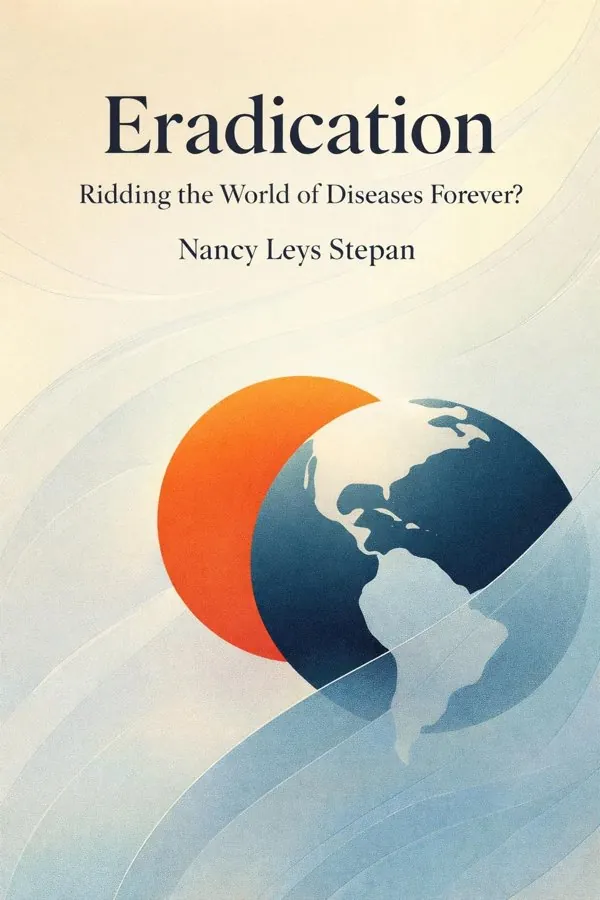
Eradication: Ridding the World of Diseases Forever?: Summary & Key Insights
 10 min10 chaptersAudio available
What Is Eradication: Ridding the World of Diseases Forever? About?
Eradication: Ridding the World of Diseases Forever? by Nancy Leys Stepan is a health_med book spanning 10 pages. This book explores the history and ethics of disease eradication campaigns, examining how global health initiatives have sought to eliminate diseases such as smallpox, malaria, and polio. Nancy Leys Stepan analyzes the scientific, political, and moral dimensions of eradication efforts, questioning whether the goal of completely eliminating diseases is achievable or desirable.
This FizzRead summary covers all 10 key chapters of Eradication: Ridding the World of Diseases Forever? in approximately 10 minutes, distilling the most important ideas, arguments, and takeaways from Nancy Leys Stepan's work. Also available as an audio summary and Key Quotes Podcast.
Eradication: Ridding the World of Diseases Forever?
This book explores the history and ethics of disease eradication campaigns, examining how global health initiatives have sought to eliminate diseases such as smallpox, malaria, and polio. Nancy Leys Stepan analyzes the scientific, political, and moral dimensions of eradication efforts, questioning whether the goal of completely eliminating diseases is achievable or desirable.
Who Should Read Eradication: Ridding the World of Diseases Forever??
This book is perfect for anyone interested in health_med and looking to gain actionable insights in a short read. Whether you're a student, professional, or lifelong learner, the key ideas from Eradication: Ridding the World of Diseases Forever? by Nancy Leys Stepan will help you think differently.
- ✓Readers who enjoy health_med and want practical takeaways
- ✓Professionals looking to apply new ideas to their work and life
- ✓Anyone who wants the core insights of Eradication: Ridding the World of Diseases Forever? in just 10 minutes
Want the full summary?
Get instant access to this book summary and 100K+ more with Fizz Moment.
Get Free SummaryAvailable on App Store • Free to download
Key Chapters
The dream of eradication did not emerge suddenly; it evolved gradually from older efforts in public health and sanitation. In the nineteenth century, with the rise of urbanization and empire, health reformers sought to control contagious diseases through improved sanitation, quarantine, and hygiene. The successes of these early movements were tangible yet limited—they reduced epidemics but could not make them disappear. The turn of the twentieth century brought a scientific revolution through bacteriology and epidemiology. The discovery that diseases had specific microbial agents shifted health strategies toward targeting those agents directly. Smallpox was no longer a divine punishment or urban hazard—it was a biological adversary that could be understood and defeated.
As colonial powers expanded into tropical regions, medicine became both a tool of governance and moral justification. Eradication emerged as a metaphor for purity and progress, implying not merely control but mastery over nature. Institutions such as the Rockefeller Foundation and later the World Health Organization (WHO) transformed this ideal into administrative agendas. By the mid-twentieth century, advances in vaccines, insecticides, and mapping technologies seemed to make global eradication realizable. This historical background reveals the intertwining of scientific optimism and political ambition—the belief that human reason could cleanse the world of disease.
Yet even as the technological means improved, the underlying assumptions remained ethically fraught. The dream of eradication often ignored local realities: cultural practices, social inequalities, and ecological interconnections. Early eradication campaigns were not just about microbes; they were about imposing order, rationality, and Western scientific authority on the diversity of human life. Thus, the very origins of eradication are inseparable from the history of imperial medicine, a legacy that would shape both its triumphs and tragedies.
Smallpox stands as the singular triumph of global eradication—a moment that, for many, confirmed the feasibility and moral righteousness of eliminating disease altogether. The campaign, formally led by the WHO from 1966 to 1980, drew on centuries of knowledge about vaccination, beginning with Edward Jenner’s pioneering work in the late eighteenth century. The eradication strategy combined mass vaccination with a more refined technique known as surveillance and containment: locate outbreaks, vaccinate contacts, and prevent further spread.
The success of smallpox eradication hinged on several factors. Smallpox had no animal reservoir, reliable symptoms, and a highly effective vaccine. These scientific conditions made eradication technically possible. But more than science was at work—it was a massive political and logistical effort involving collaboration across countries divided by Cold War politics. The Soviet Union provided vaccine production and technical expertise; the United States mobilized funding; and countless local workers carried out fieldwork under extraordinary conditions. The campaign illustrated the potential of global solidarity through shared scientific purpose.
Yet the campaign also exposed the moral and social tensions inherent in eradication. Consent was often secondary to administrative efficiency. Vaccination could be enforced; communities sometimes resisted not out of ignorance but due to mistrust or prior abuses. Smallpox eradication symbolized both the power and cost of global intervention—the ability to align nations under a common goal, and the tendency to overlook issues of autonomy and equity. When the WHO declared victory in 1980, it seemed to herald a new era for global health: the model of eradication appeared not only achievable but universally desirable. The irony, however, is that this success created a paradigm—one that future campaigns would follow, sometimes blindly, without recognizing that smallpox was exceptional, not typical.
+ 8 more chapters — available in the FizzRead app
All Chapters in Eradication: Ridding the World of Diseases Forever?
About the Author
Nancy Leys Stepan is a historian of science and medicine, known for her research on tropical medicine, race, and gender in scientific history. She has taught at Columbia University and authored several influential works on the social history of science.
Get This Summary in Your Preferred Format
Read or listen to the Eradication: Ridding the World of Diseases Forever? summary by Nancy Leys Stepan anytime, anywhere. FizzRead offers multiple formats so you can learn on your terms — all free.
Available formats: App · Audio · PDF · EPUB — All included free with FizzRead
Download Eradication: Ridding the World of Diseases Forever? PDF and EPUB Summary
Key Quotes from Eradication: Ridding the World of Diseases Forever?
“The dream of eradication did not emerge suddenly; it evolved gradually from older efforts in public health and sanitation.”
“Smallpox stands as the singular triumph of global eradication—a moment that, for many, confirmed the feasibility and moral righteousness of eliminating disease altogether.”
Frequently Asked Questions about Eradication: Ridding the World of Diseases Forever?
Eradication: Ridding the World of Diseases Forever? by Nancy Leys Stepan is a health_med book that explores key ideas across 10 chapters. This book explores the history and ethics of disease eradication campaigns, examining how global health initiatives have sought to eliminate diseases such as smallpox, malaria, and polio. Nancy Leys Stepan analyzes the scientific, political, and moral dimensions of eradication efforts, questioning whether the goal of completely eliminating diseases is achievable or desirable.
You Might Also Like
On Immunity
Eula Biss
10 min
The Three-Body Problem
Liu Cixin
10 min
Community Health Volunteer Toolkit: Training and Practical Activities
World Health Organization
10 min
Healing Back Pain: The Mind-Body Connection
John E. Sarno
10 min
Health Literacy for All: Practical Guides to Communicate Health Information (Compilations)
World Health Organization
10 min
The Complete Guide to Sports Supplements: An Evidence-Based Review
Anita Bean
10 minBrowse by Category
Ready to read Eradication: Ridding the World of Diseases Forever??
Get the full summary and 100K+ more books with Fizz Moment.