
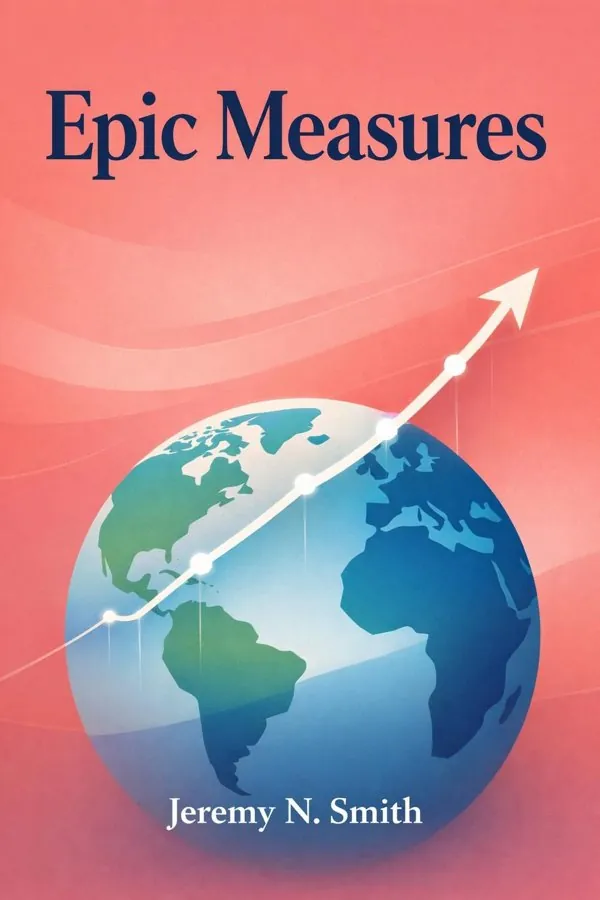
Epic Measures: One Doctor. Seven Billion Patients.: Summary & Key Insights
 10 min8 chaptersAudio available
Key Takeaways from Epic Measures: One Doctor. Seven Billion Patients.
Big change often begins with an unusual way of seeing.
A revolution in public health began with a deceptively simple question: how do you compare the impact of dying young with the impact of living for decades with disability?
What gets measured gains moral and political weight.
Numbers may look objective, but the power to produce them is never neutral.
Public policy often fails not because people do not care, but because they are solving the wrong problem.
What Is Epic Measures: One Doctor. Seven Billion Patients. About?
Epic Measures: One Doctor. Seven Billion Patients. by Jeremy N. Smith is a health_med book spanning 5 pages. Epic Measures: One Doctor. Seven Billion Patients. is the story of an idea so ambitious it sounds almost impossible: what if a doctor could diagnose the health of the entire human population with the same rigor used to treat an individual patient? Jeremy N. Smith follows physician and health metrics pioneer Christopher Murray as he builds the Global Burden of Disease study, a project designed to measure illness, injury, disability, and death across nations with unprecedented precision. The book is part biography, part scientific history, and part argument for why good data is essential to saving lives. What makes this book matter is its central claim: public health decisions are only as good as the evidence behind them. For decades, governments and institutions often acted on incomplete, inconsistent, or politically distorted information. Murray’s work challenged that uncertainty by creating tools to compare diseases, risks, and outcomes across the world. Smith, an experienced journalist covering science and health, brings both narrative energy and analytical clarity to a complex subject. The result is a deeply engaging account of how numbers, when used well, can reshape policy, expose neglected suffering, and improve health on a global scale.
This FizzRead summary covers all 8 key chapters of Epic Measures: One Doctor. Seven Billion Patients. in approximately 10 minutes, distilling the most important ideas, arguments, and takeaways from Jeremy N. Smith's work. Also available as an audio summary and Key Quotes Podcast.
Epic Measures: One Doctor. Seven Billion Patients.
Epic Measures: One Doctor. Seven Billion Patients. is the story of an idea so ambitious it sounds almost impossible: what if a doctor could diagnose the health of the entire human population with the same rigor used to treat an individual patient? Jeremy N. Smith follows physician and health metrics pioneer Christopher Murray as he builds the Global Burden of Disease study, a project designed to measure illness, injury, disability, and death across nations with unprecedented precision. The book is part biography, part scientific history, and part argument for why good data is essential to saving lives.
What makes this book matter is its central claim: public health decisions are only as good as the evidence behind them. For decades, governments and institutions often acted on incomplete, inconsistent, or politically distorted information. Murray’s work challenged that uncertainty by creating tools to compare diseases, risks, and outcomes across the world. Smith, an experienced journalist covering science and health, brings both narrative energy and analytical clarity to a complex subject. The result is a deeply engaging account of how numbers, when used well, can reshape policy, expose neglected suffering, and improve health on a global scale.
Who Should Read Epic Measures: One Doctor. Seven Billion Patients.?
This book is perfect for anyone interested in health_med and looking to gain actionable insights in a short read. Whether you're a student, professional, or lifelong learner, the key ideas from Epic Measures: One Doctor. Seven Billion Patients. by Jeremy N. Smith will help you think differently.
- ✓Readers who enjoy health_med and want practical takeaways
- ✓Professionals looking to apply new ideas to their work and life
- ✓Anyone who wants the core insights of Epic Measures: One Doctor. Seven Billion Patients. in just 10 minutes
Want the full summary?
Get instant access to this book summary and 100K+ more with Fizz Moment.
Get Free SummaryAvailable on App Store • Free to download
Key Chapters
Big change often begins with an unusual way of seeing. Christopher Murray’s defining insight was to treat humanity itself as a patient—something that sounds abstract until you realize how powerful it is. As the son of missionaries in Niger, Murray grew up close to poverty, fragile health systems, and preventable illness. He saw that where a person was born often determined whether they lived, what they died from, and whether anyone would even count their suffering properly. That early exposure gave him both moral urgency and scientific curiosity.
Rather than accepting medicine as one-on-one treatment alone, Murray asked a bigger question: how can we know what is making populations sick if we do not measure it consistently? This was not just a technical problem. It was an ethical one. If deaths from childbirth, malaria, road injuries, depression, or smoking-related disease are miscounted or ignored, then entire groups of people become invisible to policymakers.
Smith shows how Murray’s training in medicine, economics, and demography helped him connect the clinic to the world stage. He was not satisfied with noble intentions or broad public health slogans. He wanted quantifiable evidence. That meant comparing diseases across countries, developing common metrics, and challenging institutions that relied on rough estimates or outdated assumptions.
In practical terms, this mindset applies well beyond global health. Any leader, organization, or community trying to solve large problems needs a clear diagnostic framework. Schools need meaningful learning measures, cities need accurate safety data, and nonprofits need outcome tracking rather than anecdotal success stories.
Actionable takeaway: before trying to fix any large problem, define how you will measure it. What is not counted clearly is rarely addressed effectively.
A revolution in public health began with a deceptively simple question: how do you compare the impact of dying young with the impact of living for decades with disability? Before the Global Burden of Disease study, health data was fragmented. Countries counted deaths differently, many lacked reliable records, and policymakers often focused on dramatic diseases rather than the conditions causing the greatest total loss of life and well-being.
Murray, working closely with economist Alan Lopez and backed in part by the World Bank, helped create a framework that brought order to this chaos. The Global Burden of Disease study aimed to estimate mortality and disability from hundreds of diseases and injuries across regions, age groups, and time periods. Its innovation was not merely collecting more data, but organizing health loss in a way that allowed meaningful comparison.
One of the study’s major conceptual advances was the Disability-Adjusted Life Year, or DALY. This metric combined years of life lost to premature death with years lived with disability. It made visible problems that had been overlooked because they did not always kill quickly, such as mental illness, chronic pain, or nonfatal injury. Suddenly, health planners could see that a nation burdened by depression, road trauma, and stroke might need different priorities than one dominated by infectious disease.
The practical applications are enormous. Governments can allocate funding more intelligently. NGOs can target neglected conditions. Researchers can spot trends early. Even local health systems can learn from the model by comparing disease burden rather than relying on hospital impressions alone.
Actionable takeaway: whenever you evaluate competing priorities, use a framework that captures both immediate harm and long-term impact, not just the most visible outcomes.
Public policy often fails not because people do not care, but because they are solving the wrong problem. Epic Measures shows how improved health data can redirect attention, funding, and strategy toward the conditions that actually cause the greatest harm. When policymakers rely on assumptions, media attention, or outdated disease models, resources can flow to high-profile issues while more burdensome conditions remain neglected.
The Global Burden of Disease study offered a sharper map. It allowed leaders to compare the burden of infectious diseases with noncommunicable diseases, or fatal conditions with disabling ones. In many places, this revealed a health transition already underway: populations were increasingly affected by heart disease, diabetes, depression, and injury even while institutions remained organized around older priorities. Good data did not make decisions easy, but it made them more grounded.
Smith illustrates that metrics become most useful when they influence action. Governments can redesign prevention programs, target spending toward major risk factors, and assess whether interventions are producing real gains. For example, if a country learns that tobacco, air pollution, or hypertension is driving a larger share of premature death than expected, it can adjust laws, public messaging, and treatment access accordingly. If maternal mortality is concentrated in certain regions, resources can be directed more precisely.
The same logic works on smaller scales. A hospital can use readmission and complication data to improve care pathways. A city can match traffic injury data to infrastructure redesign. A nonprofit can shift from storytelling alone to measurable outcomes.
Actionable takeaway: use evidence not just to describe a problem, but to reallocate time, money, and attention toward the interventions with the highest likely impact.
The act of measuring human suffering is powerful, but it is never morally simple. Epic Measures does not portray global health metrics as a flawless triumph. Instead, it highlights the ethical challenges that come with turning lives, disabilities, and deaths into comparable units. Can a number ever fully represent grief, pain, or the social meaning of illness? How should researchers assign weights to different forms of disability without flattening lived experience? These are not side questions; they sit at the center of the project.
The DALY, for example, was groundbreaking because it made hidden burden visible. Yet any metric that combines death and disability requires judgments. How severe is blindness compared with chronic depression? How should age, function, and quality of life be weighed? Critics worried that such formulas could oversimplify human difference or encode cultural bias. Supporters argued that imperfect measurement is still better than neglect and guesswork.
Smith treats these debates seriously. The book suggests that the answer is not to abandon measurement, but to improve it continually and use it humbly. Good metrics should invite scrutiny, revision, and public conversation. They should inform policy without pretending to resolve every moral question.
This lesson matters in many fields. Employee performance scores, credit ratings, school assessments, and AI models all compress human complexity into indicators. Those systems can help or harm depending on how transparently they are built and how cautiously they are used.
Actionable takeaway: when using any metric about human welfare, pair precision with humility. Treat numbers as tools for judgment, not substitutes for judgment.
One of the most important scientific virtues in Epic Measures is the willingness to be wrong in public. Murray’s project did not succeed by producing a final, perfect map of world health. It advanced by continually revising estimates, expanding datasets, refining methods, and inviting challenge. That iterative process is a core reason the Global Burden of Disease enterprise became so influential.
Health patterns change quickly. Wars disrupt populations. New epidemics emerge. Treatments improve survival while increasing the number of people living with chronic conditions. Risk factors such as obesity, pollution, and substance use rise or fall unevenly across regions. A health system that depends on static assumptions will fall behind reality. Murray’s approach treated measurement as a living discipline rather than a one-time report.
Smith shows that this commitment to revision was demanding. It required global networks of collaborators, sophisticated statistical modeling, and enormous effort to reconcile incomplete or contradictory data. But the payoff was credibility. Better estimates over time allowed researchers to identify real trends instead of repeating outdated narratives.
The broader lesson is that any serious attempt to understand complex systems must be dynamic. Businesses need rolling forecasts rather than annual guesses. Cities need real-time transportation and safety dashboards. Individuals managing personal health need regular monitoring, not assumptions based on old habits.
Actionable takeaway: build review and revision into your decision process. If your evidence base is not updated regularly, your strategy may be answering yesterday’s problem instead of today’s.
Treating disease after it appears is necessary, but understanding what drives disease is where prevention becomes powerful. A central contribution of burden-of-disease thinking is its emphasis on risk factors: the upstream conditions and behaviors that create downstream illness. Rather than focusing only on diseases one at a time, Murray’s framework helps show how smoking, malnutrition, unsafe sex, high blood pressure, alcohol use, poor sanitation, and air pollution contribute to multiple forms of harm across populations.
This is an important shift because risk factors are often more actionable than disease categories. A government may struggle to reduce every cardiovascular diagnosis directly, but it can lower salt consumption, improve blood pressure screening, reduce tobacco use, and expand access to preventive care. A city cannot eliminate all traffic trauma overnight, but it can redesign roads, enforce speed limits, and improve helmet use.
Smith demonstrates how this risk-based perspective improves prioritization. It also reveals that health burdens are interconnected with economics, infrastructure, culture, and regulation. Public health is not just about hospitals. It is about clean air, road design, maternal education, taxes on harmful products, and whether policymakers pay attention to long-term hazards.
This idea scales to personal life as well. Instead of waiting for burnout, someone can monitor sleep, workload, and stress habits. Instead of reacting to financial crisis, a household can track debt ratios and emergency savings.
Actionable takeaway: identify the leading risk factors behind your most important problems. Addressing root drivers usually creates larger and more lasting gains than repeatedly managing visible symptoms.
All Chapters in Epic Measures: One Doctor. Seven Billion Patients.
About the Author
Jeremy N. Smith is an American journalist and author whose work focuses on science, health, technology, and the ways research shapes everyday life. He has written for major publications including The Atlantic, Discover, and The New York Times, building a reputation for making complex subjects clear, human, and engaging. Smith is especially skilled at turning technical material into narrative nonfiction that appeals to both specialists and general readers. In Epic Measures, he applies that talent to the world of global health metrics, showing how statistics, medicine, and public policy intersect on a global scale. His writing is marked by careful reporting, accessible explanation, and a strong interest in the people behind important scientific ideas.
Get This Summary in Your Preferred Format
Read or listen to the Epic Measures: One Doctor. Seven Billion Patients. summary by Jeremy N. Smith anytime, anywhere. FizzRead offers multiple formats so you can learn on your terms — all free.
Available formats: App · Audio · PDF · EPUB — All included free with FizzRead
Download Epic Measures: One Doctor. Seven Billion Patients. PDF and EPUB Summary
Key Quotes from Epic Measures: One Doctor. Seven Billion Patients.
“Big change often begins with an unusual way of seeing.”
“A revolution in public health began with a deceptively simple question: how do you compare the impact of dying young with the impact of living for decades with disability?”
“What gets measured gains moral and political weight.”
“Numbers may look objective, but the power to produce them is never neutral.”
“Public policy often fails not because people do not care, but because they are solving the wrong problem.”
Frequently Asked Questions about Epic Measures: One Doctor. Seven Billion Patients.
Epic Measures: One Doctor. Seven Billion Patients. by Jeremy N. Smith is a health_med book that explores key ideas across 8 chapters. Epic Measures: One Doctor. Seven Billion Patients. is the story of an idea so ambitious it sounds almost impossible: what if a doctor could diagnose the health of the entire human population with the same rigor used to treat an individual patient? Jeremy N. Smith follows physician and health metrics pioneer Christopher Murray as he builds the Global Burden of Disease study, a project designed to measure illness, injury, disability, and death across nations with unprecedented precision. The book is part biography, part scientific history, and part argument for why good data is essential to saving lives. What makes this book matter is its central claim: public health decisions are only as good as the evidence behind them. For decades, governments and institutions often acted on incomplete, inconsistent, or politically distorted information. Murray’s work challenged that uncertainty by creating tools to compare diseases, risks, and outcomes across the world. Smith, an experienced journalist covering science and health, brings both narrative energy and analytical clarity to a complex subject. The result is a deeply engaging account of how numbers, when used well, can reshape policy, expose neglected suffering, and improve health on a global scale.
You Might Also Like

On Immunity
Eula Biss
10 min
The Three-Body Problem
Liu Cixin
10 min
Community Health Volunteer Toolkit: Training and Practical Activities
World Health Organization
10 min
Healing Back Pain: The Mind-Body Connection
John E. Sarno
10 min
Health Literacy for All: Practical Guides to Communicate Health Information (Compilations)
World Health Organization
10 min
The Complete Guide to Sports Supplements: An Evidence-Based Review
Anita Bean
10 minBrowse by Category
Ready to read Epic Measures: One Doctor. Seven Billion Patients.?
Get the full summary and 100K+ more books with Fizz Moment.