
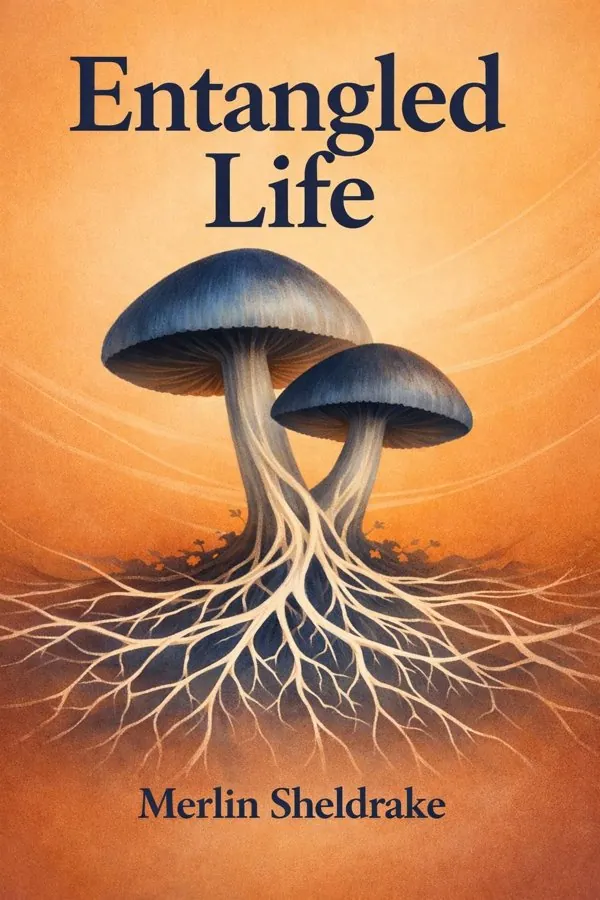
Entangled Life: How Fungi Make Our Worlds, Change Our Minds & Shape Our Futures: Summary & Key Insights
 10 min10 chaptersAudio available
What Is Entangled Life: How Fungi Make Our Worlds, Change Our Minds & Shape Our Futures About?
Entangled Life: How Fungi Make Our Worlds, Change Our Minds & Shape Our Futures by Merlin Sheldrake is a popular_sci book spanning 10 pages. Entangled Life is a profound and poetic exploration of the world of fungi. Merlin Sheldrake reveals how these invisible organisms connect and transform ecosystems, influence evolution, and challenge our understanding of life. Through scientific and narrative examples, the author shows how fungi are essential to the planet’s health and the interconnection of all living forms.
This FizzRead summary covers all 10 key chapters of Entangled Life: How Fungi Make Our Worlds, Change Our Minds & Shape Our Futures in approximately 10 minutes, distilling the most important ideas, arguments, and takeaways from Merlin Sheldrake's work. Also available as an audio summary and Key Quotes Podcast.
Entangled Life: How Fungi Make Our Worlds, Change Our Minds & Shape Our Futures
Entangled Life is a profound and poetic exploration of the world of fungi. Merlin Sheldrake reveals how these invisible organisms connect and transform ecosystems, influence evolution, and challenge our understanding of life. Through scientific and narrative examples, the author shows how fungi are essential to the planet’s health and the interconnection of all living forms.
Who Should Read Entangled Life: How Fungi Make Our Worlds, Change Our Minds & Shape Our Futures?
This book is perfect for anyone interested in popular_sci and looking to gain actionable insights in a short read. Whether you're a student, professional, or lifelong learner, the key ideas from Entangled Life: How Fungi Make Our Worlds, Change Our Minds & Shape Our Futures by Merlin Sheldrake will help you think differently.
- ✓Readers who enjoy popular_sci and want practical takeaways
- ✓Professionals looking to apply new ideas to their work and life
- ✓Anyone who wants the core insights of Entangled Life: How Fungi Make Our Worlds, Change Our Minds & Shape Our Futures in just 10 minutes
Want the full summary?
Get instant access to this book summary and 100K+ more with Fizz Moment.
Get Free SummaryAvailable on App Store • Free to download
Key Chapters
Mycelium is the body of a fungus—a vast, decentralized network of threads known as hyphae. These threads extend through soil, wood, and organic matter, forming intricate webs of communication and exchange. To walk through a forest is to step over miles of mycelium stretching unseen beneath your feet. Unlike roots, which serve a single plant, mycelium connects many organisms, transcending species and even kingdoms. It is the living infrastructure that underpins ecosystems.
When I study mycelium, what amazes me most is its resourcefulness. A fungal network can navigate complex environments, finding nutrients efficiently and adapting fluidly to obstacles. It does not have a brain, yet it exhibits behaviors that resemble decision-making. Patterns of growth and retreat reflect an awareness—an embodied intelligence distributed throughout its threads.
In the book, I describe how this network functions almost like the Internet: flow-based systems of data and nutrients, connecting what seems separate into shared experience. A rotting log becomes not waste but sustenance; a root system becomes not isolated but communal. This mycelial world reframes our notion of agency. Life exists as connection—as the conversation between entities, not their separation. Once you see mycelium this way, even your sense of individuality begins to shift. You begin to wonder: where does one organism end and another begin? Perhaps life itself is the network.
Most plants rely on fungi to survive. Mycorrhizal fungi form partnerships with roots, trading nutrients and information in a complex barter. The fungus extends the plant’s reach for water and minerals; in return, the plant shares sugars produced through photosynthesis. This symbiosis is foundational to terrestrial life—without it, forests, grasslands, and crops as we know them would collapse.
One remarkable aspect of mycorrhizal relationships is communication. Through their networks, plants can send signals—warnings of insect attack, requests for aid. Nearby plants respond, adjusting their chemistry accordingly. What we have long called the “Wood Wide Web” is a living demonstration that cooperation is as intrinsic to nature as competition.
When I first immersed myself in this research, I felt a profound shift. We humans have inherited a story of survival through rivalry, a notion that thrives in industrial and economic thinking. Yet fungi reveal another narrative—where survival depends on exchange and reciprocity. Seeing the forest as a collaborative web changes how we perceive both ecology and ethics. Fungi whisper a worldview in which thriving arises from relationship, not domination.
+ 8 more chapters — available in the FizzRead app
All Chapters in Entangled Life: How Fungi Make Our Worlds, Change Our Minds & Shape Our Futures
About the Author
Merlin Sheldrake is a British biologist and writer specializing in ecology and mycology. He holds a PhD from the University of Cambridge and has researched symbiotic relationships between plants and fungi. His work combines science, philosophy, and art to explore the complexity of living systems.
Get This Summary in Your Preferred Format
Read or listen to the Entangled Life: How Fungi Make Our Worlds, Change Our Minds & Shape Our Futures summary by Merlin Sheldrake anytime, anywhere. FizzRead offers multiple formats so you can learn on your terms — all free.
Available formats: App · Audio · PDF · EPUB — All included free with FizzRead
Download Entangled Life: How Fungi Make Our Worlds, Change Our Minds & Shape Our Futures PDF and EPUB Summary
Key Quotes from Entangled Life: How Fungi Make Our Worlds, Change Our Minds & Shape Our Futures
“Mycelium is the body of a fungus—a vast, decentralized network of threads known as hyphae.”
“Mycorrhizal fungi form partnerships with roots, trading nutrients and information in a complex barter.”
Frequently Asked Questions about Entangled Life: How Fungi Make Our Worlds, Change Our Minds & Shape Our Futures
Entangled Life: How Fungi Make Our Worlds, Change Our Minds & Shape Our Futures by Merlin Sheldrake is a popular_sci book that explores key ideas across 10 chapters. Entangled Life is a profound and poetic exploration of the world of fungi. Merlin Sheldrake reveals how these invisible organisms connect and transform ecosystems, influence evolution, and challenge our understanding of life. Through scientific and narrative examples, the author shows how fungi are essential to the planet’s health and the interconnection of all living forms.
You Might Also Like

Structures: Or Why Things Don"t Fall Down
J.E. Gordon
10 min
The Road to Wigan Pier
George Orwell
10 min
Bonk: The Curious Coupling of Science and Sex
Mary Roach
10 min
First Bite: How We Learn to Eat
Bee Wilson
10 min
In Pursuit Of The Unknown: 17 Equations That Changed The World
Ian Stewart
10 min
Napoleon's Buttons: 17 Molecules That Changed History
Penny Le Couteur and Jay Burreson
10 minBrowse by Category
Ready to read Entangled Life: How Fungi Make Our Worlds, Change Our Minds & Shape Our Futures?
Get the full summary and 100K+ more books with Fizz Moment.