
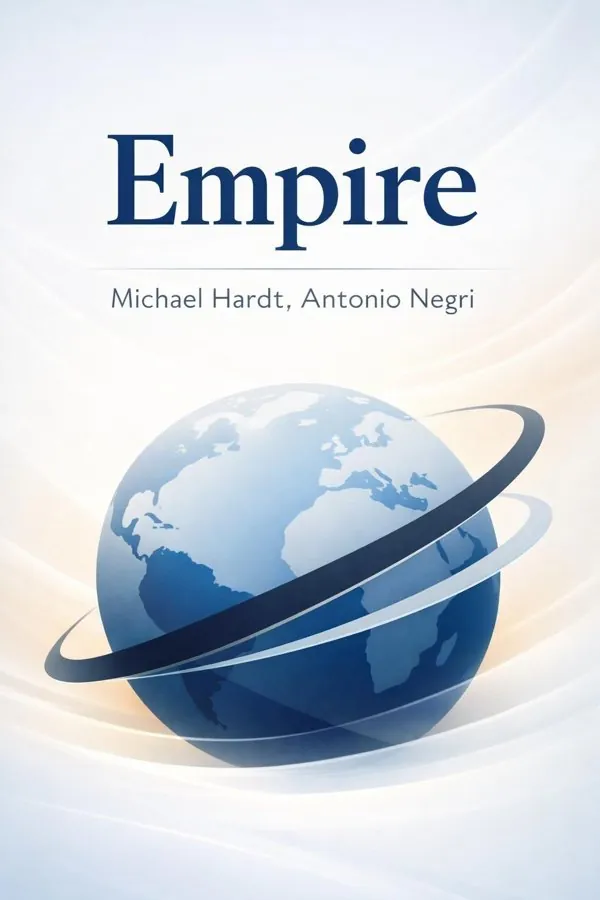
Empire: Summary & Key Insights
by Michael Hardt, Antonio Negri
 10 min10 chaptersAudio available
What Is Empire About?
Empire by Michael Hardt, Antonio Negri is a politics book spanning 10 pages. Empire es una obra de filosofía política que analiza la transformación del poder soberano en la era de la globalización. Hardt y Negri argumentan que el antiguo sistema de estados-nación ha sido reemplazado por una nueva forma de soberanía global, a la que llaman 'Imperio'. Este Imperio no tiene un centro territorial fijo, sino que se manifiesta como una red descentralizada de poder económico, político y cultural. El libro combina teoría marxista, postestructuralismo y análisis contemporáneo para ofrecer una visión utópica de resistencia y democracia global.
This FizzRead summary covers all 10 key chapters of Empire in approximately 10 minutes, distilling the most important ideas, arguments, and takeaways from Michael Hardt, Antonio Negri's work. Also available as an audio summary and Key Quotes Podcast.
Empire
Empire es una obra de filosofía política que analiza la transformación del poder soberano en la era de la globalización. Hardt y Negri argumentan que el antiguo sistema de estados-nación ha sido reemplazado por una nueva forma de soberanía global, a la que llaman 'Imperio'. Este Imperio no tiene un centro territorial fijo, sino que se manifiesta como una red descentralizada de poder económico, político y cultural. El libro combina teoría marxista, postestructuralismo y análisis contemporáneo para ofrecer una visión utópica de resistencia y democracia global.
Who Should Read Empire?
This book is perfect for anyone interested in politics and looking to gain actionable insights in a short read. Whether you're a student, professional, or lifelong learner, the key ideas from Empire by Michael Hardt, Antonio Negri will help you think differently.
- ✓Readers who enjoy politics and want practical takeaways
- ✓Professionals looking to apply new ideas to their work and life
- ✓Anyone who wants the core insights of Empire in just 10 minutes
Want the full summary?
Get instant access to this book summary and 100K+ more with Fizz Moment.
Get Free SummaryAvailable on App Store • Free to download
Key Chapters
The story begins with decline—the fading of modern imperialism. The old model of global order was one of territorial expansion: European empires conquering and administering faraway lands. These structures rested on clear hierarchies between metropolis and colony, center and periphery. Yet as we entered the late twentieth century, those distinctions began to blur. Decolonization and the rise of multinational corporations fractured the relationship between territorial sovereignty and power.
What replaced the imperial map was not chaos, but a new system of organization. Economic and juridical instruments started to regulate international interaction: global financial institutions, trade agreements, and supranational organizations began operating as nodes in what would become a postmodern form of rule. We describe this process as a 'progressive deterritorialization'—power escaping from specific places and becoming embedded in networks that transcend borders. The Cold War’s end intensified this shift, unifying markets and governance apparatuses under a seemingly liberal consensus.
From our perspective, these transformations do not constitute a mere continuation of imperialism. Empire is qualitatively different. It does not rely on physical domination or colonial administration. Rather, it functions through integration, consensus, and the management of flows—flows of capital, information, and people. Where imperialism imposed its order from outside, Empire operates from within; it produces subjectivities and desires that align with its political economy.
Empire is founded on a new form of law. In previous eras, sovereignty was exercised by the state within its territorial boundaries, regulated by international law among discrete powers. In the new order, law becomes universal and immanent. The global system does not simply coordinate states but subsumes them into a common framework of governance. Our analysis shows that institutions such as the United Nations, the World Trade Organization, and the International Monetary Fund establish rules that apply everywhere, irrespective of local political processes.
This juridical universality marks a decisive break. Empire presents itself as a guarantor of human rights and global peace, but this benevolent image conceals a deeper logic: it legitimizes intervention and administration on a planetary scale. By claiming to act for humanity as a whole, Empire transcends the old Westphalian balance of powers. Sovereignty becomes deterritorialized—it no longer emanates from one ruler or nation but circulates throughout the institutional fabric of globalization.
In this juridico-political space, the old notion of 'exception'—where the sovereign could suspend law—gives way to continuous management. War becomes police action; moral norms justify economic governance. The distinction between inside and outside collapses. The world becomes one juridical space, unified not through conquest but through the diffusion of protocols, contracts, and communicative order.
+ 8 more chapters — available in the FizzRead app
All Chapters in Empire
About the Authors
Michael Hardt es un teórico político estadounidense y profesor en la Universidad de Duke, conocido por su trabajo sobre la globalización y la teoría marxista contemporánea. Antonio Negri es un filósofo y activista político italiano, reconocido por sus estudios sobre el trabajo, la soberanía y la multitud. Juntos, son autores de una trilogía influyente que incluye 'Empire', 'Multitude' y 'Commonwealth'.
Get This Summary in Your Preferred Format
Read or listen to the Empire summary by Michael Hardt, Antonio Negri anytime, anywhere. FizzRead offers multiple formats so you can learn on your terms — all free.
Available formats: App · Audio · PDF · EPUB — All included free with FizzRead
Download Empire PDF and EPUB Summary
Key Quotes from Empire
“The story begins with decline—the fading of modern imperialism.”
“In previous eras, sovereignty was exercised by the state within its territorial boundaries, regulated by international law among discrete powers.”
Frequently Asked Questions about Empire
Empire by Michael Hardt, Antonio Negri is a politics book that explores key ideas across 10 chapters. Empire es una obra de filosofía política que analiza la transformación del poder soberano en la era de la globalización. Hardt y Negri argumentan que el antiguo sistema de estados-nación ha sido reemplazado por una nueva forma de soberanía global, a la que llaman 'Imperio'. Este Imperio no tiene un centro territorial fijo, sino que se manifiesta como una red descentralizada de poder económico, político y cultural. El libro combina teoría marxista, postestructuralismo y análisis contemporáneo para ofrecer una visión utópica de resistencia y democracia global.
You Might Also Like
Antifa: The Anti-Fascist Handbook
Mark Bray
10 min
Attack from Within: How Disinformation Is Sabotaging America
Barbara McQuade
10 min
Coercion, Capital, and European States, AD 990–1992
Charles Tilly
10 min
Digital Democracy: Concepts, Methodologies, Tools, and Applications
Various Authors
10 min
Fascism
Stanley G. Payne
10 min
Fire And Fury: Inside The Trump White House
Michael Wolff
10 minBrowse by Category
Ready to read Empire?
Get the full summary and 100K+ more books with Fizz Moment.