
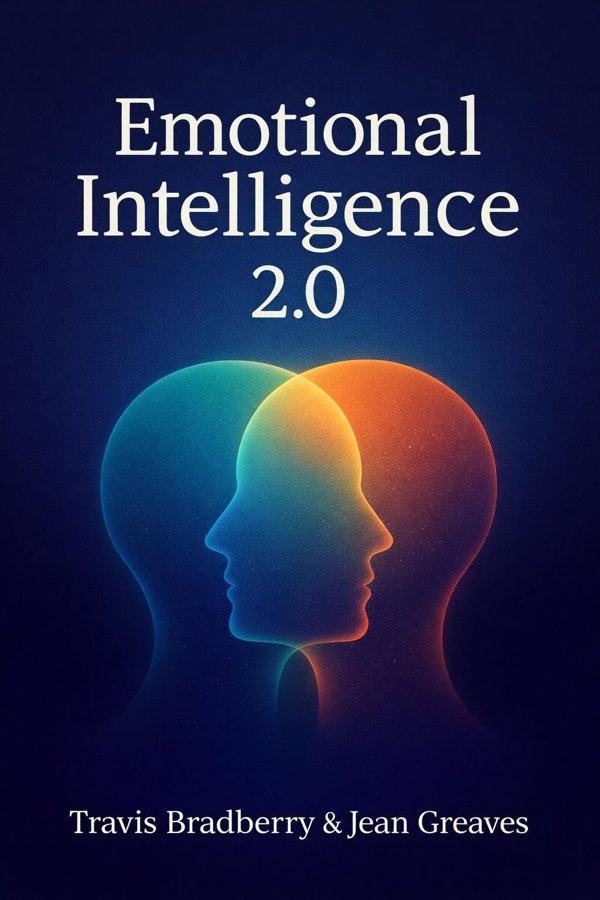
Emotional Intelligence 2.0: Summary & Key Insights
by Travis Bradberry, Jean Greaves
 10 min5 chaptersAudio available
What Is Emotional Intelligence 2.0 About?
Emotional Intelligence 2.0 by Travis Bradberry & Jean Greaves is a positive_psych book spanning 5 pages. Emotional Intelligence 2.0 offers a practical guide to understanding and improving emotional intelligence (EQ) through four core skills: self-awareness, self-management, social awareness, and relationship management. The book provides step-by-step strategies and self-assessment tools to help readers enhance their emotional and interpersonal effectiveness in both personal and professional contexts.
This FizzRead summary covers all 5 key chapters of Emotional Intelligence 2.0 in approximately 10 minutes, distilling the most important ideas, arguments, and takeaways from Travis Bradberry & Jean Greaves's work. Also available as an audio summary and Key Quotes Podcast.
Emotional Intelligence 2.0
Emotional Intelligence 2.0 offers a practical guide to understanding and improving emotional intelligence (EQ) through four core skills: self-awareness, self-management, social awareness, and relationship management. The book provides step-by-step strategies and self-assessment tools to help readers enhance their emotional and interpersonal effectiveness in both personal and professional contexts.
Who Should Read Emotional Intelligence 2.0?
This book is perfect for anyone interested in positive_psych and looking to gain actionable insights in a short read. Whether you're a student, professional, or lifelong learner, the key ideas from Emotional Intelligence 2.0 by Travis Bradberry & Jean Greaves will help you think differently.
- ✓Readers who enjoy positive_psych and want practical takeaways
- ✓Professionals looking to apply new ideas to their work and life
- ✓Anyone who wants the core insights of Emotional Intelligence 2.0 in just 10 minutes
Want the full summary?
Get instant access to this book summary and 100K+ more with Fizz Moment.
Get Free SummaryAvailable on App Store • Free to download
Key Chapters
To understand emotional intelligence, we must first separate it from intelligence quotient (IQ) and personality. IQ determines how well we process information and solve logical problems. Personality, in turn, defines our preferences, temperament, and inclinations—whether we are introverted or outgoing, deliberate or spontaneous. But emotional intelligence stands apart. EQ is the ability to recognize, understand, and manage our own emotions while also recognizing, understanding, and influencing the emotions of others.
Through our data at TalentSmart, we found that EQ accounts for nearly 58% of performance across jobs—a staggering figure that underlines how indispensable these skills truly are. Unlike IQ, which stabilizes early in life, EQ can be developed indefinitely. It is learned, practiced, and refined.
Imagine a situation in which you’ve prepared meticulously for a meeting, only to have your proposal brushed aside by a supervisor. Your reaction in that instant—whether you retreat in frustration, fight back defensively, or respond with calm curiosity—defines your emotional intelligence. It is not the emotion itself that’s problematic; anger, frustration, or disappointment are natural. The difference lies in awareness and choice—knowing what you feel, why you feel it, and what best serves your long-term goals.
That awareness and intentional management of emotion separate the effective professional from the merely capable one. EQ is the invisible language of leadership, the measure of our influence and our integrity. And it begins with two inner skills—self-awareness and self-management—before it extends outward to social awareness and relationship management. These four form the foundation upon which all EQ growth stands.
The model we present divides emotional intelligence into four interdependent skills. The first two, self-awareness and self-management, focus inward. They help us understand and regulate our internal world. The next two, social awareness and relationship management, turn that intelligence outward—toward others.
Self-awareness is the cornerstone. You cannot manage what you do not recognize. Most people move through their days unaware of what triggers their emotions or shapes their tone, body language, and decision-making. Emotional awareness turns that fog into clarity. When you know precisely what you’re feeling and why, you gain the power to respond rather than react.
Self-management, then, is the act of choosing your response. It’s the discipline to pause before speaking, to control impulsive reactions, and to adapt to changing circumstances without losing your sense of balance. In these moments, self-management becomes leadership over oneself—a steady hand that keeps your emotional ship on course, no matter the waves.
Social awareness extends this same sensitivity outward. It is empathy in practice—the ability to pick up the subtle signals others send, to read the emotions beneath words, and to perceive group dynamics as they unfold. Those who master social awareness communicate not only through words but through presence—they listen fully, without scripts or assumptions.
Finally, relationship management is where all these skills converge. It’s about guiding interactions toward understanding, connection, and shared purpose. Whether you are resolving conflict, inspiring collaboration, or mentoring a colleague, effective relationship management depends on the foundation of self-awareness, emotional control, and empathy built in the earlier stages. Together, these four skills form a feedback loop. Each one strengthens the others, shaping emotional intelligence into a living, evolving skill set you carry through every aspect of life.
+ 3 more chapters — available in the FizzRead app
All Chapters in Emotional Intelligence 2.0
About the Authors
Travis Bradberry and Jean Greaves are cofounders of TalentSmart, a consultancy specializing in emotional intelligence training and assessment. They are recognized experts in leadership development and have authored several works on emotional intelligence and performance.
Get This Summary in Your Preferred Format
Read or listen to the Emotional Intelligence 2.0 summary by Travis Bradberry & Jean Greaves anytime, anywhere. FizzRead offers multiple formats so you can learn on your terms — all free.
Available formats: App · Audio · PDF · EPUB — All included free with FizzRead
Download Emotional Intelligence 2.0 PDF and EPUB Summary
Key Quotes from Emotional Intelligence 2.0
“To understand emotional intelligence, we must first separate it from intelligence quotient (IQ) and personality.”
“The model we present divides emotional intelligence into four interdependent skills.”
Frequently Asked Questions about Emotional Intelligence 2.0
Emotional Intelligence 2.0 by Travis Bradberry & Jean Greaves is a positive_psych book that explores key ideas across 5 chapters. Emotional Intelligence 2.0 offers a practical guide to understanding and improving emotional intelligence (EQ) through four core skills: self-awareness, self-management, social awareness, and relationship management. The book provides step-by-step strategies and self-assessment tools to help readers enhance their emotional and interpersonal effectiveness in both personal and professional contexts.
You Might Also Like

Don't Sweat the Small Stuff... and It's All Small Stuff
Richard Carlson
10 min
Option B
Sheryl Sandberg & Adam Grant
10 min
Hallelujah Anyway: Rediscovering Mercy
Anne Lamott
10 min
I Can Do It: How to Use Affirmations to Change Your Life
Louise Hay
10 min
The Coffee Bean: A Simple Lesson to Create Positive Change
Jon Gordon, Damon West
10 min
The Happiness Hypothesis: Finding Modern Truth in Ancient Wisdom
Jonathan Haidt
10 minBrowse by Category
Ready to read Emotional Intelligence 2.0?
Get the full summary and 100K+ more books with Fizz Moment.