
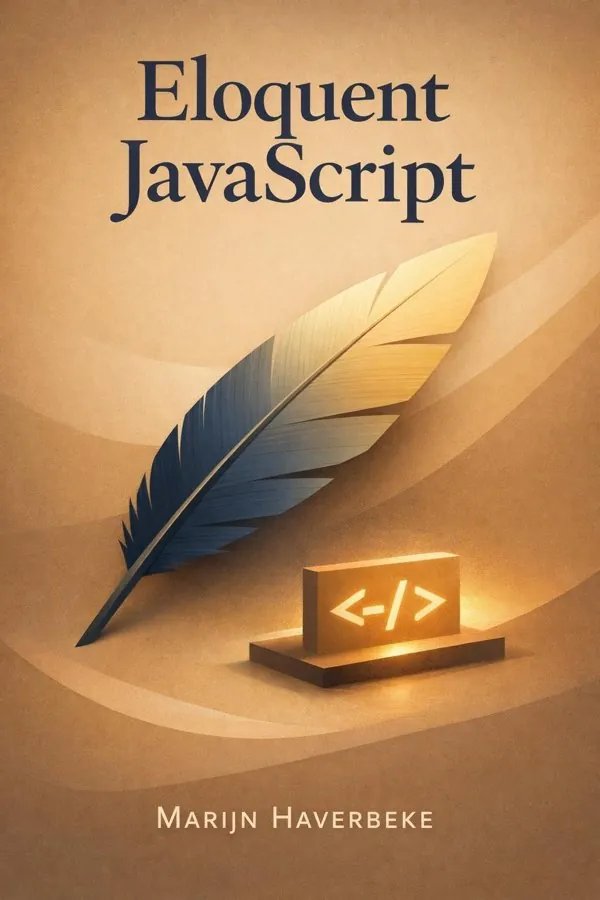
Eloquent JavaScript: A Modern Introduction to Programming: Summary & Key Insights
 10 min9 chapters
Key Takeaways from Eloquent JavaScript: A Modern Introduction to Programming
Every program begins with a simple question: what kind of thing am I working with?
A computer does exactly what you tell it, but without structure, your instructions are just noise.
Programming becomes powerful when code can represent the structure of the real world.
One sign of programming maturity is when you stop writing the same logic over and over and start describing patterns.
Some of JavaScript’s most powerful features are also the easiest to misunderstand.
What Is Eloquent JavaScript: A Modern Introduction to Programming About?
Eloquent JavaScript: A Modern Introduction to Programming by Marijn Haverbeke is a programming book spanning 9 pages. Programming is often taught as a set of rules, but Eloquent JavaScript teaches it as a way of thinking. Marijn Haverbeke uses JavaScript as the entry point, but his real subject is deeper: how to break problems into steps, represent ideas in code, and build programs that are both useful and elegant. The book begins with the fundamentals—values, variables, control flow, and functions—then gradually leads readers into data structures, higher-order functions, modular design, asynchronous programming, and browser-based applications. Along the way, it shows not just how JavaScript works, but why certain programming techniques matter. What makes the book especially valuable is its balance of accessibility and rigor. Haverbeke is an experienced developer and creator of CodeMirror, one of the web’s most widely used in-browser code editors, and his technical credibility shows in the clarity of his explanations. Rather than encouraging memorization, he invites readers to experiment, reason, and practice. The result is a modern programming classic: a book that helps beginners start well and gives intermediate developers a stronger mental model for writing clean, expressive, and reliable code.
This FizzRead summary covers all 9 key chapters of Eloquent JavaScript: A Modern Introduction to Programming in approximately 10 minutes, distilling the most important ideas, arguments, and takeaways from Marijn Haverbeke's work.
Eloquent JavaScript: A Modern Introduction to Programming
Programming is often taught as a set of rules, but Eloquent JavaScript teaches it as a way of thinking. Marijn Haverbeke uses JavaScript as the entry point, but his real subject is deeper: how to break problems into steps, represent ideas in code, and build programs that are both useful and elegant. The book begins with the fundamentals—values, variables, control flow, and functions—then gradually leads readers into data structures, higher-order functions, modular design, asynchronous programming, and browser-based applications. Along the way, it shows not just how JavaScript works, but why certain programming techniques matter.
What makes the book especially valuable is its balance of accessibility and rigor. Haverbeke is an experienced developer and creator of CodeMirror, one of the web’s most widely used in-browser code editors, and his technical credibility shows in the clarity of his explanations. Rather than encouraging memorization, he invites readers to experiment, reason, and practice. The result is a modern programming classic: a book that helps beginners start well and gives intermediate developers a stronger mental model for writing clean, expressive, and reliable code.
Who Should Read Eloquent JavaScript: A Modern Introduction to Programming?
This book is perfect for anyone interested in programming and looking to gain actionable insights in a short read. Whether you're a student, professional, or lifelong learner, the key ideas from Eloquent JavaScript: A Modern Introduction to Programming by Marijn Haverbeke will help you think differently.
- ✓Readers who enjoy programming and want practical takeaways
- ✓Professionals looking to apply new ideas to their work and life
- ✓Anyone who wants the core insights of Eloquent JavaScript: A Modern Introduction to Programming in just 10 minutes
Want the full summary?
Get instant access to this book summary and 100K+ more with Fizz Moment.
Get Free SummaryAvailable on App Store • Free to download
Key Chapters
Every program begins with a simple question: what kind of thing am I working with? Eloquent JavaScript starts by showing that programming is fundamentally about manipulating values, and that understanding types is the first step toward writing correct code. Numbers, strings, booleans, null, undefined, and objects each behave differently, and JavaScript’s flexibility can be both empowering and dangerous if you do not understand those differences.
Haverbeke explains how operators combine and transform values, from arithmetic and comparison to logical expressions. He also highlights JavaScript’s quirks, such as type coercion, where values may be converted automatically in ways that surprise beginners. For example, adding numbers behaves differently from concatenating strings, and equality comparisons can produce unexpected results if you use loose equality carelessly.
This matters in practice because many bugs begin at the level of assumptions about data. If you expect a number but receive a string, a calculation may silently fail. If you misunderstand truthy and falsy values, a condition may run when it should not. These are not minor technicalities; they shape the reliability of every program.
A practical application is form handling in web apps. User input often arrives as text, even when it represents a number, so a programmer must deliberately convert and validate it. The broader lesson is that good programmers pay close attention to what their data is and how the language interprets it.
Actionable takeaway: Before writing complex logic, identify the types of values your program uses and test how JavaScript treats them in common operations.
A computer does exactly what you tell it, but without structure, your instructions are just noise. One of the book’s earliest and most important lessons is that programming is not merely issuing commands; it is organizing decisions, repetition, and reusable behavior so that a program can respond intelligently to different situations.
Haverbeke introduces expressions, statements, bindings, conditional logic, loops, and functions as the tools that turn isolated instructions into coherent processes. Conditionals let a program choose between paths. Loops allow repeated work without duplication. Functions package behavior into named units that can be reused and understood independently.
Consider a simple task like checking whether a number is even, printing a sequence, or processing items in a list. Without structure, you would write repetitive, brittle code. With if statements, while loops, for loops, and well-defined functions, the same task becomes compact and understandable. This shift is crucial because real-world software quickly grows beyond what any person can hold in mind at once.
The book also encourages readers to think in terms of decomposition. If a problem feels overwhelming, split it into smaller tasks and give each task its own function. This is more than style; it improves testing, debugging, and collaboration. A clear function name communicates intent better than a tangled block of logic ever could.
In practice, this approach helps in everything from validating passwords to calculating totals in an online store. Each step of the process can be isolated, named, and improved over time.
Actionable takeaway: When solving a problem, first sketch the flow—inputs, decisions, repetitions, and outputs—then turn each part into small, focused functions.
Programming becomes powerful when code can represent the structure of the real world. Eloquent JavaScript shows that arrays and objects are the basic building blocks for organizing information, and that mastering them is essential to building anything beyond toy examples.
Arrays are useful when order matters or when you have a collection of similar items, such as a list of names, prices, or messages. Objects are better when you want to group related properties under a single concept, such as a user profile with a name, age, and email address. JavaScript makes both flexible and easy to create, which is one reason it is so effective for web development.
Haverbeke goes beyond syntax to show how these structures support actual thinking. A to-do app might store tasks in an array. A game character might be represented as an object with position, health, and inventory. A blog platform may use arrays of post objects, each containing title, author, and content. Once you understand this pattern, data starts to feel less abstract and more like a map of the problem domain.
The book also introduces methods for accessing, modifying, and iterating over data. This matters because choosing the right structure simplifies code dramatically. If you fight your data model, your program becomes confusing. If you align the structure of data with the structure of the problem, the program becomes easier to reason about.
Actionable takeaway: Before coding a feature, ask what information you need to store and whether it is best represented as a list, a grouped object, or a combination of both.
One sign of programming maturity is when you stop writing the same logic over and over and start describing patterns. Eloquent JavaScript presents higher-order functions as a major leap in abstraction: functions that take other functions as arguments, return functions as results, or both. This is where JavaScript starts to feel especially expressive.
Instead of manually looping through an array each time you want to transform, filter, or combine data, you can use patterns like map, filter, and reduce. These tools let you focus on the purpose of the operation rather than the mechanical details of iteration. For example, you can turn a list of prices into a list of discounted prices with map, select only active users with filter, or compute a total with reduce.
Haverbeke uses this topic to teach a broader principle: abstraction is what allows software to scale. When repetitive details are packaged into reusable functions, code becomes shorter, clearer, and less error-prone. Higher-order functions also encourage a more declarative style, where you describe what should happen rather than how every step must unfold.
This is especially useful in data-heavy applications, such as dashboards, report generators, and user interfaces that process arrays of objects. It also supports composition, where small functions are combined to create more sophisticated behavior.
The key is not to use functional techniques for fashion, but to reduce complexity. A good abstraction should make the underlying intention more visible, not more obscure.
Actionable takeaway: Look for repeated array-processing patterns in your code and replace them with map, filter, reduce, or custom helper functions that express intent clearly.
Some of JavaScript’s most powerful features are also the easiest to misunderstand. Eloquent JavaScript gives special attention to scope and closures because they explain how variables live, where they can be accessed, and why functions can remember information from the context in which they were created.
Scope determines visibility. A variable declared inside a function is not available everywhere, and that limitation is useful because it prevents accidental interference. Local scope makes functions safer and easier to reason about. Block scope, introduced with let and const, gives even more precise control over where variables exist.
Closures build on this idea. When a function is created inside another scope, it can continue to access variables from that outer scope even after the outer function has finished running. This allows elegant patterns such as function factories, private state, and encapsulated behavior. For example, a function that creates counters can return another function that remembers the current count without exposing it directly.
These concepts matter in practical code. Event handlers, timers, asynchronous callbacks, and modular design often depend on closures. Misunderstanding them can cause classic bugs, such as all callbacks referring to the same variable when a loop was written incorrectly.
Haverbeke’s treatment helps readers see that closures are not magic; they are a natural result of how functions and environments interact. Once that mental model clicks, many parts of JavaScript become much easier to understand.
Actionable takeaway: Practice writing small functions that return other functions, and observe which variables remain available—this is the fastest way to build intuition about closures and scope.
A program is not truly understood until you know how it fails. Eloquent JavaScript treats error handling and debugging not as side topics, but as core programming skills. This is an important distinction because many beginners assume the goal is simply to make code run, when the real goal is to make it run reliably and fail intelligibly.
Haverbeke explains syntax errors, runtime errors, logic errors, and deliberate exceptions. He shows that mistakes are inevitable, especially in nontrivial programs, and that good developers build systems that can detect, isolate, and communicate problems clearly. Throwing and catching exceptions allows code to separate normal behavior from exceptional conditions, while assertions and tests help verify that assumptions remain true.
Debugging is presented as an act of investigation. Instead of guessing, you observe. You inspect values, narrow down where things go wrong, and reason from evidence. Browser developer tools, console logging, and careful experimentation are all part of this process. The larger lesson is that errors are information. They tell you where your mental model of the program differs from what the machine is actually doing.
In practical terms, error handling matters everywhere: validating API responses, checking user input, reading files, and handling network failures. A program that crashes mysteriously is frustrating; a program that explains what went wrong is maintainable.
Actionable takeaway: Treat every bug as a clue, not a setback—reproduce it consistently, inspect the relevant values, and add clear error handling wherever assumptions can fail.
Modern software often spends more time waiting than calculating. It waits for user actions, network responses, file reads, and timers. Eloquent JavaScript helps readers make the mental shift from step-by-step synchronous execution to asynchronous programming, where operations can start now and finish later.
This topic is crucial in JavaScript because the language is deeply tied to environments like browsers and servers that handle many events at once. Haverbeke explains callbacks, promises, and async/await as successive improvements in how programmers manage delayed results. Callbacks are direct but can become hard to follow when deeply nested. Promises provide a clearer model of future values and error propagation. Async/await makes asynchronous code read more like synchronous logic while preserving non-blocking behavior.
A practical example is fetching data from an API. The program requests information, continues running, and then processes the result when it arrives. Another example is handling a button click that triggers a save operation without freezing the interface. These patterns are central to real web applications.
The book also emphasizes that asynchronous programming is not merely about syntax. It is about control flow, timing, and state. You must think carefully about what should happen before, during, and after an operation completes, and what should happen if it fails.
For many learners, this is one of the hardest transitions in programming. Haverbeke’s strength is showing the underlying model rather than just the surface features.
Actionable takeaway: Rewrite one callback-based task using promises and then async/await so you can compare the flow and understand how each style manages delayed results.
JavaScript became globally important because it runs in the browser, and Eloquent JavaScript makes clear that learning the language in isolation is not enough. To build real applications, you must understand the browser as a rich environment with documents, events, and interfaces users can see and manipulate.
Haverbeke introduces the Document Object Model, or DOM, as the browser’s structured representation of a web page. With JavaScript, you can query elements, change text, update styles, create new nodes, and respond to user actions like clicks and typing. Suddenly, programming stops being abstract and becomes interactive.
This is where many readers feel the excitement of software creation. A static page can become a calculator, a drawing tool, a note-taking app, or a small game. Event-driven programming becomes central: instead of running from top to bottom once, your code waits for user input and reacts. Managing that interaction requires careful organization, especially when application state changes over time.
The book also discusses forms, event handling, and browser APIs. These are the foundations of front-end development. Even if a reader eventually moves into frameworks like React or Vue, understanding the browser directly provides a stronger base. Frameworks automate patterns, but they do not replace the need to understand what is happening underneath.
Actionable takeaway: Build a small browser project—such as a to-do list or interactive counter—using only plain JavaScript and DOM methods to strengthen your understanding of how web pages actually work.
Good code is not merely code that works; it is code that can be understood, changed, and trusted. One of the most enduring messages of Eloquent JavaScript is that elegance in programming comes from clarity of thought. Haverbeke consistently pushes readers to think beyond syntax toward design.
This means choosing meaningful names, decomposing problems into manageable parts, avoiding duplication, and keeping functions focused. It also means understanding that simplicity is not the same as shortness. A cryptic one-line solution may impress in the moment, but readable code is usually more valuable over time. Eloquent code communicates intention.
The book reinforces this through examples and exercises that encourage revision rather than brute-force completion. As your programs grow, the quality of structure matters more than the number of features. Clean code is easier to debug, easier to test, and easier for collaborators to extend. In professional development, this is often the difference between a maintainable codebase and one that collapses under its own complexity.
Haverbeke’s broader contribution is philosophical as well as technical. He presents programming as a craft: a discipline in which precision, taste, and reflection matter. This perspective helps readers move from "Can I make it run?" to "Can I make it good?"
Actionable takeaway: After finishing any program, refactor it once—rename unclear variables, split large functions, remove repetition, and ask whether someone else could understand the code without your explanation.
All Chapters in Eloquent JavaScript: A Modern Introduction to Programming
About the Author
Marijn Haverbeke is a software developer, technical writer, and open-source contributor known for his deep expertise in JavaScript and programming language design. He is the creator of CodeMirror, a highly influential in-browser code editor used in many developer tools and web applications. Haverbeke has built a reputation for explaining difficult technical concepts with unusual clarity, combining practical experience with a thoughtful, philosophical approach to coding. His writing often emphasizes not just how programs work, but how programmers should think about structure, abstraction, and elegance in software. Through Eloquent JavaScript, he has helped generations of learners move beyond syntax and develop a more mature understanding of programming as both a craft and a form of disciplined problem-solving.
Get This Summary in Your Preferred Format
Read or listen to the Eloquent JavaScript: A Modern Introduction to Programming summary by Marijn Haverbeke anytime, anywhere. FizzRead offers multiple formats so you can learn on your terms — all free.
Available formats: App · Audio · PDF · EPUB — All included free with FizzRead
Download Eloquent JavaScript: A Modern Introduction to Programming PDF and EPUB Summary
Key Quotes from Eloquent JavaScript: A Modern Introduction to Programming
“Every program begins with a simple question: what kind of thing am I working with?”
“A computer does exactly what you tell it, but without structure, your instructions are just noise.”
“Programming becomes powerful when code can represent the structure of the real world.”
“One sign of programming maturity is when you stop writing the same logic over and over and start describing patterns.”
“Some of JavaScript’s most powerful features are also the easiest to misunderstand.”
Frequently Asked Questions about Eloquent JavaScript: A Modern Introduction to Programming
Eloquent JavaScript: A Modern Introduction to Programming by Marijn Haverbeke is a programming book that explores key ideas across 9 chapters. Programming is often taught as a set of rules, but Eloquent JavaScript teaches it as a way of thinking. Marijn Haverbeke uses JavaScript as the entry point, but his real subject is deeper: how to break problems into steps, represent ideas in code, and build programs that are both useful and elegant. The book begins with the fundamentals—values, variables, control flow, and functions—then gradually leads readers into data structures, higher-order functions, modular design, asynchronous programming, and browser-based applications. Along the way, it shows not just how JavaScript works, but why certain programming techniques matter. What makes the book especially valuable is its balance of accessibility and rigor. Haverbeke is an experienced developer and creator of CodeMirror, one of the web’s most widely used in-browser code editors, and his technical credibility shows in the clarity of his explanations. Rather than encouraging memorization, he invites readers to experiment, reason, and practice. The result is a modern programming classic: a book that helps beginners start well and gives intermediate developers a stronger mental model for writing clean, expressive, and reliable code.
You Might Also Like

ANSI Common Lisp
Paul Graham
10 min
Automate the Boring Stuff with Python: Practical Programming for Total Beginners
Al Sweigart
10 min
Black Hat Python: Python Programming for Hackers and Pentesters
Justin Seitz
10 min
Building Microservices: Designing Fine-Grained Systems
Sam Newman
10 min
C++ Primer
Stanley B. Lippman, Josée Lajoie, Barbara E. Moo
10 min
Clean Code: A Handbook of Agile Software Craftsmanship
Robert C. Martin
10 minBrowse by Category
Ready to read Eloquent JavaScript: A Modern Introduction to Programming?
Get the full summary and 100K+ more books with Fizz Moment.