
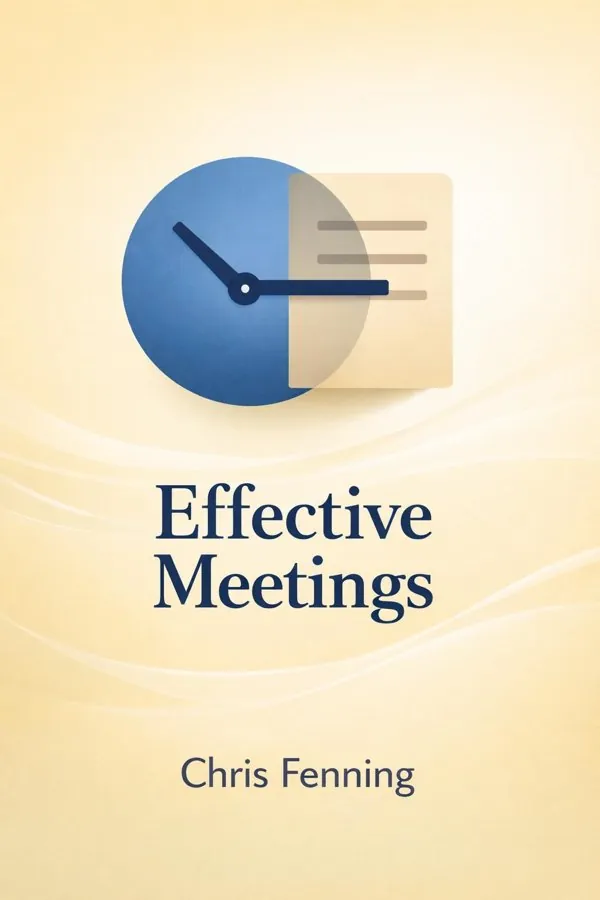
Effective Meetings: Summary & Key Insights
 10 min9 chaptersAudio available
What Is Effective Meetings About?
Effective Meetings by Chris Fenning is a communication book spanning 9 pages. Effective Meetings by Chris Fenning provides practical guidance on how to make workplace meetings more productive and less painful. Drawing on experiences from thousands of meetings, Fenning offers a clear, structured approach to improving communication, setting agendas, and achieving results efficiently.
This FizzRead summary covers all 9 key chapters of Effective Meetings in approximately 10 minutes, distilling the most important ideas, arguments, and takeaways from Chris Fenning's work. Also available as an audio summary and Key Quotes Podcast.
Effective Meetings
Effective Meetings by Chris Fenning provides practical guidance on how to make workplace meetings more productive and less painful. Drawing on experiences from thousands of meetings, Fenning offers a clear, structured approach to improving communication, setting agendas, and achieving results efficiently.
Who Should Read Effective Meetings?
This book is perfect for anyone interested in communication and looking to gain actionable insights in a short read. Whether you're a student, professional, or lifelong learner, the key ideas from Effective Meetings by Chris Fenning will help you think differently.
- ✓Readers who enjoy communication and want practical takeaways
- ✓Professionals looking to apply new ideas to their work and life
- ✓Anyone who wants the core insights of Effective Meetings in just 10 minutes
Want the full summary?
Get instant access to this book summary and 100K+ more with Fizz Moment.
Get Free SummaryAvailable on App Store • Free to download
Key Chapters
Before scheduling any meeting, ask one vital question: why are we meeting? Sounds simple, yet this single question seldom receives an honest answer. As Chris Fenning emphasizes, the lack of purpose is the root of meeting dysfunction. A gathering without a defined reason becomes chaos — people talk in circles, misaligned expectations multiply, and frustration sets in. To fix this, Fenning defines three fundamental categories of meetings, each with a distinct logic and structure: information sharing, decision-making, and problem-solving.
Information-sharing meetings are about alignment — ensuring everyone has the same understanding of updates, status, or progress. They should be concise and prioritize clarity over discussion. Decision-making meetings are fundamentally different; they demand preparation, debate, and closure. These sessions succeed only when participants arrive informed and empowered to decide. Problem-solving meetings, the most complex, require exploration and brainstorming; they are about collaboration, creativity, and convergence toward solutions.
Fenning challenges readers to label their meetings explicitly according to these categories. Doing so immediately filters intentions and builds clarity. It also reduces resistance. When attendees know what kind of session they are entering, they adapt their mindset accordingly. A well-defined purpose reduces confusion and increases engagement — people know what success looks like. By distinguishing these meeting types, you protect attendees’ time and earn their respect as a leader who knows what a meeting should accomplish. In Fenning’s experience, organizations that rigorously define meeting purposes cut wasted time by up to 30%, because fewer unnecessary meetings are scheduled in the first place.
As the author, I hold a deep conviction that purpose is leadership. When you define why you are gathering, you model intentionality. You say, “We value your time, and we know what we are here to achieve.” That small act alone transforms the collective psychology of any team. Start there — and every subsequent step toward effective meetings becomes easier.
No amount of clever facilitation can save a meeting that begins without preparation. Chris Fenning insists that preparation is not optional; it is the foundation of effectiveness. Most meetings fail because they start with ambiguity — unknown objectives, unclear attendees, and undefined outcomes. The solution sounds modest: prepare like a professional. Before you even open the calendar invite, define three core elements.
First, objectives. The objective describes what you want to achieve, not what you want to discuss. Fenning teaches that every objective must be framed as an outcome statement: “By the end of the meeting, we will have decided on X,” or “We will have generated at least three options for Y.” Objectives are not topics; they are end states. Second, participants. You only invite people who have a direct role in achieving the objective — those with decision authority, relevant information, or necessary perspectives. Inviting people for politics or courtesy dilutes attention. Finally, outcomes. Defining the expected deliverables before the meeting sets a finishing line; it tells participants what success looks like and when the conversation should stop.
When preparation meets discipline, meetings become predictable environments that drive action. Fenning offers a simple but powerful practice: write the meeting purpose and objective in the invitation itself. This small gesture compels attendees to come prepared and helps those who should not be there to opt out. It filters attendance naturally and boosts commitment. In his workshops, Fenning demonstrates that teams who implement pre-meeting preparation cut their meeting durations by as much as 40% while increasing satisfaction and decision clarity.
My personal advice as the author echoes this: preparation is respect in action. When you prepare well, you communicate that you value people’s time and trust their contribution. Preparation builds confidence; it turns chaos into collaboration. Every effective meeting begins long before it starts — in a focused mind and a clear purpose statement.
+ 7 more chapters — available in the FizzRead app
All Chapters in Effective Meetings
About the Author
Chris Fenning is a communication expert and author known for his practical books on workplace communication, including The First Minute and Effective Emails. His work focuses on helping professionals communicate clearly and effectively in business settings.
Get This Summary in Your Preferred Format
Read or listen to the Effective Meetings summary by Chris Fenning anytime, anywhere. FizzRead offers multiple formats so you can learn on your terms — all free.
Available formats: App · Audio · PDF · EPUB — All included free with FizzRead
Download Effective Meetings PDF and EPUB Summary
Key Quotes from Effective Meetings
“Before scheduling any meeting, ask one vital question: why are we meeting?”
“No amount of clever facilitation can save a meeting that begins without preparation.”
Frequently Asked Questions about Effective Meetings
Effective Meetings by Chris Fenning is a communication book that explores key ideas across 9 chapters. Effective Meetings by Chris Fenning provides practical guidance on how to make workplace meetings more productive and less painful. Drawing on experiences from thousands of meetings, Fenning offers a clear, structured approach to improving communication, setting agendas, and achieving results efficiently.
More by Chris Fenning
You Might Also Like
Magic Words: The Science and Secrets Behind Seven Words That Motivate, Engage, and Influence
Tim David
10 min
Talking Across The Divide: How to Communicate with People You Disagree with and Maybe Even Change the World
Justin Lee
10 min
The Exceptional Presenter: A Proven Formula to Open Up! and Own the Room
Timothy J. Koegel
10 min
4 Essential Keys to Effective Communication in Love, Life, Work--Anywhere!: Including the 12-Day Communication Challenge!
Bento C. Leal III
10 min
Active Listening Techniques: 30 Practical Tools to Hone Your Communication Skills
Nisha Gupta
10 min
Bargaining for Advantage: Negotiation Strategies for Reasonable People
G. Richard Shell
10 minFeatured In
Browse by Category
Ready to read Effective Meetings?
Get the full summary and 100K+ more books with Fizz Moment.