
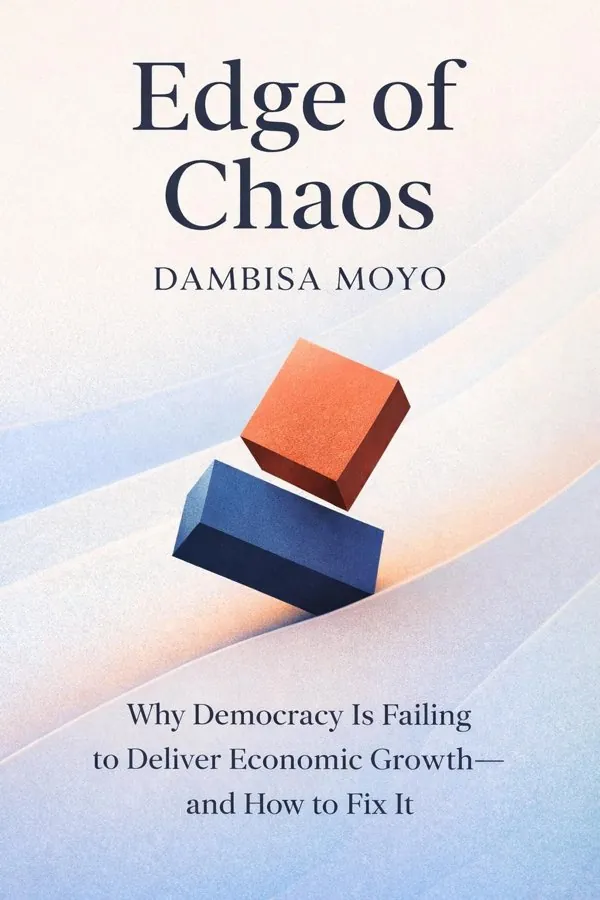
Edge of Chaos: Why Democracy Is Failing to Deliver Economic Growth—and How to Fix It: Summary & Key Insights
by Dambisa Moyo
 10 min9 chaptersAudio available
Key Takeaways from Edge of Chaos: Why Democracy Is Failing to Deliver Economic Growth—and How to Fix It
A political system should be judged not only by its ideals, but by the results it consistently produces.
Economic growth is not a luxury variable; it is the fuel that keeps social contracts intact.
What if the biggest weakness of democracy is not representation, but timing?
Economic decline often begins quietly, through institutional erosion rather than dramatic crisis.
No country has solved the tension between democracy and growth perfectly, but comparative examples reveal useful patterns.
What Is Edge of Chaos: Why Democracy Is Failing to Deliver Economic Growth—and How to Fix It About?
Edge of Chaos: Why Democracy Is Failing to Deliver Economic Growth—and How to Fix It by Dambisa Moyo is a economics book spanning 8 pages. In Edge of Chaos, economist Dambisa Moyo tackles a question that many democracies would rather avoid: why have political systems built to represent citizens become so poor at generating broad, sustained economic progress? Her answer is provocative. Democracy, she argues, is not automatically self-correcting. Under modern conditions—24-hour media cycles, polarized electorates, rising debt, aging populations, and weak institutional trust—it often rewards short-term promises over long-term prosperity. The result is slower growth, fragile policymaking, and a widening gap between what voters expect and what governments can realistically deliver. Moyo approaches this issue not as an abstract theorist but as a seasoned global economist. With experience at the World Bank and Goldman Sachs, and with a track record of writing on aid, development, and global competition, she brings both data and international perspective to the debate. Rather than rejecting democracy, she asks how it can be redesigned to survive the pressures of the twenty-first century. This book matters because it reframes economic stagnation not merely as a market problem, but as a governance problem—and insists that without institutional reform, prosperity and political legitimacy may continue to erode together.
This FizzRead summary covers all 9 key chapters of Edge of Chaos: Why Democracy Is Failing to Deliver Economic Growth—and How to Fix It in approximately 10 minutes, distilling the most important ideas, arguments, and takeaways from Dambisa Moyo's work. Also available as an audio summary and Key Quotes Podcast.
Edge of Chaos: Why Democracy Is Failing to Deliver Economic Growth—and How to Fix It
In Edge of Chaos, economist Dambisa Moyo tackles a question that many democracies would rather avoid: why have political systems built to represent citizens become so poor at generating broad, sustained economic progress? Her answer is provocative. Democracy, she argues, is not automatically self-correcting. Under modern conditions—24-hour media cycles, polarized electorates, rising debt, aging populations, and weak institutional trust—it often rewards short-term promises over long-term prosperity. The result is slower growth, fragile policymaking, and a widening gap between what voters expect and what governments can realistically deliver.
Moyo approaches this issue not as an abstract theorist but as a seasoned global economist. With experience at the World Bank and Goldman Sachs, and with a track record of writing on aid, development, and global competition, she brings both data and international perspective to the debate. Rather than rejecting democracy, she asks how it can be redesigned to survive the pressures of the twenty-first century. This book matters because it reframes economic stagnation not merely as a market problem, but as a governance problem—and insists that without institutional reform, prosperity and political legitimacy may continue to erode together.
Who Should Read Edge of Chaos: Why Democracy Is Failing to Deliver Economic Growth—and How to Fix It?
This book is perfect for anyone interested in economics and looking to gain actionable insights in a short read. Whether you're a student, professional, or lifelong learner, the key ideas from Edge of Chaos: Why Democracy Is Failing to Deliver Economic Growth—and How to Fix It by Dambisa Moyo will help you think differently.
- ✓Readers who enjoy economics and want practical takeaways
- ✓Professionals looking to apply new ideas to their work and life
- ✓Anyone who wants the core insights of Edge of Chaos: Why Democracy Is Failing to Deliver Economic Growth—and How to Fix It in just 10 minutes
Want the full summary?
Get instant access to this book summary and 100K+ more with Fizz Moment.
Get Free SummaryAvailable on App Store • Free to download
Key Chapters
A political system should be judged not only by its ideals, but by the results it consistently produces. Moyo begins by revisiting the historical partnership between democracy and capitalism, especially in the decades after World War II. During that period, many democratic nations combined political freedom, legal stability, industrial expansion, and rising living standards. Citizens could reasonably believe that democratic government was not only morally legitimate, but materially effective. Economic growth, strong institutions, and social mobility reinforced one another.
That earlier success matters because it shaped modern expectations. Voters in advanced democracies came to assume that elections, markets, and public institutions would naturally deliver prosperity across generations. But Moyo argues this historical alignment was contingent, not permanent. It depended on favorable demographics, postwar reconstruction, expanding global trade, technological leadership, and political cultures more capable of long-term planning. As those conditions weakened, democratic systems did not adapt quickly enough.
A practical example is postwar infrastructure investment. Governments built roads, ports, schools, and research systems that often took years or decades to pay off. Political leaders were willing to support them because national strategy had a longer horizon. In contrast, many governments today struggle to commit to projects whose gains may arrive after the next election cycle.
The lesson is not that democracy has failed in principle, but that its past performance should not be romanticized. Institutional design matters. When incentives support patience, competence, and investment, democracy can coexist with growth. When incentives reward short-term consumption and political theater, that relationship frays.
Actionable takeaway: Evaluate democratic systems by whether they still encourage long-term investment, not by whether they succeeded under very different historical conditions.
Economic growth is not a luxury variable; it is the fuel that keeps social contracts intact. Moyo argues that many democratic nations are experiencing a dangerous slowdown in productivity, wage growth, and investment, while debt burdens rise and public expectations remain high. When economies stop expanding meaningfully, distributional conflict intensifies. Groups begin fighting harder over slices of a stagnant pie, and politics grows angrier, more tribal, and less constructive.
This is one of the book’s central warnings. Slow growth does more than weaken stock markets or government revenues. It reduces room for compromise. Politicians can no longer satisfy competing constituencies through expansion, so they increasingly rely on borrowing, symbolic politics, or unrealistic promises. Citizens, seeing little improvement in their own lives, lose trust in both experts and institutions. This helps explain why stagnant democracies become vulnerable to populism, scapegoating, and abrupt policy swings.
Consider the difference between a fast-growing economy and a stagnant one. In a growing economy, workers may tolerate disruption if new opportunities appear; governments can fund social programs without crushing tax increases; businesses can invest with confidence. In a stagnant economy, however, even modest reforms become politically explosive because every change creates visible losers and few immediate winners.
Moyo’s insight is practical: democratic resilience depends heavily on economic performance. Stability is easier to preserve when incomes rise and opportunity expands. This means governments should treat productivity, innovation, education, and capital formation as core democratic priorities, not technical side issues.
Actionable takeaway: When assessing policy, ask whether it increases long-term productive capacity rather than merely redistributing short-term gains.
What if the biggest weakness of democracy is not representation, but timing? Moyo argues that modern democratic systems often reward leaders for maximizing near-term political survival rather than long-term national health. Election cycles, public opinion polling, media scrutiny, and constant campaigning push policymakers toward visible, immediate benefits while discouraging painful reforms whose rewards may arrive years later.
This short-termism shows up everywhere: underinvestment in infrastructure, delayed pension reform, reluctance to tackle debt, weak responses to demographic change, and inconsistent industrial strategy. Politicians know that voters often punish present costs more than they reward future gains. As a result, governments postpone difficult decisions until the fiscal or institutional damage becomes severe.
A simple example is public borrowing. Running deficits can soften present-day pain and finance popular programs without immediate taxation. But repeated reliance on debt transfers costs into the future. The same logic applies to climate adaptation, healthcare reform, or labor market modernization. The political system prefers postponement because postponement is easier to sell.
Moyo does not claim voters are irrational. Rather, she suggests that democratic structures often fail to align individual political incentives with collective long-term welfare. If leaders are judged every few years, and if media rewards conflict and instant reactions, then patience becomes politically expensive.
Possible solutions include longer policy planning horizons, more independent expert bodies, institutional fiscal rules, and reforms that separate strategic national investments from daily partisan battles. None of these eliminate accountability; they make accountability more compatible with time-intensive policymaking.
Actionable takeaway: Support reforms that protect long-term public investments from short-term electoral pressure, especially in areas like infrastructure, education, debt, and research.
Economic decline often begins quietly, through institutional erosion rather than dramatic crisis. Moyo argues that when democratic institutions lose credibility, policymaking becomes less coherent and less effective long before a country experiences outright failure. Trust in legislatures, parties, civil services, central institutions, and even factual expertise can deteriorate gradually, producing a system that still looks democratic on paper but functions poorly in practice.
Institutional erosion matters because strong growth depends on predictability. Businesses invest when rules are stable. Households plan when policy is credible. Markets function better when courts, regulators, and public agencies are competent and trusted. But when institutions become politicized, fragmented, or chronically gridlocked, governments struggle to execute even sensible policies. This uncertainty suppresses investment and weakens national capacity.
You can see this in repeated budget standoffs, regulatory reversals, politicized appointments, or abrupt changes in tax and trade policy. Each episode may seem manageable on its own, but together they create an environment in which long-term planning becomes harder. Institutional weakness is therefore not just a constitutional concern; it is an economic one.
Moyo’s deeper point is that legitimacy and performance are linked. Democracies cannot rely forever on moral symbolism if they consistently fail to deliver competence. Rebuilding institutional strength requires professional civil services, clearer lines of responsibility, safeguards against capture, and mechanisms that reward implementation rather than rhetoric.
Actionable takeaway: Pay attention not only to election outcomes, but to whether institutions remain capable, trusted, and consistent enough to support long-term economic decision-making.
No country has solved the tension between democracy and growth perfectly, but comparative examples reveal useful patterns. Moyo draws on global case studies to show that nations differ in how they balance accountability, state capacity, expertise, and speed. Looking abroad helps challenge the assumption that there is only one democratic model worth considering.
Some countries are better at long-term infrastructure planning. Others excel at industrial policy, education, or fiscal discipline. Still others demonstrate the costs of paralysis, fragmentation, or overpromising. The value of comparison is not to copy another nation wholesale, but to identify institutional features that improve decision quality. For example, one country may use independent commissions to guide pension reform, while another relies on stronger bureaucratic continuity across administrations. A third may maintain greater political consensus around national competitiveness or export strategy.
Moyo also notes that authoritarian systems can sometimes move faster, especially on infrastructure or strategic planning, but speed is not the same as wisdom. Democracies retain important advantages: legitimacy, correction mechanisms, pluralism, and protection against concentrated power. The challenge is to preserve those strengths while reducing dysfunction.
This comparative lens is practical for policymakers and citizens alike. If housing, transportation, education, and innovation systems work better elsewhere, then institutional humility becomes necessary. Democratic pride should not prevent democratic learning.
Actionable takeaway: Study which institutional features in other countries produce better long-term outcomes, and adapt those mechanisms pragmatically instead of treating your own system as beyond revision.
The world has become faster, more connected, and less forgiving of bad policy. Moyo argues that technology and globalization have amplified the weaknesses of democratic systems already prone to short-term thinking. Capital moves quickly, supply chains shift, labor markets change rapidly, and information spreads instantly. Under these conditions, governments that cannot make credible, forward-looking decisions fall behind more easily than before.
Technology increases productivity but also disrupts jobs, industries, and skills. Globalization expands markets but also intensifies competition and exposes domestic weaknesses. Both forces reward adaptability. Yet democracies often respond slowly because electoral incentives encourage protection of existing groups rather than investment in future capabilities. That can lead to policy drift: too little reskilling, weak digital infrastructure, outdated education systems, and reactive trade politics.
At the same time, digital media changes politics itself. Public debate becomes more emotional, fragmented, and immediate. Leaders face pressure to comment on everything now, even when sound policy requires time, evidence, and discipline. The result is a mismatch between the speed of communication and the slower logic of high-quality governance.
A practical example is workforce transition. An economy facing automation needs coordinated investments in training, mobility, entrepreneurship, and social insurance. But such policies are complex and expensive upfront. It is politically easier to promise protection than to build adaptation.
Moyo’s point is not anti-technology or anti-globalization. It is that modern economic pressures require stronger state capacity and more strategic governance than many democracies currently possess.
Actionable takeaway: Back policies that help societies adapt to disruption—especially education, retraining, digital infrastructure, and innovation—rather than simply resisting change.
Bad outcomes often come from bad governing structures, not merely bad individual decisions. Moyo emphasizes that democracies need process reform as much as policy reform. It is not enough to debate tax rates, trade rules, or spending priorities if the machinery producing those decisions remains fragmented, reactive, and politically distorted.
This means asking institutional questions: Who gets to make long-term plans? How are expert inputs incorporated? What protects strategic investments from partisan reversals? How can governments coordinate across ministries and election cycles? How are tradeoffs communicated honestly to voters? Without better processes, even smart policies may be diluted, reversed, or never implemented effectively.
Examples include independent fiscal councils that assess budget credibility, infrastructure authorities insulated from electoral volatility, or multi-year national investment frameworks that survive changes in administration. Another example is reforming legislative incentives so representatives spend less time fundraising and campaigning and more time governing. Even improvements in public data transparency can help by making it harder to hide the long-term costs of short-term promises.
Moyo’s broader argument is that governance quality should be treated as productive capital. Countries invest in roads and universities because they generate future growth; they should also invest in policy architectures that produce more disciplined decisions. Good process is not bureaucratic decoration. It determines whether democracies can think beyond the next headline.
Actionable takeaway: When evaluating reform, ask not only “What policy do we want?” but also “What decision-making system will make good policy more likely over time?”
A society can be fully democratic and still rely more heavily on expertise. One of Moyo’s most debated ideas is that democracies need to rebalance the relationship between popular accountability and technocratic competence. She does not advocate replacing elected government with rule by experts. Instead, she argues that some domains—fiscal management, infrastructure planning, central banking, scientific regulation, pension design—require more insulation from short-term politics than many democracies currently allow.
The reason is straightforward: complex systems often fail when every decision is subjected to immediate partisan pressure. Expertise matters because many policy choices involve delayed effects, technical constraints, and tradeoffs that are easy to misrepresent in campaigns. If governments consistently sideline professionals in favor of politically attractive messaging, policy quality deteriorates.
Central banks provide a familiar example. Many countries grant them independence because monetary policy can be damaged by short-term political incentives. Moyo suggests similar thinking may be needed in other areas where credibility and continuity are essential. Independent advisory bodies, automatic stabilizers, rules-based frameworks, and stronger civil services can all help.
Still, technocracy must remain accountable. Experts can be wrong, insulated institutions can become complacent, and public legitimacy still matters. The goal is balance: democratic oversight at the level of goals and values, expert stewardship at the level of implementation and long-range design.
Actionable takeaway: Support democratic reforms that strengthen professional, evidence-based institutions without removing public oversight of major national priorities.
The hardest truth in democratic politics may be that not all good things can be maximized at once. Moyo’s book repeatedly points to the damage caused when leaders pretend otherwise. Voters are often promised low taxes, generous benefits, rapid growth, protected jobs, fiscal stability, and painless transitions all at the same time. When reality eventually intrudes, disappointment fuels distrust and opens space for more extreme politics.
Healthy democracies need a culture of economic honesty. That means acknowledging tradeoffs between consumption and investment, present comfort and future resilience, openness and adjustment costs, borrowing and sustainability, flexibility and security. Citizens do not need constant pessimism, but they do need leaders willing to explain that long-term prosperity requires disciplined choices.
Take retirement systems in aging societies. If populations live longer and birth rates fall, pension systems must adapt through higher contributions, later retirement, lower benefits, or some combination. There is no magical option with no cost. Similarly, if countries want stronger technological competitiveness, they may need more investment in research, education, and infrastructure before visible gains appear.
Moyo’s final contribution is therefore cultural as much as institutional. Democracy functions better when publics are treated as capable adults rather than audiences to be placated. Long-term growth requires political narratives that reward realism, not fantasy.
Actionable takeaway: Look for leaders and institutions that explain economic tradeoffs clearly, and be skeptical of programs that promise major benefits without identifiable costs.
All Chapters in Edge of Chaos: Why Democracy Is Failing to Deliver Economic Growth—and How to Fix It
About the Author
Dambisa Moyo is a Zambian-born economist, author, and international commentator whose work focuses on macroeconomics, geopolitics, governance, and global development. She studied at Harvard University and Oxford University, earning advanced degrees in economics, and later built a career that included roles at the World Bank and Goldman Sachs. Moyo became widely known for her bestselling book Dead Aid, which challenged conventional assumptions about foreign assistance to Africa. She has since written several influential books on global competition, resource scarcity, leadership, and institutional performance. Known for her contrarian but data-driven perspective, Moyo often explores how large systems fail and what reforms might restore resilience. In Edge of Chaos, she applies that lens to one of her most ambitious questions yet: whether modern democracy can still deliver economic growth.
Get This Summary in Your Preferred Format
Read or listen to the Edge of Chaos: Why Democracy Is Failing to Deliver Economic Growth—and How to Fix It summary by Dambisa Moyo anytime, anywhere. FizzRead offers multiple formats so you can learn on your terms — all free.
Available formats: App · Audio · PDF · EPUB — All included free with FizzRead
Download Edge of Chaos: Why Democracy Is Failing to Deliver Economic Growth—and How to Fix It PDF and EPUB Summary
Key Quotes from Edge of Chaos: Why Democracy Is Failing to Deliver Economic Growth—and How to Fix It
“A political system should be judged not only by its ideals, but by the results it consistently produces.”
“Economic growth is not a luxury variable; it is the fuel that keeps social contracts intact.”
“What if the biggest weakness of democracy is not representation, but timing?”
“Economic decline often begins quietly, through institutional erosion rather than dramatic crisis.”
“No country has solved the tension between democracy and growth perfectly, but comparative examples reveal useful patterns.”
Frequently Asked Questions about Edge of Chaos: Why Democracy Is Failing to Deliver Economic Growth—and How to Fix It
Edge of Chaos: Why Democracy Is Failing to Deliver Economic Growth—and How to Fix It by Dambisa Moyo is a economics book that explores key ideas across 9 chapters. In Edge of Chaos, economist Dambisa Moyo tackles a question that many democracies would rather avoid: why have political systems built to represent citizens become so poor at generating broad, sustained economic progress? Her answer is provocative. Democracy, she argues, is not automatically self-correcting. Under modern conditions—24-hour media cycles, polarized electorates, rising debt, aging populations, and weak institutional trust—it often rewards short-term promises over long-term prosperity. The result is slower growth, fragile policymaking, and a widening gap between what voters expect and what governments can realistically deliver. Moyo approaches this issue not as an abstract theorist but as a seasoned global economist. With experience at the World Bank and Goldman Sachs, and with a track record of writing on aid, development, and global competition, she brings both data and international perspective to the debate. Rather than rejecting democracy, she asks how it can be redesigned to survive the pressures of the twenty-first century. This book matters because it reframes economic stagnation not merely as a market problem, but as a governance problem—and insists that without institutional reform, prosperity and political legitimacy may continue to erode together.
More by Dambisa Moyo
You Might Also Like
Business Adventures
John Brooks
10 min
Nudge
Richard H. Thaler, Cass R. Sunstein
10 min
The Hitchhiker"s Guide to the Galaxy
Douglas Adams
10 minThe Muqaddimah
Ibn Khaldun
10 minThe Outsiders
William N. Thorndike
10 min
A Little History of Economics
Niall Kishtainy
10 minBrowse by Category
Ready to read Edge of Chaos: Why Democracy Is Failing to Deliver Economic Growth—and How to Fix It?
Get the full summary and 100K+ more books with Fizz Moment.