
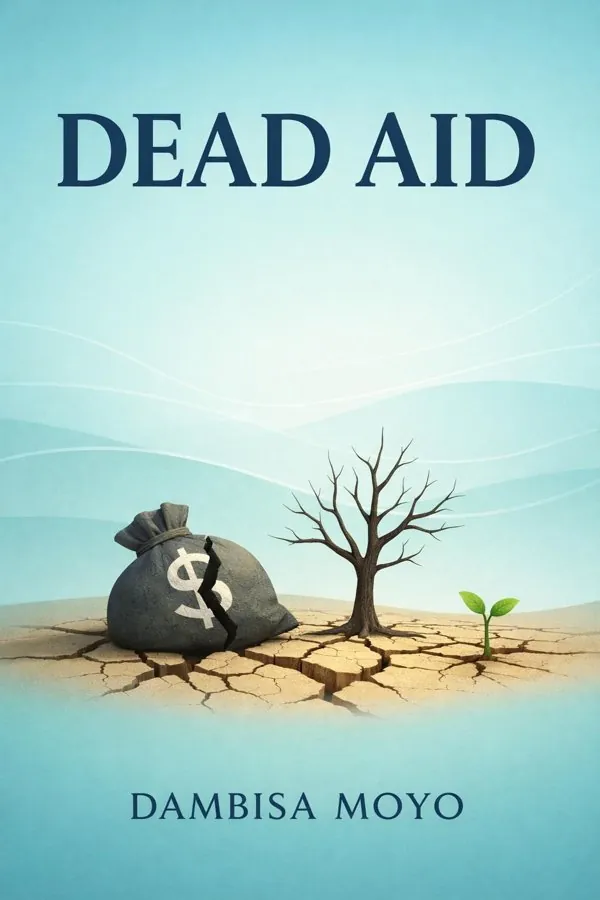
Dead Aid: Why Aid Is Not Working and How There Is a Better Way for Africa: Summary & Key Insights
by Dambisa Moyo
 10 min9 chaptersAudio available
Key Takeaways from Dead Aid: Why Aid Is Not Working and How There Is a Better Way for Africa
Big policy failures often begin with good intentions.
A government that does not need its citizens’ money has less reason to listen to its citizens.
Easy money rarely stays clean for long.
When outside money floods an economy, it can quietly crush the very markets needed for long-term growth.
The most dangerous development myth is that noble motives guarantee effective outcomes.
What Is Dead Aid: Why Aid Is Not Working and How There Is a Better Way for Africa About?
Dead Aid: Why Aid Is Not Working and How There Is a Better Way for Africa by Dambisa Moyo is a economics book spanning 12 pages. What if one of the world’s most celebrated tools for fighting poverty has actually helped keep poor countries poor? In Dead Aid, economist Dambisa Moyo makes that unsettling case with clarity and force. Focusing on Africa, she argues that decades of government-to-government foreign aid have too often entrenched corruption, weakened institutions, discouraged private investment, and created a culture of dependency rather than self-sustaining growth. Her central claim is not that compassion is misguided, but that the dominant aid model has produced harmful incentives and disappointing results. The book matters because it challenges a deeply rooted moral and political consensus. Instead of assuming that more aid means more progress, Moyo asks readers to judge aid by outcomes: stronger economies, accountable governments, productive enterprise, and rising living standards. She then points toward alternatives such as trade, access to capital markets, foreign investment, entrepreneurship, and financial inclusion. Moyo writes with unusual authority. A Zambian-born economist educated at Harvard and Oxford, and a former World Bank consultant and Goldman Sachs economist, she combines policy experience, market knowledge, and personal familiarity with the African context. The result is a provocative, influential book that pushes readers to rethink development at its foundations.
This FizzRead summary covers all 9 key chapters of Dead Aid: Why Aid Is Not Working and How There Is a Better Way for Africa in approximately 10 minutes, distilling the most important ideas, arguments, and takeaways from Dambisa Moyo's work. Also available as an audio summary and Key Quotes Podcast.
Dead Aid: Why Aid Is Not Working and How There Is a Better Way for Africa
What if one of the world’s most celebrated tools for fighting poverty has actually helped keep poor countries poor? In Dead Aid, economist Dambisa Moyo makes that unsettling case with clarity and force. Focusing on Africa, she argues that decades of government-to-government foreign aid have too often entrenched corruption, weakened institutions, discouraged private investment, and created a culture of dependency rather than self-sustaining growth. Her central claim is not that compassion is misguided, but that the dominant aid model has produced harmful incentives and disappointing results.
The book matters because it challenges a deeply rooted moral and political consensus. Instead of assuming that more aid means more progress, Moyo asks readers to judge aid by outcomes: stronger economies, accountable governments, productive enterprise, and rising living standards. She then points toward alternatives such as trade, access to capital markets, foreign investment, entrepreneurship, and financial inclusion.
Moyo writes with unusual authority. A Zambian-born economist educated at Harvard and Oxford, and a former World Bank consultant and Goldman Sachs economist, she combines policy experience, market knowledge, and personal familiarity with the African context. The result is a provocative, influential book that pushes readers to rethink development at its foundations.
Who Should Read Dead Aid: Why Aid Is Not Working and How There Is a Better Way for Africa?
This book is perfect for anyone interested in economics and looking to gain actionable insights in a short read. Whether you're a student, professional, or lifelong learner, the key ideas from Dead Aid: Why Aid Is Not Working and How There Is a Better Way for Africa by Dambisa Moyo will help you think differently.
- ✓Readers who enjoy economics and want practical takeaways
- ✓Professionals looking to apply new ideas to their work and life
- ✓Anyone who wants the core insights of Dead Aid: Why Aid Is Not Working and How There Is a Better Way for Africa in just 10 minutes
Want the full summary?
Get instant access to this book summary and 100K+ more with Fizz Moment.
Get Free SummaryAvailable on App Store • Free to download
Key Chapters
Big policy failures often begin with good intentions. Moyo starts by placing modern development aid in historical context, showing that large-scale aid emerged after World War II in a world shaped by reconstruction, Cold War politics, and postcolonial upheaval. The success of the Marshall Plan encouraged the belief that capital injections from rich countries could similarly lift poor nations. But Africa’s situation was very different from postwar Europe’s. European states already had functioning institutions, industrial capacity, tax systems, and administrative competence. Many newly independent African countries did not.
This difference matters because aid was transferred into weak political and bureaucratic environments where incentives were fragile. During the Cold War, aid was also frequently allocated for strategic reasons rather than based on governance quality or economic soundness. That meant regimes could receive substantial support not because they were effective, but because they were geopolitically useful. Over time, aid became normalized as a permanent feature of African public finance rather than a temporary bridge to self-reliance.
A practical implication is that development tools cannot simply be copied across contexts. A financing model that works in one institutional setting may fail badly in another. For policymakers, investors, and nonprofit leaders, this means asking a harder question before funding any intervention: what local systems exist to absorb capital productively? If institutions are weak, money alone is unlikely to solve the problem and may worsen it.
Actionable takeaway: judge development strategies by institutional fit, not moral appeal. Before supporting aid, ask whether it strengthens local accountability, productive capacity, and long-term independence.
A government that does not need its citizens’ money has less reason to listen to its citizens. One of Moyo’s most powerful arguments is that regular aid flows distort the relationship between African governments and the people they govern. In healthy political systems, states rely heavily on tax revenue, and taxation creates pressure for representation, transparency, and performance. Citizens who fund the state demand roads, schools, security, and competent administration in return.
Aid interrupts that feedback loop. When a large share of government income comes from foreign donors rather than domestic taxpayers, leaders become accountable upward to aid agencies and international institutions instead of outward to voters and businesses. This can allow poor governance to persist because the financial consequences of failure are softened by external transfers. A government may neglect tax reform, public service improvement, or business development if donor money continues to arrive regardless.
You can see the broader application of this idea beyond Africa. Any organization that becomes dependent on outside funding can drift away from serving its real stakeholders. A company sustained by subsidies may ignore customers. A nonprofit reliant on grants may optimize for donor reporting rather than mission results. The same incentive logic applies at the national level.
Moyo’s point is not that all aid recipients are passive or cynical. Rather, systems shape behavior. If leaders know that essential budget support will continue, the urgency to build a productive economy weakens. Citizens are then left with less leverage over the state.
Actionable takeaway: support policies that increase domestic revenue capacity, tax legitimacy, and citizen oversight. Sustainable development depends on governments needing their people more than they need foreign donors.
Easy money rarely stays clean for long. Moyo argues that large aid inflows often create fertile conditions for corruption, patronage, and political manipulation. Where institutions are weak, sudden access to significant external funds gives ruling elites more resources to distribute for loyalty, conceal through opaque contracts, or divert into private accounts. Even when donors intend to support poverty reduction, the money can leak through layers of bureaucracy and political favoritism before it reaches ordinary people.
The problem is not simply theft, though theft matters. It is also that aid can normalize rent-seeking behavior. If political office becomes the fastest route to controlling foreign funds, the incentive to gain and hold power intensifies. Competition shifts away from productive enterprise and toward access to the state. In such an environment, talented people may rationally choose politics, brokerage, or bureaucracy over building businesses or improving local industry.
Moyo’s argument helps explain why anti-corruption campaigns often disappoint when underlying incentives remain unchanged. Better auditing and donor conditions can help, but they cannot fully solve a system where large pools of externally supplied money are politically contestable. Similar patterns appear in resource-rich countries where oil revenues reduce the need for broad-based taxation; concentrated revenue streams can weaken democratic accountability.
For practitioners, the lesson is to distinguish between funding outputs and strengthening institutions. Handing over money without improving procurement, courts, budgeting, media freedom, and civic monitoring may unintentionally deepen the very abuses the aid is meant to address.
Actionable takeaway: prioritize transparency systems and dispersed economic opportunity over large, centralized cash transfers. Development works better when wealth is created across society rather than controlled by a narrow political elite.
When outside money floods an economy, it can quietly crush the very markets needed for long-term growth. Moyo shows how aid can distort exchange rates, pricing, labor incentives, and domestic competition. Large inflows of foreign currency may make local exports less competitive, a pattern related to the broader economic problem sometimes called Dutch disease. At the same time, donor-funded goods and services can displace local providers who might otherwise build sustainable businesses.
Consider a simple example. If imported, aid-funded food enters a region at below-market prices, local farmers may struggle to sell their crops profitably. If international NGOs pay much higher salaries than local firms or public agencies, skilled workers may leave productive domestic sectors for aid administration. If social services depend on donor programs instead of local tax-funded systems, governments may underinvest in building durable national capacity.
The key issue is not generosity but distortion. Markets coordinate incentives, signal scarcity, and reward efficiency. If aid repeatedly overrides those signals, entrepreneurs face a confusing environment in which political access and donor priorities matter more than customer demand. That weakens private-sector development, one of Moyo’s central concerns.
This insight applies to any effort to “help” an economy. Subsidies, emergency programs, and external grants should be evaluated for their second-order effects: whom do they crowd out, what incentives do they change, and what local capabilities do they weaken? A successful intervention should leave behind stronger markets, not permanent dependence.
Actionable takeaway: whenever evaluating a development program, ask how it affects local producers, prices, and incentives. If it weakens domestic enterprise, it may be solving today’s problem by deepening tomorrow’s.
The most dangerous development myth is that noble motives guarantee effective outcomes. Moyo challenges the assumption that aid should be judged primarily by the generosity behind it. Instead, she insists that aid be measured against actual economic and social results. If decades of assistance have coincided with persistent poverty, weak growth, and institutional fragility, then the model deserves serious scrutiny no matter how morally appealing it sounds.
This is one reason Dead Aid sparked such strong reactions. It asks readers to separate compassion from policy design. Moyo does not argue that Africans do not need support or that rich countries should be indifferent. She argues that one dominant form of support, long-term government-to-government aid, has too often failed on its own terms. In policy, intentions are input; outcomes are the true test.
A practical lesson here is the importance of evidence and time horizons. Some aid programs can produce visible short-term gains, such as more clinics, more vaccines, or emergency relief after disasters. Moyo’s critique is aimed mainly at chronic, systemic aid dependence, especially budget support that substitutes for domestic state-building. Readers should therefore learn to ask what kind of aid is being discussed, over what period, and with what institutional effects.
This principle matters in business and public life generally. Leaders often continue failing strategies because the mission sounds virtuous. But if a program repeatedly undermines its own goals, moral commitment should motivate redesign, not denial.
Actionable takeaway: evaluate development efforts by long-term institutional outcomes, not by funding levels or emotional appeal. Ask what improved because of the aid, what worsened, and whether the receiving country is becoming more self-sufficient.
Money that must be repaid changes behavior. One of Moyo’s most distinctive proposals is that African countries should rely more on bond markets and other forms of market-based finance rather than perpetual aid. Her logic is straightforward: investors, unlike many donors, demand credible plans, transparency, and the expectation of repayment. Accessing capital markets can therefore impose useful discipline on governments while reducing dependence on politically conditioned foreign assistance.
This does not mean debt is harmless. Poorly managed borrowing can become a crisis. Moyo’s point is that debt tied to market scrutiny may create healthier incentives than unconditional or semi-conditional aid. Governments that issue bonds must think about creditworthiness, inflation, fiscal stability, and investor confidence. Those concerns can push policymakers toward better economic management. In addition, successful market access signals to the world that a country is investable, potentially attracting further private capital.
For readers, the broader concept is important: sustainable finance often depends on reciprocal responsibility. Aid can become one-sided, with weak enforcement of performance. Market finance creates a clearer accountability mechanism because lenders expect returns and can withdraw support if confidence collapses.
At the same time, Moyo is not proposing that every African country rush recklessly into borrowing. Sound sequencing matters. Stronger institutions, debt management, and transparent public finance are necessary preconditions. Used wisely, however, capital markets can diversify funding sources and reduce donor dependence.
Actionable takeaway: support development finance models that reward credibility and performance. Countries seeking independence need financing structures that strengthen discipline, reputation, and long-term access to investment.
Prosperity usually comes from producing value, not receiving transfers. Moyo argues that Africa’s long-term future depends far more on trade, foreign direct investment, and integration into global markets than on continued aid dependence. Trade expands opportunity by linking producers to customers, encouraging specialization, and rewarding efficiency. Investment brings not just capital, but also technology, management practices, supply chains, and jobs.
This shift in focus matters because it changes how development is imagined. Instead of viewing African countries mainly as recipients of charity, Moyo asks readers to see them as potential trading partners, investment destinations, and entrepreneurial ecosystems. That reframing is psychologically and politically significant. It centers agency, production, and competitiveness rather than need.
A practical example is infrastructure. Roads, ports, energy systems, and telecommunications make trade possible and attract business activity. Likewise, predictable regulation, enforceable contracts, and property rights matter because investors commit capital where rules are clearer and risks are manageable. Moyo also discusses the role of China as a controversial but important actor, particularly through infrastructure-for-resources deals and commercial engagement. Whether one views China’s role positively or cautiously, it illustrates her larger point: development driven by commercial exchange differs fundamentally from development driven by recurring aid transfers.
For business leaders and policymakers, the lesson is to ask what helps local firms scale, export, and compete. Development policy should support productive capacity, not just consumption support.
Actionable takeaway: prioritize policies that make countries easier places to invest in, trade with, and build businesses in. Sustainable growth comes from participation in markets, not permanent external rescue.
The fastest way to weaken poverty is often to strengthen the people already trying to solve it through work, enterprise, and innovation. Moyo emphasizes that Africa’s development will ultimately depend on domestic entrepreneurs, small businesses, and locally grounded investment. But entrepreneurship cannot flourish in an environment starved of credit, burdened by bureaucracy, and overshadowed by aid-driven distortions.
This is where alternatives such as microfinance and broader financial inclusion enter the discussion. Small loans, savings products, mobile banking, and local credit systems can help individuals start businesses, smooth income, invest in equipment, or expand production. While microfinance is not a magic bullet, it reflects a fundamentally different philosophy from large aid transfers: empower dispersed actors to make decisions close to the ground.
Moyo’s emphasis on entrepreneurship also highlights a cultural and policy shift. Instead of assuming development arrives through ministries and donor conferences, she points to the cumulative power of thousands of private decisions by farmers, shopkeepers, manufacturers, and service providers. Real economic transformation is often decentralized. It emerges when ordinary people can keep the rewards of effort, access capital, and operate under stable rules.
For modern readers, this insight resonates strongly with Africa’s growth in fintech, mobile payments, logistics, and digital commerce. Innovation often accelerates when regulation becomes clearer and financing more accessible. The same principle applies globally: resilient economies are built by enabling productive risk-taking at the grassroots level.
Actionable takeaway: if you want to support development, look for ways to expand access to finance, reduce red tape, and strengthen the business environment for local entrepreneurs rather than concentrating all resources at the top.
A system without an exit plan becomes a trap. Moyo’s boldest recommendation is not merely to reduce aid’s harms, but to phase out long-term aid altogether over a defined period. Her reasoning is that as long as aid remains a permanent expectation, governments and donors alike will postpone the deeper reforms required for genuine independence. An orderly exit creates pressure to build alternatives: tax systems, investment channels, trade relationships, domestic financial markets, and accountable institutions.
This proposal is deliberately provocative because it forces a shift from maintenance to transition. Instead of asking how to make aid slightly more efficient, Moyo asks how African countries can stop needing it as a structural feature of public finance. That change in framing has strategic power. It encourages policy designs aimed at self-sufficiency rather than endless management of dependency.
Of course, the book does not suggest abolishing all external support in every context. Humanitarian relief in wars, pandemics, or natural disasters remains a separate category. The target of Moyo’s critique is continuous development aid that substitutes for domestic economic and political development. A credible exit would therefore need sequencing, safeguards, and tailored national strategies.
For readers, the larger lesson is that healthy systems are built around autonomy. Whether in nations, institutions, or individuals, support should increase capability, not create indefinite reliance. The success of help should be measured by whether it becomes less necessary over time.
Actionable takeaway: whenever evaluating aid or assistance, ask a simple but powerful question: what is the path to independence? If no clear exit exists, the support may be preserving dependency rather than solving it.
All Chapters in Dead Aid: Why Aid Is Not Working and How There Is a Better Way for Africa
About the Author
Dambisa Moyo is a Zambian-born economist and bestselling author known for her contrarian views on global development, finance, and macroeconomic policy. She holds degrees from American University, Harvard University, and Oxford, where she earned a doctorate in economics. Moyo has worked at the World Bank and at Goldman Sachs, giving her experience in both development institutions and global capital markets. She rose to international prominence with Dead Aid, which challenged the effectiveness of long-term foreign aid to Africa and sparked widespread debate among policymakers, academics, and investors. Her work often explores how incentives, markets, and governance shape economic outcomes. Moyo is widely recognized for bringing together rigorous economic analysis, policy experience, and an insider’s perspective on Africa’s development challenges.
Get This Summary in Your Preferred Format
Read or listen to the Dead Aid: Why Aid Is Not Working and How There Is a Better Way for Africa summary by Dambisa Moyo anytime, anywhere. FizzRead offers multiple formats so you can learn on your terms — all free.
Available formats: App · Audio · PDF · EPUB — All included free with FizzRead
Download Dead Aid: Why Aid Is Not Working and How There Is a Better Way for Africa PDF and EPUB Summary
Key Quotes from Dead Aid: Why Aid Is Not Working and How There Is a Better Way for Africa
“Big policy failures often begin with good intentions.”
“A government that does not need its citizens’ money has less reason to listen to its citizens.”
“Moyo argues that large aid inflows often create fertile conditions for corruption, patronage, and political manipulation.”
“When outside money floods an economy, it can quietly crush the very markets needed for long-term growth.”
“The most dangerous development myth is that noble motives guarantee effective outcomes.”
Frequently Asked Questions about Dead Aid: Why Aid Is Not Working and How There Is a Better Way for Africa
Dead Aid: Why Aid Is Not Working and How There Is a Better Way for Africa by Dambisa Moyo is a economics book that explores key ideas across 9 chapters. What if one of the world’s most celebrated tools for fighting poverty has actually helped keep poor countries poor? In Dead Aid, economist Dambisa Moyo makes that unsettling case with clarity and force. Focusing on Africa, she argues that decades of government-to-government foreign aid have too often entrenched corruption, weakened institutions, discouraged private investment, and created a culture of dependency rather than self-sustaining growth. Her central claim is not that compassion is misguided, but that the dominant aid model has produced harmful incentives and disappointing results. The book matters because it challenges a deeply rooted moral and political consensus. Instead of assuming that more aid means more progress, Moyo asks readers to judge aid by outcomes: stronger economies, accountable governments, productive enterprise, and rising living standards. She then points toward alternatives such as trade, access to capital markets, foreign investment, entrepreneurship, and financial inclusion. Moyo writes with unusual authority. A Zambian-born economist educated at Harvard and Oxford, and a former World Bank consultant and Goldman Sachs economist, she combines policy experience, market knowledge, and personal familiarity with the African context. The result is a provocative, influential book that pushes readers to rethink development at its foundations.
More by Dambisa Moyo
You Might Also Like

Business Adventures
John Brooks
10 min
Nudge
Richard H. Thaler, Cass R. Sunstein
10 min
The Hitchhiker"s Guide to the Galaxy
Douglas Adams
10 minThe Muqaddimah
Ibn Khaldun
10 minThe Outsiders
William N. Thorndike
10 min
A Little History of Economics
Niall Kishtainy
10 minBrowse by Category
Ready to read Dead Aid: Why Aid Is Not Working and How There Is a Better Way for Africa?
Get the full summary and 100K+ more books with Fizz Moment.