
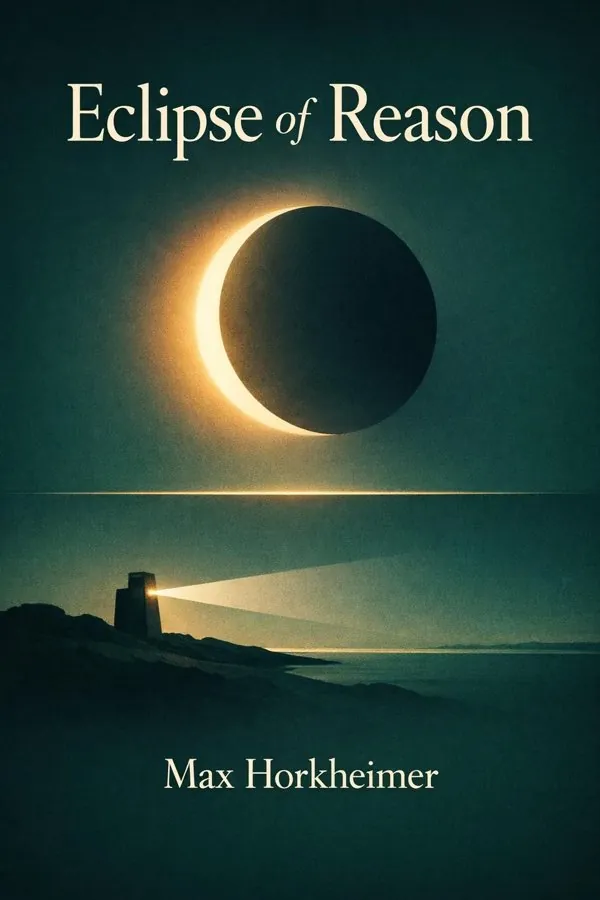
Eclipse of Reason: Summary & Key Insights
 10 min10 chaptersAudio available
What Is Eclipse of Reason About?
Eclipse of Reason by Max Horkheimer is a western_phil book spanning 10 pages. In this influential work, Max Horkheimer examines the evolution of reason in modern society and critiques its reduction to a merely instrumental tool for achieving ends. He argues that this form of reason leads to alienation and domination by neglecting ethical and critical dimensions. The book is considered a key text of Critical Theory and a continuation of ideas developed with Theodor W. Adorno in 'Dialectic of Enlightenment.'
This FizzRead summary covers all 10 key chapters of Eclipse of Reason in approximately 10 minutes, distilling the most important ideas, arguments, and takeaways from Max Horkheimer's work. Also available as an audio summary and Key Quotes Podcast.
Eclipse of Reason
In this influential work, Max Horkheimer examines the evolution of reason in modern society and critiques its reduction to a merely instrumental tool for achieving ends. He argues that this form of reason leads to alienation and domination by neglecting ethical and critical dimensions. The book is considered a key text of Critical Theory and a continuation of ideas developed with Theodor W. Adorno in 'Dialectic of Enlightenment.'
Who Should Read Eclipse of Reason?
This book is perfect for anyone interested in western_phil and looking to gain actionable insights in a short read. Whether you're a student, professional, or lifelong learner, the key ideas from Eclipse of Reason by Max Horkheimer will help you think differently.
- ✓Readers who enjoy western_phil and want practical takeaways
- ✓Professionals looking to apply new ideas to their work and life
- ✓Anyone who wants the core insights of Eclipse of Reason in just 10 minutes
Want the full summary?
Get instant access to this book summary and 100K+ more with Fizz Moment.
Get Free SummaryAvailable on App Store • Free to download
Key Chapters
To understand the predicament of modern reason, we must look back to its origins. In classical philosophy, from ancient Greece through the Enlightenment’s early stages, reason was not simply a cognitive tool but a cosmic and ethical order. For Plato, reason corresponded to the realm of eternal forms—a vision of truth that guided human life. Aristotle refined this into the notion of practical reason, where rational deliberation defined the good life and the just polis. The rational was inseparable from the moral.
This unity persisted in varying degrees through medieval scholasticism and into the Renaissance. Reason was seen as both a reflection of divine order and the foundation of human ethics. To act rationally meant to act in harmony with universal principles of justice and goodness. Truth and reason were almost synonymous, and to reason correctly was, at least in principle, to live rightly.
But the modern era introduced a sharp transformation. The rise of empirical science, industrial development, and positivism began to redefine reason as an instrument for mastering nature. Descartes, Bacon, and others heralded a new method of thought based on calculation, quantification, and control. What once served to uncover meaning and ethical order now served primarily to predict and manipulate. The metaphysical and moral dimensions of reason were gradually stripped away.
By the time of the Enlightenment, rationality had acquired an ambivalent double role. On one hand, it was celebrated as the force liberating humankind from superstition; on the other, its form was increasingly instrumental. Hegel and Kant still sought to defend reason’s objective aspect, but their heirs often reduced reason to scientific method or economic efficiency. This reduction prepared the stage for what I call the eclipse—the point at which reason ceases to ask about ends and confines itself to means. The rational subject becomes not a knower of the good but a strategist, and society a system of mechanisms rather than meanings.
Objective reason once signified the conviction that the world and human life exhibit an inherent rational structure. To think rationally was to align one’s mind and actions with that order. In this sense, reason was substantive: it could pronounce certain ends as right or good in themselves. Ethical norms, justice, and truth were rationally grounded, not dependent merely on subjective preference or social consensus.
In this vision, reason provided the standard by which both thought and behavior could be judged. It did not merely help us achieve goals—it told us which goals were worthy of pursuit. Objective reason offered a conception of humanity as part of a universal moral order. Whether in Plato’s idea of the Good, in the Stoic logos, or in Kant’s categorical imperative, reason pointed beyond individual advantage toward the common and the universal. It gave culture a center of moral gravity.
Yet this kind of reason requires faith in meaning itself—a belief that reality possesses intelligible and ethical significance. When such faith wanes, objective reason loses ground. Modern philosophy, eager to liberate humanity from metaphysical constraints, slowly detached reason from the task of discerning truth about ends. The more the world came to be seen as a field of neutral facts, the less reason could dictate moral content. The criterion of rationality moved from questions of *why* to calculations of *how*.
To defend objective reason, I do not advocate a return to dogma or to uncritical metaphysics. Rather, I insist that reason should not be confined to the logic of utility. Humanity’s greatest achievements in morality, art, and philosophy arose when reason aspired to universality. To forfeit objective reason is to abandon the possibility of genuine ethical guidance.
+ 8 more chapters — available in the FizzRead app
All Chapters in Eclipse of Reason
About the Author
Max Horkheimer (1895–1973) was a German social philosopher and one of the leading figures of the Frankfurt School. He served as director of the Institute for Social Research in Frankfurt am Main and collaborated closely with Theodor W. Adorno. His works on Critical Theory, particularly on the dialectic of enlightenment and instrumental reason, profoundly shaped twentieth-century social philosophy.
Get This Summary in Your Preferred Format
Read or listen to the Eclipse of Reason summary by Max Horkheimer anytime, anywhere. FizzRead offers multiple formats so you can learn on your terms — all free.
Available formats: App · Audio · PDF · EPUB — All included free with FizzRead
Download Eclipse of Reason PDF and EPUB Summary
Key Quotes from Eclipse of Reason
“To understand the predicament of modern reason, we must look back to its origins.”
“Objective reason once signified the conviction that the world and human life exhibit an inherent rational structure.”
Frequently Asked Questions about Eclipse of Reason
Eclipse of Reason by Max Horkheimer is a western_phil book that explores key ideas across 10 chapters. In this influential work, Max Horkheimer examines the evolution of reason in modern society and critiques its reduction to a merely instrumental tool for achieving ends. He argues that this form of reason leads to alienation and domination by neglecting ethical and critical dimensions. The book is considered a key text of Critical Theory and a continuation of ideas developed with Theodor W. Adorno in 'Dialectic of Enlightenment.'
You Might Also Like
A Little History of Philosophy
Nigel Warburton
10 min
Areopagitica
John Milton
10 min
How To Think Like A Philosopher: Essential Principles For Clear Thinking
Peter Cave
10 min
Language, Truth and Logic
A. J. Ayer
10 min
The Age of Reason
Thomas Paine
10 min
The Essays
Michel De Montaigne
10 minBrowse by Category
Ready to read Eclipse of Reason?
Get the full summary and 100K+ more books with Fizz Moment.