
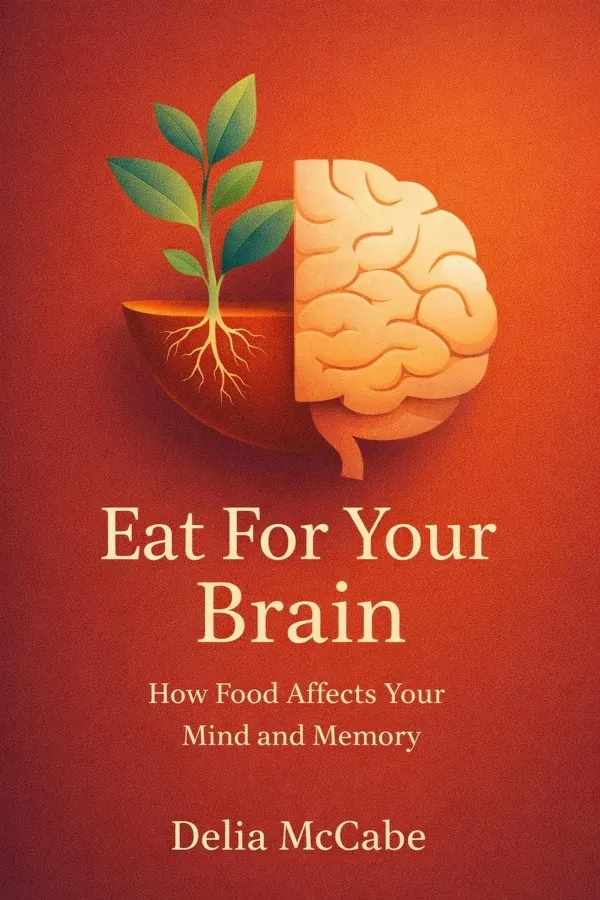
Eat For Your Brain: How Food Affects Your Mind and Memory: Summary & Key Insights
by Delia McCabe
 10 min11 chaptersAudio available
What Is Eat For Your Brain: How Food Affects Your Mind and Memory About?
Eat For Your Brain: How Food Affects Your Mind and Memory by Delia McCabe is a health_med book spanning 11 pages. This book explores the connection between nutrition and brain health, explaining how specific foods and nutrients influence cognitive function, emotional balance, and memory. Drawing on neuroscience and nutritional research, Delia McCabe provides practical guidance for improving mental clarity and resilience through dietary choices.
This FizzRead summary covers all 11 key chapters of Eat For Your Brain: How Food Affects Your Mind and Memory in approximately 10 minutes, distilling the most important ideas, arguments, and takeaways from Delia McCabe's work. Also available as an audio summary and Key Quotes Podcast.
Eat For Your Brain: How Food Affects Your Mind and Memory
This book explores the connection between nutrition and brain health, explaining how specific foods and nutrients influence cognitive function, emotional balance, and memory. Drawing on neuroscience and nutritional research, Delia McCabe provides practical guidance for improving mental clarity and resilience through dietary choices.
Who Should Read Eat For Your Brain: How Food Affects Your Mind and Memory?
This book is perfect for anyone interested in health_med and looking to gain actionable insights in a short read. Whether you're a student, professional, or lifelong learner, the key ideas from Eat For Your Brain: How Food Affects Your Mind and Memory by Delia McCabe will help you think differently.
- ✓Readers who enjoy health_med and want practical takeaways
- ✓Professionals looking to apply new ideas to their work and life
- ✓Anyone who wants the core insights of Eat For Your Brain: How Food Affects Your Mind and Memory in just 10 minutes
Want the full summary?
Get instant access to this book summary and 100K+ more with Fizz Moment.
Get Free SummaryAvailable on App Store • Free to download
Key Chapters
The brain’s architecture is astonishingly dynamic. It is composed largely of fat, yet relies constantly on glucose as its preferred energy source. Each neuron functions like a delicate communications hub, its membranes requiring the right balance of fatty acids to remain fluid and responsive. Unlike many organs, the brain stores very little energy, meaning that nutrient supply through the bloodstream must be steady for thought to flow easily.
In this section, I describe how carbohydrates, fats, proteins, vitamins, and minerals converge as biochemical partners in cognition. The mitochondria inside brain cells depend on a spectrum of micronutrients to produce ATP, the energy currency that powers every mental process from focus to creativity. When this production falters because of a nutrient shortage, one feels exhausted, impatient, or mentally slow. Conversely, an abundance of high-quality nutrition allows neurons to create and repair synapses efficiently—the very foundation of learning and memory.
I emphasize that our modern convenience–driven diet, filled with added sugars and chemically altered fats, leaves the brain undernourished despite caloric excess. Reconnecting with real food—those that human physiology evolved with—is therefore not nostalgia but necessity. Every cell in the brain is waiting for the raw materials of vitality: complex carbohydrates from whole grains, essential fatty acids from natural oils and fish, amino acids from clean proteins, and antioxidants from plants. Feeding the brain this way is a deliberate act of self-care that underpins both cognitive performance and emotional equilibrium.
Of all nutrients, none is more crucial for mental performance than fats. About sixty percent of the brain’s dry weight is lipid, and the quality of those fats determines how efficiently brain cells communicate. I explain the partnership between omega-3 and omega-6 fatty acids, especially their roles in building neuronal membranes and regulating inflammation.
Omega-3s—found in fish, flaxseed, and walnuts—make cell membranes flexible and receptive, ensuring that electrical impulses pass smoothly between neurons. They also modulate mood by influencing serotonin and dopamine activity. Omega-6s, abundant in many processed oils, are essential in small amounts but can promote inflammatory processes when consumed excessively. The modern imbalance—far too many omega-6s, too few omega-3s—correlates with rising rates of depression, memory issues, and attention difficulties.
Through research and observation, I have seen remarkable changes in individuals who restore this balance. Clearer thinking, calm confidence, and better memory often follow in a matter of weeks. The science behind this transformation lies in cell fluidity: when membranes regain optimal composition, neurotransmitters dock more effectively, signal transmission sharpens, and oxidative stress diminishes. Eating for your brain, in this sense, means choosing fats consciously—favoring natural oils, cold-water fish, nuts, and seeds over hydrogenated or refined oils that silently sabotage mental energy.
+ 9 more chapters — available in the FizzRead app
All Chapters in Eat For Your Brain: How Food Affects Your Mind and Memory
About the Author
Delia McCabe is a researcher and author specializing in nutritional neuroscience. She holds a PhD in psychology and focuses on how dietary factors affect brain performance and emotional well-being. Her work bridges scientific research and practical applications for everyday mental health.
Get This Summary in Your Preferred Format
Read or listen to the Eat For Your Brain: How Food Affects Your Mind and Memory summary by Delia McCabe anytime, anywhere. FizzRead offers multiple formats so you can learn on your terms — all free.
Available formats: App · Audio · PDF · EPUB — All included free with FizzRead
Download Eat For Your Brain: How Food Affects Your Mind and Memory PDF and EPUB Summary
Key Quotes from Eat For Your Brain: How Food Affects Your Mind and Memory
“The brain’s architecture is astonishingly dynamic.”
“Of all nutrients, none is more crucial for mental performance than fats.”
Frequently Asked Questions about Eat For Your Brain: How Food Affects Your Mind and Memory
Eat For Your Brain: How Food Affects Your Mind and Memory by Delia McCabe is a health_med book that explores key ideas across 11 chapters. This book explores the connection between nutrition and brain health, explaining how specific foods and nutrients influence cognitive function, emotional balance, and memory. Drawing on neuroscience and nutritional research, Delia McCabe provides practical guidance for improving mental clarity and resilience through dietary choices.
You Might Also Like

On Immunity
Eula Biss
10 min
The Three-Body Problem
Liu Cixin
10 min
Community Health Volunteer Toolkit: Training and Practical Activities
World Health Organization
10 min
Healing Back Pain: The Mind-Body Connection
John E. Sarno
10 min
Health Literacy for All: Practical Guides to Communicate Health Information (Compilations)
World Health Organization
10 min
The Complete Guide to Sports Supplements: An Evidence-Based Review
Anita Bean
10 minBrowse by Category
Ready to read Eat For Your Brain: How Food Affects Your Mind and Memory?
Get the full summary and 100K+ more books with Fizz Moment.