
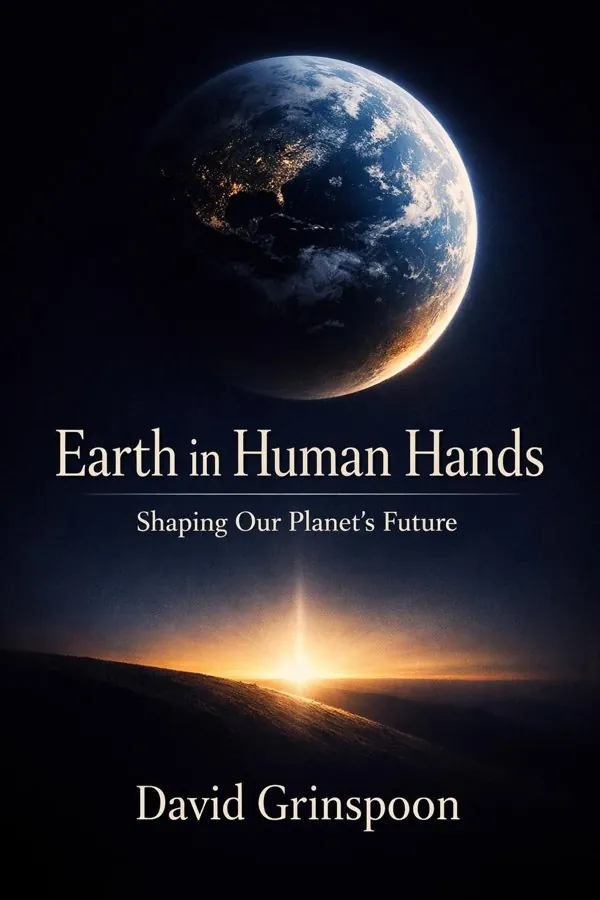
Earth in Human Hands: Shaping Our Planet's Future: Summary & Key Insights
 10 min12 chaptersAudio available
What Is Earth in Human Hands: Shaping Our Planet's Future About?
Earth in Human Hands: Shaping Our Planet's Future by David Grinspoon is a popular_sci book spanning 12 pages. In this thought-provoking work, planetary scientist David Grinspoon explores humanity’s growing role as a geological force capable of shaping the Earth’s future. Drawing on astrobiology, climate science, and philosophy, he argues that we have entered a new epoch—the Anthropocene—where our collective choices will determine the planet’s trajectory. Grinspoon examines how civilizations might evolve to become sustainable planetary stewards, offering both caution and hope for our species’ long-term survival.
This FizzRead summary covers all 12 key chapters of Earth in Human Hands: Shaping Our Planet's Future in approximately 10 minutes, distilling the most important ideas, arguments, and takeaways from David Grinspoon's work. Also available as an audio summary and Key Quotes Podcast.
Earth in Human Hands: Shaping Our Planet's Future
In this thought-provoking work, planetary scientist David Grinspoon explores humanity’s growing role as a geological force capable of shaping the Earth’s future. Drawing on astrobiology, climate science, and philosophy, he argues that we have entered a new epoch—the Anthropocene—where our collective choices will determine the planet’s trajectory. Grinspoon examines how civilizations might evolve to become sustainable planetary stewards, offering both caution and hope for our species’ long-term survival.
Who Should Read Earth in Human Hands: Shaping Our Planet's Future?
This book is perfect for anyone interested in popular_sci and looking to gain actionable insights in a short read. Whether you're a student, professional, or lifelong learner, the key ideas from Earth in Human Hands: Shaping Our Planet's Future by David Grinspoon will help you think differently.
- ✓Readers who enjoy popular_sci and want practical takeaways
- ✓Professionals looking to apply new ideas to their work and life
- ✓Anyone who wants the core insights of Earth in Human Hands: Shaping Our Planet's Future in just 10 minutes
Want the full summary?
Get instant access to this book summary and 100K+ more with Fizz Moment.
Get Free SummaryAvailable on App Store • Free to download
Key Chapters
When scientists speak of the Anthropocene, they describe a geological epoch defined not by natural forces alone, but by human influence. The evidence is everywhere: carbon isotopes preserved in ice cores, altered landscapes visible from orbit, synthetic materials embedded in sediments. I see the Anthropocene as a profound scientific revelation—it tells us that humanity has become a planetary process. But beyond science, it’s a psychological and moral threshold. To declare this new epoch is to acknowledge that we have inherited responsibility for the future trajectory of Earth itself.
Unlike previous geological boundaries formed by asteroid impacts or volcanic cataclysms, this one arises from consciousness—the awareness and intentional action of a thinking species. That’s unprecedented. For some, this realization is terrifying. For me, it’s exhilarating. It means Earth has reached a new phase in its history: the biosphere has become self-reflective. The Anthropocene is thus not just an epoch of disruption; it is also one of potential maturity, where intelligence becomes a planetary force intertwined with life and geology. What remains uncertain is whether that force will stabilize or unravel the system it depends upon.
Studying other planets has always sharpened my sense of Earth’s uniqueness. When I compare our planet to Venus and Mars, the contrasts are stunning. Venus, once perhaps friendly to life, turned into an inferno as runaway greenhouse gases thickened its atmosphere. Mars, in contrast, lost its protective air and froze into desolation. Earth, against all odds, found balance—a moderate climate and intricate web of life sustained over eons. Understanding why requires thinking like a planetary scientist: ecosystems, climate, and geology are all parts of a single feedback system.
This planetary perspective reveals that habitability is fragile, contingent, and deeply dynamic. Earth’s biosphere is not a steady-state given to us by nature, but a complex, evolving system created by life itself. The oxygen we breathe and the temperature we enjoy are legacies of billions of years of microbial innovation. Recognizing this helps us see that our technological civilization is an extension of that same evolutionary process. We have become agents of planetary feedbacks—unwittingly at first, but now with growing awareness. The task before us is not to “save the planet,” but to learn how to guide it wisely.
+ 10 more chapters — available in the FizzRead app
All Chapters in Earth in Human Hands: Shaping Our Planet's Future
About the Author
David Grinspoon is an American astrobiologist, planetary scientist, and author. He has served as an advisor to NASA on planetary exploration and climate issues and is known for his engaging science communication. His research focuses on planetary habitability, climate evolution, and the search for life beyond Earth.
Get This Summary in Your Preferred Format
Read or listen to the Earth in Human Hands: Shaping Our Planet's Future summary by David Grinspoon anytime, anywhere. FizzRead offers multiple formats so you can learn on your terms — all free.
Available formats: App · Audio · PDF · EPUB — All included free with FizzRead
Download Earth in Human Hands: Shaping Our Planet's Future PDF and EPUB Summary
Key Quotes from Earth in Human Hands: Shaping Our Planet's Future
“When scientists speak of the Anthropocene, they describe a geological epoch defined not by natural forces alone, but by human influence.”
“Studying other planets has always sharpened my sense of Earth’s uniqueness.”
Frequently Asked Questions about Earth in Human Hands: Shaping Our Planet's Future
Earth in Human Hands: Shaping Our Planet's Future by David Grinspoon is a popular_sci book that explores key ideas across 12 chapters. In this thought-provoking work, planetary scientist David Grinspoon explores humanity’s growing role as a geological force capable of shaping the Earth’s future. Drawing on astrobiology, climate science, and philosophy, he argues that we have entered a new epoch—the Anthropocene—where our collective choices will determine the planet’s trajectory. Grinspoon examines how civilizations might evolve to become sustainable planetary stewards, offering both caution and hope for our species’ long-term survival.
You Might Also Like

Structures: Or Why Things Don"t Fall Down
J.E. Gordon
10 min
The Road to Wigan Pier
George Orwell
10 min
Bonk: The Curious Coupling of Science and Sex
Mary Roach
10 min
First Bite: How We Learn to Eat
Bee Wilson
10 min
In Pursuit Of The Unknown: 17 Equations That Changed The World
Ian Stewart
10 min
Napoleon's Buttons: 17 Molecules That Changed History
Penny Le Couteur and Jay Burreson
10 minBrowse by Category
Ready to read Earth in Human Hands: Shaping Our Planet's Future?
Get the full summary and 100K+ more books with Fizz Moment.