
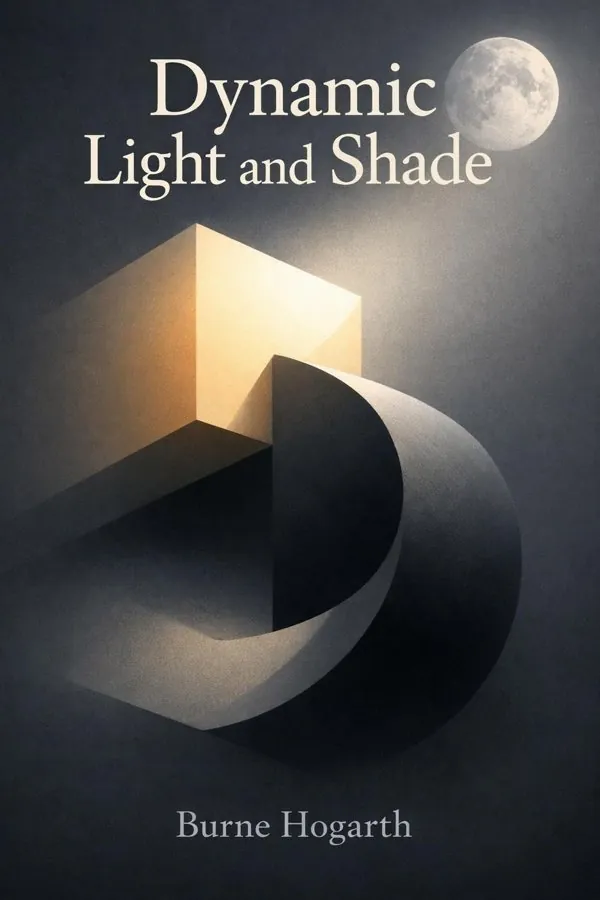
Dynamic Light and Shade: Summary & Key Insights
 10 min4 chaptersAudio available
What Is Dynamic Light and Shade About?
Dynamic Light and Shade by Burne Hogarth is a design book spanning 4 pages. Dynamic Light and Shade is a comprehensive guide to understanding and applying the principles of light and shadow in drawing and painting. Burne Hogarth, a master illustrator and educator, explores five fundamental categories of light—single-source, double-source, diffused, moonlight, and sculptural light—demonstrating how each affects form, texture, and mood. The book provides detailed illustrations and step-by-step analyses to help artists achieve depth, realism, and expressive power in their work.
This FizzRead summary covers all 4 key chapters of Dynamic Light and Shade in approximately 10 minutes, distilling the most important ideas, arguments, and takeaways from Burne Hogarth's work. Also available as an audio summary and Key Quotes Podcast.
Dynamic Light and Shade
Dynamic Light and Shade is a comprehensive guide to understanding and applying the principles of light and shadow in drawing and painting. Burne Hogarth, a master illustrator and educator, explores five fundamental categories of light—single-source, double-source, diffused, moonlight, and sculptural light—demonstrating how each affects form, texture, and mood. The book provides detailed illustrations and step-by-step analyses to help artists achieve depth, realism, and expressive power in their work.
Who Should Read Dynamic Light and Shade?
This book is perfect for anyone interested in design and looking to gain actionable insights in a short read. Whether you're a student, professional, or lifelong learner, the key ideas from Dynamic Light and Shade by Burne Hogarth will help you think differently.
- ✓Readers who enjoy design and want practical takeaways
- ✓Professionals looking to apply new ideas to their work and life
- ✓Anyone who wants the core insights of Dynamic Light and Shade in just 10 minutes
Want the full summary?
Get instant access to this book summary and 100K+ more with Fizz Moment.
Get Free SummaryAvailable on App Store • Free to download
Key Chapters
Light is both a scientific and an aesthetic reality. It travels in straight lines from its source, strikes surfaces, and rebounds into our eyes, creating the visual world. But for the artist, this physics must transform into intuition. I begin by asking you to imagine light as a sculptor — carving, defining, and revealing form through direction, intensity, and texture.
The direction of light is the most basic condition of perception. It defines orientation, reveals depth, and turns the flat surface of paper into spatial illusion. When light hits an object head-on, the form appears symmetrical and static. As it shifts obliquely, drama begins — because shadow starts to play. Intensity adds another dimension. A bright, concentrated light emphasizes contour and texture, while low intensity invites the subtle play of tone. Diffusion, finally, softens edges and merges transitions.
Every artist must learn to predict how light behaves on different surfaces: smooth, rough, glossy, or absorbent. A marble statue catches hard contrast between light and dark, emphasizing planes. Skin, on the other hand, absorbs light and returns it gently, creating the rounded tones that give the human body its breath. Understanding this behavior allows you to differentiate between material identities.
Throughout my teaching, I insist that observation and imagination complement each other. Light is not static; it moves, bends, and wraps. In drawing, we simulate these actions through gradation — the gradual blending of tone from white to black. This gradation mirrors the continuous transition of light in the real world. Learning to control it transforms your drawings from diagrammatic constructions into living realities.
Light behaves in countless ways, yet in practice, its variations can be understood through five major categories: single-source light, double-source light, diffused light, moonlight, and sculptural light. Each creates distinct expressive effects and technical challenges.
Single-source light is the purest condition. It comes from one strong direction — like sunlight or a spotlight — and it defines shape with maximum clarity. Every shadow points away from the source, creating patterns that reveal form. Artists use this lighting to explore anatomy and volume because it gives decisive contour and strong sense of dimensional contrast.
Double-source light introduces complexity. When two lights interact — perhaps daylight combined with reflected lamplight — the shadowing system becomes layered. A shadow may have inner and outer edges, reflecting different intensities or colors. This condition teaches visual negotiation — the ability to balance hierarchy among competing lights.
Diffused light, the most common and forgiving, scatters illumination through clouds or translucent material. It softens shadows and reduces contrast, yielding serene tonal harmonies. Portraitists often choose it for emotional subtlety: under diffused light, character emerges through soft transitions rather than harsh separation.
Moonlight shifts the equation away from intensity toward tone. It is a reflected light, blue-tinted and quiet. In moonlight, darkness dominates and forms dissolve into atmosphere. Painting or drawing moonlight requires tuning your sensitivity to half-tones and the emotional texture of night.
Sculptural light crowns all others in expressive potential. It comes not from natural sources but from creative intention — constructed lighting that amplifies volumetric presence. In a sculptural setup, I invite artists to think like designers of space: to arrange light so that every form becomes architecture, every shadow a deliberate compositional element. This lighting transforms observation into aesthetic control.
+ 2 more chapters — available in the FizzRead app
All Chapters in Dynamic Light and Shade
About the Author
Burne Hogarth (1911–1996) was an American artist, educator, and author best known for his dynamic figure drawing books and his work on the Tarzan comic strip. He co-founded the School of Visual Arts in New York and wrote several influential art instruction books that continue to shape the study of anatomy and illustration.
Get This Summary in Your Preferred Format
Read or listen to the Dynamic Light and Shade summary by Burne Hogarth anytime, anywhere. FizzRead offers multiple formats so you can learn on your terms — all free.
Available formats: App · Audio · PDF · EPUB — All included free with FizzRead
Download Dynamic Light and Shade PDF and EPUB Summary
Key Quotes from Dynamic Light and Shade
“Light is both a scientific and an aesthetic reality.”
“Each creates distinct expressive effects and technical challenges.”
Frequently Asked Questions about Dynamic Light and Shade
Dynamic Light and Shade by Burne Hogarth is a design book that explores key ideas across 4 chapters. Dynamic Light and Shade is a comprehensive guide to understanding and applying the principles of light and shadow in drawing and painting. Burne Hogarth, a master illustrator and educator, explores five fundamental categories of light—single-source, double-source, diffused, moonlight, and sculptural light—demonstrating how each affects form, texture, and mood. The book provides detailed illustrations and step-by-step analyses to help artists achieve depth, realism, and expressive power in their work.
More by Burne Hogarth
You Might Also Like

The Design of Everyday Things
Don Norman
10 min
The Better Angels of Our Nature
Steven Pinker
10 min
A Designer's Art
Paul Rand
10 min
Architects' Sketchbooks
Various Editors
10 min
Architectural Graphic Standards
The American Institute of Architects
10 min
Design Is Storytelling
Ellen Lupton
10 minBrowse by Category
Ready to read Dynamic Light and Shade?
Get the full summary and 100K+ more books with Fizz Moment.