
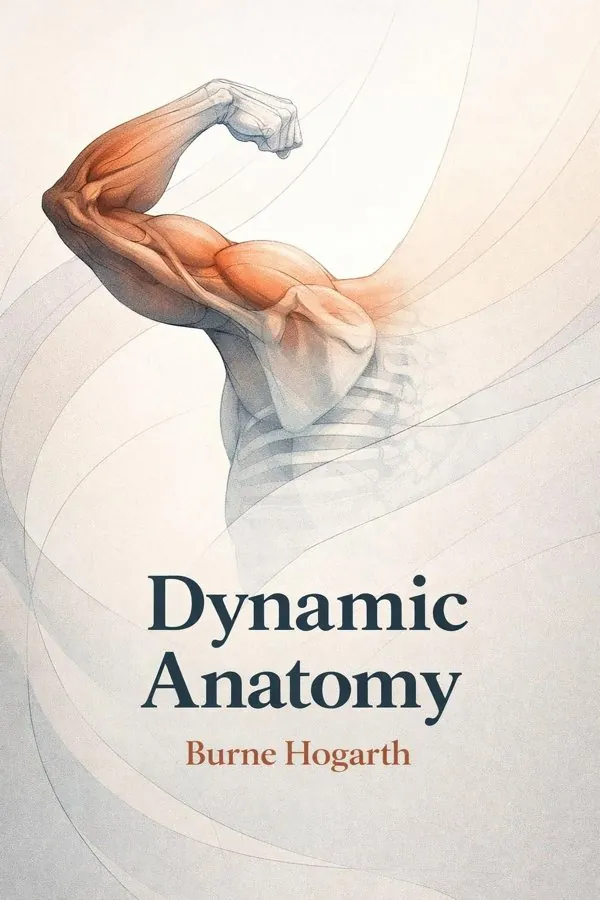
Dynamic Anatomy: Summary & Key Insights
 10 min11 chaptersAudio available
What Is Dynamic Anatomy About?
Dynamic Anatomy by Burne Hogarth is a design book spanning 11 pages. Dynamic Anatomy es una guía fundamental para artistas que estudian la figura humana. Burne Hogarth explora la estructura muscular y ósea desde la perspectiva del artista, no del anatomista médico, ofreciendo más de 300 ilustraciones que muestran cómo el cuerpo humano se mueve y se equilibra. El libro combina análisis anatómico con principios de diseño y movimiento, ayudando a los artistas a comprender la forma humana en acción.
This FizzRead summary covers all 11 key chapters of Dynamic Anatomy in approximately 10 minutes, distilling the most important ideas, arguments, and takeaways from Burne Hogarth's work. Also available as an audio summary and Key Quotes Podcast.
Dynamic Anatomy
Dynamic Anatomy es una guía fundamental para artistas que estudian la figura humana. Burne Hogarth explora la estructura muscular y ósea desde la perspectiva del artista, no del anatomista médico, ofreciendo más de 300 ilustraciones que muestran cómo el cuerpo humano se mueve y se equilibra. El libro combina análisis anatómico con principios de diseño y movimiento, ayudando a los artistas a comprender la forma humana en acción.
Who Should Read Dynamic Anatomy?
This book is perfect for anyone interested in design and looking to gain actionable insights in a short read. Whether you're a student, professional, or lifelong learner, the key ideas from Dynamic Anatomy by Burne Hogarth will help you think differently.
- ✓Readers who enjoy design and want practical takeaways
- ✓Professionals looking to apply new ideas to their work and life
- ✓Anyone who wants the core insights of Dynamic Anatomy in just 10 minutes
Want the full summary?
Get instant access to this book summary and 100K+ more with Fizz Moment.
Get Free SummaryAvailable on App Store • Free to download
Key Chapters
At the heart of every successful figure drawing lies the skeleton. I treat the skeletal structure as a living armature—a spatial framework that dictates proportion, balance, and the reach of movement. Artists must study the skeleton not to learn medical precision but to comprehend functional design.
The spine is central. It’s not a rigid pole but a flexible axis that defines posture and gesture. From its curvature emerges rhythm—an essential quality that animates the figure. The rib cage, shaped like a protective barrel, expands and contracts, influencing the sense of breath and strength in your drawing. The pelvis acts as the counterbalance to the upper body, transmitting weight to the legs and defining stance.
Bones serve as directional pointers. When you draw, note how the clavicles set the breadth of the shoulders, how the scapula contributes to arm movement, how femurs and tibiae direct leg rhythm. Understanding these spatial relationships allows you to position the figure convincingly in space—whether standing, crouching, or twisting.
Anatomy becomes art when bones define gesture. Once you see bones as architectural lines, you can manipulate them to enhance drama. A tilted pelvis or curved spine creates an organic flow. The skeleton, thus understood, stops being inert structure and becomes the first living design in your composition.
Muscles are the artist’s palette of power and expression. They give life to the skeleton, creating contours and tensions that define surface form. My teaching insists that muscles must be studied dynamically, not as isolated units but as interdependent actors in movement.
The major muscle groups—the pectorals, deltoids, trapezius, and latissimus in the upper torso—operate in harmony. Each expands or contracts depending on the direction of action. The relationship of opposing muscle groups generates tension, and tension is the heart of visual energy. For instance, when an arm extends, the triceps lengthen while the biceps contract, creating vivid design contrasts.
Artists often fear muscle complexity. My approach simplifies this by focusing on dominant planes and rhythms. A muscle’s shape is never absolute—it transforms as the figure breathes, turns, or strains. By learning the internal logic behind these shifting forms, you achieve credibility and vitality. Observe athletes, dancers, or workers in motion—you’ll see how musculature orchestrates shape instant by instant.
The surface rhythm of muscle gives character. Even subtle differences—like the tension at a bent wrist or the flex behind the knee—tell the emotional truth of the pose. Muscles are not mere anatomical facts; they are dramatic instruments. To draw them is to record the pulse of life.
+ 9 more chapters — available in the FizzRead app
All Chapters in Dynamic Anatomy
About the Author
Burne Hogarth (1911–1996) fue un artista, ilustrador y educador estadounidense, conocido por su trabajo en la serie de cómics Tarzan y por sus influyentes manuales de anatomía artística. Cofundador de la School of Visual Arts de Nueva York, Hogarth dedicó su carrera a enseñar la anatomía dinámica y la figura humana a generaciones de artistas.
Get This Summary in Your Preferred Format
Read or listen to the Dynamic Anatomy summary by Burne Hogarth anytime, anywhere. FizzRead offers multiple formats so you can learn on your terms — all free.
Available formats: App · Audio · PDF · EPUB — All included free with FizzRead
Download Dynamic Anatomy PDF and EPUB Summary
Key Quotes from Dynamic Anatomy
“At the heart of every successful figure drawing lies the skeleton.”
“Muscles are the artist’s palette of power and expression.”
Frequently Asked Questions about Dynamic Anatomy
Dynamic Anatomy by Burne Hogarth is a design book that explores key ideas across 11 chapters. Dynamic Anatomy es una guía fundamental para artistas que estudian la figura humana. Burne Hogarth explora la estructura muscular y ósea desde la perspectiva del artista, no del anatomista médico, ofreciendo más de 300 ilustraciones que muestran cómo el cuerpo humano se mueve y se equilibra. El libro combina análisis anatómico con principios de diseño y movimiento, ayudando a los artistas a comprender la forma humana en acción.
More by Burne Hogarth

You Might Also Like

The Design of Everyday Things
Don Norman
10 min
The Better Angels of Our Nature
Steven Pinker
10 min
A Designer's Art
Paul Rand
10 min
Architects' Sketchbooks
Various Editors
10 min
Architectural Graphic Standards
The American Institute of Architects
10 min
Design Is Storytelling
Ellen Lupton
10 minBrowse by Category
Ready to read Dynamic Anatomy?
Get the full summary and 100K+ more books with Fizz Moment.