
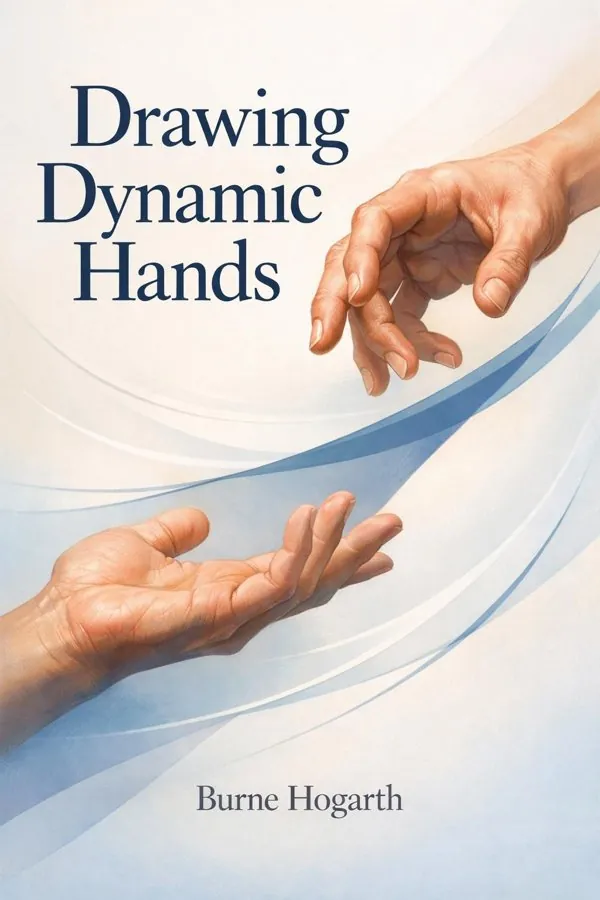
Drawing Dynamic Hands: Summary & Key Insights
 10 min9 chaptersAudio available
Key Takeaways from Drawing Dynamic Hands
Every convincing hand drawing begins where most hesitant drawings fail: beneath the surface.
A hand does not merely exist; it activates.
Complexity becomes manageable the moment you stop thinking in outlines and start thinking in volumes.
A hand can speak before the mouth does.
Nothing exposes uncertainty in drawing faster than a hand aimed toward the viewer.
What Is Drawing Dynamic Hands About?
Drawing Dynamic Hands by Burne Hogarth is a design book spanning 7 pages. The human hand is one of the most difficult subjects in art because it is also one of the most revealing. A hand can point, grasp, resist, tremble, command, protect, and communicate emotion faster than a face in many situations. In Drawing Dynamic Hands, Burne Hogarth approaches this challenge with the conviction that hands are not decorative details but engines of expression. He breaks down their anatomy, structure, rhythm, and movement so artists can draw them with power rather than hesitation. Instead of copying isolated poses, readers learn how bones, joints, muscles, tendons, perspective, and gesture work together to create believable action. What makes this book endure is Hogarth’s combination of anatomical seriousness and dramatic visual imagination. Best known for his dynamic figure drawing instruction and his influential work in comics and illustration, he teaches artists to think of the hand as a living architectural form in motion. This matters for beginners struggling with proportions, for illustrators needing expressive poses, and for advanced artists refining realism and force. The book’s real lesson is larger than hands alone: to draw convincingly, you must understand structure, not just appearance.
This FizzRead summary covers all 9 key chapters of Drawing Dynamic Hands in approximately 10 minutes, distilling the most important ideas, arguments, and takeaways from Burne Hogarth's work. Also available as an audio summary and Key Quotes Podcast.
Drawing Dynamic Hands
The human hand is one of the most difficult subjects in art because it is also one of the most revealing. A hand can point, grasp, resist, tremble, command, protect, and communicate emotion faster than a face in many situations. In Drawing Dynamic Hands, Burne Hogarth approaches this challenge with the conviction that hands are not decorative details but engines of expression. He breaks down their anatomy, structure, rhythm, and movement so artists can draw them with power rather than hesitation. Instead of copying isolated poses, readers learn how bones, joints, muscles, tendons, perspective, and gesture work together to create believable action.
What makes this book endure is Hogarth’s combination of anatomical seriousness and dramatic visual imagination. Best known for his dynamic figure drawing instruction and his influential work in comics and illustration, he teaches artists to think of the hand as a living architectural form in motion. This matters for beginners struggling with proportions, for illustrators needing expressive poses, and for advanced artists refining realism and force. The book’s real lesson is larger than hands alone: to draw convincingly, you must understand structure, not just appearance.
Who Should Read Drawing Dynamic Hands?
This book is perfect for anyone interested in design and looking to gain actionable insights in a short read. Whether you're a student, professional, or lifelong learner, the key ideas from Drawing Dynamic Hands by Burne Hogarth will help you think differently.
- ✓Readers who enjoy design and want practical takeaways
- ✓Professionals looking to apply new ideas to their work and life
- ✓Anyone who wants the core insights of Drawing Dynamic Hands in just 10 minutes
Want the full summary?
Get instant access to this book summary and 100K+ more with Fizz Moment.
Get Free SummaryAvailable on App Store • Free to download
Key Chapters
Every convincing hand drawing begins where most hesitant drawings fail: beneath the surface. Hogarth insists that the hand is not a soft, vague shape but a carefully organized mechanical structure built from bones, joints, and proportional relationships. Once an artist understands the underlying framework, the hand stops feeling random and starts becoming legible. That shift is crucial, because most problems in hand drawing come from guessing at finger lengths, palm width, joint placement, or thumb attachment rather than constructing them deliberately.
The hand’s architecture depends on a clear grasp of the metacarpals, phalanges, and the wrist structure that anchors movement. Hogarth emphasizes that each finger has a patterned logic in both length and segmentation, while the thumb operates on a different axis and must be treated as a distinct structural force. This is what gives the hand both stability and expressive range. Even when a hand is dramatically posed, its anatomy still obeys proportional laws.
In practical drawing, this means starting with major masses before details. For example, instead of outlining five fingers individually, you can first block in the palm as a broad wedge, map the knuckle line, and then place the finger units according to their relative lengths and taper. If a hand is holding a cup, gripping a sword, or opening toward the viewer, the basic bone structure remains your guide for believable placement.
Hogarth’s deeper lesson is that accuracy and expressiveness are not opposites. The more clearly you understand the hand’s internal order, the more boldly you can distort, rotate, and dramatize it without losing credibility. Actionable takeaway: practice drawing hands from memory using only bone landmarks, joint positions, and simple proportional rules before adding surface detail.
A hand does not merely exist; it activates. Hogarth shows that if the skeleton provides the hand’s architecture, muscles and tendons give it vitality, tension, and visible life. This insight is especially important because many hand drawings look stiff not from bad anatomy, but from ignoring the subtle systems that animate the surface. The hand is always changing shape as it opens, clenches, twists, supports weight, or relaxes.
The visible topography of the hand comes from the interplay between tendon lines, fleshy pads, skin tension, and the shifting masses at the base of the thumb and little finger. On the back of the hand, tendons often become prominent when fingers extend or strain. In the palm, compressed flesh creates bulges, folds, and pressure changes. Hogarth treats these not as decorative wrinkles, but as evidence of force. A hand in repose and a hand gripping a railing may share the same bones, yet their surfaces communicate completely different states of action.
For artists, this means learning to observe what changes and what remains stable. When sketching a fist, notice how knuckles rise, tendons tighten, and flesh compresses into angular planes. When drawing an open hand reaching upward, observe the stretch between the fingers, the lifted thumb pad, and the way the palm flattens or cups depending on gesture. These shifts make drawings feel inhabited rather than mannequin-like.
Hogarth’s great contribution here is showing that anatomy is expressive. Surface motion tells the viewer whether a hand is delicate, forceful, nervous, exhausted, or determined. If you can read muscular tension, you can draw emotion through structure. Actionable takeaway: study one hand pose in three states—relaxed, engaged, and strained—and compare how tendons, pads, and surface forms change with effort.
Complexity becomes manageable the moment you stop thinking in outlines and start thinking in volumes. Hogarth repeatedly demonstrates that the hand, however intricate it appears, can be simplified into geometric masses: wedges, blocks, cylinders, and tapered forms. This does not reduce the hand’s sophistication; it gives the artist a practical method for constructing it in space. Without this approach, many artists drift into flat contour drawing and lose solidity almost immediately.
The palm can be treated as a broad box or wedge with tilt and thickness. Fingers can begin as segmented cylinders or rectangular units that bend at clear intervals. The thumb becomes its own articulated block system set at an opposing angle. By organizing the hand this way, artists can rotate it mentally, place it in perspective, and preserve believable volume even in extreme positions.
This method is especially useful when drawing from imagination. Suppose you need a hand thrusting toward the viewer in a comic panel or a hand gripping fabric in a concept sketch. If you rely only on remembered outlines, the form collapses. But if you first build the palm as a solid mass and attach finger units as directional forms, the pose gains depth and coherence. Details such as nails, wrinkles, and veins can come later.
Hogarth’s emphasis on geometric simplification also trains artistic judgment. Not every crease deserves equal attention, and not every edge should be drawn the same way. By prioritizing major forms, the artist learns what truly defines the hand’s structure. This discipline improves speed, especially in life drawing and visual storytelling.
Actionable takeaway: before rendering any hand, create a rough construction using only a palm block, a thumb wedge, and finger cylinders, then refine the drawing once the three-dimensional volumes feel stable.
A hand can speak before the mouth does. Hogarth treats gesture as the bridge between anatomy and meaning, arguing that the hand is one of the body’s most direct instruments of expression. This is why technically correct hands can still feel lifeless: they may be accurate in structure but empty in intention. Dynamic hand drawing requires understanding not just what the hand is, but what it is doing and why.
Gesture emerges through rhythm, directional flow, spacing, and tension. Splayed fingers suggest openness, alarm, or release. A partially curled hand may indicate hesitation, fatigue, or subtle readiness. A tightly compressed grip implies strength, aggression, or resistance. Hogarth encourages artists to look for the dominant action running through the entire hand rather than treating fingers as separate appendages. The whole gesture often follows a single expressive arc.
This idea matters greatly in illustration, comics, animation, and character design. A villain’s hand resting lightly on a chair can communicate control. A child’s reaching hand can express trust or need. A dancer’s extended fingers may transform a pose from merely anatomical to lyrical. Even in realistic portraiture, the gesture of the hand can deepen the subject’s psychological presence.
To apply Hogarth’s approach, begin by identifying the emotional force of the pose. Is the hand pulling, pushing, presenting, clutching, shielding, blessing, or trembling? Once the action is clear, exaggerate the directional energy slightly while keeping the anatomy sound. This creates drawings that feel intentional rather than neutral.
Hogarth reminds artists that gesture is not an afterthought added to anatomy; it is anatomy in action. The hand’s expressive power emerges when structure serves communication. Actionable takeaway: label the emotional verb of each hand pose you draw—such as grasping, offering, resisting, or warning—before you begin rendering details.
Nothing exposes uncertainty in drawing faster than a hand aimed toward the viewer. Hogarth understands that perspective and foreshortening are where many artists lose confidence, yet these same tools are what make hand drawings dramatic and alive. A hand seen from the front, side, below, or in extreme projection will not preserve familiar proportions on the page. Instead, forms overlap, compress, and enlarge according to their position in space.
Hogarth teaches artists to think spatially rather than symbolically. The nearest knuckle may appear much larger than those behind it. Finger lengths may visually collapse when bent toward the viewer. The palm may hide part of the thumb base, or the fingers may obscure one another in layered depth. If the artist draws what they think a hand should look like instead of what the perspective demands, the illusion breaks immediately.
This principle is especially valuable in action-oriented imagery. A boxer’s fist lunging forward, a hand reaching out of darkness, or a dramatic close-up in a graphic novel all depend on persuasive foreshortening. To achieve this, Hogarth recommends building the hand as forms in depth rather than tracing contours. Measure relative size by distance, overlap masses boldly, and let nearer forms dominate.
Even subtle perspective matters in everyday drawing. A hand resting on a table still has planes receding from the viewer. A tilted wrist changes the visibility of the metacarpals. A raised thumb can create a strong diagonal in space. Once artists internalize these principles, hands become more than appendages; they become spatial events.
Actionable takeaway: practice drawing the same hand pose from three viewpoints—eye level, above, and below—using simple block-and-cylinder construction to understand how forms compress and overlap.
A hand becomes believable not only through correct structure, but through the way light reveals that structure. Hogarth pays close attention to light and shadow because they turn abstract anatomy into visible form. Without tonal clarity, even a well-constructed hand can appear flat. With intelligent shading, the planes of the palm, knuckles, tendons, and finger joints gain weight, texture, and presence.
The hand is particularly rich in changing surfaces. The palm has thicker, softer pads that catch light differently from the leaner, more angular back of the hand. Knuckles create plane breaks. Finger segments roll gradually from light into shadow. Nails reflect light with their own curvature. Wrinkles and creases can either support the form or clutter it, depending on how carefully they are handled. Hogarth’s approach is to use light descriptively, not decoratively.
For practical application, artists can begin by identifying the largest light and shadow masses before focusing on minor details. In a hand gripping an object, the side facing the light may reveal bony ridges and stretched tendons, while the shadow side simplifies into larger tonal shapes. In a softly lit open palm, transitions may be gradual, emphasizing rounded fullness. Hard light can make the hand look more sculptural and dramatic, while diffuse light softens its emotional tone.
This understanding is crucial for realism, but also for stylization. Even comic or concept artists can use tonal grouping to clarify action and avoid visual confusion. Good shading tells the viewer where to look and what the hand is doing.
Hogarth’s lesson is that rendering should serve structure. Light is not added after the drawing; it is a way of explaining form. Actionable takeaway: when shading hands, limit yourself first to three values—light, midtone, and shadow—to organize the major planes before adding smaller tonal nuances.
No single hand represents all humanity. Hogarth emphasizes that while structural principles are universal, the visible character of the hand varies enormously across age, sex, occupation, body type, and personality. This matters because generic hands weaken storytelling. A convincing drawing must balance anatomical consistency with individual difference.
A child’s hand tends to be softer, shorter, and less angular, with smaller joints and subtler tendon definition. An elderly hand often reveals thinner skin, more pronounced bones, visible veins, and accumulated surface irregularity. A laborer’s hand may appear thick, broad, and worn, with strong knuckles and compressed pads. A musician’s might look refined and elongated. Gender presentation can influence proportion, softness, taper, and gesture, though Hogarth’s larger point is not stereotype but observational specificity.
For artists working in narrative art, this idea is invaluable. The hand of a king, mechanic, dancer, surgeon, or farmer should not communicate the same life experience. Costume and face design alone cannot carry character. Hands often reveal what a person does, how they live, and how they relate to the world. A clenched, scarred hand tells a different story than an elegant, relaxed one.
Practically, this means studying categories of variation without losing underlying structure. Compare the same pose in different ages and physiques. Notice where fullness collects, where tendons appear, how nails differ, and how skin texture changes. These distinctions deepen realism and strengthen characterization.
Hogarth encourages artists to see individuality as an anatomical extension rather than superficial decoration. The hand remains structurally coherent, but its life history becomes visible in form. Actionable takeaway: create a character study sheet drawing the same hand gesture as a child, an elder, and a working adult to explore how structure stays constant while surface character changes.
Hands are designed to do, not merely to pose. One of Hogarth’s most useful insights is that the hand is best understood through function: grasping, pinching, pressing, pointing, lifting, supporting, or releasing. When artists study hands only as static objects, they often miss the mechanical logic that explains finger spacing, thumb opposition, and pressure distribution. Function reveals form.
The hand’s extraordinary versatility comes from how its parts cooperate. The thumb opposes the fingers to create grip. The palm adjusts shape depending on whether it cups, flattens, or bears weight. Fingers rarely move identically; some lead while others support. In action, the hand organizes itself according to purpose. A hand holding a pen differs structurally and rhythmically from one climbing a rope or turning a doorknob.
This functional approach is especially helpful for artists drawing narrative scenes. Instead of inventing decorative finger positions, ask what the hand must physically accomplish. If a character is carrying a suitcase, where is the tension concentrated? If they are gently touching someone’s shoulder, how much pressure is present? If they are pulling a bowstring, which tendons become visible? Such questions produce more believable and expressive drawings.
Studying function also improves memory drawing. Once you understand how a hand operates during specific tasks, you can reconstruct poses more convincingly from imagination. It becomes easier to draw believable interactions with tools, weapons, clothing, furniture, and other characters.
Hogarth ultimately teaches that a hand’s pose is never arbitrary. It is shaped by purpose, force, and contact. The artist who understands action draws with more authority than the one who merely copies appearance. Actionable takeaway: sketch hands performing everyday tasks—holding keys, opening jars, typing, lifting bags—to train yourself to connect anatomical structure with practical function.
The hand remains difficult not because it is impossible, but because it punishes casual seeing. Hogarth’s broader teaching method rests on a demanding but liberating idea: mastery comes from repeated analysis, not passive exposure. Looking at hands all day does not automatically teach an artist how to draw them. Progress begins when observation is paired with deliberate breakdown, reconstruction, and comparison.
This is why Hogarth’s examples move beyond finished illustrations into structured studies. Artists must learn to draw the hand from multiple angles, in various actions, with and without detail, from observation and from memory. Repetition matters, but only when each repetition has a question behind it. What changes when the wrist rotates? How does the thumb base shift during a grip? Which finger joints align, and which offset? Why does one pose look forceful while another looks weak?
A practical study routine might include quick gesture sketches for rhythm, construction studies for volume, anatomy notes for landmarks, and longer renderings for light and surface. Copying master drawings can help, but Hogarth’s philosophy encourages transformation rather than imitation. The goal is to internalize principles so thoroughly that the hand can be invented, corrected, and energized from within.
This lesson applies far beyond hand drawing. It reflects a larger artistic discipline: complexity yields to understanding when broken into systems and practiced deliberately. The hand becomes a proving ground for serious draftsmanship.
Hogarth’s final gift is confidence through method. He does not pretend the hand is simple; he shows that difficulty can be organized. Actionable takeaway: build a focused hand practice habit by studying one theme per session—such as thumbs, fists, foreshortened fingers, or open palms—and review your drawings for recurring structural mistakes.
All Chapters in Drawing Dynamic Hands
About the Author
Burne Hogarth (1911-1996) was an American artist, illustrator, educator, and author whose work shaped generations of figure artists. He became widely known for his dramatic run on the Tarzan comic strip, where his energetic anatomy and cinematic compositions stood out for their power and movement. Beyond commercial art, Hogarth dedicated much of his career to teaching drawing and visual storytelling. He was a co-founder of the School of Visual Arts in New York, an institution that became highly influential in illustration, comics, and design education. His instructional books, including volumes on the human figure, anatomy, and hands, remain widely read because they combine structural analysis with expressive force. Hogarth’s legacy lies in showing artists that mastery of form and dynamic imagination can work together.
Get This Summary in Your Preferred Format
Read or listen to the Drawing Dynamic Hands summary by Burne Hogarth anytime, anywhere. FizzRead offers multiple formats so you can learn on your terms — all free.
Available formats: App · Audio · PDF · EPUB — All included free with FizzRead
Download Drawing Dynamic Hands PDF and EPUB Summary
Key Quotes from Drawing Dynamic Hands
“Every convincing hand drawing begins where most hesitant drawings fail: beneath the surface.”
“A hand does not merely exist; it activates.”
“Complexity becomes manageable the moment you stop thinking in outlines and start thinking in volumes.”
“Hogarth treats gesture as the bridge between anatomy and meaning, arguing that the hand is one of the body’s most direct instruments of expression.”
“Nothing exposes uncertainty in drawing faster than a hand aimed toward the viewer.”
Frequently Asked Questions about Drawing Dynamic Hands
Drawing Dynamic Hands by Burne Hogarth is a design book that explores key ideas across 9 chapters. The human hand is one of the most difficult subjects in art because it is also one of the most revealing. A hand can point, grasp, resist, tremble, command, protect, and communicate emotion faster than a face in many situations. In Drawing Dynamic Hands, Burne Hogarth approaches this challenge with the conviction that hands are not decorative details but engines of expression. He breaks down their anatomy, structure, rhythm, and movement so artists can draw them with power rather than hesitation. Instead of copying isolated poses, readers learn how bones, joints, muscles, tendons, perspective, and gesture work together to create believable action. What makes this book endure is Hogarth’s combination of anatomical seriousness and dramatic visual imagination. Best known for his dynamic figure drawing instruction and his influential work in comics and illustration, he teaches artists to think of the hand as a living architectural form in motion. This matters for beginners struggling with proportions, for illustrators needing expressive poses, and for advanced artists refining realism and force. The book’s real lesson is larger than hands alone: to draw convincingly, you must understand structure, not just appearance.
More by Burne Hogarth
You Might Also Like
The Design of Everyday Things
Don Norman
10 min
The Better Angels of Our Nature
Steven Pinker
10 min
A Designer's Art
Paul Rand
10 min
Architects' Sketchbooks
Various Editors
10 min
Architectural Graphic Standards
The American Institute of Architects
10 min
Design Is Storytelling
Ellen Lupton
10 minBrowse by Category
Ready to read Drawing Dynamic Hands?
Get the full summary and 100K+ more books with Fizz Moment.