
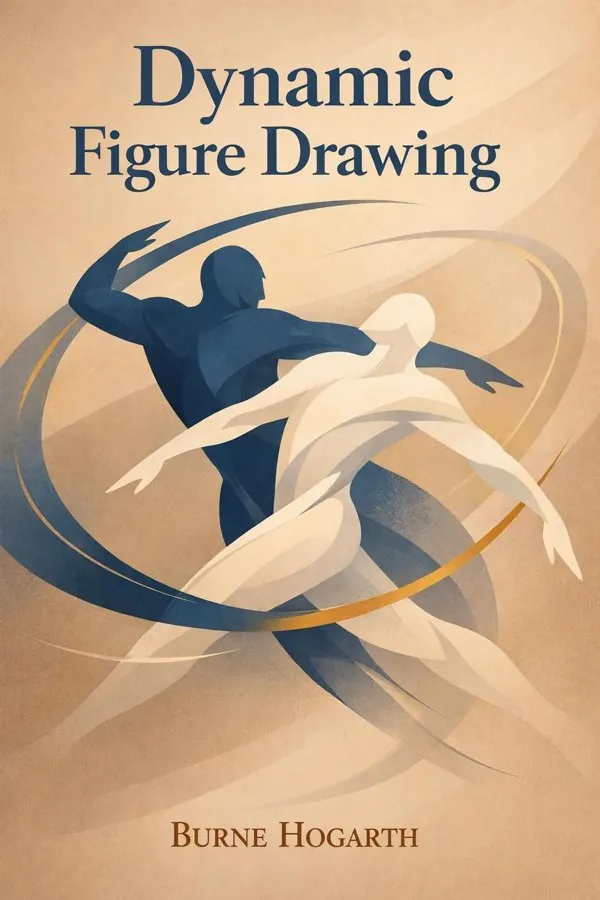
Dynamic Figure Drawing: Summary & Key Insights
 10 min9 chaptersAudio available
What Is Dynamic Figure Drawing About?
Dynamic Figure Drawing by Burne Hogarth is a design book spanning 9 pages. Dynamic Figure Drawing is a comprehensive guide to understanding and mastering the human form in motion. Burne Hogarth, a renowned illustrator and art instructor, presents a systematic approach to figure drawing that emphasizes anatomy, rhythm, and dynamic movement. The book explores the structure of the body, gesture, and the mechanics of motion, providing artists with tools to create lifelike and expressive figures.
This FizzRead summary covers all 9 key chapters of Dynamic Figure Drawing in approximately 10 minutes, distilling the most important ideas, arguments, and takeaways from Burne Hogarth's work. Also available as an audio summary and Key Quotes Podcast.
Dynamic Figure Drawing
Dynamic Figure Drawing is a comprehensive guide to understanding and mastering the human form in motion. Burne Hogarth, a renowned illustrator and art instructor, presents a systematic approach to figure drawing that emphasizes anatomy, rhythm, and dynamic movement. The book explores the structure of the body, gesture, and the mechanics of motion, providing artists with tools to create lifelike and expressive figures.
Who Should Read Dynamic Figure Drawing?
This book is perfect for anyone interested in design and looking to gain actionable insights in a short read. Whether you're a student, professional, or lifelong learner, the key ideas from Dynamic Figure Drawing by Burne Hogarth will help you think differently.
- ✓Readers who enjoy design and want practical takeaways
- ✓Professionals looking to apply new ideas to their work and life
- ✓Anyone who wants the core insights of Dynamic Figure Drawing in just 10 minutes
Want the full summary?
Get instant access to this book summary and 100K+ more with Fizz Moment.
Get Free SummaryAvailable on App Store • Free to download
Key Chapters
To draw the human body dynamically, you must understand its construction. Anatomy to an artist is not about memorizing every muscle; it's about interpreting the structure through form and function. The skeleton is the foundation—rigid yet articulate, defining proportion and balance. Upon it rests the muscle system, the machinery of motion.
I teach you to think of anatomy in three-dimensional shapes—cylinders, spheres, boxes—because these are the forms that build volume and depth. The bony landmarks, such as the clavicle or the iliac crest, provide orientation. But anatomy, seen dynamically, is never symmetrical. When one side contracts, the other stretches. When the arm thrusts forward, the ribs twist and compress, the pelvis realigns, the weight shifts. This oppositional play is what breathes life into form.
Unlike in static studies, we are not merely recording anatomy; we are orchestrating it. The muscle masses are instruments of tension and balance. You must understand how the deltoid rotates the arm in motion, how the latissimus dorsi pulls the torso, how the quadriceps and hamstrings alternate dominance during stride. Each motion is a chain reaction, and your drawing must show that continuity.
Anatomy, then, becomes a visual grammar. By simplifying anatomical complexity into dynamic structure—overlapping masses, directional axes, opposing curves—you acquire the ability to invent convincing, moving figures from imagination. Realism comes not from copying but from comprehension. Once structure becomes intuitive, you can distort, exaggerate, and still remain true to the essence of the human form.
The human figure is an architecture of balance, constantly negotiating gravity. Every pose, no matter how spontaneous, must appear stable or deliberately unstable to convey the sense of real movement. Proportion is the measure; balance is the principle that gives measure meaning.
I encourage you to think of proportion as relational, not mathematical. The head may divide the body into eight equal units, but those divisions shift with perspective, tilt, and gesture. A figure leaning forward will compress the torso and elongate the opposite leg. Static proportion charts cannot capture this dynamism; only relational observation can.
Balance, on the other hand, is a matter of center of gravity. The spine acts as the axis—its curvature reflects motion and counter-motion. When the torso leans, the pelvis rotates to compensate. The shoulders and hips rarely align; they work as opposing planes, giving the figure torsional energy. Visualize a dancer raising one arm: the weight shifts to the supporting leg, the pelvis inclines, the spine curves to maintain poise. That internal correction is the soul of believable motion.
In drawing, you must always sense the pull of gravity. A figure that does not obey it will appear artificial. Yet, by exaggerating balance—thrusting it to the limit—you achieve drama. A warrior lunging forward, a runner at full stride, a falling figure—all captivate the eye because they imply momentum, the imminent restoration or loss of balance. Understanding proportion and balance gives you the control needed to choreograph both stillness and motion on the stage of your page.
+ 7 more chapters — available in the FizzRead app
All Chapters in Dynamic Figure Drawing
About the Author
Burne Hogarth (1911–1996) was an American artist, educator, and author best known for his work on the Tarzan comic strip and his influential art instruction books. He co-founded the School of Visual Arts in New York and became one of the most respected teachers of figure drawing and anatomy for artists.
Get This Summary in Your Preferred Format
Read or listen to the Dynamic Figure Drawing summary by Burne Hogarth anytime, anywhere. FizzRead offers multiple formats so you can learn on your terms — all free.
Available formats: App · Audio · PDF · EPUB — All included free with FizzRead
Download Dynamic Figure Drawing PDF and EPUB Summary
Key Quotes from Dynamic Figure Drawing
“To draw the human body dynamically, you must understand its construction.”
“The human figure is an architecture of balance, constantly negotiating gravity.”
Frequently Asked Questions about Dynamic Figure Drawing
Dynamic Figure Drawing by Burne Hogarth is a design book that explores key ideas across 9 chapters. Dynamic Figure Drawing is a comprehensive guide to understanding and mastering the human form in motion. Burne Hogarth, a renowned illustrator and art instructor, presents a systematic approach to figure drawing that emphasizes anatomy, rhythm, and dynamic movement. The book explores the structure of the body, gesture, and the mechanics of motion, providing artists with tools to create lifelike and expressive figures.
More by Burne Hogarth

You Might Also Like

The Design of Everyday Things
Don Norman
10 min
The Better Angels of Our Nature
Steven Pinker
10 min
A Designer's Art
Paul Rand
10 min
Architects' Sketchbooks
Various Editors
10 min
Architectural Graphic Standards
The American Institute of Architects
10 min
Design Is Storytelling
Ellen Lupton
10 minBrowse by Category
Ready to read Dynamic Figure Drawing?
Get the full summary and 100K+ more books with Fizz Moment.