
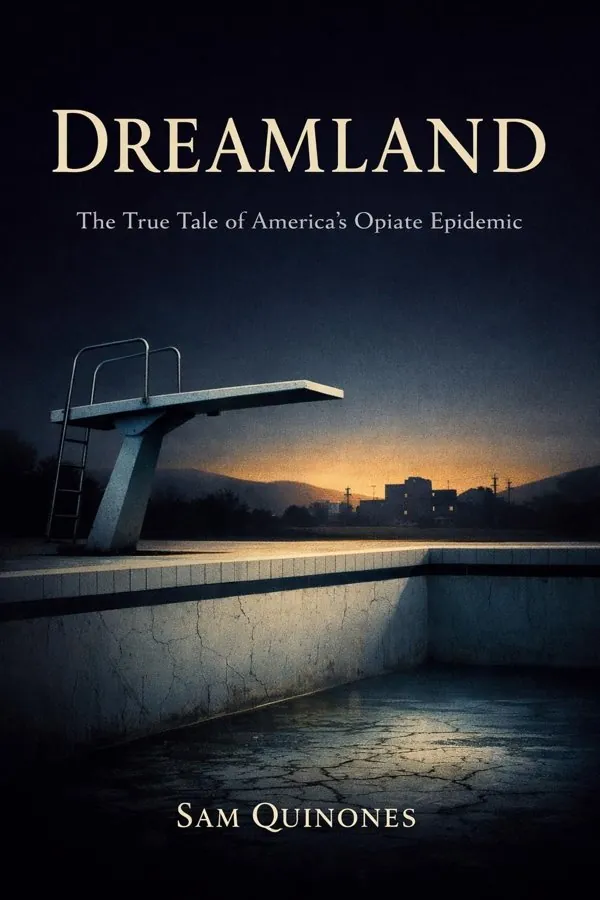
Dreamland: The True Tale of America's Opiate Epidemic: Summary & Key Insights
by Sam Quinones
 10 min9 chaptersAudio available
Key Takeaways from Dreamland: The True Tale of America's Opiate Epidemic
Dreamland was once a bustling municipal pool where families gathered, teenagers socialized, and a working-class town expressed shared pride.
One of the book’s most unsettling insights is that a sincere desire to reduce suffering was transformed into a commercial opening.
Quinones argues that the opioid epidemic accelerated when corporate storytelling became more powerful than medical restraint.
An epidemic becomes explosive when demand, supply, and weak oversight align.
One of the book’s most original contributions is its portrait of a heroin network that operated less like a cartel and more like a pizza delivery service.
What Is Dreamland: The True Tale of America's Opiate Epidemic About?
Dreamland: The True Tale of America's Opiate Epidemic by Sam Quinones is a health_med book spanning 9 pages. Dreamland: The True Tale of America's Opiate Epidemic is a gripping work of narrative nonfiction that explains how America’s opioid crisis was not caused by one bad drug, one criminal organization, or one reckless decision. Instead, Sam Quinones shows how a national disaster emerged from the convergence of aggressive pharmaceutical marketing, changing medical attitudes toward pain, fragile local economies, and an unusually efficient heroin distribution system. At the center of the book is Portsmouth, Ohio, where Dreamland, a once-beloved public swimming pool, becomes a symbol of a lost communal America. What makes this book so powerful is its refusal to reduce the epidemic to stereotypes. Quinones humanizes grieving families, overworked doctors, police officers, recovering users, and even the young traffickers from Xalisco, Mexico, whose business model transformed heroin sales. The result is both investigative reporting and social history. Quinones brings exceptional authority to the subject through years of reporting as a journalist and his deep familiarity with Mexican migration, American communities, and public policy. Dreamland matters because it explains not only how addiction spread, but what the crisis reveals about loneliness, profit, denial, and the weakening of community in modern America.
This FizzRead summary covers all 9 key chapters of Dreamland: The True Tale of America's Opiate Epidemic in approximately 10 minutes, distilling the most important ideas, arguments, and takeaways from Sam Quinones's work. Also available as an audio summary and Key Quotes Podcast.
Dreamland: The True Tale of America's Opiate Epidemic
Dreamland: The True Tale of America's Opiate Epidemic is a gripping work of narrative nonfiction that explains how America’s opioid crisis was not caused by one bad drug, one criminal organization, or one reckless decision. Instead, Sam Quinones shows how a national disaster emerged from the convergence of aggressive pharmaceutical marketing, changing medical attitudes toward pain, fragile local economies, and an unusually efficient heroin distribution system. At the center of the book is Portsmouth, Ohio, where Dreamland, a once-beloved public swimming pool, becomes a symbol of a lost communal America.
What makes this book so powerful is its refusal to reduce the epidemic to stereotypes. Quinones humanizes grieving families, overworked doctors, police officers, recovering users, and even the young traffickers from Xalisco, Mexico, whose business model transformed heroin sales. The result is both investigative reporting and social history. Quinones brings exceptional authority to the subject through years of reporting as a journalist and his deep familiarity with Mexican migration, American communities, and public policy. Dreamland matters because it explains not only how addiction spread, but what the crisis reveals about loneliness, profit, denial, and the weakening of community in modern America.
Who Should Read Dreamland: The True Tale of America's Opiate Epidemic?
This book is perfect for anyone interested in health_med and looking to gain actionable insights in a short read. Whether you're a student, professional, or lifelong learner, the key ideas from Dreamland: The True Tale of America's Opiate Epidemic by Sam Quinones will help you think differently.
- ✓Readers who enjoy health_med and want practical takeaways
- ✓Professionals looking to apply new ideas to their work and life
- ✓Anyone who wants the core insights of Dreamland: The True Tale of America's Opiate Epidemic in just 10 minutes
Want the full summary?
Get instant access to this book summary and 100K+ more with Fizz Moment.
Get Free SummaryAvailable on App Store • Free to download
Key Chapters
A public swimming pool might seem like an unlikely symbol for a national drug epidemic, yet Quinones uses Dreamland in Portsmouth, Ohio, to show how addiction thrives where community life has weakened. Dreamland was once a bustling municipal pool where families gathered, teenagers socialized, and a working-class town expressed shared pride. Its decline mirrors the collapse of industrial towns across America, places where jobs disappeared, neighborhoods frayed, and people became more isolated from one another.
This matters because addiction is not only a chemical dependency problem. It is also a social problem. Quinones suggests that when institutions such as factories, churches, parks, neighborhood clubs, and civic groups weaken, people lose structures that provide meaning, belonging, and accountability. Portsmouth becomes more than a setting; it becomes a case study in how economic erosion and loneliness can create fertile ground for substance abuse.
The insight applies far beyond Ohio. Any community that loses gathering places, stable employment, and informal social ties may become more vulnerable to despair-driven behaviors, whether that means drug abuse, depression, or crime. We often focus on treatment after addiction takes hold, but Dreamland reminds us that prevention begins long before the first pill or injection.
A practical lesson is that healthy communities need shared spaces and strong local institutions. Parents, educators, policymakers, and civic leaders can support sports leagues, libraries, recreation centers, neighborhood events, and mentoring programs not as luxuries, but as forms of public health.
Actionable takeaway: If you want to understand or fight addiction, look beyond the individual and ask what forms of connection your community has lost and how they can be rebuilt.
One of the book’s most unsettling insights is that a sincere desire to reduce suffering was transformed into a commercial opening. In the 1980s and 1990s, American medicine increasingly embraced the idea that pain was under-treated and should be addressed more aggressively. Doctors were urged to consider pain the “fifth vital sign,” and many came to believe that long-term opioid prescribing was safer than previously thought.
On the surface, this shift sounded humane. No patient should suffer unnecessarily. But Quinones shows how a cultural and medical redefinition of pain changed the entire landscape of prescribing. Conditions that had once been managed with caution, physical therapy, limited medication, or watchful waiting increasingly became occasions for potent narcotics. The language of compassion made it harder to question whether these drugs were being overused.
This transformation was not just clinical; it was psychological and institutional. Doctors were pressured by patient satisfaction scores, influenced by continuing medical education, and often reassured by incomplete or misleading claims about addiction risk. As a result, opioids moved from the margins of acute and cancer pain treatment into mainstream care.
The broader application is clear: good intentions do not protect systems from bad incentives. Any field can drift into dangerous territory when empathy is paired with oversimplified solutions and commercial influence. In health care, the desire to solve pain quickly can obscure long-term harm.
Patients and clinicians can learn from this history by asking harder questions: What are the risks? What evidence supports this treatment? What are the alternatives? Is short-term relief being purchased at the cost of long-term dependence?
Actionable takeaway: Treat any “simple fix” for a complex human problem with caution, especially when powerful institutions profit from its widespread adoption.
Quinones argues that the opioid epidemic accelerated when corporate storytelling became more powerful than medical restraint. Purdue Pharma did not invent opioid drugs, but it transformed the market by promoting OxyContin as a breakthrough product with supposedly manageable addiction risks. Through relentless sales tactics, targeted physician outreach, and a carefully crafted message of safe, effective pain relief, the company helped normalize large-scale opioid prescribing.
The significance of OxyContin was not only pharmacological but cultural. Purdue sold more than a pill; it sold a worldview. In that worldview, chronic pain could be controlled reliably, doctors could prescribe with confidence, and concerns about addiction were often exaggerated. This message spread quickly through sales representatives, sponsored education, and incentives that rewarded volume.
Quinones highlights how this campaign exploited trust. Physicians trusted what they were told. Patients trusted physicians. Families trusted the health care system. By the time many communities realized how addictive and widely diverted OxyContin had become, the damage was already deep. The drug was especially dangerous because it was medically legitimized. Many users first encountered opioids not in alleyways but in medicine cabinets.
This lesson extends to any industry where corporate claims shape professional behavior. Marketing can redefine risk, especially when the product is wrapped in expertise and humanitarian language. Critical scrutiny is essential, particularly when profits depend on expanding the boundaries of normal use.
For readers today, the practical application is to be wary of how health products are framed. Whether considering medications, supplements, or medical devices, it helps to ask who benefits financially and what independent evidence exists.
Actionable takeaway: Do not confuse regulatory approval or polished marketing with safety; always look for independent evidence, second opinions, and long-term risk data.
An epidemic becomes explosive when demand, supply, and weak oversight align. Quinones shows how “pill mills” did exactly that. These clinics, concentrated in places like southern Florida, dispensed enormous quantities of opioid prescriptions with minimal medical scrutiny. They turned addiction into an assembly line. Patients traveled long distances, paid cash, received prescriptions, and fed a secondary market that spread pills far beyond the clinic walls.
What made pill mills so destructive was their appearance of legitimacy. They often operated under the cover of medicine, complete with office staff and paperwork, even when everyone involved understood that narcotics were the true product. This blurred the line between treatment and trafficking. Dealers, users, and opportunists all entered the system, and entire local economies emerged around prescription access.
Quinones makes clear that these operations did not merely serve existing addiction; they expanded it. When large volumes of pills became easily available, experimentation increased, dependency deepened, and communities flooded with diverted medication. Young people could get opioids through friends or relatives without ever meeting a street dealer.
The broader implication is that harmful systems often flourish when legality and illegality overlap. Fraudulent practices can persist for years when institutions lack coordination, data sharing, or the will to intervene. Health care, finance, and education all face similar vulnerabilities when oversight lags behind innovation or profit-seeking.
For practical application, communities need prescription monitoring programs, better licensing enforcement, and stronger collaboration between public health agencies and law enforcement. Families also need to secure and dispose of unused medications responsibly.
Actionable takeaway: Watch for systems that produce harmful outcomes at scale while hiding behind official labels, and support oversight that tracks patterns rather than isolated incidents.
One of the book’s most original contributions is its portrait of a heroin network that operated less like a cartel and more like a pizza delivery service. Young men from Xalisco, in the Mexican state of Nayarit, created a highly disciplined retail heroin system in American cities. They sold black tar heroin through cell phones, home delivery, and customer service, targeting white suburban and small-town users who had become dependent on prescription opioids.
This model was innovative because it rejected the usual markers of the drug trade. The Xalisco boys avoided guns, gang displays, and public street corners when possible. They focused on efficiency, discretion, and repeat business. Their operation looked almost entrepreneurial: drivers rotated, product was packaged carefully, and addicts were treated like customers. In a devastating way, they understood the principles of modern distribution better than many legal businesses.
Quinones uses this story to show that markets adapt quickly to unmet demand. Once people hooked on pain pills needed a cheaper, stronger alternative, heroin suppliers filled the gap with remarkable precision. The crisis was not simply imported from abroad; it was enabled by a domestic population already primed for addiction.
The larger lesson is that harmful enterprises often grow by identifying friction in an existing market and removing it. Convenience can magnify destruction when the product is dangerous. This applies in digital scams, illegal vaping supply chains, and other fast-moving gray markets.
Communities can learn from this by paying attention to shifts in distribution, not just the substance itself. When access becomes easier, use often follows. Prevention strategies must address convenience, secrecy, and delivery networks.
Actionable takeaway: To understand a crisis, study not only what is being sold but how it is being made frictionless, personalized, and easy to obtain.
A central insight of Dreamland is that the move from painkillers to heroin was not a moral leap but a market transition. Many Americans imagine a sharp divide between prescription drug users and heroin users, as if one group is medical and the other criminal. Quinones destroys that illusion. Once people became dependent on OxyContin, Percocet, Vicodin, and similar drugs, many found heroin to be cheaper, stronger, and more accessible. For countless users, heroin was simply the next available opioid.
This transition matters because it changed the public face of addiction. The opioid crisis did not initially fit old stereotypes of urban drug abuse. It spread through middle-class suburbs, rural towns, high schools, sports injuries, medicine cabinets, and dental prescriptions. When pill supplies tightened or became too expensive, heroin stepped in seamlessly.
The practical implication is profound: if society treats prescription misuse and heroin use as separate problems, it will miss the continuity between them. Prevention must begin with first exposure to opioids, not only with later-stage illicit drug use. Doctors prescribing after surgery, parents storing medications at home, schools educating teens, and insurers covering non-opioid pain care all play a role in interrupting the pipeline.
Quinones also invites compassion by reframing the story. Many users did not set out to become “heroin addicts.” They followed a path shaped by biology, availability, cost, and untreated dependency. Understanding that path does not remove accountability, but it does improve the odds of effective intervention.
Actionable takeaway: Stop thinking in separate drug categories and start seeing addiction as a progression shaped by exposure, access, and economics; prevention is strongest at the earliest point of contact.
Statistics can measure overdose deaths, but they cannot capture how addiction reorganizes an entire family’s emotional life. Quinones fills Dreamland with stories of parents, children, spouses, and siblings who watch someone they love become unrecognizable. Jobs are lost, trust evaporates, theft enters the home, and ordinary routines become dominated by crisis management, fear, and grief.
What makes these accounts so painful is that they show addiction as both intimate and relentless. The person suffering from opioid dependence may lie, disappear, relapse, or overdose, yet still remain deeply loved. Families often swing between denial, rescue, anger, shame, and hope. Communities face a similar emotional whiplash: they want to help, but repeated losses can produce burnout and moral judgment.
Quinones’s reporting reminds readers that addiction is not only a legal or medical issue. It is a disorder that reshapes identity. People who were once athletes, students, workers, or caregivers become consumed by avoiding withdrawal and seeking the next dose. This erosion of self is one reason recovery requires more than detox. People need a life to return to, not just a drug to stop using.
The broader application is relevant to anyone supporting someone through destructive behavior. Whether the issue is substance use, gambling, or severe depression, families need information, boundaries, and support for themselves. Enabling and compassion are not the same thing.
Practical responses include naloxone access, support groups, family counseling, and treatment plans that recognize relapse as common without normalizing it. The emotional burden on caregivers deserves attention too.
Actionable takeaway: If addiction enters your family or community, seek support early, set clear boundaries, and remember that sustaining the helpers is part of helping the person in crisis.
When a crisis looks criminal, the instinct is to intensify policing. Quinones shows why that response, while sometimes necessary, is never sufficient. Arresting dealers can disrupt supply temporarily, but opioid addiction is sustained by dependency, medical practices, social breakdown, and adaptable markets. If treatment, prevention, and community rebuilding are absent, enforcement simply pushes the problem into new forms or locations.
Dreamland does not dismiss the role of police. Investigators, prosecutors, and sheriffs often appear as hardworking people trying to stop real harm. Some helped expose pill mills and trafficking networks. But Quinones emphasizes that law enforcement was often left to manage a public health catastrophe with tools designed for crime, not chronic illness and social collapse.
The key lesson is that fragmented institutions fail. Doctors prescribe, companies market, regulators lag, police arrest, emergency rooms revive, and families grieve, yet no single actor sees the whole system. Effective response requires coordination across medicine, public health, schools, treatment providers, courts, and local government.
This insight has broad relevance. Societies often treat complex problems as if they belonged to one department. Homelessness gets handed to police, mental illness to jails, and loneliness to private coping mechanisms. But when causes are interconnected, solutions must be too.
Practical applications include drug courts linked to treatment, expanded medication-assisted treatment, better data sharing, recovery housing, school-based prevention, and local coalitions that combine health and safety goals. Communities recover faster when institutions stop working in silos.
Actionable takeaway: Support responses that combine accountability with treatment and prevention, because crises rooted in dependency and despair cannot be arrested out of existence.
Perhaps the deepest argument in Dreamland is that the opioid epidemic was not an accident in the ordinary sense. It was the product of many small failures that reinforced one another: pharmaceutical greed, medical overconfidence, regulatory weakness, economic decline, cultural denial, and consumer demand for quick relief. No single villain explains the catastrophe, but neither can anyone claim innocence.
This systems view is uncomfortable because it spreads responsibility widely. Companies misled. Doctors overprescribed. Patients sometimes sought easy solutions. Officials hesitated. Communities ignored warning signs. Families kept silent out of shame. Traffickers exploited vulnerability. The epidemic grew in the spaces between these decisions.
Quinones’s achievement is that he does not turn complexity into excuse. Instead, he shows that complexity is exactly why the crisis became so severe. Systems fail when each participant sees only a narrow piece of reality and assumes someone else is responsible for the whole. That lesson applies to public health, financial crashes, environmental damage, and digital misinformation.
The practical use of this idea is to train ourselves to look for interacting causes rather than isolated blame. In any institution, ask what incentives, blind spots, and feedback loops are shaping behavior. What gets rewarded? What is ignored? Who profits? Who pays later?
For communities facing addiction now, systemic thinking encourages comprehensive solutions: cautious prescribing, transparent corporate accountability, accessible treatment, economic revitalization, and spaces that restore connection and dignity.
Actionable takeaway: When confronting a major social problem, resist the search for a single culprit and instead map the system of incentives and failures that allows harm to multiply.
All Chapters in Dreamland: The True Tale of America's Opiate Epidemic
About the Author
Sam Quinones is an American journalist and author known for his deeply reported work on social change, immigration, drug trafficking, and addiction in the United States and Mexico. He spent years as a reporter for the Los Angeles Times, where he developed a reputation for combining investigative rigor with vivid, human-centered storytelling. Quinones has written extensively about the cross-border realities that shape American life, which gave him a unique vantage point for understanding the opioid epidemic. In Dreamland, he brought together medical history, pharmaceutical influence, small-town decline, and heroin trafficking into one of the most influential books on the crisis. His work is widely praised for showing how large systemic failures unfold through the lives of ordinary people.
Get This Summary in Your Preferred Format
Read or listen to the Dreamland: The True Tale of America's Opiate Epidemic summary by Sam Quinones anytime, anywhere. FizzRead offers multiple formats so you can learn on your terms — all free.
Available formats: App · Audio · PDF · EPUB — All included free with FizzRead
Download Dreamland: The True Tale of America's Opiate Epidemic PDF and EPUB Summary
Key Quotes from Dreamland: The True Tale of America's Opiate Epidemic
“Dreamland was once a bustling municipal pool where families gathered, teenagers socialized, and a working-class town expressed shared pride.”
“One of the book’s most unsettling insights is that a sincere desire to reduce suffering was transformed into a commercial opening.”
“Quinones argues that the opioid epidemic accelerated when corporate storytelling became more powerful than medical restraint.”
“An epidemic becomes explosive when demand, supply, and weak oversight align.”
“One of the book’s most original contributions is its portrait of a heroin network that operated less like a cartel and more like a pizza delivery service.”
Frequently Asked Questions about Dreamland: The True Tale of America's Opiate Epidemic
Dreamland: The True Tale of America's Opiate Epidemic by Sam Quinones is a health_med book that explores key ideas across 9 chapters. Dreamland: The True Tale of America's Opiate Epidemic is a gripping work of narrative nonfiction that explains how America’s opioid crisis was not caused by one bad drug, one criminal organization, or one reckless decision. Instead, Sam Quinones shows how a national disaster emerged from the convergence of aggressive pharmaceutical marketing, changing medical attitudes toward pain, fragile local economies, and an unusually efficient heroin distribution system. At the center of the book is Portsmouth, Ohio, where Dreamland, a once-beloved public swimming pool, becomes a symbol of a lost communal America. What makes this book so powerful is its refusal to reduce the epidemic to stereotypes. Quinones humanizes grieving families, overworked doctors, police officers, recovering users, and even the young traffickers from Xalisco, Mexico, whose business model transformed heroin sales. The result is both investigative reporting and social history. Quinones brings exceptional authority to the subject through years of reporting as a journalist and his deep familiarity with Mexican migration, American communities, and public policy. Dreamland matters because it explains not only how addiction spread, but what the crisis reveals about loneliness, profit, denial, and the weakening of community in modern America.
You Might Also Like

On Immunity
Eula Biss
10 min
The Three-Body Problem
Liu Cixin
10 min
Community Health Volunteer Toolkit: Training and Practical Activities
World Health Organization
10 min
Healing Back Pain: The Mind-Body Connection
John E. Sarno
10 min
Health Literacy for All: Practical Guides to Communicate Health Information (Compilations)
World Health Organization
10 min
The Complete Guide to Sports Supplements: An Evidence-Based Review
Anita Bean
10 minBrowse by Category
Ready to read Dreamland: The True Tale of America's Opiate Epidemic?
Get the full summary and 100K+ more books with Fizz Moment.