
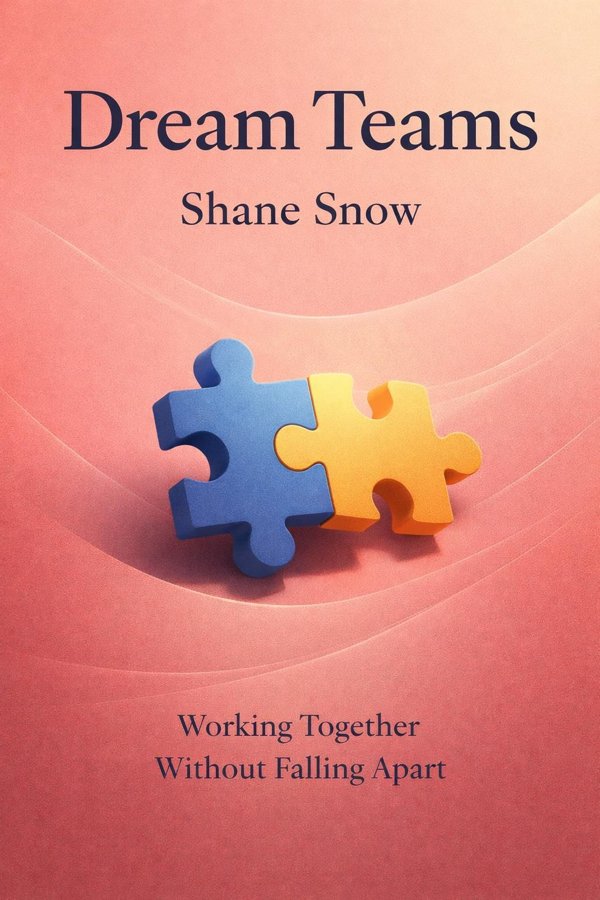
Dream Teams: Working Together Without Falling Apart: Summary & Key Insights
by Shane Snow
 10 min9 chaptersAudio available
Key Takeaways from Dream Teams: Working Together Without Falling Apart
The instinct to surround ourselves with people who think like us feels safe, but it often makes teams weaker.
Great teams are not unusually peaceful; they are unusually good at disagreeing.
Diversity alone does not produce a dream team.
Teams do not run on logic alone; they run on stories.
People do their best work not only when they are challenged intellectually, but also when they feel connected to one another.
What Is Dream Teams: Working Together Without Falling Apart About?
Dream Teams: Working Together Without Falling Apart by Shane Snow is a leadership book spanning 4 pages. Why do some teams achieve breakthroughs that seem impossible while others, full of smart and capable people, stall out in conflict, politics, or groupthink? In Dream Teams, Shane Snow tackles that question by exploring what truly makes collaboration work. Rather than treating teamwork as a soft skill or corporate cliché, Snow examines it as a science. Drawing on psychology, neuroscience, sociology, and a wide range of real-world stories, he shows that exceptional teams are not built on harmony alone. They are built on difference, trust, productive tension, and a shared willingness to challenge one another without breaking apart. The book matters because modern work depends more than ever on collaboration across functions, backgrounds, and perspectives. Yet many organizations still confuse agreement with effectiveness and chemistry with performance. Snow argues the opposite: the best teams often feel uncomfortable at times because they think differently, debate honestly, and learn faster. As a journalist, entrepreneur, and researcher of innovation, Snow brings both storytelling skill and analytical depth to the subject. Dream Teams offers a practical, evidence-based guide for leaders, creators, and professionals who want to build groups that are not just cooperative, but genuinely extraordinary.
This FizzRead summary covers all 9 key chapters of Dream Teams: Working Together Without Falling Apart in approximately 10 minutes, distilling the most important ideas, arguments, and takeaways from Shane Snow's work. Also available as an audio summary and Key Quotes Podcast.
Dream Teams: Working Together Without Falling Apart
Why do some teams achieve breakthroughs that seem impossible while others, full of smart and capable people, stall out in conflict, politics, or groupthink? In Dream Teams, Shane Snow tackles that question by exploring what truly makes collaboration work. Rather than treating teamwork as a soft skill or corporate cliché, Snow examines it as a science. Drawing on psychology, neuroscience, sociology, and a wide range of real-world stories, he shows that exceptional teams are not built on harmony alone. They are built on difference, trust, productive tension, and a shared willingness to challenge one another without breaking apart.
The book matters because modern work depends more than ever on collaboration across functions, backgrounds, and perspectives. Yet many organizations still confuse agreement with effectiveness and chemistry with performance. Snow argues the opposite: the best teams often feel uncomfortable at times because they think differently, debate honestly, and learn faster. As a journalist, entrepreneur, and researcher of innovation, Snow brings both storytelling skill and analytical depth to the subject. Dream Teams offers a practical, evidence-based guide for leaders, creators, and professionals who want to build groups that are not just cooperative, but genuinely extraordinary.
Who Should Read Dream Teams: Working Together Without Falling Apart?
This book is perfect for anyone interested in leadership and looking to gain actionable insights in a short read. Whether you're a student, professional, or lifelong learner, the key ideas from Dream Teams: Working Together Without Falling Apart by Shane Snow will help you think differently.
- ✓Readers who enjoy leadership and want practical takeaways
- ✓Professionals looking to apply new ideas to their work and life
- ✓Anyone who wants the core insights of Dream Teams: Working Together Without Falling Apart in just 10 minutes
Want the full summary?
Get instant access to this book summary and 100K+ more with Fizz Moment.
Get Free SummaryAvailable on App Store • Free to download
Key Chapters
The instinct to surround ourselves with people who think like us feels safe, but it often makes teams weaker. One of Shane Snow’s central insights is that diversity is not merely a social ideal; it is a performance advantage. The most effective teams are not those with the most similar backgrounds, temperaments, or assumptions. They are the ones that bring together different ways of seeing the world.
Snow emphasizes cognitive diversity, meaning differences in perspective, problem-solving style, training, life experience, and mental models. When everyone on a team approaches an issue the same way, they tend to miss the same risks and reach the same predictable conclusions. But when people interpret evidence differently, ask different questions, and challenge default assumptions, the team becomes more innovative and resilient.
This helps explain why mixed teams often outperform groups of individually brilliant but highly similar people. A team composed entirely of elite experts from the same discipline may move quickly toward consensus, but that speed can hide blind spots. By contrast, a team that includes people from different functions, cultures, and personalities may feel slower at first, yet it often produces better answers because it sees more of reality.
In practice, this means hiring and forming teams for difference, not just chemistry. A product team, for example, should not consist only of engineers who share the same educational path and worldview. It should also include voices from design, customer support, operations, and markets the company wants to serve. The friction this creates is not a flaw; it is part of the value.
Actionable takeaway: Audit your team for sameness. Identify which perspectives are overrepresented and which are missing, then deliberately add people who think differently enough to improve the team’s collective judgment.
Great teams are not unusually peaceful; they are unusually good at disagreeing. Snow shows that one hidden feature of high-performing groups is cognitive friction, the tension that arises when different ideas collide. While many teams avoid disagreement to preserve harmony, the best teams understand that thoughtful conflict is often the path to truth.
Productive friction is different from personal hostility. It is not about ego, status battles, or attacking people. It is about challenging ideas, testing assumptions, and refusing to settle for easy consensus. Teams that never argue often mistake politeness for effectiveness. In reality, they may be suppressing valuable dissent, allowing weak ideas to pass untested, or drifting into groupthink.
Snow uses examples from science, sports, and business to illustrate that breakthrough performance often depends on open disagreement. The point is not to create constant conflict, but to normalize respectful challenge. When people feel safe enough to say, “I think we’re wrong,” the team becomes smarter. When leaders punish dissent, the team becomes fragile and blind.
Organizations can design for this by separating idea evaluation from hierarchy. In meetings, for instance, leaders can invite objections before making decisions, ask quieter members to speak first, or assign someone to play devil’s advocate. Teams can also create norms that distinguish critique of work from critique of character.
The deeper lesson is that discomfort is not always a warning sign. Sometimes it is evidence that a team is doing the hard work of thinking. Innovation requires pressure between unlike ideas.
Actionable takeaway: In your next major discussion, explicitly ask, “What are we missing?” and require at least one serious counterargument before the team moves to agreement.
Diversity alone does not produce a dream team. Without trust, difference becomes division. Snow argues that what allows teams to benefit from contrasting perspectives is a foundation of empathy and psychological safety. People need to believe they can speak honestly, make mistakes, and challenge others without being humiliated or excluded.
This insight is reinforced by neuroscience and behavioral research. Human beings are wired to detect threat quickly, especially social threat. If a workplace feels judgmental, political, or punishing, the brain shifts toward self-protection. People hold back ideas, hide uncertainty, and interpret disagreement as danger. In that environment, even a highly talented team cannot collaborate well.
Trust does not mean everyone must be close friends or agree on everything. It means there is enough mutual respect for people to assume good intentions and stay engaged through tension. In trusted teams, disagreement is less likely to become personal because members believe others are trying to improve the outcome, not undermine them.
Leaders play a major role here. A leader who admits uncertainty, asks for input, and responds calmly to criticism teaches the team that honesty is safe. A leader who reacts defensively or rewards only certainty teaches the opposite. Teams also build trust through repeated small behaviors: listening fully, following through on promises, sharing credit, and showing curiosity about other viewpoints.
A practical example is a project retrospective where every member, regardless of rank, is invited to discuss what worked and what failed. If the conversation is handled with openness rather than blame, trust grows. If it becomes a search for scapegoats, trust collapses.
Actionable takeaway: Build one ritual that increases psychological safety, such as a weekly check-in where team members can openly share concerns, lessons, or mistakes without penalty.
Teams do not run on logic alone; they run on stories. Snow highlights that culture is formed by the narratives groups tell about who they are, what they value, and how success happens. These stories influence whether people cooperate, compete, speak up, or stay silent.
A team’s culture is not just defined by mission statements or posters on a wall. It is expressed through repeated behaviors and shared myths. If the dominant story is that the organization rewards lone geniuses, people will hoard ideas and optimize for personal visibility. If the story is that breakthroughs come from unusual partnerships and candid debate, people will collaborate more openly.
This is why some teams with average talent outperform teams with greater individual star power. Their internal narrative encourages members to align around something larger than status. Snow shows that dream teams often develop a collective identity that honors difference while reinforcing belonging. Members feel they are part of a meaningful experiment, not just a transactional work group.
Leaders influence this by the examples they celebrate. If they repeatedly spotlight heroes who solved problems alone, they unintentionally weaken teamwork. If they tell stories about cross-functional wins, thoughtful dissent, and shared resilience, they shape a culture that supports collaboration.
For example, after a successful product launch, a leader can frame the story as the triumph of one visionary manager or as the result of engineering, design, customer research, operations, and honest internal debate. The second story teaches the team how success really happens.
Actionable takeaway: Examine the stories your team repeats most often and replace any hero narrative that glorifies individual brilliance with stories that celebrate collective problem-solving and constructive challenge.
Some of the most transformative ideas come from people who do not fully belong to the established system. Snow argues that outsiders are often valuable because they are less constrained by tradition, status expectations, and inherited assumptions. They can see options insiders overlook because they are not as invested in “how things have always been done.”
This outsider advantage appears across fields. In business, newcomers may question a process veterans no longer notice. In science, cross-disciplinary thinkers may connect ideas that experts in one silo keep separate. In creative work, people from different cultures or industries often generate fresh combinations because they bring unfamiliar reference points.
The challenge is that teams frequently resist outsiders. Human groups naturally prefer familiarity, and organizations often treat conformity as a sign of fit. But when fit becomes similarity, the team loses one of its strongest engines of innovation. Snow’s broader message is that dream teams make room for people who do not match the dominant mold.
Of course, outsider thinking must be integrated rather than romanticized. A contrarian who only disrupts without engaging the team can create noise rather than progress. The goal is to combine fresh perspective with shared purpose. Teams benefit most when they welcome unusual viewpoints and give them a real voice in decisions.
A practical example is hiring from adjacent industries rather than only direct competitors, or inviting newer employees to challenge legacy processes during planning sessions. Another is rotating people across departments so they can bring one function’s assumptions into contact with another’s.
Actionable takeaway: Intentionally include at least one nontraditional voice in your next important decision, someone new, cross-functional, or outside the usual circle, and ask them what everyone else is taking for granted.
Teams fail when they force people to choose between fitting in and being themselves. Snow makes clear that high-performing collaboration depends on a delicate balance: people must feel they belong to the group, but they must also retain the distinct perspectives that make the group stronger. Too much emphasis on belonging can produce conformity. Too much emphasis on individuality can produce fragmentation.
This tension explains why some diversity initiatives disappoint. An organization may recruit people from different backgrounds, then pressure them to adopt the dominant culture so completely that their differences no longer influence decisions. On paper the team becomes more diverse, but in practice it still thinks the same way. Dream teams avoid this trap by creating environments where people can contribute their full perspective without losing connection to the group.
Leaders support this balance by making expectations clear while remaining open about how those expectations can be met. Shared goals, values, and standards provide cohesion. Openness to different communication styles, experiences, and approaches preserves uniqueness. The aim is unity of mission, not uniformity of mind.
This can be applied in meetings, performance reviews, and decision processes. Teams should ask whether all members are truly shaping outcomes or merely being included symbolically. A culturally varied team, for example, should not just be present in the room; its members should influence how problems are framed and which solutions are considered credible.
The best collaborative cultures signal two messages at once: you are one of us, and your difference is useful here. That combination is powerful because it converts diversity from a demographic fact into a strategic advantage.
Actionable takeaway: Review one current team norm and ask whether it promotes genuine contribution or merely surface inclusion, then adjust it so people can belong without having to think alike.
Many teams are assembled around convenience, hierarchy, or personal preference. Snow argues that exceptional teams are built more intentionally. They are designed around the demands of the mission. That means choosing people, roles, and interaction patterns based on what the problem requires, not on who gets along most easily or who is already close to one another.
This is a crucial distinction. Comfortable teams can feel efficient because they communicate smoothly and avoid conflict. But if the mission is complex, ambiguous, or innovative, comfort can become a liability. The team may lack the range of insight needed to see the whole challenge. Dream teams are often less immediately comfortable because they are optimized for performance under real conditions.
Designing for mission involves several questions. What kinds of expertise are necessary? Which viewpoints are likely to disagree in productive ways? Where are the blind spots if the group becomes too similar? How should work be structured so that difference generates learning rather than paralysis?
For example, a company launching a product in a new market should not rely only on headquarters executives and product specialists. It should include regional voices, operational experts, local customer insight, and people willing to question existing assumptions. Likewise, a crisis response team should include fast decision-makers, skeptical analysts, and communicators who can translate complexity clearly.
Snow’s broader point is that teamwork should be architected, not assumed. Great collaboration is rarely accidental. It comes from thoughtful choices about who is in the room, how they interact, and what norms guide them.
Actionable takeaway: Before forming your next team, define the mission’s biggest uncertainties and select members specifically to address those uncertainties, rather than defaulting to familiar or convenient choices.
A common misconception is that leaders create great teams by eliminating conflict and maintaining constant harmony. Snow presents a more demanding view: strong leaders orchestrate healthy tension. They create the conditions where diverse people can challenge each other, stay aligned to a shared purpose, and keep conflict from becoming destructive.
This requires emotional maturity and structural skill. A leader must know when to encourage debate, when to step back, and when to intervene. Too little structure and disagreements become chaotic. Too much control and dissent disappears. The best leaders do not dominate the conversation; they shape the environment in which the right conversation can happen.
They do this by setting clear goals, defining norms for respectful disagreement, and making it safe to question assumptions. They also model the behavior they want to see. If a leader asks for feedback but punishes candor, the team learns to stay quiet. If a leader welcomes criticism, changes their mind when evidence demands it, and gives credit broadly, the team learns that truth matters more than ego.
Leadership in this framework is less about having all the answers and more about drawing out the team’s collective intelligence. It is the art of helping difference become contribution instead of conflict. This is especially important in high-stakes moments when pressure pushes groups toward defensiveness or rushed consensus.
A practical application is a meeting format where the leader first clarifies the decision, then invites competing interpretations, then summarizes areas of agreement and disagreement before moving toward action. This preserves both speed and rigor.
Actionable takeaway: In your next leadership moment, focus less on being the smartest voice in the room and more on creating a process where the smartest ideas, wherever they come from, can surface and be tested.
All Chapters in Dream Teams: Working Together Without Falling Apart
About the Author
Shane Snow is an American journalist, entrepreneur, and bestselling author whose work focuses on innovation, creativity, human behavior, and teamwork. He is the co-founder of Contently, a technology company built around content strategy and storytelling, and he has written for major publications including Wired, Fast Company, and The New Yorker. Snow is known for translating research from psychology, business, and social science into engaging narratives that are practical for professionals and leaders. In his books and speaking, he explores how people and organizations adapt, collaborate, and create change. Dream Teams reflects his signature approach: combining compelling real-world stories with evidence-based insight to explain how extraordinary performance happens in groups. His work is especially relevant to readers interested in leadership, culture, and the future of work.
Get This Summary in Your Preferred Format
Read or listen to the Dream Teams: Working Together Without Falling Apart summary by Shane Snow anytime, anywhere. FizzRead offers multiple formats so you can learn on your terms — all free.
Available formats: App · Audio · PDF · EPUB — All included free with FizzRead
Download Dream Teams: Working Together Without Falling Apart PDF and EPUB Summary
Key Quotes from Dream Teams: Working Together Without Falling Apart
“The instinct to surround ourselves with people who think like us feels safe, but it often makes teams weaker.”
“Great teams are not unusually peaceful; they are unusually good at disagreeing.”
“Diversity alone does not produce a dream team.”
“Teams do not run on logic alone; they run on stories.”
“People do their best work not only when they are challenged intellectually, but also when they feel connected to one another.”
Frequently Asked Questions about Dream Teams: Working Together Without Falling Apart
Dream Teams: Working Together Without Falling Apart by Shane Snow is a leadership book that explores key ideas across 9 chapters. Why do some teams achieve breakthroughs that seem impossible while others, full of smart and capable people, stall out in conflict, politics, or groupthink? In Dream Teams, Shane Snow tackles that question by exploring what truly makes collaboration work. Rather than treating teamwork as a soft skill or corporate cliché, Snow examines it as a science. Drawing on psychology, neuroscience, sociology, and a wide range of real-world stories, he shows that exceptional teams are not built on harmony alone. They are built on difference, trust, productive tension, and a shared willingness to challenge one another without breaking apart. The book matters because modern work depends more than ever on collaboration across functions, backgrounds, and perspectives. Yet many organizations still confuse agreement with effectiveness and chemistry with performance. Snow argues the opposite: the best teams often feel uncomfortable at times because they think differently, debate honestly, and learn faster. As a journalist, entrepreneur, and researcher of innovation, Snow brings both storytelling skill and analytical depth to the subject. Dream Teams offers a practical, evidence-based guide for leaders, creators, and professionals who want to build groups that are not just cooperative, but genuinely extraordinary.
More by Shane Snow

You Might Also Like

Extreme Ownership
Jocko Willink
10 min
Dare to Lead
Brene Brown
10 min
Leaders Eat Last
Simon Sinek
10 min
The 21 Irrefutable Laws of Leadership
John Maxwell
10 min
Start With Why
Simon Sinek
10 min
How to Lead When You're Not in Charge
Clay Scroggins
10 minBrowse by Category
Ready to read Dream Teams: Working Together Without Falling Apart?
Get the full summary and 100K+ more books with Fizz Moment.