
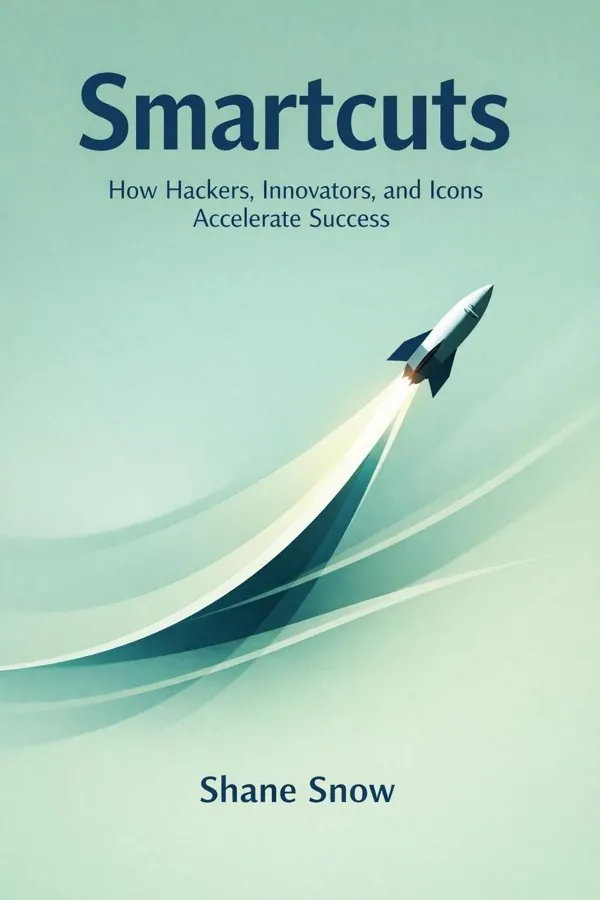
Smartcuts: How Hackers, Innovators, and Icons Accelerate Success: Summary & Key Insights
by Shane Snow
 10 min10 chaptersAudio available
Key Takeaways from Smartcuts: How Hackers, Innovators, and Icons Accelerate Success
Most people imagine success as a ladder: you start at the bottom, prove yourself, and rise one step at a time.
No one rises entirely alone, but not every mentor relationship creates real acceleration.
Improvement slows when feedback is delayed.
Many ambitious people waste years trying to build everything from scratch.
Effort matters, but timing can multiply effort.
What Is Smartcuts: How Hackers, Innovators, and Icons Accelerate Success About?
Smartcuts: How Hackers, Innovators, and Icons Accelerate Success by Shane Snow is a entrepreneurship book spanning 10 pages. Smartcuts is a book about a powerful idea: success does not always follow a slow, linear path. In most careers and industries, people are taught to climb one rung at a time, wait their turn, and trust that steady effort will eventually pay off. Shane Snow argues that while hard work still matters, many of the world’s most remarkable achievers move faster by using smarter routes. They find patterns, exploit hidden opportunities, learn from the right people, and challenge outdated rules. Drawing on stories from entrepreneurs, athletes, artists, and organizations such as SpaceX, Ferrari, and YouTube, Snow shows that the biggest leaps often come not from cheating the system, but from understanding it deeply enough to bend it. These “smartcuts” are ethical accelerators: creative strategies that reduce wasted effort and increase momentum. The book matters because modern competition is too intense for purely conventional thinking. Whether you are building a company, advancing a career, or learning a new skill, Smartcuts offers a framework for progressing faster without sacrificing excellence. As an entrepreneur and award-winning journalist, Shane Snow brings both business credibility and investigative rigor to the subject.
This FizzRead summary covers all 10 key chapters of Smartcuts: How Hackers, Innovators, and Icons Accelerate Success in approximately 10 minutes, distilling the most important ideas, arguments, and takeaways from Shane Snow's work. Also available as an audio summary and Key Quotes Podcast.
Smartcuts: How Hackers, Innovators, and Icons Accelerate Success
Smartcuts is a book about a powerful idea: success does not always follow a slow, linear path. In most careers and industries, people are taught to climb one rung at a time, wait their turn, and trust that steady effort will eventually pay off. Shane Snow argues that while hard work still matters, many of the world’s most remarkable achievers move faster by using smarter routes. They find patterns, exploit hidden opportunities, learn from the right people, and challenge outdated rules.
Drawing on stories from entrepreneurs, athletes, artists, and organizations such as SpaceX, Ferrari, and YouTube, Snow shows that the biggest leaps often come not from cheating the system, but from understanding it deeply enough to bend it. These “smartcuts” are ethical accelerators: creative strategies that reduce wasted effort and increase momentum.
The book matters because modern competition is too intense for purely conventional thinking. Whether you are building a company, advancing a career, or learning a new skill, Smartcuts offers a framework for progressing faster without sacrificing excellence. As an entrepreneur and award-winning journalist, Shane Snow brings both business credibility and investigative rigor to the subject.
Who Should Read Smartcuts: How Hackers, Innovators, and Icons Accelerate Success?
This book is perfect for anyone interested in entrepreneurship and looking to gain actionable insights in a short read. Whether you're a student, professional, or lifelong learner, the key ideas from Smartcuts: How Hackers, Innovators, and Icons Accelerate Success by Shane Snow will help you think differently.
- ✓Readers who enjoy entrepreneurship and want practical takeaways
- ✓Professionals looking to apply new ideas to their work and life
- ✓Anyone who wants the core insights of Smartcuts: How Hackers, Innovators, and Icons Accelerate Success in just 10 minutes
Want the full summary?
Get instant access to this book summary and 100K+ more with Fizz Moment.
Get Free SummaryAvailable on App Store • Free to download
Key Chapters
Most people imagine success as a ladder: you start at the bottom, prove yourself, and rise one step at a time. Smartcuts challenges that image. Shane Snow argues that many exceptional performers do not simply climb upward; they move sideways into overlooked opportunities, adjacent fields, or unconventional routes that let them bypass bottlenecks. The insight is simple but disruptive: the fastest path forward is often not the most obvious one.
Lateral thinking means questioning the default sequence. Instead of asking, “What is the next approved step?” you ask, “What route gets me to the same destination with less friction?” This can mean entering a new industry through a niche role, building an audience before seeking institutional approval, or combining skills from different disciplines to create unusual value. Innovators often win not because they are more patient than everyone else, but because they refuse to be trapped by inherited assumptions.
Snow points to examples of people and organizations that found alternative paths rather than waiting for permission. In entrepreneurship, a founder may avoid years of gatekeeping by using the internet to test demand directly. In a career, someone might gain influence by creating public work, such as writing, videos, or open-source projects, instead of relying only on formal promotions. In learning, lateral thinkers often master complementary skills that make them stand out faster than specialists following standard tracks.
This idea does not reject effort; it redirects effort toward leverage. Hard work on the wrong path can still be slow. Smart work on a better path can compound quickly.
Actionable takeaway: Identify one goal you are pursuing and list the “official” path to get there. Then force yourself to sketch three unconventional routes that could achieve the same result faster, cheaper, or with greater visibility.
No one rises entirely alone, but not every mentor relationship creates real acceleration. Smartcuts emphasizes that the best mentors do more than give advice. They transmit judgment, pattern recognition, and shortcuts earned through experience. A great mentor can help you avoid mistakes you have not yet made, see opportunities you did not know existed, and move with confidence through unfamiliar terrain.
Shane Snow highlights a crucial distinction: transformational mentorship is not passive admiration. It is active access to someone else’s tested mental models. Instead of learning only through trial and error, you learn through guided trial and selective error. That dramatically changes the speed of progress. The right mentor reduces noise, sharpens priorities, and teaches what matters most now, not just in theory.
This does not apply only to formal apprenticeships. Mentorship can come through direct relationships, professional communities, reverse engineering admired careers, and even close study of people whose work leaves a clear trail. In startups, first-time founders often accelerate by surrounding themselves with experienced operators. In creative work, artists improve faster when they receive honest feedback from people who have already built excellence. In sports and performance, elite coaching can reveal blind spots that raw effort alone cannot fix.
Snow’s broader point is that success leaves clues, and mentors help decode them. They can also open doors to networks and standards you may not reach on your own. Importantly, good mentorship is not dependence. The goal is not to borrow someone else’s life, but to borrow their lessons so you can build your own.
Actionable takeaway: Make a list of three people who are five to ten years ahead of you in a skill or career path you value. Reach out with one specific question or request for feedback, rather than a vague request to “be my mentor.”
Improvement slows when feedback is delayed. One of the smartest accelerators in any field is shortening the loop between action and response. Smartcuts shows that people and organizations that improve quickly do not wait months or years to discover whether they are on the right track. They test, measure, adapt, and repeat while others are still planning.
Rapid feedback works because learning is most effective when cause and effect stay close together. If you launch a product and hear from users immediately, you can correct flaws before they harden into expensive problems. If you practice a skill with quick correction, your brain updates faster. If you publish ideas regularly and observe what resonates, you refine your message in public rather than in isolation.
This principle explains why startups often outlearn larger competitors. Small teams can release quickly, gather data, and iterate. It also explains why top performers in music, sports, design, and sales often improve through repetition in real conditions, not endless preparation. Skrillex, for example, became known not just through talent but through prolific experimentation and adaptation to audience response. The same logic applies to entrepreneurs validating an offer, marketers testing headlines, or job seekers refining how they communicate their value.
The danger, of course, is confusing activity with learning. Fast feedback only helps if you pay attention to meaningful signals. You need metrics that reflect real progress, honest critics who tell the truth, and the humility to change course. Speed without reflection becomes chaos. But speed with learning becomes compounding advantage.
Actionable takeaway: Choose one project and reduce its feedback cycle by half. If you currently review progress monthly, review weekly. If you currently wait for a perfect launch, create a small test version and get real reactions within seven days.
Many ambitious people waste years trying to build everything from scratch. Smartcuts argues that one of the fastest ways to advance is to leverage platforms that already have distribution, trust, infrastructure, or audiences. Rather than seeing platforms as constraints, Snow shows how they can serve as launchpads.
A platform could be a marketplace, a media channel, a social network, an established brand, a community, or even a technological ecosystem. The key idea is that scale often comes faster when you attach your value to something people already use. YouTube helped creators reach audiences without needing television networks. App stores allowed developers to reach millions without owning hardware distribution. Entrepreneurs routinely grow faster when they piggyback on customer flows that already exist.
This strategy matters because attention and trust are scarce. Building both from zero is difficult. By plugging into an existing system, you reduce friction and focus on what makes your offering distinctive. For a founder, this might mean selling through Amazon, Shopify, or a strategic partner before investing in a standalone channel. For a professional, it might mean publishing on platforms where relevant audiences already gather. For a consultant, it could mean collaborating with a recognized brand to borrow credibility.
Of course, platforms come with risk. Rules can change, algorithms can shift, and dependency can become dangerous. Snow’s point is not to surrender your future to someone else’s system, but to use leverage wisely. Platforms are accelerators, not substitutes for a durable strategy.
Actionable takeaway: Audit your current goals and ask where infrastructure already exists. Instead of building a new audience, channel, or process from zero, identify one platform you can use this month to reach customers, employers, or collaborators faster.
Effort matters, but timing can multiply effort. One of the most practical lessons in Smartcuts is that successful people often rise by aligning themselves with powerful trends already in motion. Snow compares this to catching a wave: when momentum exists in the environment, even imperfect execution can travel farther than brilliant work in a stagnant context.
Waves can be technological, cultural, economic, or social. A founder launching in an emerging market category may grow faster than a stronger founder entering a declining one. An artist whose style aligns with a new cultural appetite can break through quickly. A professional who develops skills just as they become scarce can leap ahead without waiting decades. In each case, timing amplifies output.
This helps explain why some people seem to accelerate suddenly. Often, they have positioned themselves where the world is about to move. That does not happen by luck alone. It requires observation, curiosity, and a willingness to place bets before a trend becomes obvious to everyone. Snow shows that the smartest achievers study patterns, notice inflection points, and act when others hesitate.
But catching waves is not trend-chasing for its own sake. You still need substance. A wave may create visibility, but it cannot sustain mediocrity for long. The ideal combination is competence plus timing: build something valuable, then align it with forces that are growing.
Actionable takeaway: Look at your industry and identify one rising wave over the next two to three years, such as a new technology, customer behavior, or market shift. Then ask how you can position your skills, product, or brand to benefit from that momentum before it peaks.
Complexity is often mistaken for sophistication, but Smartcuts repeatedly shows that simplification is a form of intelligence. The more moving parts a system has, the more energy it consumes, the more likely it is to stall, and the harder it becomes to execute consistently. High performers accelerate not only by doing more, but by stripping away what does not matter.
This is why elite teams, from race car engineers to startup operators, obsess over reducing friction. Ferrari is an example Snow uses to illustrate how performance depends on focusing intensely on the few variables that create the biggest gains. In business, this might mean narrowing a product to its most valuable use case rather than serving every possible customer. In personal productivity, it means committing to fewer priorities and protecting time for deep work. In communication, it means expressing ideas clearly enough that others can act on them quickly.
Simplification also improves decision-making. When goals are cluttered, attention is fragmented. When metrics are too numerous, teams lose direction. When products try to solve everything, users get confused. The fastest path often becomes visible only after noise is removed. This principle is especially useful for entrepreneurs, who frequently believe growth requires adding features, channels, or hires when what they really need is clarity.
Importantly, simplification is not laziness. It is disciplined subtraction. It asks what truly drives outcomes and what merely feels productive. Snow’s smartcut here is that speed often comes from fewer commitments made better.
Actionable takeaway: Review your current projects, meetings, features, or goals and cut one low-value element that creates disproportionate complexity. Then redirect that time or energy toward the single activity most tied to results.
Talent matters, but connections often determine how far talent travels. In Smartcuts, Shane Snow explores the role of “superconnectors,” people who sit at the center of networks and create disproportionate opportunity by linking others, sharing information, and facilitating trust. These individuals do not just know many people; they know how to make relationships useful, generous, and timely.
Networks accelerate success because opportunities rarely move in a straight line. Jobs, deals, collaborations, introductions, and insights often come through social pathways. Superconnectors thrive because they understand that value grows when people are linked across industries, disciplines, and communities. They are not merely social; they are strategic in creating bridges.
For entrepreneurs, this can mean getting warm introductions to investors, customers, or partners that would be impossible through cold outreach. For creators, it can mean collaborating with adjacent audiences. For professionals, a strong network can surface hidden roles and accelerate reputation. Snow’s point is that relationships compress trust. In a noisy world, trust is one of the most powerful forms of leverage.
The deeper lesson is that networking works best when it is rooted in contribution. The strongest connectors are often the most helpful people in the room. They share useful resources, connect others without immediate gain, and become known as reliable nodes in the system. Over time, this creates reciprocal momentum.
If you want smartcuts through networking, do not focus only on meeting “important” people. Build a pattern of being useful, curious, and consistent. Networks are not trophies; they are living ecosystems.
Actionable takeaway: This week, make two valuable introductions, share one relevant resource with your network, and reconnect with one dormant contact. Focus on adding value first rather than asking for something immediately.
Incremental thinking produces incremental outcomes. One of the boldest ideas in Smartcuts is that breakthrough achievers often work from a 10x mindset rather than a 10 percent mindset. Instead of asking how to improve a system slightly, they ask what would need to be true to make it radically better. That kind of thinking changes both the scale of ambition and the quality of solutions.
A 10x approach forces you to abandon assumptions. If your goal is only modest improvement, you can often get there by adding effort. But if your goal is tenfold improvement, old methods usually collapse. You must redesign the process itself. This is why companies like SpaceX captured imagination: they did not set out merely to be a somewhat better aerospace company. They challenged cost structures, timelines, and engineering norms that others had accepted as fixed.
In entrepreneurship, 10x thinking can lead to business models that scale instead of businesses that merely survive. In personal performance, it can mean focusing on one high-leverage skill or channel that creates outsized results instead of trying to improve everything equally. In product design, it can mean solving the customer’s problem so completely that comparison becomes difficult.
Of course, 10x thinking is not fantasy. It still requires constraints, testing, and execution. The value lies in asking larger questions that reveal hidden possibilities. Bigger thinking often leads to simpler, stronger solutions because it exposes how inefficient current systems really are.
Actionable takeaway: Take one current goal and rewrite it in 10x terms. Then ask: if a tenfold result were required, what assumptions, processes, or habits would I have to abandon immediately?
People who accelerate quickly are not people who avoid failure; they are people who interpret failure differently. Smartcuts reframes failure as information. When viewed as identity damage, failure leads to hesitation, defensiveness, and stagnation. When viewed as feedback, it becomes a mechanism for adaptation.
This mindset is especially important because smartcuts often involve experimentation, and experimentation carries risk. If you try unconventional routes, not all of them will work. The difference between fast learners and slow ones is not that one group has perfect instincts. It is that they recover insight from mistakes more efficiently. They ask what the result reveals about timing, audience, process, or assumptions.
Entrepreneurs live this reality constantly. A product launch that underperforms can reveal weak messaging, flawed targeting, or poor timing. A rejected pitch can reveal which objections matter most. A failed career move can clarify strengths and misalignment. Snow emphasizes that icons and innovators tend to run more experiments, which means they often encounter more visible failures. But because they learn quickly, those failures become stepping stones rather than endpoints.
There is also an emotional smartcut here: detaching ego from outcomes preserves momentum. If every setback feels like proof of inadequacy, you will stop trying bold things. If setbacks are treated as useful signals, you become more resilient and more strategic.
Actionable takeaway: After your next disappointment, conduct a short debrief before moving on. Write down what happened, what you expected, what you learned, and what you will change next time. Make learning explicit so failure becomes fuel rather than fog.
The word “shortcut” often sounds suspicious, as if speed must come at the expense of quality or integrity. One of Snow’s most important clarifications is that smartcuts are not cheats. They are ethical accelerators: methods that remove unnecessary friction while preserving, and often increasing, excellence. This distinction matters because unsustainable shortcuts can produce temporary wins but long-term damage.
An ethical smartcut respects reality. It does not fake expertise, deceive customers, or exploit people. Instead, it asks how systems can be navigated more intelligently. A sustainable smartcut also scales with success. If your rapid growth depends on burnout, fragile hacks, or relationships you abuse, it will eventually collapse. But if your acceleration comes from better learning, better leverage, better networks, and better timing, it tends to compound over time.
This final principle ties the entire book together. Snow is not glorifying hustle for its own sake or speed at any cost. He is advocating a higher standard of ambition: achieve more by understanding how progress actually works. The best smartcuts improve both outcomes and process. They save time not by cutting corners, but by cutting waste.
For entrepreneurs, this means building systems that can survive scale. For leaders, it means creating cultures where experimentation and adaptation are encouraged without sacrificing values. For individuals, it means resisting the temptation to imitate surface-level success while ignoring the discipline underneath it.
Actionable takeaway: Evaluate your current strategy by asking two questions: does this approach create genuine value, and could I keep doing it successfully for years? If the answer to either is no, it is not a smartcut; it is a liability.
All Chapters in Smartcuts: How Hackers, Innovators, and Icons Accelerate Success
About the Author
Shane Snow is an American journalist, entrepreneur, and bestselling author who writes about innovation, human behavior, leadership, and the future of work. He is the co-founder of Contently, a technology company focused on content marketing, and has contributed to major publications including Wired, Fast Company, GQ, The New Yorker, and Harvard Business Review. Snow is known for combining investigative reporting with practical business insight, often exploring why some people and organizations outperform others in rapidly changing environments. His work stands out for turning complex ideas into engaging narratives supported by research and real-world examples. In Smartcuts, he brings together his experience as both a founder and a reporter to explain how innovators, hackers, and icons achieve success faster by challenging conventional paths.
Get This Summary in Your Preferred Format
Read or listen to the Smartcuts: How Hackers, Innovators, and Icons Accelerate Success summary by Shane Snow anytime, anywhere. FizzRead offers multiple formats so you can learn on your terms — all free.
Available formats: App · Audio · PDF · EPUB — All included free with FizzRead
Download Smartcuts: How Hackers, Innovators, and Icons Accelerate Success PDF and EPUB Summary
Key Quotes from Smartcuts: How Hackers, Innovators, and Icons Accelerate Success
“Most people imagine success as a ladder: you start at the bottom, prove yourself, and rise one step at a time.”
“No one rises entirely alone, but not every mentor relationship creates real acceleration.”
“Improvement slows when feedback is delayed.”
“Many ambitious people waste years trying to build everything from scratch.”
“Effort matters, but timing can multiply effort.”
Frequently Asked Questions about Smartcuts: How Hackers, Innovators, and Icons Accelerate Success
Smartcuts: How Hackers, Innovators, and Icons Accelerate Success by Shane Snow is a entrepreneurship book that explores key ideas across 10 chapters. Smartcuts is a book about a powerful idea: success does not always follow a slow, linear path. In most careers and industries, people are taught to climb one rung at a time, wait their turn, and trust that steady effort will eventually pay off. Shane Snow argues that while hard work still matters, many of the world’s most remarkable achievers move faster by using smarter routes. They find patterns, exploit hidden opportunities, learn from the right people, and challenge outdated rules. Drawing on stories from entrepreneurs, athletes, artists, and organizations such as SpaceX, Ferrari, and YouTube, Snow shows that the biggest leaps often come not from cheating the system, but from understanding it deeply enough to bend it. These “smartcuts” are ethical accelerators: creative strategies that reduce wasted effort and increase momentum. The book matters because modern competition is too intense for purely conventional thinking. Whether you are building a company, advancing a career, or learning a new skill, Smartcuts offers a framework for progressing faster without sacrificing excellence. As an entrepreneur and award-winning journalist, Shane Snow brings both business credibility and investigative rigor to the subject.
More by Shane Snow
You Might Also Like

Lean Analytics
Alistair Croll, Benjamin Yoskovitz
10 min
21 Days To A Big Idea: Creating Breakthrough Business Concepts
Bryan Mattimore
10 min
Sam Walton: Made in America: My Story
Sam Walton
10 min
10x Is Easier Than 2x: How World-Class Entrepreneurs Achieve More by Doing Less
Dan Sullivan, Benjamin Hardy
10 min
12 Months to $1 Million: How to Pick a Winning Product, Build a Real Business, and Become a Seven-Figure Entrepreneur
Ryan Daniel Moran
10 min
24 Assets: Create a Digital, Scalable, Valuable Business
Daniel Priestley
10 minBrowse by Category
Ready to read Smartcuts: How Hackers, Innovators, and Icons Accelerate Success?
Get the full summary and 100K+ more books with Fizz Moment.