
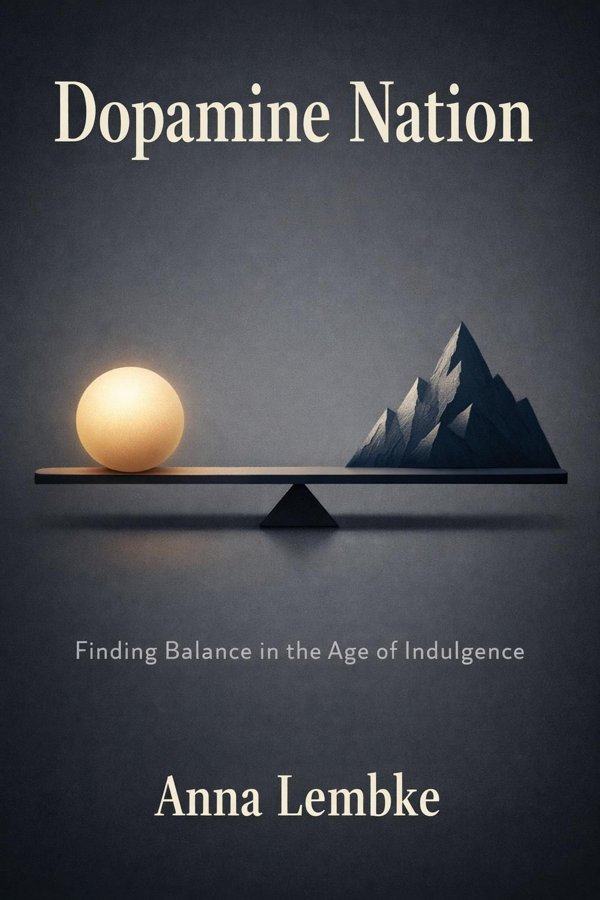
Dopamine Nation: Finding Balance in the Age of Indulgence: Summary & Key Insights
by Anna Lembke
 10 min9 chaptersAudio available
Key Takeaways from Dopamine Nation: Finding Balance in the Age of Indulgence
What if the very experiences we chase for relief are quietly increasing our suffering?
We often assume dopamine is the brain’s “pleasure chemical,” but Lembke shows that it is more accurately the molecule of wanting, seeking, and anticipation.
Addiction is not limited to drugs in dark alleys or dramatic public collapse; it often lives inside normal routines, respectable identities, and culturally rewarded habits.
One of addiction’s greatest powers is not the substance or behavior itself, but the lies that protect it.
In a culture that equates freedom with unlimited access, restraint can sound punitive or old-fashioned.
What Is Dopamine Nation: Finding Balance in the Age of Indulgence About?
Dopamine Nation: Finding Balance in the Age of Indulgence by Anna Lembke is a neuroscience book spanning 8 pages. In "Dopamine Nation," psychiatrist Anna Lembke argues that one of the defining problems of modern life is not scarcity, but excess. We live in a world engineered to deliver pleasure on demand: endless entertainment, online shopping, processed food, pornography, gambling apps, social media, and increasingly potent drugs. Yet instead of becoming happier, many people feel more restless, numb, compulsive, and emotionally depleted. Lembke explains why by turning to neuroscience, especially the brain’s dopamine system, which governs motivation, reward, craving, and adaptation. Drawing on her work as a Stanford addiction specialist, she combines scientific insight with vivid clinical stories of patients struggling with substance abuse, digital dependency, compulsive sex, shopping, gaming, and other forms of overconsumption. Her central claim is both unsettling and hopeful: the same brain mechanisms that make us vulnerable to addiction also reveal a path back to balance. By understanding how pleasure and pain are linked, practicing intentional restraint, and rebuilding our capacity for honesty, connection, and meaning, we can regain freedom. This book matters because it explains not just addiction, but the everyday compulsions shaping life in the age of indulgence.
This FizzRead summary covers all 9 key chapters of Dopamine Nation: Finding Balance in the Age of Indulgence in approximately 10 minutes, distilling the most important ideas, arguments, and takeaways from Anna Lembke's work. Also available as an audio summary and Key Quotes Podcast.
Dopamine Nation: Finding Balance in the Age of Indulgence
In "Dopamine Nation," psychiatrist Anna Lembke argues that one of the defining problems of modern life is not scarcity, but excess. We live in a world engineered to deliver pleasure on demand: endless entertainment, online shopping, processed food, pornography, gambling apps, social media, and increasingly potent drugs. Yet instead of becoming happier, many people feel more restless, numb, compulsive, and emotionally depleted. Lembke explains why by turning to neuroscience, especially the brain’s dopamine system, which governs motivation, reward, craving, and adaptation.
Drawing on her work as a Stanford addiction specialist, she combines scientific insight with vivid clinical stories of patients struggling with substance abuse, digital dependency, compulsive sex, shopping, gaming, and other forms of overconsumption. Her central claim is both unsettling and hopeful: the same brain mechanisms that make us vulnerable to addiction also reveal a path back to balance. By understanding how pleasure and pain are linked, practicing intentional restraint, and rebuilding our capacity for honesty, connection, and meaning, we can regain freedom. This book matters because it explains not just addiction, but the everyday compulsions shaping life in the age of indulgence.
Who Should Read Dopamine Nation: Finding Balance in the Age of Indulgence?
This book is perfect for anyone interested in neuroscience and looking to gain actionable insights in a short read. Whether you're a student, professional, or lifelong learner, the key ideas from Dopamine Nation: Finding Balance in the Age of Indulgence by Anna Lembke will help you think differently.
- ✓Readers who enjoy neuroscience and want practical takeaways
- ✓Professionals looking to apply new ideas to their work and life
- ✓Anyone who wants the core insights of Dopamine Nation: Finding Balance in the Age of Indulgence in just 10 minutes
Want the full summary?
Get instant access to this book summary and 100K+ more with Fizz Moment.
Get Free SummaryAvailable on App Store • Free to download
Key Chapters
We often assume dopamine is the brain’s “pleasure chemical,” but Lembke shows that it is more accurately the molecule of wanting, seeking, and anticipation. Dopamine spikes most strongly not when we passively enjoy a reward, but when we pursue it, expect it, or encounter something unexpectedly better than predicted. This helps explain why craving can feel more intense than actual satisfaction, and why the chase itself becomes addictive.
At the center of this process is reward prediction error: the difference between what we expect and what actually happens. When the outcome exceeds expectations, dopamine surges, reinforcing the behavior and teaching the brain to repeat it. This is why variable rewards are so powerful. Slot machines, social media notifications, dating apps, and online marketplaces all exploit uncertainty. You do not know when the next exciting post, message, win, or purchase will appear, so the brain keeps seeking.
The danger is that repeated dopamine surges recalibrate the baseline. Ordinary life starts to feel flat compared with hyperstimulating rewards. Reading a book, having a quiet dinner, or taking a walk may seem dull not because they lack value, but because the brain has been trained to expect stronger spikes.
One practical implication is to become suspicious of activities built on endless novelty and unpredictable reinforcement. If something keeps you checking, refreshing, or repeating “just one more time,” dopamine is likely doing the heavy lifting. Actionable takeaway: reduce one variable-reward habit this week by adding friction, such as turning off notifications, deleting an app from your phone, or setting a fixed time window for use.
Addiction is not limited to drugs in dark alleys or dramatic public collapse; it often lives inside normal routines, respectable identities, and culturally rewarded habits. Lembke broadens the definition of addiction by showing how people become trapped by behaviors that are legal, socially accepted, and even admired. Work, exercise, social media, romance, gaming, shopping, pornography, and food can all become compulsive when they continue despite harm and when control steadily erodes.
Through clinical stories, she illustrates that addiction rarely begins with self-destruction in mind. It often starts as a solution: alcohol to ease social anxiety, painkillers after surgery, online gaming to escape loneliness, shopping to soothe sadness, achievement to quiet insecurity. The behavior works, at first. That is what makes it dangerous. Gradually, the brain learns to rely on the external stimulus rather than developing internal coping capacities. The person still appears functional, but their emotional range narrows and their freedom shrinks.
This perspective matters because it replaces moral judgment with observation. The question is not whether a habit looks extreme from the outside, but whether it has become difficult to stop, whether tolerance has increased, and whether life is being organized around access to the reward. Someone can be outwardly successful and inwardly enslaved.
A useful exercise is to look for signs of compulsion: secrecy, failed attempts to cut back, escalating use, neglected relationships, or irritability when deprived. Actionable takeaway: choose one habit you defend as harmless and test your level of control by abstaining from it for a week while journaling your urges, rationalizations, and mood shifts.
One of addiction’s greatest powers is not the substance or behavior itself, but the lies that protect it. Lembke argues that addiction thrives in secrecy, fragmentation, and self-deception. People minimize use, hide consequences, split themselves into public and private selves, and construct narratives that preserve access to the thing they crave. Radical honesty becomes therapeutic because it reunites those divided parts and removes the distortions that keep the cycle running.
In her clinical work, Lembke describes how telling the full truth about behavior can be both humiliating and liberating. Patients often discover that the energy spent concealing their habits is part of the suffering. Confession, whether in therapy, recovery groups, or trusted relationships, disrupts the closed system of addiction. Once behavior is spoken plainly, it becomes observable, measurable, and open to accountability.
Honesty also matters internally. Many compulsive behaviors are shielded by vague language: “I’m just unwinding,” “I deserve this,” “It’s not that much,” “Everyone does it.” Replacing euphemism with specificity changes the picture. “I drink half a bottle of wine most nights to numb stress” is harder to ignore than “I like to relax in the evening.” Clear language restores agency.
This does not mean public oversharing or confession for spectacle. The point is disciplined truth-telling in service of recovery. Practical methods include tracking consumption, naming triggers, and sharing patterns with someone who will not collude with denial. Actionable takeaway: write an unedited account of one behavior you suspect is controlling you, including how often it happens, what it costs, and what you hide about it, then share it with one trustworthy person.
In a culture that equates freedom with unlimited access, restraint can sound punitive or old-fashioned. Lembke reframes it as a neuroscientific tool for healing. If repeated overconsumption tilts the brain’s balance toward pain, then a sustained period without the stimulating substance or behavior gives the reward system a chance to reset. Abstinence is not merely a moral stance; it is a biological intervention.
She often recommends a dopamine fast of about thirty days for a problematic behavior. This is long enough for many people to move through acute withdrawal, confront the discomfort they have been avoiding, and allow pleasure-pain mechanisms to recalibrate. During this period, cravings may intensify before they fade. Mood may dip. Restlessness, irritability, boredom, or emotional pain may surface. These reactions are not proof that restraint is failing; they are evidence that dependence had formed.
Importantly, restraint works best when it is specific and structured. Vague intentions like “I’ll cut back” leave too much room for negotiation. Clear boundaries, environmental changes, and social accountability strengthen success. If someone is trying to reduce compulsive online shopping, unsubscribing from promotional emails, deleting saved payment information, and avoiding certain websites can matter as much as willpower.
Restraint also teaches a deeper lesson: many urges crest and pass if not obeyed immediately. This builds confidence in one’s capacity to withstand discomfort. Actionable takeaway: choose one behavior that has become compulsive and design a time-bound abstinence experiment with clear rules, a start date, substitute activities, and one person who will check in on your progress.
The modern world trains us to avoid discomfort at all costs, yet Lembke argues that certain forms of voluntary pain can be restorative. This is one of the book’s most surprising ideas. Because pleasure and pain are linked on the same balance, controlled exposure to manageable discomfort may help reset a brain dulled by overindulgence. Practices such as exercise, cold exposure, difficult effort, honest emotional confrontation, and disciplined routines can strengthen resilience and improve mood.
This does not mean glorifying suffering or recommending harsh self-punishment. Lembke distinguishes between destructive pain and chosen, bounded challenges that awaken the nervous system and recalibrate reward. For example, a person accustomed to constant digital entertainment may initially experience silence or boredom as painful. But staying with that discomfort can expand attention and restore enjoyment of simpler experiences. Likewise, physical exercise may feel effortful in the moment yet create greater well-being afterward.
The principle is ancient but newly relevant: avoiding all pain shrinks us, while engaging selected forms of difficulty can enlarge our tolerance and deepen satisfaction. Recovery is not just about removing an addictive reward; it is about relearning how to live in a body and mind that cannot be optimized for comfort at every moment.
Practical examples include taking walks without a phone, doing strenuous exercise, practicing meditation, having difficult conversations, or delaying gratification in small ways. These acts train the brain to bear friction instead of fleeing it. Actionable takeaway: incorporate one deliberate discomfort practice into your week, such as a daily workout, a cold shower, or thirty minutes of device-free boredom, and treat it as training for emotional resilience.
Individual weakness is only part of the story; modern culture is built to amplify desire. Lembke emphasizes that we now inhabit an unprecedented ecosystem of abundance, accessibility, and engineered stimulation. Products and platforms are designed to maximize engagement, reduce effort, and increase repetition. The result is a society where addictive consumption is not an accident but a profitable business model.
This environment changes what self-control requires. In a world of occasional temptation, moderation may come naturally. In a world where high-dopamine stimuli are portable, personalized, and always available, people must actively defend their attention and impulses. Smartphones deliver endless novelty. Food companies optimize hyperpalatable products. Streaming services autoplay the next episode. Online pornography removes all practical barriers. Gambling mechanics appear inside games and apps. The brain, evolved for scarcity and uncertainty, is badly matched to such abundance.
Lembke’s cultural critique is important because it reduces shame without reducing responsibility. We are not powerless victims, but neither are we making choices in a neutral environment. Understanding the system helps explain why so many people struggle privately with compulsion.
A practical response is to shape the environment rather than relying solely on willpower. Keep devices out of the bedroom, avoid storing trigger foods at home, use website blockers, set spending limits, or establish tech-free zones and times. These are not signs of weakness; they are forms of intelligent self-governance. Actionable takeaway: identify one part of your environment that is constantly cueing compulsive behavior and redesign it today to make the unwanted habit less convenient and the healthier alternative easier.
Addiction isolates, even when it appears social on the surface. Lembke shows that many compulsive behaviors function as substitutes for genuine connection. They offer predictable relief without the vulnerability, uncertainty, or effort that real relationships require. But because they cannot reciprocate, challenge, or truly know us, they often deepen loneliness over time.
Healing, by contrast, often depends on connection. This includes therapeutic relationships, recovery communities, honest friendships, family repair, and service to others. When people tell the truth about their struggles and are met with accountability rather than abandonment, shame begins to loosen. Shame says, “I am uniquely broken.” Connection answers, “You are human, and change is possible.” This shift matters because shame itself is a trigger for further use. Feeling defective can drive people back toward the very behavior that numbs the feeling.
Lembke also highlights the importance of social belonging in recovery. Structured groups can provide ritual, language, role models, and a sense that one’s suffering can be transformed into wisdom that helps others. Even outside formal recovery programs, supportive connection creates interruptions in automatic behavior. A person is less likely to spiral when they can text someone, attend a meeting, or spend time in relationships that are not organized around consumption.
The practical lesson is that overcoming compulsion is rarely a solo project. Independence is overrated when the problem itself thrives in secrecy. Actionable takeaway: replace one hour currently spent in a compulsive or numbing behavior with a relational alternative this week, such as calling a friend, attending a support group, eating with family, or volunteering.
Removing an addictive behavior creates a void, and if that void is not filled wisely, relapse becomes likely. Lembke stresses that recovery is not simply subtraction; it is reconstruction. The brain and the person both need new sources of structure, identity, reward, and meaning. Otherwise, the old habit retains its power as the fastest route to relief.
This is why successful change often includes routines that seem simple but are profoundly stabilizing: regular sleep, exercise, meals, work, reflection, and planned leisure. These habits may not produce dramatic dopamine spikes, but they restore rhythm and predictability. Over time, they help the brain recover sensitivity to ordinary pleasures. A conversation, a meal, a creative project, or a quiet morning can become rewarding again once overstimulation decreases.
Meaning matters as much as routine. Many people become vulnerable to compulsive behavior when they feel unmoored, purposeless, or emotionally underfed. Recovery gains traction when individuals reconnect with values beyond immediate gratification: caregiving, craftsmanship, faith, learning, community, service, or long-term goals. The question shifts from “How do I stop using?” to “What kind of life makes using less appealing?”
Practical planning is essential. People should anticipate triggers, boredom, loneliness, and success itself, which can produce overconfidence. Building a calendar that includes exercise, social contact, and purpose-driven activity is not rigidness for its own sake; it is relapse prevention. Actionable takeaway: create a replacement plan for one habit you want to reduce, listing exactly what you will do instead at the time, place, and emotional state where the old behavior usually occurs.
All Chapters in Dopamine Nation: Finding Balance in the Age of Indulgence
About the Author
Anna Lembke, M.D., is a psychiatrist, professor of psychiatry at Stanford University School of Medicine, and a leading expert in addiction medicine. She serves as the medical director of Stanford Addiction Medicine and has spent years treating patients with substance use disorders and behavioral addictions. Her work focuses on the neuroscience of craving, reward, and compulsive behavior, as well as the cultural conditions that make addiction more common in modern life. Lembke is known for translating complex clinical and scientific ideas into clear, compelling insights for general readers. In both her medical practice and her writing, she explores how people can recover agency in environments saturated with pleasure, stimulation, and temptation. Her perspective combines rigorous science, frontline clinical experience, and humane attention to the realities of suffering and recovery.
Get This Summary in Your Preferred Format
Read or listen to the Dopamine Nation: Finding Balance in the Age of Indulgence summary by Anna Lembke anytime, anywhere. FizzRead offers multiple formats so you can learn on your terms — all free.
Available formats: App · Audio · PDF · EPUB — All included free with FizzRead
Download Dopamine Nation: Finding Balance in the Age of Indulgence PDF and EPUB Summary
Key Quotes from Dopamine Nation: Finding Balance in the Age of Indulgence
“What if the very experiences we chase for relief are quietly increasing our suffering?”
“We often assume dopamine is the brain’s “pleasure chemical,” but Lembke shows that it is more accurately the molecule of wanting, seeking, and anticipation.”
“Addiction is not limited to drugs in dark alleys or dramatic public collapse; it often lives inside normal routines, respectable identities, and culturally rewarded habits.”
“One of addiction’s greatest powers is not the substance or behavior itself, but the lies that protect it.”
“In a culture that equates freedom with unlimited access, restraint can sound punitive or old-fashioned.”
Frequently Asked Questions about Dopamine Nation: Finding Balance in the Age of Indulgence
Dopamine Nation: Finding Balance in the Age of Indulgence by Anna Lembke is a neuroscience book that explores key ideas across 9 chapters. In "Dopamine Nation," psychiatrist Anna Lembke argues that one of the defining problems of modern life is not scarcity, but excess. We live in a world engineered to deliver pleasure on demand: endless entertainment, online shopping, processed food, pornography, gambling apps, social media, and increasingly potent drugs. Yet instead of becoming happier, many people feel more restless, numb, compulsive, and emotionally depleted. Lembke explains why by turning to neuroscience, especially the brain’s dopamine system, which governs motivation, reward, craving, and adaptation. Drawing on her work as a Stanford addiction specialist, she combines scientific insight with vivid clinical stories of patients struggling with substance abuse, digital dependency, compulsive sex, shopping, gaming, and other forms of overconsumption. Her central claim is both unsettling and hopeful: the same brain mechanisms that make us vulnerable to addiction also reveal a path back to balance. By understanding how pleasure and pain are linked, practicing intentional restraint, and rebuilding our capacity for honesty, connection, and meaning, we can regain freedom. This book matters because it explains not just addiction, but the everyday compulsions shaping life in the age of indulgence.
More by Anna Lembke
You Might Also Like
Anxious
Joseph LeDoux
10 min
Hallucinations
Oliver Sacks
10 min
The Biological Mind: How Brain, Body, and Environment Collaborate to Make Us Who We Are
Alan Jasanoff
10 min
The Feeling of Life Itself: Why Consciousness Is Widespread but Can't Be Computed
Christof Koch
10 min
The No-Nonsense Meditation Book
Steven Laureys
10 min
A General Theory of Love
Thomas Lewis, Fari Amini, Richard Lannon
10 minBrowse by Category
Ready to read Dopamine Nation: Finding Balance in the Age of Indulgence?
Get the full summary and 100K+ more books with Fizz Moment.