
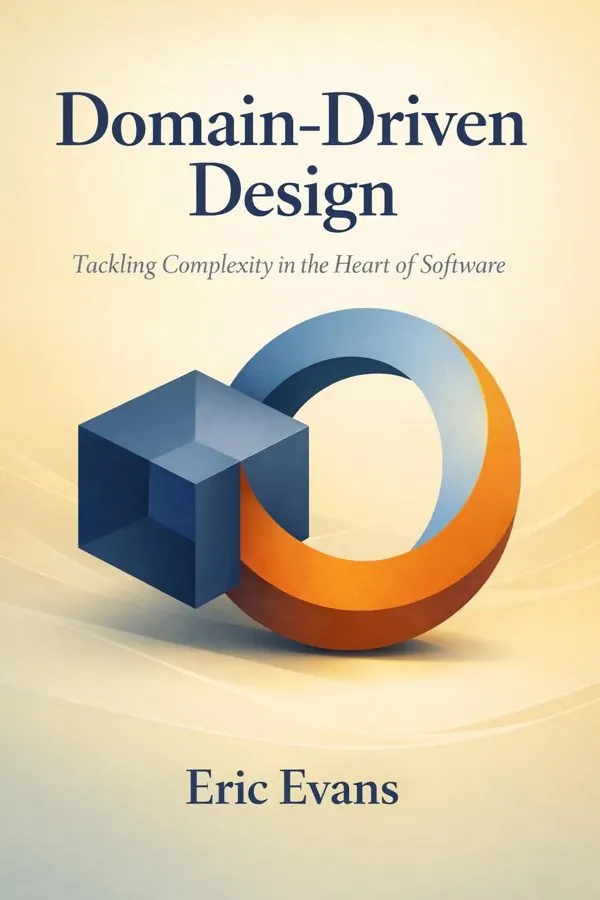
Domain-Driven Design: Tackling Complexity in the Heart of Software: Summary & Key Insights
by Eric Evans
 10 min6 chaptersAudio available
What Is Domain-Driven Design: Tackling Complexity in the Heart of Software About?
Domain-Driven Design: Tackling Complexity in the Heart of Software by Eric Evans is a programming book spanning 6 pages. Domain-Driven Design introduces a comprehensive approach to software development that aligns technical design with business domain understanding. Eric Evans presents principles and patterns for creating models that reflect real-world complexity, enabling teams to build systems that evolve gracefully and remain connected to their core business logic.
This FizzRead summary covers all 6 key chapters of Domain-Driven Design: Tackling Complexity in the Heart of Software in approximately 10 minutes, distilling the most important ideas, arguments, and takeaways from Eric Evans's work. Also available as an audio summary and Key Quotes Podcast.
Domain-Driven Design: Tackling Complexity in the Heart of Software
Domain-Driven Design introduces a comprehensive approach to software development that aligns technical design with business domain understanding. Eric Evans presents principles and patterns for creating models that reflect real-world complexity, enabling teams to build systems that evolve gracefully and remain connected to their core business logic.
Who Should Read Domain-Driven Design: Tackling Complexity in the Heart of Software?
This book is perfect for anyone interested in programming and looking to gain actionable insights in a short read. Whether you're a student, professional, or lifelong learner, the key ideas from Domain-Driven Design: Tackling Complexity in the Heart of Software by Eric Evans will help you think differently.
- ✓Readers who enjoy programming and want practical takeaways
- ✓Professionals looking to apply new ideas to their work and life
- ✓Anyone who wants the core insights of Domain-Driven Design: Tackling Complexity in the Heart of Software in just 10 minutes
Want the full summary?
Get instant access to this book summary and 100K+ more with Fizz Moment.
Get Free SummaryAvailable on App Store • Free to download
Key Chapters
Every meaningful software system lives within a business domain—a sphere of knowledge, activity, and purpose that gives the software its identity. The domain is what your organization does, day after day, to deliver value. For a bank, it’s managing accounts and risk; for a hospital, it’s coordinating patient care; for a logistics company, it’s optimizing the movement of goods across borders. The richest source of insight about this domain is not in code but in the minds of experts who work within it.
Too often, teams attempt to reduce complex business realities into overly simplistic software abstractions. But abstraction without understanding is just distortion. That’s why design must begin with collaboration. Domain experts and developers must form a symbiotic partnership. The expert brings deep contextual wisdom—the lived understanding of what matters and why. The developer brings the discipline of precision, abstraction, and translation into executable form. Together, they create a model—a distilled description of the domain that can be reasoned about, tested, and ultimately, coded.
This collaboration doesn’t happen in a few early meetings; it’s a sustained conversation that evolves as both parties learn. When I walk into a new project, I never begin by drawing architecture diagrams or defining layers. I start by listening. I look for the language people use to describe their work, the patterns of meaning that recur, and the contradictions that reveal misunderstanding. Only through this iterative exchange do we arrive at a model capable of guiding design decisions and surviving change.
In short, the domain gives purpose to the software, and the experts give life to the model. Without them, code degenerates into technical machinery detached from meaning.
If there is one principle that underlies every success I’ve seen in Domain-Driven Design, it is this: the model must live in language. I call this a ubiquitous language—a shared vocabulary that captures the key concepts of the domain and is used consistently by every member of the team. The language is not mere documentation; it is the medium through which understanding flows.
For example, suppose we’re building an insurance claim system. The domain expert talks about policies, coverage periods, and adjusters. The code, however, might reference ‘records,’ ‘entries,’ and ‘users.’ When the language diverges, the model fractures. Developers stop asking the right questions, experts lose trust, and the software begins to drift away from the business reality it must reflect. Conversely, when the team commits to a ubiquitous language, something magical happens: conversation becomes precision. A bug report isn’t about an ‘error’ in the system; it’s that ‘a claim’s status was set to pending when the coverage period had already expired.’ That clarity reduces miscommunication, uncovers deeper insights, and directly shapes the code.
This doesn’t mean everyone must talk like a computer scientist or a business analyst. It means we converge on terms that carry shared meaning. The ubiquitous language should live in whiteboard sketches, daily stand-ups, and especially the code itself. Class names, method names, and tests should reflect the domain vocabulary. The closer the code mirrors the language of the experts, the more transparent and adaptable it becomes.
+ 4 more chapters — available in the FizzRead app
All Chapters in Domain-Driven Design: Tackling Complexity in the Heart of Software
About the Author
Eric Evans is a software engineer and consultant, founder of Domain Language, a company that helps organizations design software systems deeply connected to their business domains. He is widely recognized as the originator of the Domain-Driven Design methodology.
Get This Summary in Your Preferred Format
Read or listen to the Domain-Driven Design: Tackling Complexity in the Heart of Software summary by Eric Evans anytime, anywhere. FizzRead offers multiple formats so you can learn on your terms — all free.
Available formats: App · Audio · PDF · EPUB — All included free with FizzRead
Download Domain-Driven Design: Tackling Complexity in the Heart of Software PDF and EPUB Summary
Key Quotes from Domain-Driven Design: Tackling Complexity in the Heart of Software
“Every meaningful software system lives within a business domain—a sphere of knowledge, activity, and purpose that gives the software its identity.”
“If there is one principle that underlies every success I’ve seen in Domain-Driven Design, it is this: the model must live in language.”
Frequently Asked Questions about Domain-Driven Design: Tackling Complexity in the Heart of Software
Domain-Driven Design: Tackling Complexity in the Heart of Software by Eric Evans is a programming book that explores key ideas across 6 chapters. Domain-Driven Design introduces a comprehensive approach to software development that aligns technical design with business domain understanding. Eric Evans presents principles and patterns for creating models that reflect real-world complexity, enabling teams to build systems that evolve gracefully and remain connected to their core business logic.
You Might Also Like

ANSI Common Lisp
Paul Graham
10 min
Automate the Boring Stuff with Python: Practical Programming for Total Beginners
Al Sweigart
10 min
Black Hat Python: Python Programming for Hackers and Pentesters
Justin Seitz
10 min
Building Microservices: Designing Fine-Grained Systems
Sam Newman
10 min
C++ Primer
Stanley B. Lippman, Josée Lajoie, Barbara E. Moo
10 min
Clean Code: A Handbook of Agile Software Craftsmanship
Robert C. Martin
10 minBrowse by Category
Ready to read Domain-Driven Design: Tackling Complexity in the Heart of Software?
Get the full summary and 100K+ more books with Fizz Moment.