
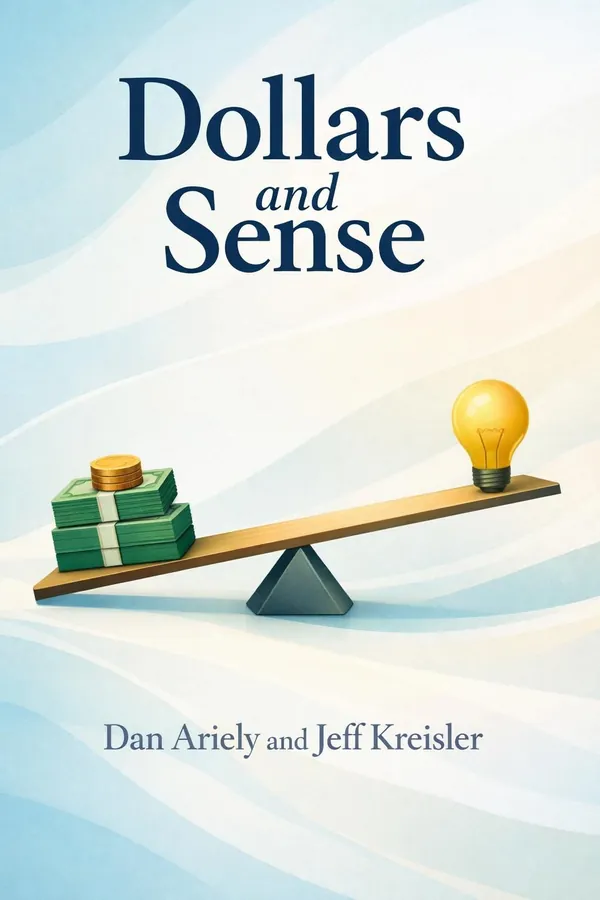
Dollars and Sense: How We Misthink Money and How to Spend Smarter: Summary & Key Insights
 10 min12 chaptersAudio available
What Is Dollars and Sense: How We Misthink Money and How to Spend Smarter About?
Dollars and Sense: How We Misthink Money and How to Spend Smarter by Dan Ariely and Jeff Kreisler is a economics book spanning 12 pages. Written by behavioral economist Dan Ariely and humorist Jeff Kreisler, this book explores the subconscious and emotional factors that influence how people perceive money, make spending decisions, and value purchases. Through engaging stories and scientific insights, the authors reveal why our financial choices are often irrational and how we can make smarter decisions about money.
This FizzRead summary covers all 12 key chapters of Dollars and Sense: How We Misthink Money and How to Spend Smarter in approximately 10 minutes, distilling the most important ideas, arguments, and takeaways from Dan Ariely and Jeff Kreisler's work. Also available as an audio summary and Key Quotes Podcast.
Dollars and Sense: How We Misthink Money and How to Spend Smarter
Written by behavioral economist Dan Ariely and humorist Jeff Kreisler, this book explores the subconscious and emotional factors that influence how people perceive money, make spending decisions, and value purchases. Through engaging stories and scientific insights, the authors reveal why our financial choices are often irrational and how we can make smarter decisions about money.
Who Should Read Dollars and Sense: How We Misthink Money and How to Spend Smarter?
This book is perfect for anyone interested in economics and looking to gain actionable insights in a short read. Whether you're a student, professional, or lifelong learner, the key ideas from Dollars and Sense: How We Misthink Money and How to Spend Smarter by Dan Ariely and Jeff Kreisler will help you think differently.
- ✓Readers who enjoy economics and want practical takeaways
- ✓Professionals looking to apply new ideas to their work and life
- ✓Anyone who wants the core insights of Dollars and Sense: How We Misthink Money and How to Spend Smarter in just 10 minutes
Want the full summary?
Get instant access to this book summary and 100K+ more with Fizz Moment.
Get Free SummaryAvailable on App Store • Free to download
Key Chapters
Money, on its surface, is a measurement — a neutral medium of exchange, a way to quantify value. But in human minds, it rarely stays that simple. Every dollar we earn or spend carries emotional weight. We attach stories to it, memories, anxieties, even moral connotations. When we explore the psychology of money, we see that decisions involving it engage the same parts of our brain that process fear, joy, and social belonging. This is why, when spending, we are never purely rational.
In our experiments, we’ve watched how the context of a purchase changes its emotional flavor. If you buy an expensive bottle of wine to celebrate a promotion, it feels justified. But buy the same bottle on a random night, and guilt seeps in. The action is identical; the story changes everything. People also compare their choices to those of others — friends, neighbors, even strangers. Your sense of satisfaction with your salary or apartment isn’t derived from objective numbers but from how you stack up to those around you.
That is the first great insight of behavioral economics: emotions and social context shape monetary behavior far more than numeric logic. When you recognize that truth, money management stops being a problem of discipline alone; it becomes a challenge of awareness and self-understanding.
Every purchase we make creates a small psychological tension between desire and loss — what I call the 'pain of paying.' This is not a metaphor; brain-imaging studies show that spending activates the same neural regions associated with physical pain. It literally hurts to see money leave our hands. Yet modern technology has dulled that pain dramatically. When you swipe a card, tap a screen, or set up automatic payments, you separate the pleasure of consumption from the awareness of cost.
Consider the difference between handing over a hundred-dollar bill and clicking 'Buy Now.' The physical act of payment creates a tangible sense of sacrifice; digital methods dissolve it. That’s why cashless spending often leads to overspending — not because we’re careless but because our brains no longer feel the loss in real time.
Understanding the pain of paying helps us make smarter arrangements. If a certain behavior feels painless — like auto-renewing subscriptions — scrutinize it. If another feels painful — like paying with cash for each coffee — consider whether that pain might be protecting you from mindless consumption. By aligning the timing of payment with consumption, we can regain a sense of control. Prepaying can make experiences feel freer (think of an all-inclusive vacation where the 'bill' has already been paid), while paying afterward can sour even delightful moments. The key lies in designing our financial systems to balance mindfulness with enjoyment.
+ 10 more chapters — available in the FizzRead app
All Chapters in Dollars and Sense: How We Misthink Money and How to Spend Smarter
About the Authors
Dan Ariely is a professor of psychology and behavioral economics at Duke University, widely known for his research on irrational behavior and decision-making. Jeff Kreisler is a writer, speaker, and financial expert with a background in law and economics.
Get This Summary in Your Preferred Format
Read or listen to the Dollars and Sense: How We Misthink Money and How to Spend Smarter summary by Dan Ariely and Jeff Kreisler anytime, anywhere. FizzRead offers multiple formats so you can learn on your terms — all free.
Available formats: App · Audio · PDF · EPUB — All included free with FizzRead
Download Dollars and Sense: How We Misthink Money and How to Spend Smarter PDF and EPUB Summary
Key Quotes from Dollars and Sense: How We Misthink Money and How to Spend Smarter
“Money, on its surface, is a measurement — a neutral medium of exchange, a way to quantify value.”
“Every purchase we make creates a small psychological tension between desire and loss — what I call the 'pain of paying.”
Frequently Asked Questions about Dollars and Sense: How We Misthink Money and How to Spend Smarter
Dollars and Sense: How We Misthink Money and How to Spend Smarter by Dan Ariely and Jeff Kreisler is a economics book that explores key ideas across 12 chapters. Written by behavioral economist Dan Ariely and humorist Jeff Kreisler, this book explores the subconscious and emotional factors that influence how people perceive money, make spending decisions, and value purchases. Through engaging stories and scientific insights, the authors reveal why our financial choices are often irrational and how we can make smarter decisions about money.
You Might Also Like
Business Adventures
John Brooks
10 min
Nudge
Richard H. Thaler, Cass R. Sunstein
10 min
The Hitchhiker"s Guide to the Galaxy
Douglas Adams
10 minThe Muqaddimah
Ibn Khaldun
10 minThe Outsiders
William N. Thorndike
10 min
A Little History of Economics
Niall Kishtainy
10 minBrowse by Category
Ready to read Dollars and Sense: How We Misthink Money and How to Spend Smarter?
Get the full summary and 100K+ more books with Fizz Moment.