
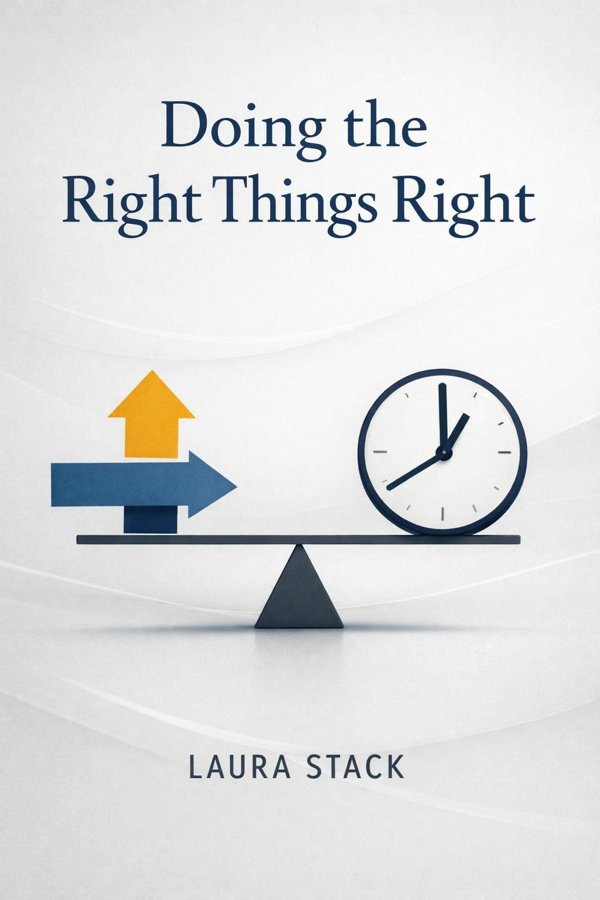
Doing the Right Things Right: How the Effective Executive Spends Time: Summary & Key Insights
by Laura Stack
 10 min9 chaptersAudio available
Key Takeaways from Doing the Right Things Right: How the Effective Executive Spends Time
Being busy is often a sign of organizational weakness, not leadership strength.
If your calendar does not reflect your priorities, your priorities are fictional.
When leaders keep too much on their own plate, they do not prove their value—they limit it.
Teams do not become effective just because talented people work together.
A brilliant strategy means little if daily operations are chaotic.
What Is Doing the Right Things Right: How the Effective Executive Spends Time About?
Doing the Right Things Right: How the Effective Executive Spends Time by Laura Stack is a leadership book spanning 5 pages. Most executives do not fail because they are lazy or disorganized. They fail because they spend their limited time on the wrong things. In Doing the Right Things Right, productivity expert Laura Stack tackles one of leadership’s most persistent challenges: how to balance efficiency with real effectiveness. It is not enough to move quickly, clear inboxes, attend meetings, and check off tasks. Leaders must make sure their effort is directed toward work that advances strategy, strengthens teams, and produces meaningful results. Stack offers a practical framework for doing exactly that. Through her 3T Leadership Model—Thinking, Teamwork, and Tactics—she shows how executives can align daily actions with organizational goals, delegate more intelligently, create stronger systems, and protect the time needed for high-value decision-making. The book blends productivity principles with leadership execution, making it useful not only for senior executives but also for managers, entrepreneurs, and ambitious professionals. What makes this book especially valuable is Stack’s authority in the field. As a well-known productivity consultant and speaker, she translates time-management theory into concrete tools leaders can use immediately. The result is a disciplined, actionable guide to spending time where it matters most.
This FizzRead summary covers all 9 key chapters of Doing the Right Things Right: How the Effective Executive Spends Time in approximately 10 minutes, distilling the most important ideas, arguments, and takeaways from Laura Stack's work. Also available as an audio summary and Key Quotes Podcast.
Doing the Right Things Right: How the Effective Executive Spends Time
Most executives do not fail because they are lazy or disorganized. They fail because they spend their limited time on the wrong things. In Doing the Right Things Right, productivity expert Laura Stack tackles one of leadership’s most persistent challenges: how to balance efficiency with real effectiveness. It is not enough to move quickly, clear inboxes, attend meetings, and check off tasks. Leaders must make sure their effort is directed toward work that advances strategy, strengthens teams, and produces meaningful results.
Stack offers a practical framework for doing exactly that. Through her 3T Leadership Model—Thinking, Teamwork, and Tactics—she shows how executives can align daily actions with organizational goals, delegate more intelligently, create stronger systems, and protect the time needed for high-value decision-making. The book blends productivity principles with leadership execution, making it useful not only for senior executives but also for managers, entrepreneurs, and ambitious professionals.
What makes this book especially valuable is Stack’s authority in the field. As a well-known productivity consultant and speaker, she translates time-management theory into concrete tools leaders can use immediately. The result is a disciplined, actionable guide to spending time where it matters most.
Who Should Read Doing the Right Things Right: How the Effective Executive Spends Time?
This book is perfect for anyone interested in leadership and looking to gain actionable insights in a short read. Whether you're a student, professional, or lifelong learner, the key ideas from Doing the Right Things Right: How the Effective Executive Spends Time by Laura Stack will help you think differently.
- ✓Readers who enjoy leadership and want practical takeaways
- ✓Professionals looking to apply new ideas to their work and life
- ✓Anyone who wants the core insights of Doing the Right Things Right: How the Effective Executive Spends Time in just 10 minutes
Want the full summary?
Get instant access to this book summary and 100K+ more with Fizz Moment.
Get Free SummaryAvailable on App Store • Free to download
Key Chapters
Being busy is often a sign of organizational weakness, not leadership strength. Laura Stack’s central insight is that executives need a structure for deciding where their attention belongs, because time pressure alone cannot tell them what matters most. Her answer is the 3T Leadership Model: Thinking, Teamwork, and Tactics. These three dimensions are interconnected and together define how effective leaders spend time.
Thinking is about direction. It requires leaders to step back from daily noise, clarify priorities, and ensure their own work aligns with the organization’s strategic goals. Teamwork is about leverage. No executive can scale impact alone, so leaders must build trust, delegate intelligently, and coordinate the efforts of others. Tactics is about execution. Even the best strategy and strongest team will struggle without systems, routines, and disciplined follow-through.
Stack’s model is powerful because it prevents a common trap: overinvesting in one area while neglecting the others. A leader may be highly tactical and efficient but lack strategic clarity. Another may be visionary but poor at delegation. A third may build a strong team but fail to create execution discipline. The 3T framework exposes these imbalances.
Imagine a department head overwhelmed by meetings and urgent requests. Using the 3T lens, she can ask: Am I spending enough time thinking about long-term priorities? Am I relying on my team appropriately? Do our systems support smooth execution? These questions shift attention from activity to effectiveness.
The actionable takeaway is to audit your calendar for one week and categorize your time into Thinking, Teamwork, and Tactics. If one area dominates at the expense of the others, rebalance your schedule before imbalance becomes underperformance.
If your calendar does not reflect your priorities, your priorities are fictional. Stack argues that effective leadership begins with Thinking: the deliberate practice of connecting daily actions to what truly matters. Leaders often assume they are being strategic because they understand company goals. But understanding is not enough. Strategy only becomes real when it shapes how time is spent.
This means executives must continually align personal objectives, departmental initiatives, and organizational outcomes. Without that alignment, leaders become trapped in reactive work—responding to emails, solving minor problems, and attending meetings that feel necessary but produce little strategic value. Thinking requires making hard choices about what deserves attention and what does not.
Stack encourages leaders to define desired outcomes clearly, not just activities. For example, “improve customer retention by 10 percent” is a strategic outcome; “have weekly customer meetings” is only an activity. Once outcomes are clear, the leader can identify which actions directly contribute to them. This process often reveals how much time is being consumed by low-value obligations.
A practical example is a vice president who wants to drive innovation but spends nearly every day approving routine requests. By reviewing goals against actual calendar use, he may realize he has no protected time for long-range planning, market scanning, or coaching the people responsible for new initiatives. Strategic drift happens exactly this way.
Thinking also includes reflection. Leaders need regular pauses to assess whether current priorities still make sense in changing conditions. The most effective executives do not simply work harder on yesterday’s plan.
The actionable takeaway is to identify your top three strategic outcomes for the quarter and block recurring calendar time each week devoted only to work that directly advances those outcomes.
When leaders keep too much on their own plate, they do not prove their value—they limit it. One of Stack’s strongest messages is that Teamwork is not just about collaboration; it is about multiplying executive effectiveness through the intelligent use of other people’s strengths. Delegation is therefore not a sign of withdrawal from responsibility but a higher form of responsibility.
Many executives resist delegation for understandable reasons. They believe they can do the task faster, they worry about quality, or they fear losing control. But this mindset traps them in operational work and starves the organization of leadership attention. Time spent on tasks others can handle is time stolen from strategy, coaching, and decision-making.
Stack reframes delegation as a development tool as well as a productivity tool. When leaders assign meaningful ownership rather than fragments of work, they build capability across the team. A manager who delegates preparation for a monthly performance review meeting, for example, is not just saving time. She is teaching analysis, accountability, and presentation skills.
Effective delegation requires clarity. Leaders must define the outcome, the level of authority, the deadline, and the checkpoints. Poor delegation often fails because expectations are vague. Dumping work on someone without context is not empowerment; it is abandonment. By contrast, thoughtful delegation includes support, trust, and follow-up.
Teamwork also means recognizing who is best suited for which tasks. High-performing teams are not created by distributing work evenly but by aligning responsibilities with strengths. An executive who understands this can move the right work to the right people and increase both speed and quality.
The actionable takeaway is to list five tasks you currently handle that someone on your team could own with guidance. Delegate one this week using clear expectations, a defined outcome, and a scheduled review point.
Teams do not become effective just because talented people work together. In many organizations, collaboration actually destroys productivity because it is unstructured, overcommunicated, and meeting-heavy. Stack emphasizes that Teamwork must be designed carefully. Without clear communication norms, executives and teams drown in interruptions, duplicated effort, and decision confusion.
A major source of inefficiency is the assumption that more communication is always better. In reality, constant messaging, unnecessary meetings, and broad cc habits create noise that hides what is important. Strong leaders establish rules for how and when communication happens. What belongs in email? What deserves a meeting? What can be handled asynchronously? Who really needs to be included?
For example, a leadership team might agree that status updates are shared in writing before a meeting so live discussion can focus on decisions and obstacles. They might designate specific channels for urgent issues, reducing the false urgency that comes from treating every message like a crisis. They might also shorten recurring meetings or eliminate those that no longer serve a purpose.
Stack’s broader point is that teamwork should reduce friction, not create it. Clear communication norms protect focus while still enabling coordination. They also make delegation and accountability stronger because expectations are visible and repeatable. When everyone knows where information lives, how decisions are made, and when to escalate issues, the organization moves faster with less confusion.
This idea is especially relevant in hybrid and remote environments, where informal hallway clarification is limited. In those settings, communication discipline becomes even more important.
The actionable takeaway is to define three team communication rules this month—for example, meeting agendas required in advance, status updates shared asynchronously, and urgent requests clearly labeled—then review whether these rules reduce interruptions and improve decision quality.
A brilliant strategy means little if daily operations are chaotic. Stack’s third dimension, Tactics, focuses on the systems and habits that convert priorities into consistent execution. This is where many leaders underestimate the importance of structure. They assume discipline is restrictive, when in fact the right systems create freedom by reducing friction, errors, and decision fatigue.
Tactics include planning routines, workflow design, task management, scheduling discipline, and the intentional use of tools. An executive who starts every day reacting to incoming requests is not leading time; time is leading the executive. Tactical discipline means deciding in advance how work will be captured, prioritized, processed, and completed.
For example, a leader may establish a weekly planning ritual every Friday afternoon to review goals, pending decisions, team commitments, and critical meetings for the following week. She may batch email into designated windows instead of checking it constantly. She may use a dashboard to monitor key metrics, reducing the need for ad hoc updates. None of these tactics are glamorous, but together they create reliability.
Stack also highlights the need for systems that support the team, not just the individual. Shared task boards, documented processes, and clear handoff procedures prevent work from stalling. Tactical excellence is especially valuable during busy periods because it allows leaders to absorb pressure without descending into disorder.
The deeper lesson is that productivity is not the result of willpower alone. It is engineered through repeatable structures that make the important work easier to do.
The actionable takeaway is to identify one recurring source of operational friction—such as email overload, missed handoffs, or unclear task tracking—and build a simple system this week to reduce it, then refine the system based on actual use.
The most dangerous tasks in an executive’s day are often the ones that feel urgent. Stack repeatedly shows that leaders lose effectiveness when urgency crowds out importance. Because executives are visible problem-solvers, other people’s priorities quickly invade their schedules. Without strong boundaries, every interruption appears justified and high-value work gets postponed indefinitely.
Protecting time is therefore not selfish or unrealistic; it is part of leadership discipline. Strategic thinking, coaching, planning, and decision preparation require uninterrupted focus. Yet these are exactly the activities most likely to be displaced by meetings, instant responses, and minor operational issues. The cost is not always immediate, which is why the problem persists. A leader can survive for weeks by reacting, but over time quality declines, opportunities are missed, and the organization becomes more dependent on constant intervention.
Stack recommends intentionally designing the calendar around priority work rather than fitting priority work into leftover space. That may mean blocking morning hours for deep work, creating office hours for routine questions, or declining meetings without clear outcomes. It may also mean training others not to expect instant replies unless the issue is truly urgent.
Consider a senior manager trying to launch a new initiative while also handling routine fires. If she reserves two protected blocks each week for strategy work and communicates those boundaries clearly, progress becomes more likely. If she leaves that work to chance, immediate demands will almost always win.
This idea is especially useful for leaders who feel busy all day but cannot point to meaningful progress by the end of the week.
The actionable takeaway is to block at least two nonnegotiable focus sessions on your calendar each week for high-value work, and treat those appointments with the same seriousness as a meeting with your most important client.
Executives are not only managers of time; they are managers of attention and judgment. Stack’s framework implies that one reason leaders become overwhelmed is that they say yes too often, decide too quickly, or engage in issues that do not require their level of involvement. Effectiveness depends on decision filters—clear criteria for what deserves personal attention and what can be ignored, delegated, delayed, or declined.
Without filters, leaders become bottlenecks. They review too many documents, attend too many meetings, and weigh in on problems that others should solve. This creates hidden organizational costs. Team members stop thinking independently because they assume everything must be escalated upward. The executive becomes exhausted, while the team becomes less capable.
Better filters might include questions such as: Does this directly affect strategy, revenue, risk, or people? Am I the only person who can make this decision? What is the cost of waiting? What is the cost of my involvement? These questions slow down automatic engagement and improve judgment.
For example, a department leader may receive ten requests for input in a day. Instead of responding to all of them, she uses a filter: if the issue can be solved by team guidelines or by the responsible manager, she redirects it. If it materially affects priorities, she engages. Over time, the team learns to elevate only what truly matters.
Decision filters also reduce mental clutter. When leaders know the criteria for action, they waste less energy debating every incoming request. The result is sharper focus and more consistent leadership.
The actionable takeaway is to create a simple decision checklist of three to five questions you will use before accepting meetings, responding to escalations, or taking on new commitments, then apply it consistently for the next two weeks.
Time is not the only limit on leadership effectiveness. Energy is equally important. Stack recognizes that even a perfectly planned schedule fails if the executive operating within it is mentally drained, distracted, or chronically overextended. Sustaining effectiveness therefore requires more than prioritization; it requires managing the physical and cognitive conditions that make quality work possible.
Many leaders make the mistake of treating personal energy as secondary to organizational demands. They skip breaks, run on inadequate sleep, stack back-to-back meetings, and assume endurance is a virtue. In the short term, this can look admirable. In the long term, it undermines judgment, patience, creativity, and resilience. Exhausted leaders are more reactive, less strategic, and more likely to default to familiar but ineffective habits.
Stack’s approach is practical rather than sentimental. Energy management includes preserving focus by reducing context switching, scheduling demanding work during peak mental hours, taking renewal breaks, and setting realistic workload limits. It may also involve protecting time for exercise, sleep, or reflection—not as lifestyle luxuries but as performance necessities.
For example, an executive who notices that her best analytical thinking happens early in the day should schedule planning, writing, or key decisions then, rather than using that time for routine meetings. A leader who becomes less patient in late afternoon might avoid difficult people conversations at that hour. These are not minor adjustments; they directly improve results.
The broader point is that leadership is a renewable but exhaustible resource. Sustainable performance requires deliberate recovery.
The actionable takeaway is to identify when your energy is highest and lowest across a typical week, then redesign at least one part of your schedule so your highest-value work matches your highest-energy periods.
There is no permanent productivity fix. One of Stack’s most important contributions is the reminder that effectiveness is not a one-time system you install but an ongoing discipline you practice. Roles change, teams evolve, markets shift, and new demands appear. What worked last quarter may not work now. Leaders who stay effective are those who keep reassessing how they spend time and whether that spending still serves the mission.
This mindset prevents complacency. A manager may build excellent routines, delegate effectively, and align priorities well—then suddenly inherit a larger team, face a merger, or enter a volatile business cycle. In those moments, old patterns can become mismatched to new realities. Continuous improvement means revisiting the balance among Thinking, Teamwork, and Tactics before problems compound.
Stack encourages leaders to review outcomes rather than just effort. Did the work produce meaningful progress? Did the team grow more capable? Did systems reduce complexity or create it? These questions help leaders learn from both successes and frustrations. They also shift the emphasis from self-judgment to adaptation.
A practical application is conducting a monthly leadership review: examine calendar use, major decisions, delegated tasks, team bottlenecks, and energy levels. This kind of review reveals subtle drift early. Perhaps meetings are expanding again. Perhaps the leader is reclaiming tasks that should stay delegated. Perhaps strategic work is being squeezed out. Small course corrections then keep performance high.
Ultimately, doing the right things right is not about perfection. It is about repeatedly returning attention to what matters most and building the habits that support it.
The actionable takeaway is to schedule a recurring monthly review of your leadership effectiveness, using the 3T model to assess where your time went, what created the most value, and what needs to change next.
All Chapters in Doing the Right Things Right: How the Effective Executive Spends Time
About the Author
Laura Stack is an American productivity expert, speaker, consultant, and author widely known for helping professionals improve time management, efficiency, and organizational performance. She is the founder of The Productivity Pro, Inc., a firm focused on training leaders and teams to work more effectively in fast-paced business environments. Over the course of her career, Stack has written several books on productivity, leadership, and execution, and she has built a reputation for translating broad performance principles into practical tools people can apply immediately. Her work often focuses on how individuals and organizations can reduce overload, clarify priorities, and achieve better results. In Doing the Right Things Right, she brings that expertise to the executive level, showing leaders how to align time, people, and systems with what matters most.
Get This Summary in Your Preferred Format
Read or listen to the Doing the Right Things Right: How the Effective Executive Spends Time summary by Laura Stack anytime, anywhere. FizzRead offers multiple formats so you can learn on your terms — all free.
Available formats: App · Audio · PDF · EPUB — All included free with FizzRead
Download Doing the Right Things Right: How the Effective Executive Spends Time PDF and EPUB Summary
Key Quotes from Doing the Right Things Right: How the Effective Executive Spends Time
“Being busy is often a sign of organizational weakness, not leadership strength.”
“If your calendar does not reflect your priorities, your priorities are fictional.”
“When leaders keep too much on their own plate, they do not prove their value—they limit it.”
“Teams do not become effective just because talented people work together.”
“A brilliant strategy means little if daily operations are chaotic.”
Frequently Asked Questions about Doing the Right Things Right: How the Effective Executive Spends Time
Doing the Right Things Right: How the Effective Executive Spends Time by Laura Stack is a leadership book that explores key ideas across 9 chapters. Most executives do not fail because they are lazy or disorganized. They fail because they spend their limited time on the wrong things. In Doing the Right Things Right, productivity expert Laura Stack tackles one of leadership’s most persistent challenges: how to balance efficiency with real effectiveness. It is not enough to move quickly, clear inboxes, attend meetings, and check off tasks. Leaders must make sure their effort is directed toward work that advances strategy, strengthens teams, and produces meaningful results. Stack offers a practical framework for doing exactly that. Through her 3T Leadership Model—Thinking, Teamwork, and Tactics—she shows how executives can align daily actions with organizational goals, delegate more intelligently, create stronger systems, and protect the time needed for high-value decision-making. The book blends productivity principles with leadership execution, making it useful not only for senior executives but also for managers, entrepreneurs, and ambitious professionals. What makes this book especially valuable is Stack’s authority in the field. As a well-known productivity consultant and speaker, she translates time-management theory into concrete tools leaders can use immediately. The result is a disciplined, actionable guide to spending time where it matters most.
You Might Also Like

Extreme Ownership
Jocko Willink
10 min
Dare to Lead
Brene Brown
10 min
Leaders Eat Last
Simon Sinek
10 min
The 21 Irrefutable Laws of Leadership
John Maxwell
10 min
Start With Why
Simon Sinek
10 min
How to Lead When You're Not in Charge
Clay Scroggins
10 minBrowse by Category
Ready to read Doing the Right Things Right: How the Effective Executive Spends Time?
Get the full summary and 100K+ more books with Fizz Moment.